

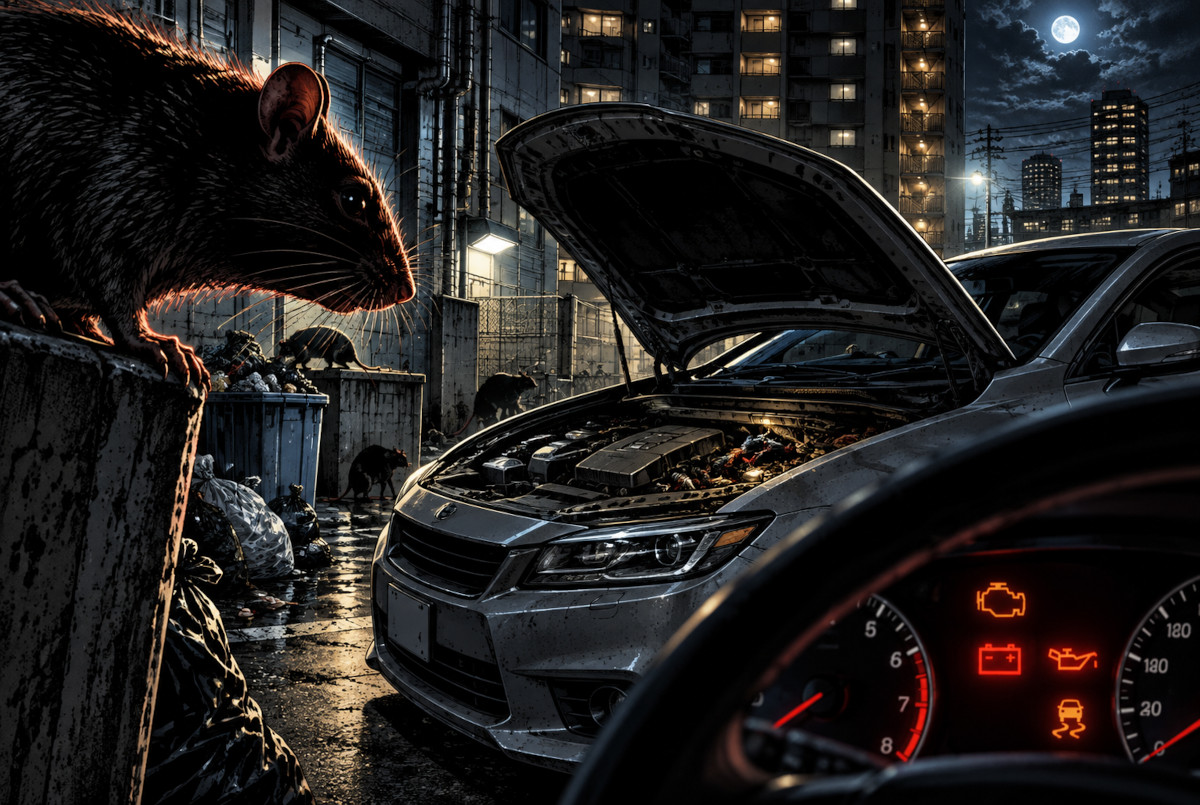
You start the car one morning and several warning lights suddenly appear on the dashboard. Depending on what has been damaged, a light may stop working, an electrical system may behave strangely, or in a severe case the engine may not start at all. Then the cause turns out to be neither sophisticated electronics nor ordinary wear, but a rat that got into the car and chewed the wrong wire.
It sounds like the sort of problem that should belong to an old farm vehicle parked in a barn. In reality, it can happen in major cities as well. The Tokyo Metropolitan Government has documented the spread of roof rats, known in Japan as kuma-nezumi, from commercial districts into residential areas. Shibuya City also notes that rats are active mainly at night, seek warmer shelter in colder conditions, and can enter buildings through surprisingly small gaps. The exact route into a vehicle varies by model, but the broader point is simple: an urban parking space is not automatically rodent-free.
Why a City Parking Space Is Not as Protected as It Looks
To a driver, an urban parking lot may look controlled and relatively clean: concrete, lighting, apartment buildings, marked spaces and perhaps security cameras. A rat sees something different. Restaurants, convenience stores, garbage collection points, shrubs, utility pipes, service alleys and building gaps can all become parts of the same territory.
Cars also are not sealed boxes. Their undersides, wheel-well areas, engine compartments and wiring routes contain openings and spaces that vary from one vehicle to another. A rat does not need to open the hood. If the surrounding environment provides food, shelter and a quiet route to the vehicle, the engine bay can become another hiding place.
Shibuya City explains that rats tend to move along walls and concealed edges rather than crossing open spaces. They prefer areas where they are harder to see and harder for predators to reach. From that perspective, the dark spaces underneath and inside a parked vehicle can be surprisingly attractive. If the animal enters after the neighborhood has gone quiet, the owner may not notice anything until the next morning.
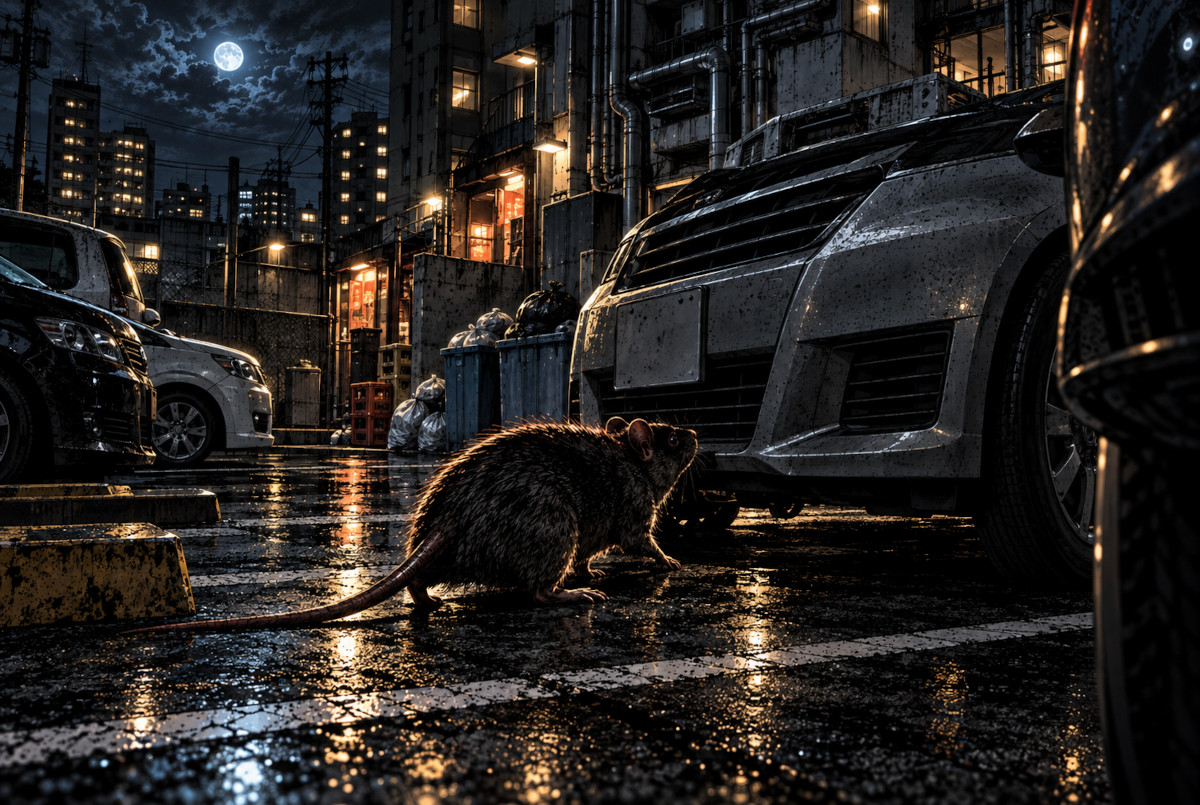 AI-generated conceptual illustration of a rat approaching a vehicle in an urban parking area. The rat’s size and exact entry route are dramatized for visual clarity and do not represent a specific real-world incident.
Rats Are Not Necessarily “Eating” Your Car
One of the most common misunderstandings is that rats chew automotive wiring because they regard the car as food. That is not necessarily what is happening. Rats are rodents, and their front incisors continue to grow throughout their lives. They regularly gnaw hard materials as part of normal behavior.
Shibuya City specifically warns that rats may chew telephone cables, gas lines, computer wiring and many other materials. From the animal’s point of view, an automotive wiring harness can simply be another chewable object that happens to be in the wrong place.
For the vehicle owner, however, that distinction offers little comfort. Modern cars rely on electrical and electronic systems for engine management, ignition, fuel delivery, ABS, airbags, cameras, sensors and driver-assistance functions. The result depends entirely on which circuit is damaged, but a single bite in the wrong area can trigger warning lights, disable a function or create a no-start condition.
The more functions a vehicle depends on electrically, the less trivial a small wiring fault can become. That does not mean every chewed wire causes a major failure, but it explains why a tiny animal can sometimes create a disproportionately expensive problem.
The damage is not necessarily limited to wiring. Rodents have also been associated with damage to hoses and insulation, and with nesting material being carried into air-intake areas, HVAC ducts and other sheltered spaces. Bits of paper, dried leaves, shredded insulation, droppings or unusual debris inside the engine bay can therefore be more than just dirt.
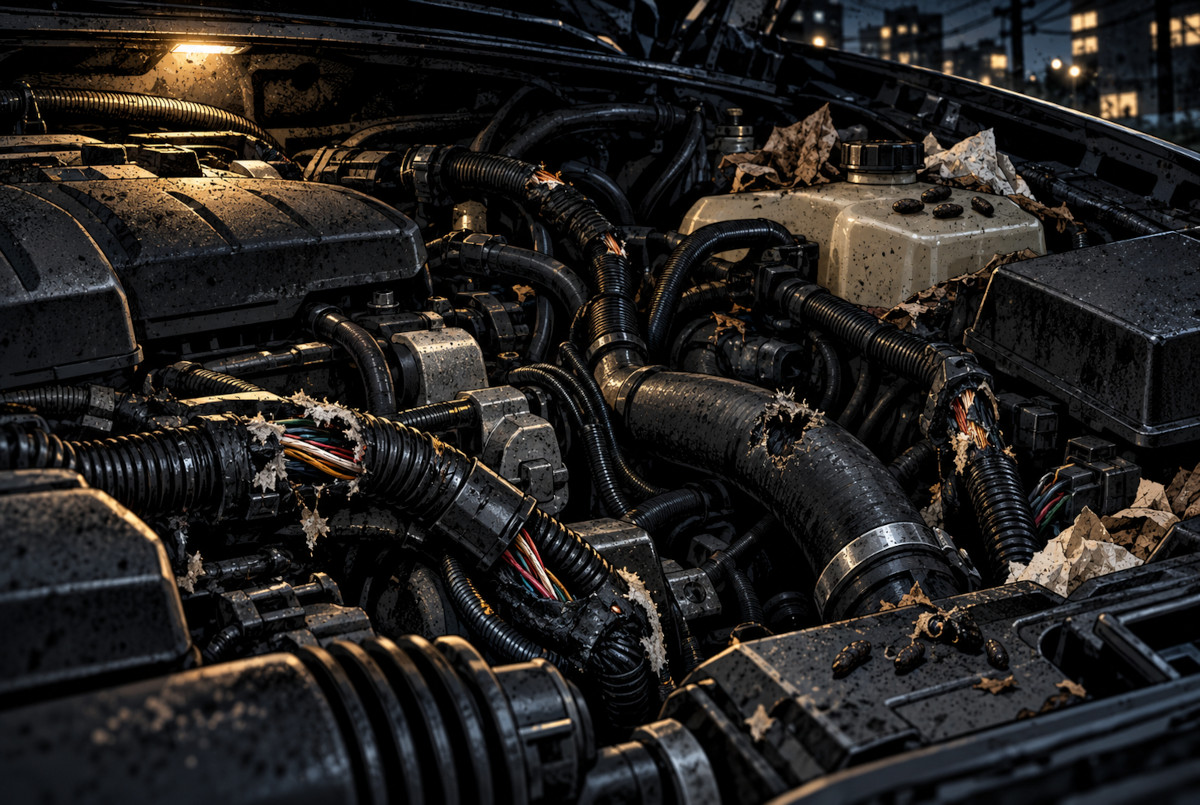 AI-generated conceptual illustration showing typical categories of rodent-related damage such as chewed wiring, hose damage and nesting debris. It does not reproduce the engine layout or damage pattern of any specific vehicle.
The Real Problem Is How Unpredictable the Repair Can Be
Rodent damage is frustrating partly because the repair cost can be difficult to estimate from what is visible. A technician may find only a few damaged wires at first glance, but those wires may belong to a larger harness routed through a difficult part of the vehicle.
Some cases can be repaired locally. Others may require replacement of a larger section of the wiring harness, and in some vehicles technicians may need to remove surrounding components simply to reach the damaged area. A problem that looks tiny from above can therefore turn into a much larger repair job underneath.
There is an uncomfortable irony here. Modern cars are marketed for their intelligence: more sensors, more safety systems, more connectivity and more automated functions. Those advances are real and valuable. But all of that sophistication still depends on physical wiring, connectors and modules that can be damaged by something as unsophisticated as a rodent’s teeth.
A highly computerized vehicle is still a physical machine, and its electronics are only as protected as the wires connecting them.
What About the “Soy-Based Wiring” Theory?
This subject often leads to another claim: that newer vehicles use environmentally friendly, plant-derived materials in wire insulation and that rodents therefore find modern wiring especially attractive. In English-language automotive discussions this is often called the “soy wiring” theory.
The idea became widespread enough to appear in lawsuits involving major automakers. However, popularity does not make the explanation scientifically established. Public statements from manufacturers including Honda and Toyota have said they were not aware of scientific evidence showing that soy-based or plant-derived wire coatings specifically attract rodents.
That distinction matters. It is reasonable to say that some modern wiring materials may contain plant-derived components. It is not equally reasonable to jump from that fact to “rats attack cars because the wiring tastes like soy.”
Rodents were chewing wires long before plant-derived automotive materials became a popular talking point. The safest interpretation is that rodent gnawing is an established behavior, while the claim that soy-based wiring itself causes or significantly increases attacks remains unproven.
What makes the story more interesting is that automakers still treat rodent damage as a real service issue. American Honda, for example, issued a service notice for certain Clarity FCV models instructing technicians to use rodent-deterrent tape containing capsaicin after repairing or replacing a damaged sub-tank wiring harness.
That does not prove the soy theory. It proves something more practical: rodent damage to vehicle wiring is real enough for a manufacturer to publish a specific repair countermeasure.
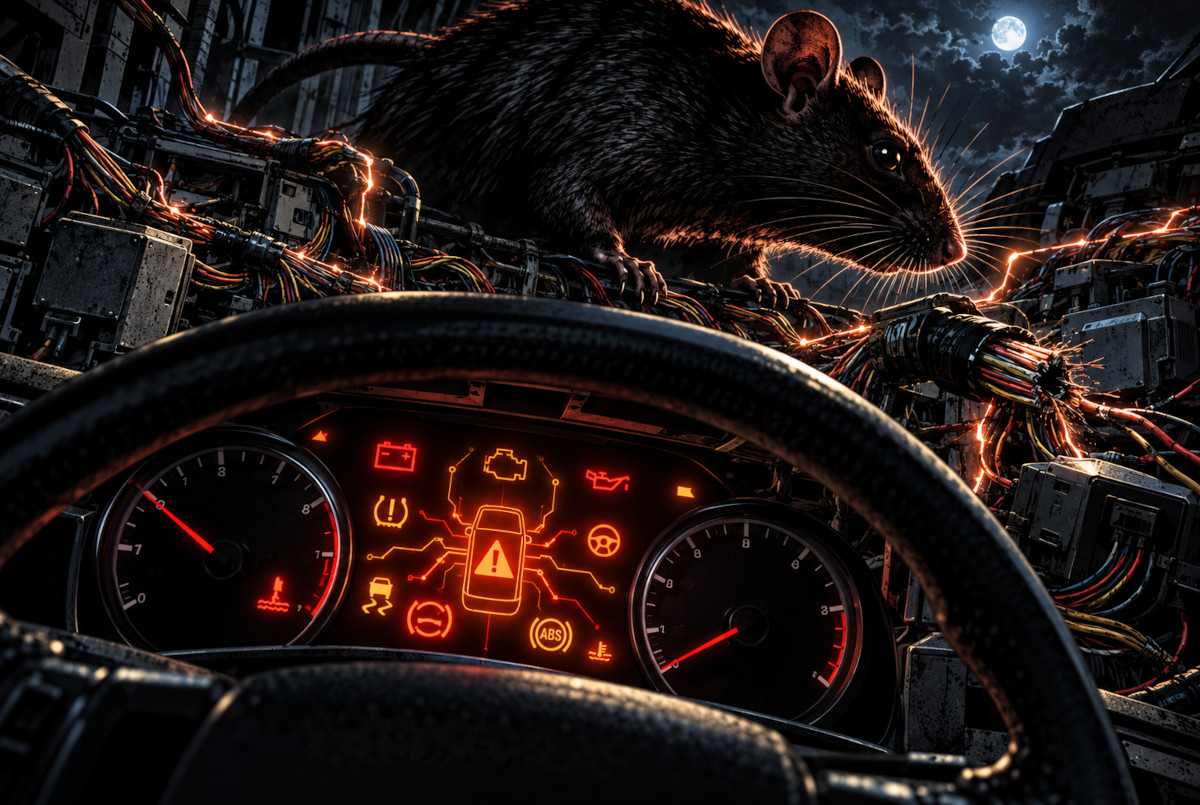 AI-generated conceptual image illustrating how wiring damage can affect electronic vehicle systems. The oversized rat, glowing wiring and warning-light effects are symbolic and do not depict a specific mechanical failure.
The First Warning Signs May Be Surprisingly Ordinary
Rodent damage does not always announce itself with a dramatic breakdown. The earliest signs can be easy to dismiss: an unusual smell from the engine bay, shredded insulation, droppings, pieces of paper, dried leaves, nuts, bite marks or debris that was not there before.
Electrical symptoms can also be intermittent. A warning light may appear, a headlamp or another electrical component may behave abnormally, or a feature may stop working without an obvious mechanical explanation. None of these symptoms automatically means “rat,” but visible evidence of gnawing or nesting material should not be ignored.
Vehicles that remain parked for long periods deserve particular attention. A car that rarely moves provides a more stable and quiet environment than one that is driven every day. Consumer Reports likewise recommends checking stored or infrequently used vehicles for signs of rodent activity.
Indoor parking is not an absolute guarantee either. If rodents can enter the garage or building, the car remains accessible. The uncomfortable part of this problem is that it does not require an abandoned scrapyard. It can develop quietly in an otherwise ordinary, clean urban parking space.
Protecting the Car Starts With the Area Around It
The most realistic prevention strategy begins outside the vehicle. Food waste, pet food, unsecured garbage, dense hiding places, stored clutter and gaps around the building can all make an area more attractive or accessible to rodents. Public-health guidance in Japan consistently emphasizes reducing food sources, nesting opportunities and entry points rather than relying on a single repellent product.
For the car itself, common-sense checks matter. If a vehicle is rarely used, drive it periodically when practical. Open the hood from time to time and look for droppings, nesting material, chewed insulation or unexplained debris. If warning lights or electrical problems appear together with physical evidence of rodent activity, have the vehicle inspected rather than assuming the fault is purely electronic.
Insurance is another area where assumptions can be expensive. In Japan, comprehensive vehicle insurance can cover a wide range of accidental losses, but the exact treatment of rodent damage depends on the policy wording, coverage type and insurer. The same general principle applies elsewhere: do not assume animal damage is automatically covered just because you have vehicle insurance. Check the specific policy.
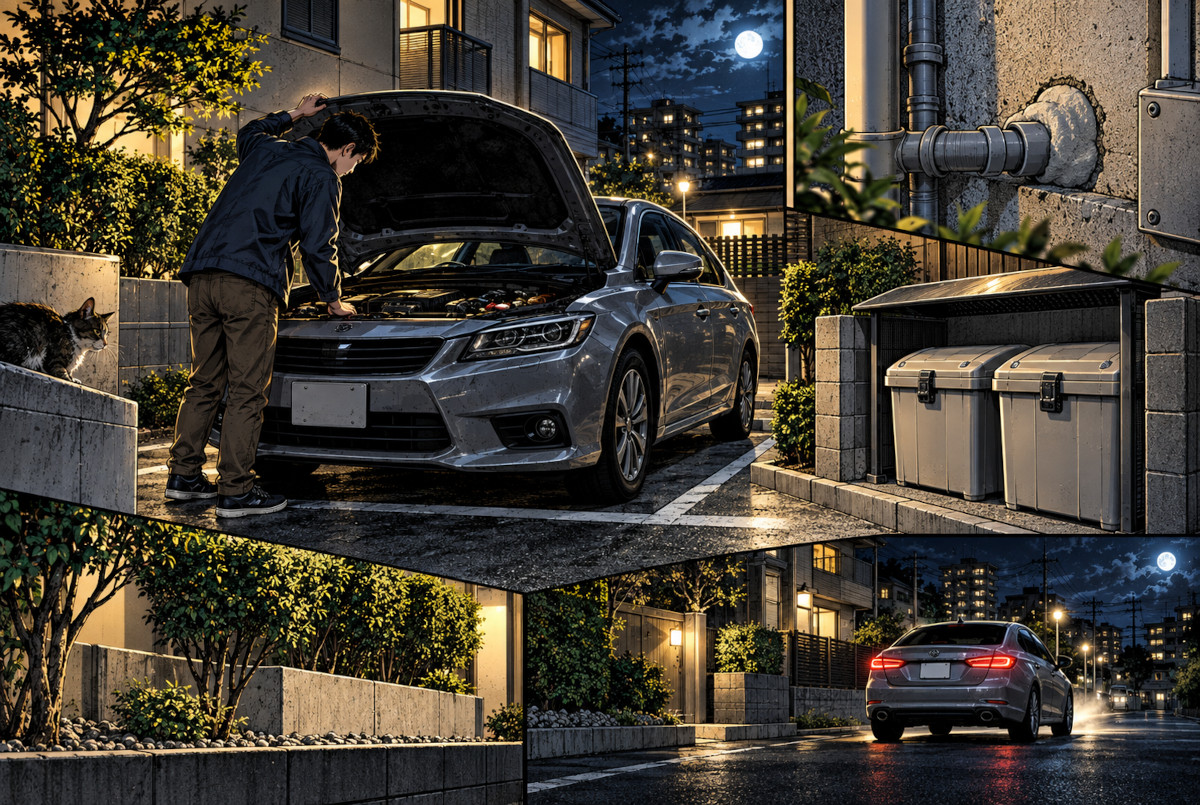 AI-generated conceptual illustration showing several environmental measures: reducing food access, maintaining a tidy parking area, inspecting the vehicle and sealing potential building entry points. The image does not imply that any single measure guarantees prevention.
The unsettling part of rodent damage is not the size or aggression of the animal. It is the possibility that, while nobody is watching, a small amount of physical damage can be inflicted on the wiring that functions like the nervous system of a modern vehicle.
A rat does not care whether the car is expensive, imported, new or packed with advanced driver-assistance technology. That is what makes the problem so oddly modern. Cities have become cleaner, cars have become smarter, and yet an old-fashioned biological nuisance can still reach straight into a machine built around twenty-first-century electronics.
【Editor’s Note】
I first heard about this from a mechanic while my own car was undergoing routine maintenance at a dealership in Tokyo. He mentioned, almost casually, that they do occasionally see rodent damage even in the city. I had always associated the problem with barns, warehouses or rural storage. Modern cars are far smarter than the more mechanical, analog cars of Japan’s Showa era, yet they are also packed with wiring. There is something very modern—and slightly ridiculous—about a highly computerized car still being vulnerable to a rat.
References
- Tokyo Metropolitan Government, Tama-Kodaira Public Health Center — Information on rats and rodent control
- Shibuya City — Rat behavior and control methods
- American Honda Motor Co., Inc. — “Clarity FCV Sub Tank Harness Rodent Damage,” ServiceNews Article (2022)
- Consumer Reports — “How to Protect Your Car From Rodents”
- Car and Driver — “Does Your Car Have Wiring That Rodents Think Is Tasty?”
- General Insurance Association of Japan — Explanation of vehicle insurance coverage