

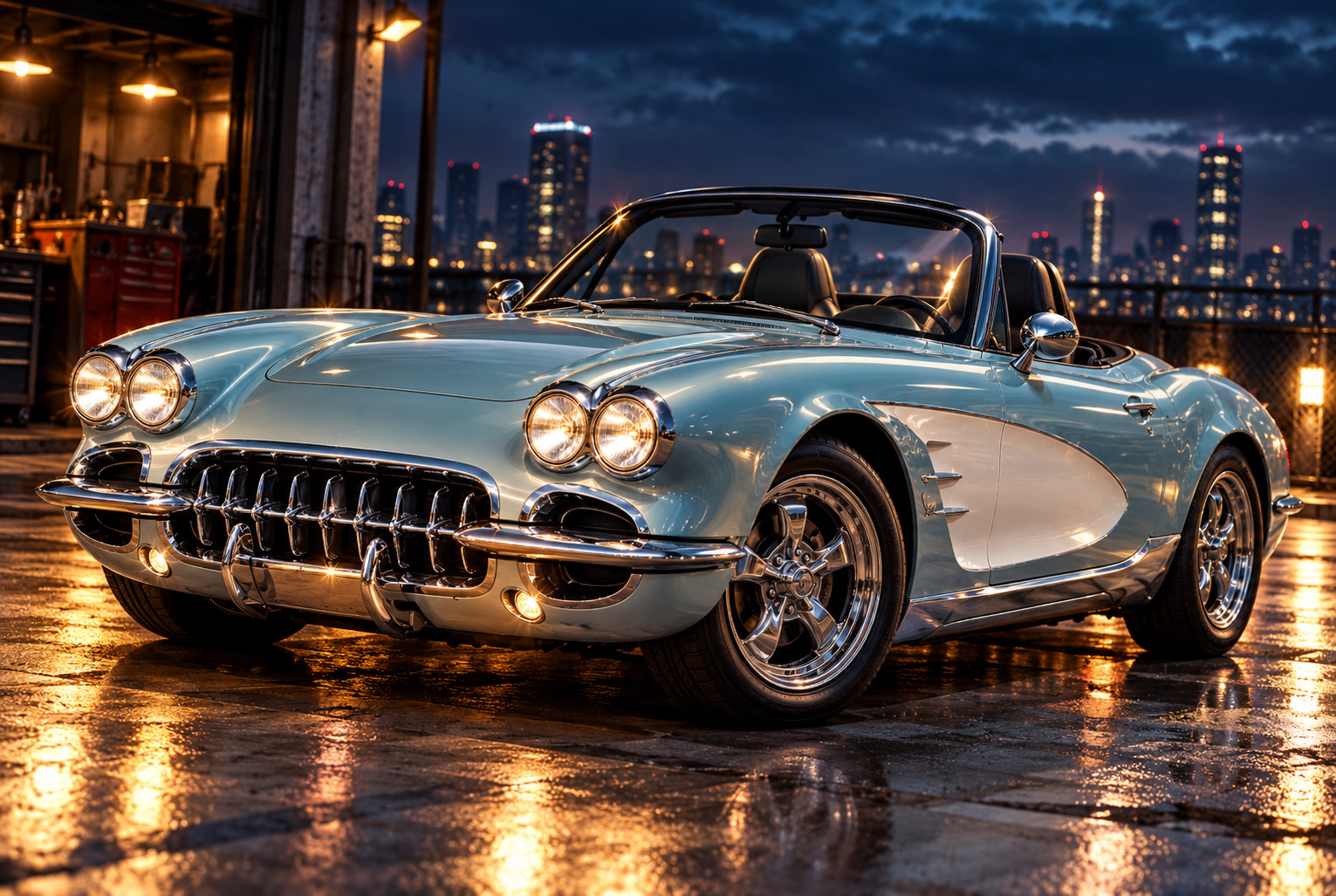
Four round headlights. A wide wall of chrome up front. And a contrasting side “cove” that looks as though it was carved out of the bodywork.
When Mitsuoka Motor unveiled a teaser for its new open-top sports car on September 17, 2026, anyone with a weakness for old American cars probably had the same reaction.
“Wait—doesn’t that look like a C1 Corvette?”
Then there is the other intriguing part: the car is widely suspected to be based on the current Mazda Roadster, better known outside Japan as the Mazda MX-5—and as the MX-5 Miata in North America. If that theory is correct, Mitsuoka has taken the ingredients of a compact Japanese lightweight roadster and wrapped them in something that looks straight out of 1950s America. Very Mitsuoka. But once I started digging, the story turned out to be more interesting than simply “an MX-5 dressed as a Corvette.”
It Looks Like a First-Generation Corvette—but Not a 1953 Corvette
First, a detail worth getting right. Mitsuoka has not officially said that the new car was designed to resemble a Corvette. Still, looking at the teaser images, it is hardly a wild leap to think of the first-generation Chevrolet Corvette—the C1, introduced in 1953.
But it does not really resemble the 1953 car. Early C1 Corvettes had one round headlight on each side. For 1958, the Corvette switched to four headlights and gained a noticeably flashier face with far more brightwork. Put Mitsuoka’s teaser alongside those later cars and the styling seems much closer to a 1958–1960-era C1.
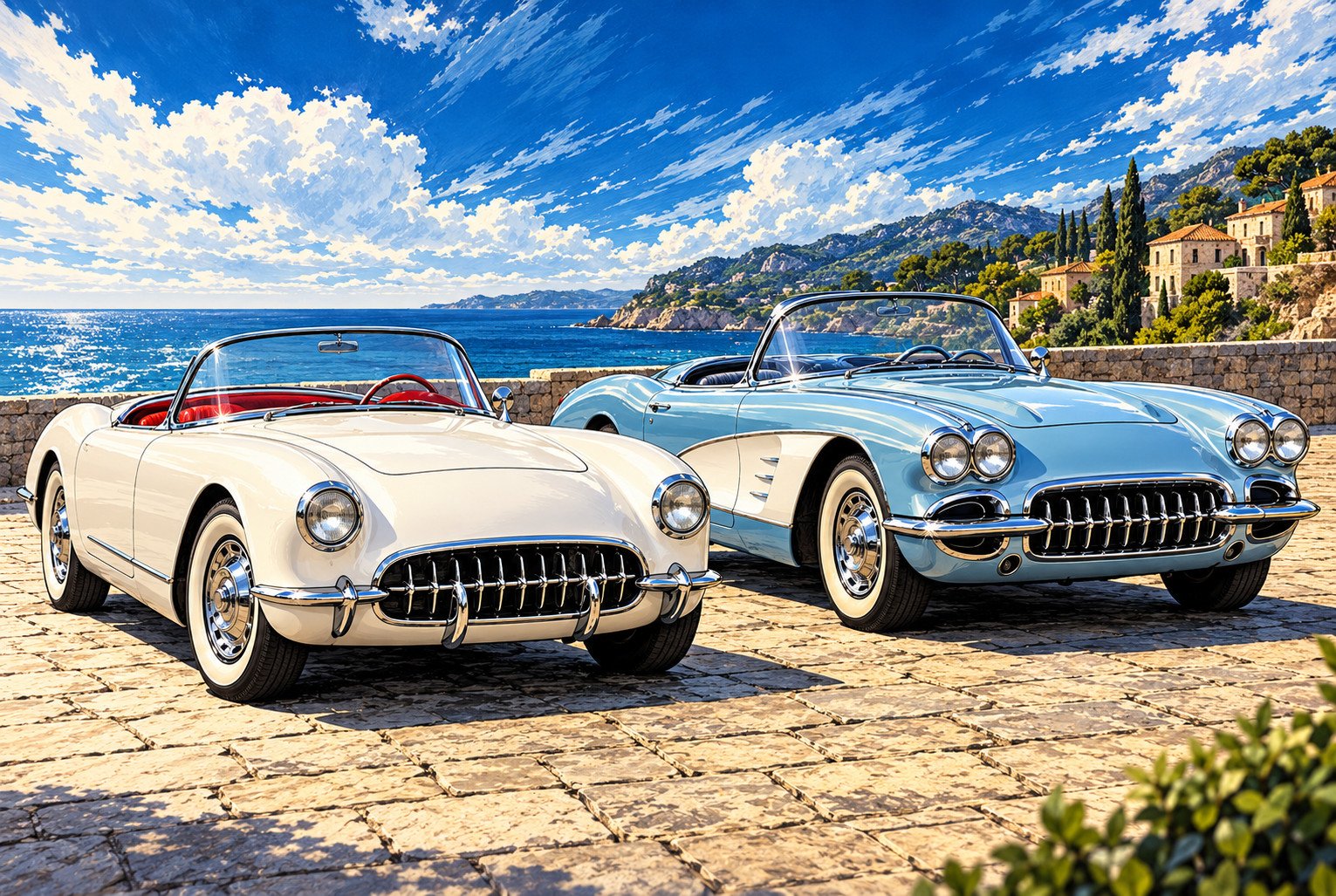 AI-generated comparison illustration. It is not a reproduction of actual vehicle photographs.
So calling it a “first-generation Corvette revival” gets the basic idea across, but misses an important detail. If Mitsuoka really is playing with C1 styling, it appears to be aiming at the period when American automotive design was deep into chrome, visual drama and late-1950s excess. For old-car people, that distinction matters.
Is There Really a Mazda MX-5 Underneath?
The donor car is the other thing that needs a little caution. The windshield, A-pillars, doors, soft-top area and overall cabin position have led automotive media to suspect that the car is based on the ND-generation Mazda Roadster/MX-5. But as of September 24, 2026, Mitsuoka has not officially identified the base vehicle.
Still, there is a very strong precedent for the theory.
Mitsuoka’s Rock Star, introduced in 2018, was based on the ND Roadster. Compared with the standard Mazda, Mitsuoka extended the overall length by roughly 430 mm, while an equivalent S-grade comparison put the weight increase at around 90 kg. The result looked less like a small Japanese roadster and much more like an American sports car from the 1960s—particularly the C2 Corvette era.
And this was not a failed experiment. The limited run of 200 Rock Stars sold out quickly, and Mitsuoka says completing production of all the cars took roughly three years.
In other words, “keep the modern Roadster underneath, then completely rewrite the visual language on top” is already a proven Mitsuoka formula.
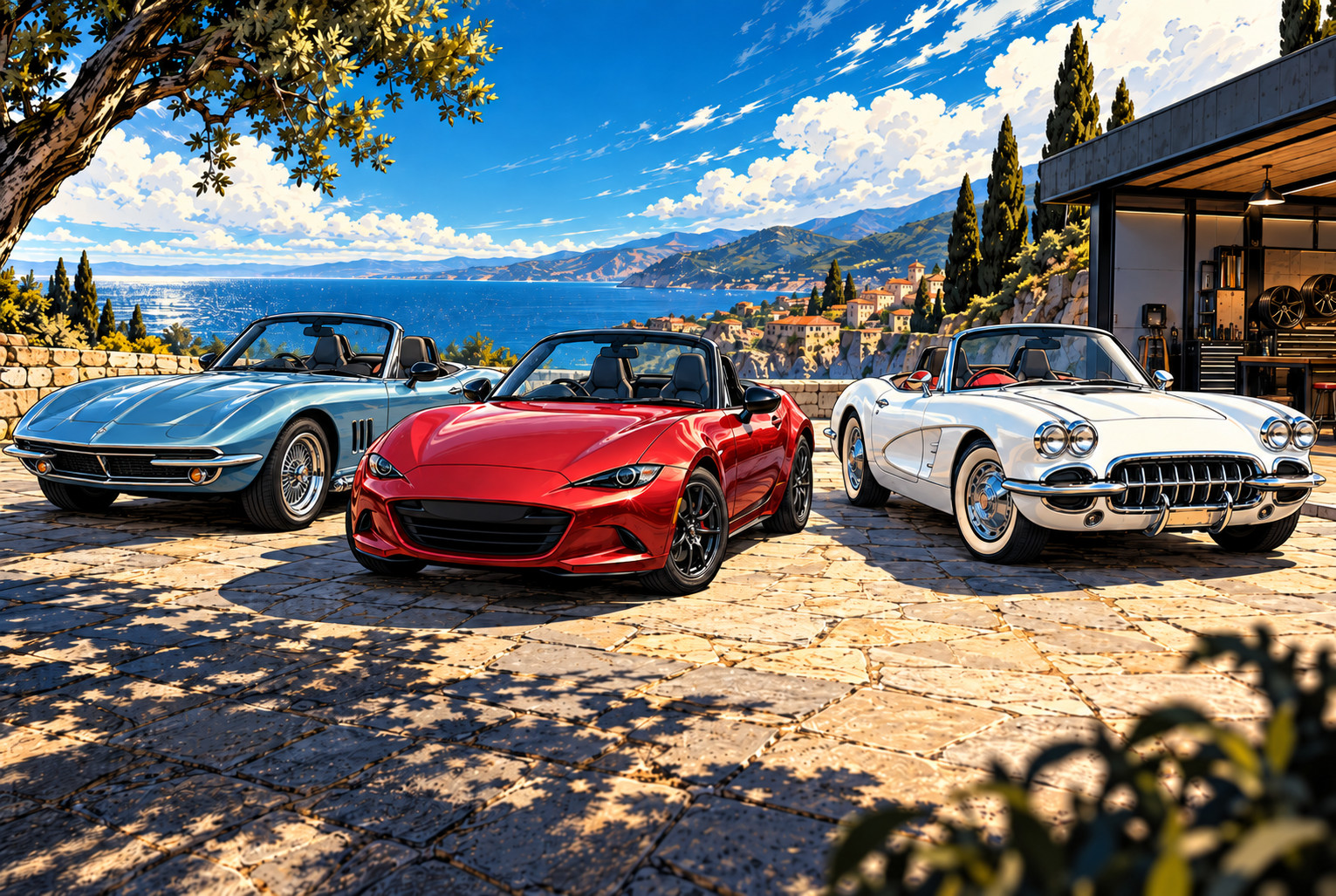 AI-generated design comparison. As of September 24, 2026, Mitsuoka has not officially confirmed the donor vehicle for the new model.
So Why Go Back from C2 Styling to C1 Styling?
This is the part that caught my attention.
If the Rock Star was Mitsuoka’s C2-flavored Roadster, this new car seems to move backward one generation into C1 territory. You would normally expect the historical sequence to go the other way. Mitsuoka appears to have done C2 first, then gone back to the 1950s.
Why?
There is a clue on Mitsuoka’s own teaser site. The company goes out of its way to describe a formative moment for founder Susumu Mitsuoka: seeing a kit car in Los Angeles that combined vintage-looking bodywork with modern mechanical components. Mitsuoka describes that experience as part of the company’s original sense of excitement—its starting point.
The corporate timeline makes the connection even more interesting. In 1987, Mitsuoka introduced the BUBU CLASSIC SSK, a custom car inspired by replica-style kit cars the company had encountered overseas. In July of that same year, it also established Mitsuoka Motors America Inc. in Los Angeles.
That suggests this new car may be about more than simply wanting to build something Corvette-like. It may be Mitsuoka returning to one of its oldest ideas: put modern mechanicals underneath a body that makes you feel as though you have stepped into another era.
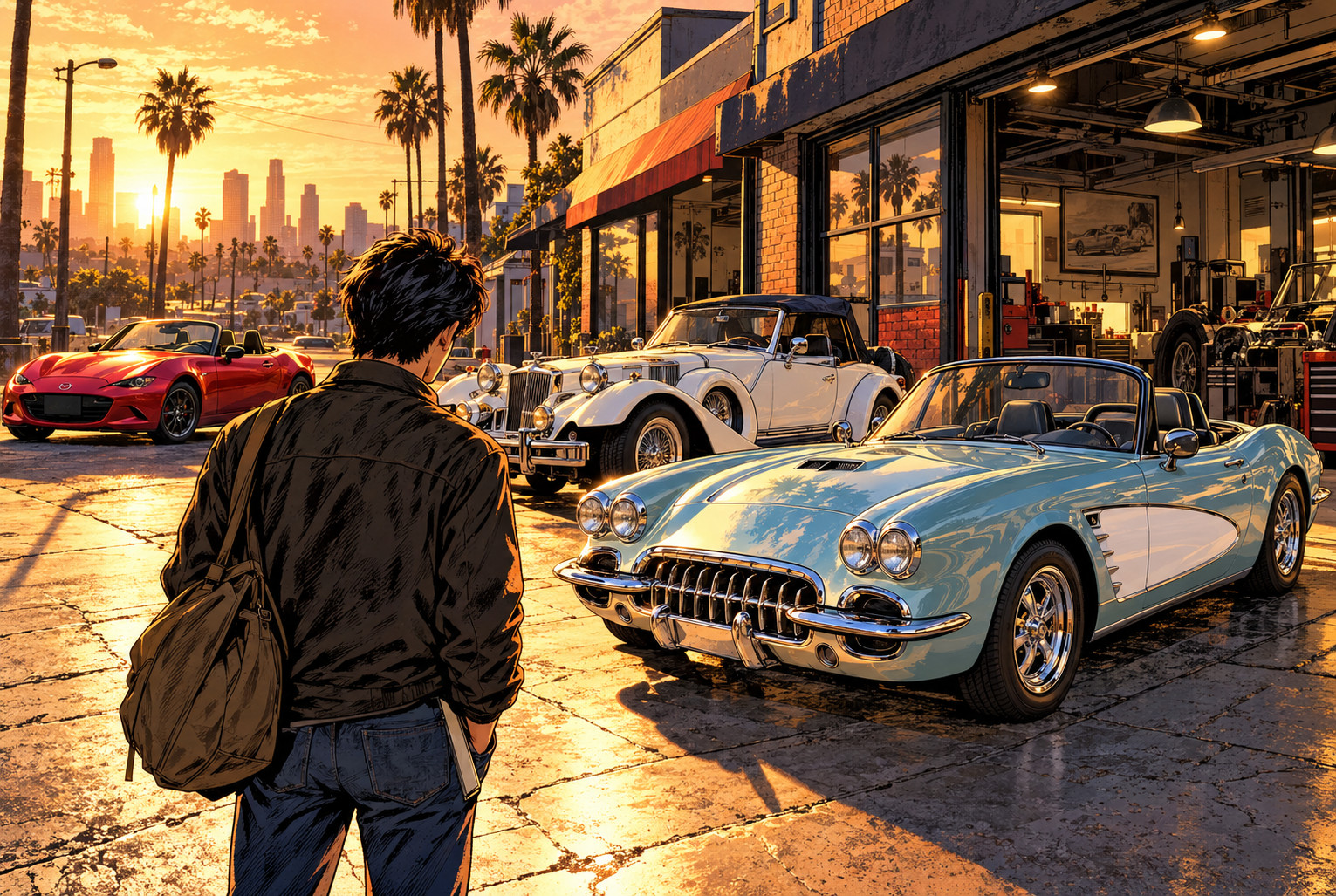 AI-generated conceptual illustration. Vehicles inspired by different eras are intentionally shown together to represent the development of Mitsuoka’s design philosophy. It is not a reconstruction of an actual 1980s Los Angeles scene.
Is “LA1” Really the Production Name?
The teaser page uses the designation “LA1,” and the same letters appear in the page URL, so Japanese automotive media have naturally begun calling the car the LA1.
But there is an important distinction: Mitsuoka has not yet formally announced “LA1” as the final production model name.
The company says the full announcement—including the vehicle name, specifications, equipment, manufacturer’s suggested retail price and color lineup—is scheduled for November 26, 2026. Customer orders are scheduled to open on November 27.
It is very tempting to read the “LA” in LA1 as “Los Angeles.” After all, Mitsuoka has chosen this exact moment to highlight the founder’s Los Angeles kit-car encounter on the teaser page.
It fits almost suspiciously well.
But until Mitsuoka explains the designation itself, that remains speculation. November should settle that question.
There Is Another Curious Detail: Himiko Ended Just Before This
The timing becomes even more interesting when you look at Mitsuoka’s lineup.
Himiko, the company’s long-running Roadster-based open sports car, first appeared in December 2008. After 17 years, Mitsuoka announced the Final Himiko in 2025 as the model’s final production run. Then, one year later, another new open-top sports car appears.
Mitsuoka has not called this new car a Himiko successor, so there is no basis for stating that it is one. Still, from a product-line perspective, the sequence is hard to ignore: one Roadster-derived open model disappears, and another open sports car arrives soon afterward.
If the MX-5 theory turns out to be correct, this would not simply be a “fake Corvette.” It would be something rather different: a way to enjoy the visual theater of 1950s America with a kind of everyday usability that belongs to a completely different era.
Editor’s Note
I actually like cars like this. And when somebody looks at a Japanese car without a V8 and says, “That’s not a Corvette,” I think they may be missing the point a little.
Keeping a genuine C1 Corvette is not just another casual ownership experience. For many people, it requires money, space, patience and a certain amount of commitment to old machinery. If you could get some of that late-1950s visual drama while still having working air conditioning, readily obtainable modern components and something that drives with the ease of an MX-5, that sounds like a pretty entertaining proposition in its own right.
What I like most, though, is the odd sequence. Mitsuoka already built something with strong C2 flavor, then apparently decided to go backward and revisit the C1 era. Mitsuoka remains a strange car company.
And yes, I mean that as a compliment.
References
- Mitsuoka Motor — “New Model Teaser Site Launched,” September 17, 2026 (Japanese press release)
- Mitsuoka Motor — LA1 New Model Teaser Site
- Mitsuoka Motor — History of Mitsuoka
- Mitsuoka Motor — Rock Star 2.0 LHD Only1 Special and Production Completion
- Mitsuoka Motor — Final Himiko Announcement and Launch, 2025 (Japanese press release)
- General Motors Heritage — 1953 Chevrolet Corvette
- General Motors Heritage — Corvette Heritage
- Car Watch — Mitsuoka Rock Star Launch Report (Japanese)