

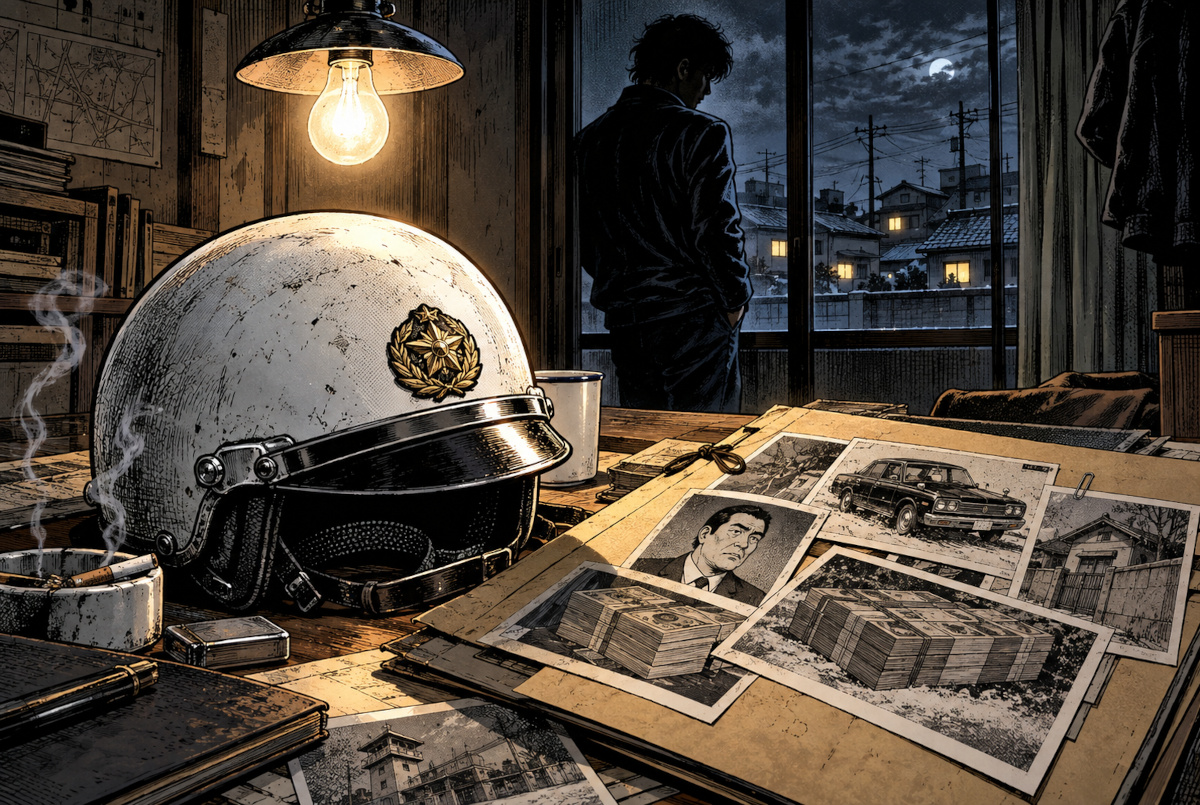
On December 10, 1968, a man disguised as a motorcycle police officer stopped a cash transport car in Fuchu, western Tokyo. Four bank employees were carrying nearly ¥300 million in year-end bonuses for workers at Toshiba’s Fuchu plant.
The impostor warned them that a bomb had been planted under the vehicle. The employees fled, and he drove away with the money. The entire robbery took only minutes. It became one of Japan’s most notorious unsolved crimes.
But just five days later, a 19-year-old young man died. His father was a serving motorcycle police officer, and the young man had reportedly attracted investigators’ attention.
A police officer’s son had come under suspicion and was dead five days after the robbery. Did investigators already know who the robber was?
Our original YouTube Short presents the case as a mystery. It includes dramatic elements and theories that have not been established as fact. The article below separates those claims from the available evidence. The video narration is in Japanese.
Why Did Police Suspect a 19-Year-Old?
The young man, referred to here as Suspect S, lived in Kokubunji, a city in western Tokyo. According to later accounts of the investigation, he had connections to a local group involved in delinquency and criminal activity.
Earlier in March 1968, members of that group had reportedly carried out a robbery using a smoke flare. A smoke flare was also central to the ¥300 million robbery: it helped convince the bank employees that the supposed bomb was real.
There was another connection. S’s father was a motorcycle police officer. In a 2021 TV Tokyo program, journalist Shoji Kondo, who had investigated the case for decades, described the father as a unit commander in the Metropolitan Police’s traffic motorcycle division.
Knowledge of police motorcycles, familiarity with the area, and a criminal method resembling an earlier offence all made S worth investigating.
But a collection of suspicious coincidences is not the same thing as proof that someone committed a crime.
A Detective Visited the House. The Young Man Died That Night.
A case study published by Bungeishunju’s Bunshun Online in March 2026, drawing on Takarajimasha’s 100 Unsolved Cases in Japan, describes a visit to S’s home by a detective from Tachikawa Police Station.
According to that account, S’s mother answered the door and said her son was not home. He was reportedly inside the house. Late on December 15, he died after ingesting cyanide.
Kondo has also spoken publicly about interviewing the father. His account raises questions about the family’s circumstances, but it does not establish that the father concealed the robbery or that S’s death proved his involvement.
No decisive evidence linking the young man’s death to his guilt has been verified in the materials examined for this article.
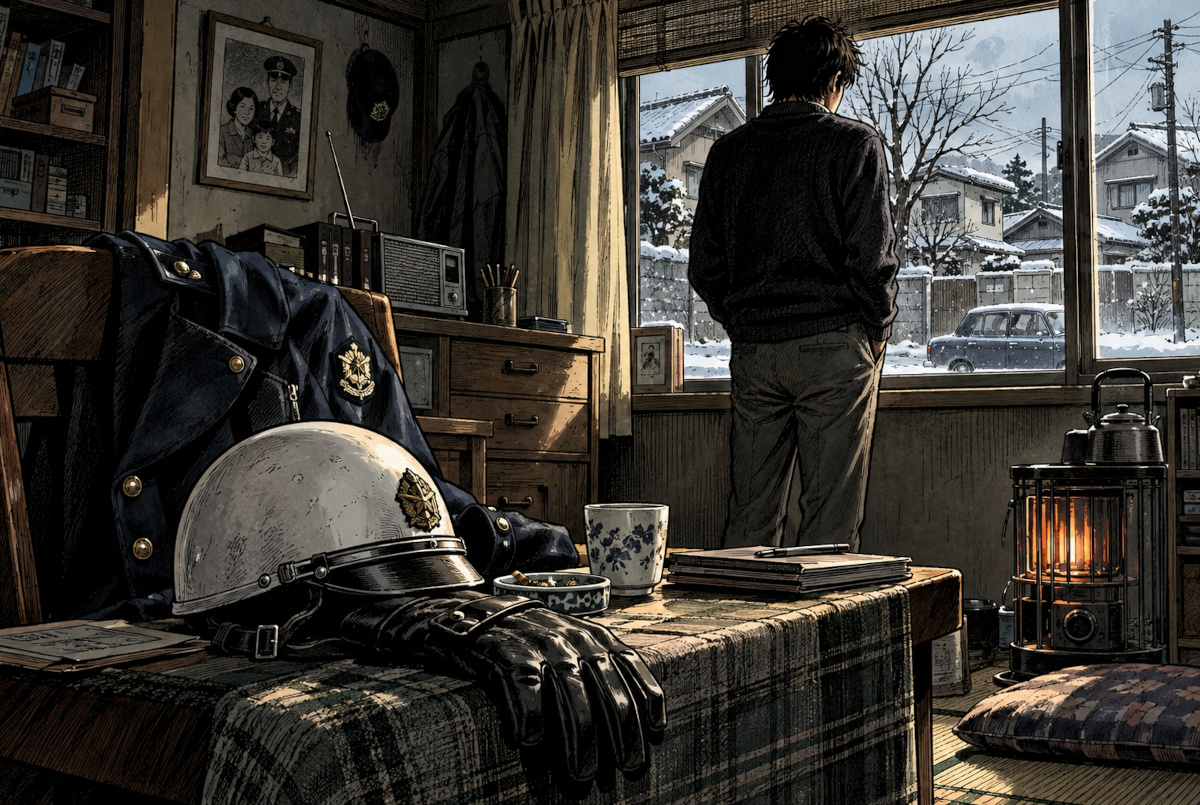 AI-generated illustration symbolizing the police officer and his 19-year-old son. It does not depict the actual people, home or uniforms involved. The snowy scenery is artistic license, not a reconstruction of the weather.
Six Days After His Death, Police Released the Famous Suspect Photograph
Comparing the dates in Fuji Television’s published chronology with reports of S’s death reveals a striking sequence.
- December 10, 1968: The ¥300 million robbery takes place.
- December 15, 1968: S dies, five days after the robbery.
- December 21, 1968: Police release the widely circulated suspect image, six days after S’s death.
- April 24, 1969: Veteran detective Hachibei Hiratsuka joins the investigation, 130 days after S’s death.
Those intervals are calculated directly from the dates above. The six-day gap is particularly striking, but the 130-day gap matters too. Hiratsuka’s later assessment of S cannot, by itself, tell us what every investigator believed in December 1968.
Then there is the photograph.
The familiar image, routinely described as a police composite, was reportedly based heavily on a photograph of another man who had already died. Its reliability was subsequently challenged, and the image was formally discarded in December 1974.
Kondo has argued that a photograph resembling S may have been used to avoid publicly exposing the police officer’s son. That is an explanation offered by a journalist, however, not an independently established police decision.
The use of another person’s photograph and the alleged reason for using it are two different claims. They should not be treated as equally proven.
Was the image deliberately misleading, or was it a serious investigative error? The available evidence does not settle that question. Nor does the six-day interval alone establish a cover-up.
Why Did a Veteran Detective Rule S Out?
Hachibei Hiratsuka, one of Japan’s best-known detectives of the period, reportedly concluded that S was not the robber. His reasoning was not entirely arbitrary.
Later case studies describe several inconsistencies. Handwriting in threatening letters linked to the wider investigation, including threats involving a local agricultural cooperative, reportedly did not match S’s handwriting.
Saliva recovered from a postage stamp was reported to indicate blood group B, while S was said to have blood group A. Accounts also state that he was in custody in connection with another matter during part of the period when related threats occurred.
These details are drawn from retrospective reporting and case studies. The original forensic reports and custody records have not been independently examined for this article.
Here is the part that bothers me.
Those contradictions work against the idea that S single-handedly planned and carried out every stage of the crime. But suppose more than one person was involved. Someone else could have written or mailed the threatening letters.
Crime novelist Seicho Matsumoto explored a multiple-perpetrator theory in his 1975 work Shosetsu San-oku-en Jiken (A Novel of the ¥300 Million Robbery).
That possibility may help explain some conflicting evidence. It does not, however, prove that S took part in the robbery. An alternative theory is not evidence simply because it makes an awkward fact fit.
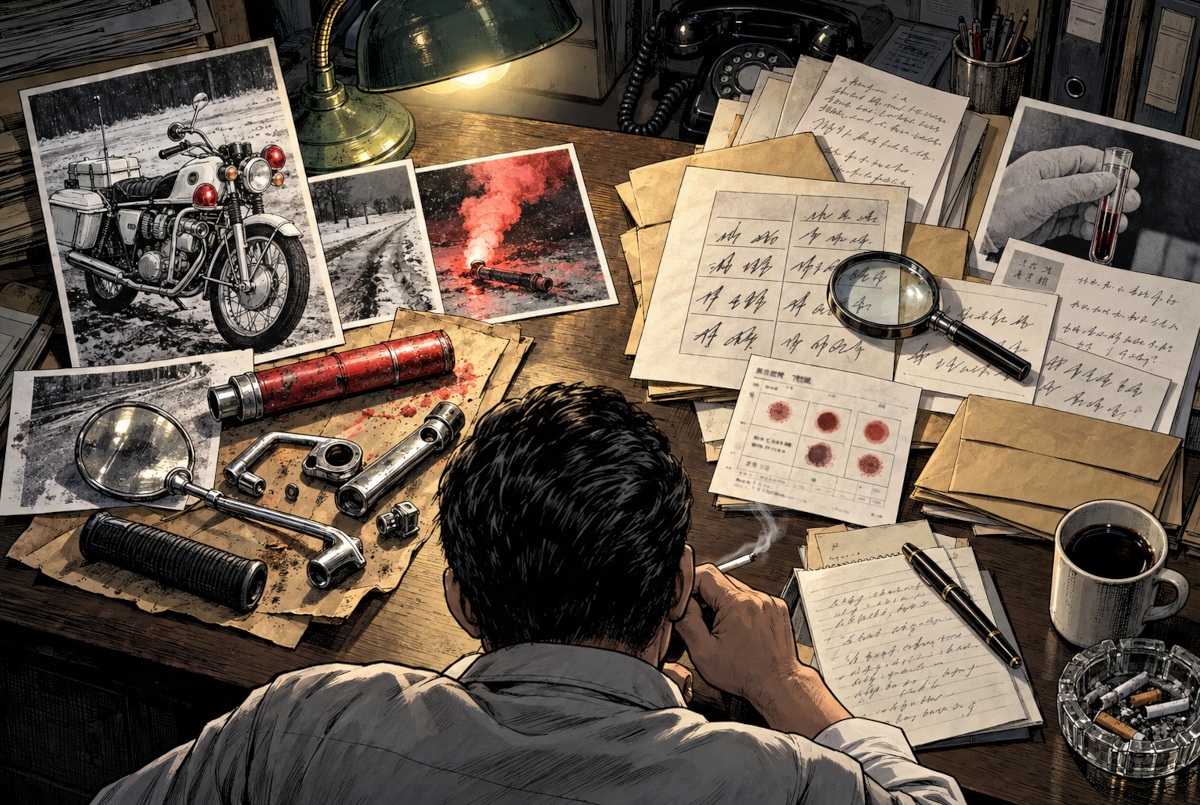 AI-generated illustration contrasting reasons for suspicion with evidence that challenged the theory. The motorcycle, parts and documents are symbolic, not reproductions of actual evidence. The blood-group issue concerned saliva on a postage stamp, not blood recovered at the robbery scene.
Did Police Hide the Truth, or Did the Investigation Fail?
On December 11, 1975, immediately after the statute of limitations had expired, Japan’s House of Representatives Local Administration Committee discussed the failure to solve the robbery.
Lawmaker Seiichi Kataoka questioned whether problems in the initial response, an inconsistent command structure and excessive reliance on preconceived suspects had contributed to the outcome.
These were questions raised during parliamentary proceedings. They were not findings that police officials had deliberately protected S or his father.
In January 2026, Japan’s public broadcaster NHK revisited the case after obtaining extensive investigative materials and approaching more than 180 people connected to it.
That makes the familiar explanation that police simply lacked sufficient evidence feel incomplete.
The more troubling question is whether investigators properly evaluated the evidence they did have.
Was important information dismissed because it contradicted a preferred theory? Did investigators disagree about S? And if they did, how carefully were those disagreements examined?
None of the sources reviewed here establishes an order from police leadership to suppress the investigation in order to protect an officer’s family. An institutional cover-up remains an allegation, not a demonstrated conclusion.
Editor’s Note
Years ago, I personally heard an account about the police officer’s son and his father from a man who said he had worked on the original investigation. That is one reason I have never been comfortable brushing this entire story aside as an urban legend. But I have not independently corroborated what he told me against official police records.
Even so, the sequence is hard to ignore. Five days after the robbery, a young man under suspicion was dead. Six days later, a photograph of a different person was released as the face of the suspect.
Did the police know more than they admitted? Or did they lose the opportunity to prove a theory and spend the following years searching elsewhere?
What I really want to know is not merely whether S looked guilty. It is how thoroughly investigators tested both the reasons to suspect him and the reasons to rule him out.
That, to me, is where this mystery gets interesting.
The 300 Million Yen Robbery $2014 Four-Part Series
The police officer's son, the missing money, the fake police motorcycle, and questions about the investigation. Four articles examine the evidence, competing theories, and what remains unproven.
- Part 1: Did the Robber Die Five Days Later? Japan’s ¥300 Million Mystery and a Police Officer’s Son
- Part 2: Did the Suspect’s Father Burn ¥300 Million? The Chimney Smoke Mystery Coming soon
- Final Part: Did Police Already Know the Culprit? Japan’s ¥300 Million Robbery, 57 Years On Coming soon
- Special: A Yamaha 350 R1 Disguised as a Police Bike? Japan’s ¥300 Million Heist Coming soon
References
- Bunshun Online — Extract from Takarajimasha’s 100 Unsolved Cases in Japan (March 24, 2026; Japanese): Reporting on Suspect S, the police visit, his death and disagreements among investigators.
- Bunshun Online — Showa Unsolved Cases: Seicho Matsumoto’s Reasoning and the Mysterious Suspect X (December 10, 2025; Japanese): S’s background, conflicting evidence and single-versus-multiple-perpetrator theories.
- TV Tokyo — Interview with investigative journalist Shoji Kondo (July 2, 2021; Japanese): Kondo’s theory concerning the police officer’s son, his father and the suspect photograph.
- Fuji Television — New Testimony: The ¥300 Million Robbery, official case chronology (Japanese): December 21 suspect image release and April 24, 1969 assignment of detective Hachibei Hiratsuka.
- House of Representatives, Local Administration Committee, December 11, 1975 — Remarks by Seiichi Kataoka (Japanese): Questions about early investigative errors, command structure and suspect-focused investigation. The proceedings can also be searched through the National Diet Library’s official proceedings database.
- NHK — Unsolved Cases, File 10: The ¥300 Million Robbery (broadcast January 10, 2026; Japanese): Documentary investigation based on extensive case materials and interviews or inquiries involving more than 180 people.