

Employees are told to save electricity, reduce expenses, and take corporate sustainability seriously. Companies publish ambitious climate pledges. But do the people at the top follow those same principles in their private lives?
That question led us to an unlikely place: the executive compensation disclosures filed with the US Securities and Exchange Commission (SEC).
Apple reported $789,991 in incremental costs associated with former CEO Tim Cook’s personal use of private aircraft in fiscal 2025. Meta disclosed approximately $2.47 million in costs related to CEO Mark Zuckerberg’s personal use of private aircraft in 2025.
Both companies have major climate commitments, yet their top executives have used private aircraft for personal travel. Does that make them hypocrites? The filings reveal a more complicated story.
Corporate Sustainability Is Mainstream. What About the Executives?
Japan offers an interesting starting point. A July 23, 2026 survey by Teikoku Databank found that 52.6% of responding Japanese companies were positive about the United Nations Sustainable Development Goals (SDGs), while 30.3% said they understood their significance and were already taking action.
The survey received 10,413 valid responses. The share of companies positive about SDGs had actually declined for two consecutive years, even as the proportion actively implementing them reached a new high.
The 17 SDGs cover much more than climate change, including poverty, education, employment, and inequality. Environmental commitments, however, remain one of the most visible ways companies demonstrate social responsibility.
Here is what caught my attention: corporate environmental reports can tell us a great deal about emissions, materials, and energy use. They rarely tell us whether an executive saves electricity at home or how that person chooses to travel privately.
A company’s environmental performance and its leaders’ personal habits are usually discussed separately. But should they be?
Apple and Meta: The Private Jet Costs Hidden in Plain Sight
Apple aims to achieve carbon neutrality across its entire carbon footprint by 2030, including its supply chain and product life cycle. In April 2026, the company reported that its greenhouse gas emissions in 2025 remained more than 60% below 2015 levels.
Meta has also set a target of achieving net-zero greenhouse gas emissions across its value chain by 2030.
Those are substantial corporate commitments. Now consider another set of official documents: the companies’ 2026 proxy statements, filed with the SEC.
| Company and executive | Reported private aircraft costs |
|---|---|
| Apple Tim Cook |
Fiscal 2025 $789,991 |
| Meta Mark Zuckerberg |
Calendar 2025 $2,467,562 |
Cook stepped down as Apple’s CEO on September 1, 2026, when John Ternus succeeded him. Cook became executive chairman. The amount above relates to his final full fiscal year as CEO.
There is an important detail in Apple’s disclosure. Its board of directors required Cook to use private aircraft for both business and personal travel, citing security and efficiency concerns. The $789,991 represents incremental costs to Apple, including variable fuel charges, departure fees, and landing fees.
Meta also cites security considerations. Its disclosures describe arrangements under which the company charters aircraft indirectly owned by Zuckerberg and operated by an independent charter company. Its reported personal-use costs are calculated under different arrangements and can include fuel, crew, passenger fees, and catering.
These are not necessarily equivalent accounting figures. More importantly, neither dollar amount tells us how much CO₂ an individual executive actually emitted. Aircraft types, flight distances, flight frequency, and other operating details would be needed for that calculation.
The records establish that personal aircraft travel occurred. They do not establish that either executive disregards environmental concerns, nor do they erase the companies’ documented environmental efforts.
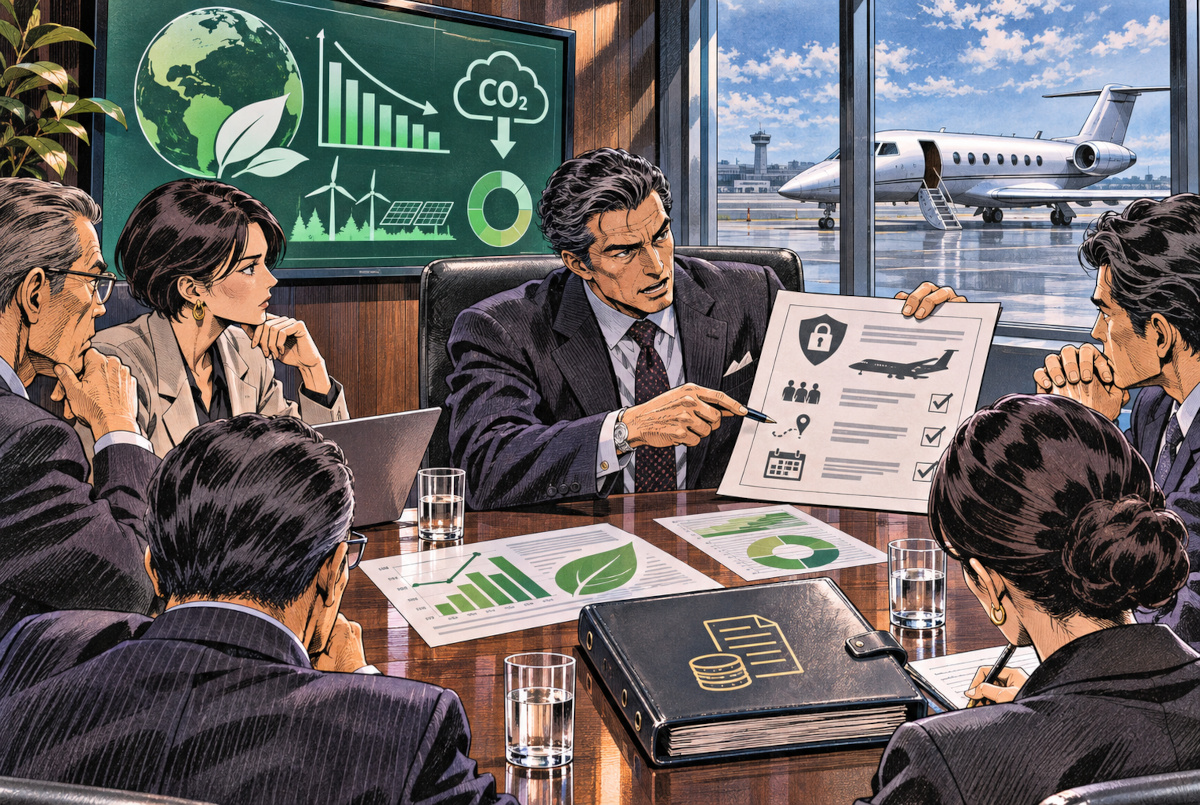
Conceptual illustration of how corporate climate goals and executive aircraft travel may be considered alongside security and operational needs. AI-generated illustration; it does not depict an actual meeting, company board, or executive.
One Private Jet Flight vs. a Japanese Household’s Annual CO₂ Emissions
If the dollar figures cannot tell us the environmental impact, what can?
A peer-reviewed study published in Communications Earth & Environment in November 2024 analyzed private aviation using flight tracking records from 2019 to 2023.
The researchers estimated that private aircraft produced an average of approximately 3.6 metric tons of direct CO₂ emissions per flight in 2023. They also found that 47.4% of the flights covered distances of less than 500 kilometers (about 311 miles).
To put that figure into perspective, I compared it with an entirely different official dataset: Japan’s latest preliminary household emissions statistics.
According to figures released by Japan’s Ministry of the Environment on October 22, 2026, the average Japanese household emitted 2.51 metric tons of CO₂ over fiscal 2025 from electricity, gas, and kerosene consumption.
The calculation is straightforward:
3.6 metric tons ÷ 2.51 metric tons = approximately 1.43
One average private aircraft flight emitted roughly 1.4 times the CO₂ associated with a Japanese household’s entire year of electricity, gas, and kerosene use.
That is a striking comparison, but it needs careful interpretation.
The aircraft figure is a worldwide 2023 average of direct emissions from fuel combustion. The household figure is a Japan-wide fiscal 2025 average that includes emissions associated with electricity consumption but excludes private cars and other household activities. The periods and accounting boundaries are not identical.
Nor does the comparison measure the actual flights of Cook or Zuckerberg. It illustrates the general scale of private aviation emissions, not either person’s individual carbon footprint.
Even with those limitations, the numbers raise a legitimate question: when an organization asks everyone to reduce their environmental impact, how should it evaluate the travel arrangements of its most senior executives?
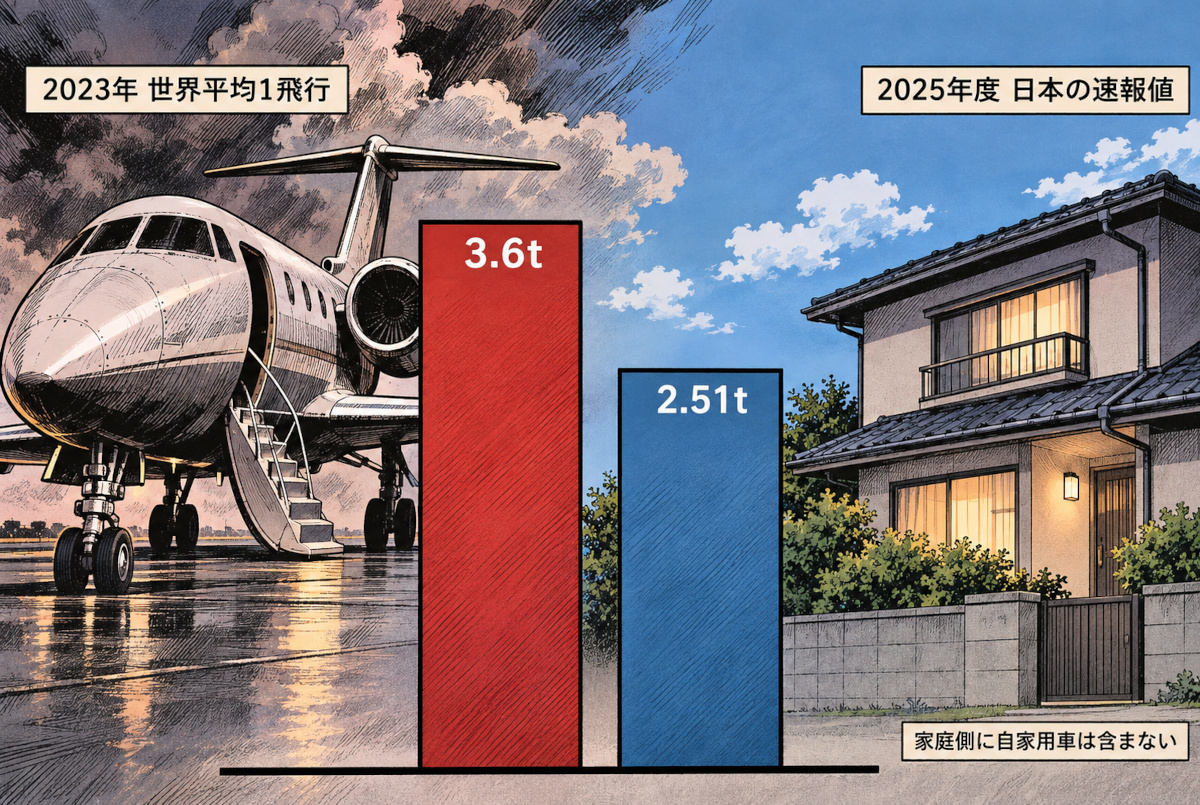
The Japanese labels in the illustration identify the 2023 worldwide average per private aircraft flight (3.6 metric tons of CO₂) and Japan’s preliminary fiscal 2025 household average (2.51 metric tons). The latter covers electricity, gas, and kerosene, excluding private vehicles. The two figures differ in year and accounting scope, and the bars are illustrative rather than precisely to scale. Source: Gössling et al. (2024) and Japan’s Ministry of the Environment (2026). AI-generated explanatory illustration.
Does a Bigger Job Title Mean Different Rules?
The point is not that wealthy people should never fly privately.
Both Apple and Meta have explained security-related reasons for their executives’ aircraft arrangements. Both have corporate environmental commitments. It would be unfair to dismiss a company’s measurable emissions reductions solely because an executive uses private aviation.
But the security explanation should not end the discussion either.
Imagine a manager who demands strict expense controls and environmental discipline from employees while treating personal privileges as beyond question. Even if those privileges are approved, would the employees see that as fair?
If a special arrangement is necessary for security, explain why. If its environmental impact cannot be eliminated, acknowledge that fact. If it can be reduced, consider how.
Japan’s Ministry of the Environment revised its environmental labeling guidelines in March 2026, emphasizing clear claims backed by appropriate evidence. A company’s executive using a private jet does not, by itself, make the company’s environmental claims misleading. Those are separate issues.
The real test is whether a company can account for both its environmental achievements and the exceptions it grants to people at the top.
Corporate progress matters. So does the willingness of powerful individuals to accept scrutiny.
Editor’s Note
Something about corporate life has always bothered me. A person gets promoted, earns more money, acquires subordinates, and suddenly seems to believe that a higher position means becoming a superior human being.
After examining these filings, I can see why security may justify certain travel arrangements. I have no interest in condemning every wealthy person’s lifestyle simply because it looks extravagant.
But if you spend your working day lecturing employees about sacrifice, responsibility, and doing the right thing, you should be prepared to apply the same standards to yourself.
Otherwise, the message starts to sound suspiciously like this: the rules are for everyone else.
A promotion increases your authority. It does not automatically improve your character. If anything, the more power and money you acquire, the more seriously you ought to examine your own appetites and excuses.
Wealth and authority are not sins. The more revealing question is whether you can still hold yourself accountable once you have enough of both to avoid uncomfortable questions.
That, to me, says more about character than any impressive title on a business card.
References
- Teikoku Databank, “Survey of Corporate Attitudes Toward the SDGs (2026)” (July 23, 2026; in Japanese). Survey of 10,413 responding Japanese companies.
- Apple Inc., 2026 Proxy Statement. Executive compensation disclosures, including Tim Cook’s personal aircraft travel costs for fiscal 2025.
- Meta Platforms, Inc., 2026 Proxy Statement. Executive compensation and related-party aircraft arrangements, including 2025 personal-use costs.
- Apple, “Apple Accelerates Environmental Progress With Highest-Ever Recycled Material in Its Products” (April 16, 2026; Japanese-language Apple release). Environmental progress and Apple 2030 commitments.
- Apple, “Tim Cook to Become Apple Executive Chairman; John Ternus to Become Apple CEO” (April 20, 2026). Official announcement of the September 1 leadership transition.
- Meta Sustainability, “Climate”. Corporate net-zero emissions target for 2030.
- Gössling, S., Humpe, A., and Leitão, J. C., “Private Aviation Is Making a Growing Contribution to Climate Change”. Communications Earth & Environment, 5, 666 (2024). DOI: 10.1038/s43247-024-01775-z.
- Ministry of the Environment, Japan, “Survey on CO₂ Emissions from the Household Sector, Fiscal 2025: Preliminary Results” (October 2026; in Japanese). National average emissions from household electricity, gas, and kerosene use.
- Ministry of the Environment, Japan, “Revision of the Environmental Labeling Guidelines” (March 31, 2026; in Japanese).