

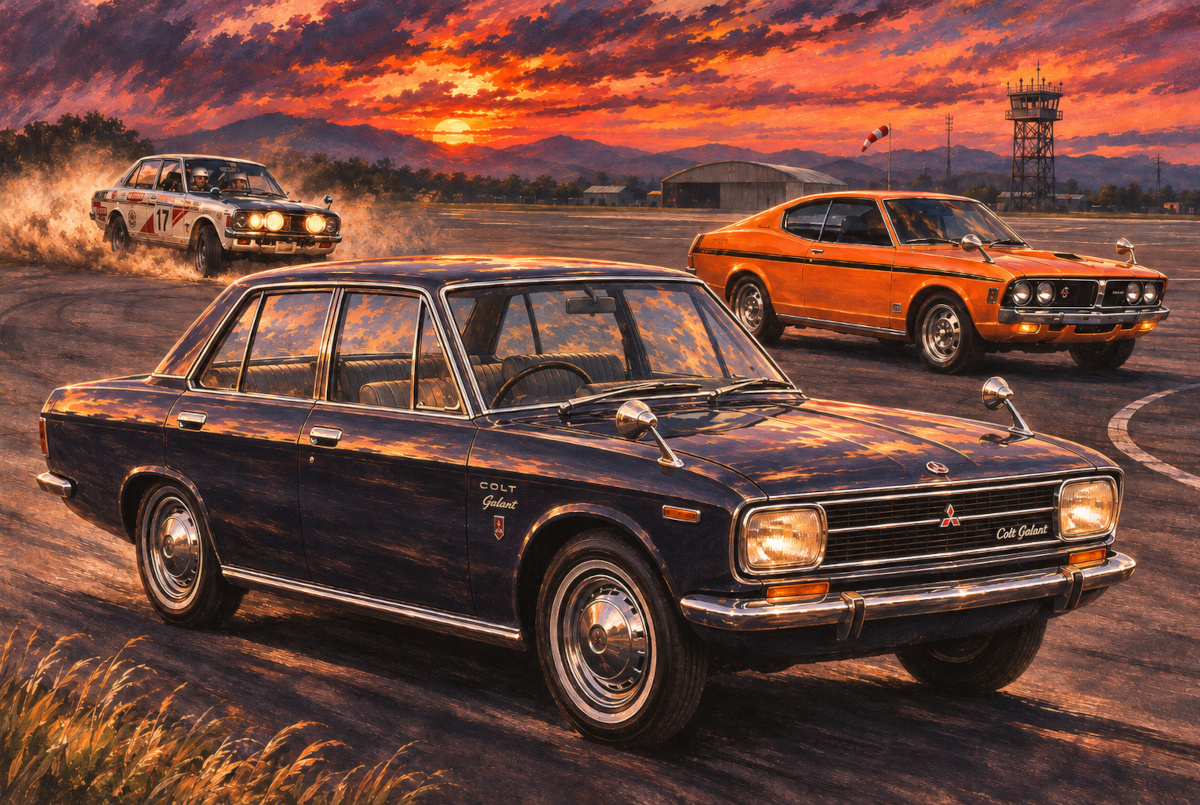
In December 1969, Mitsubishi Heavy Industries launched a new sedan called the Colt Galant. Mitsubishi Motors Corporation would not be established as an independent company until April 22, 1970. In other words, the Galant name appeared roughly four months before the automaker that would carry it for decades.
And that is only the beginning of the story. Italian design legend Giorgetto Giugiaro was involved in the car’s development, but the design chosen as the basis for production was actually created by Mitsubishi’s own styling team.
Why was Mitsubishi Heavy Industries investing so much effort in a new sedan just months before separating its automotive business? The answer lies in the transition from the Colt, the emergence of the GTO and FTO coupes, and an unexpectedly revealing chapter in Mitsubishi’s rally history.
From the Colt 1500 to the Galant: Why an Extra 70mm of Width Mattered
Before the Galant, Mitsubishi’s small passenger-car range was built around the Colt name. Introduced in October 1965, the Colt 1500 was an enlarged development of the earlier Colt, powered by a 1.5-liter engine producing 70 PS (metric horsepower).
The new Colt Galant, however, was more than a facelift or a slightly more luxurious Colt.
Comparing the representative specifications published in Mitsubishi Motors’ official vehicle history reveals just how the proportions changed.
| Dimension | Colt 1500 1965 |
Colt Galant 1969 |
|---|---|---|
| Length | 3,975mm | 4,080mm |
| Width | 1,490mm | 1,560mm |
| Height | 1,425mm | 1,385mm |
The Galant was 105mm longer, an increase of approximately 2.6%, and 70mm wider, an increase of about 4.7%. Yet it was also 40mm lower.
Longer, wider, and lower: the numbers suggest a deliberate move away from the older Colt’s upright proportions. Mitsubishi was creating a new type of sedan for Japan’s expanding car market and its increasingly extensive highway network.
The mechanical changes were equally significant. The 1.3-liter 4G30 and 1.5-liter 4G31 engines introduced Mitsubishi’s first overhead-camshaft (OHC) system. The engines were collectively named Saturn, following a tradition of astronomical names used for Mitsubishi’s prewar aircraft engines.
The body adopted a wedge-shaped profile marketed as the “Dyna-Wedge Line.” Inside, Mitsubishi fitted a patented curved, glare-reducing instrument display and double-spring seats designed to reduce fatigue on longer journeys.
The Colt Galant was not simply intended to take families from one town to another. It was designed for an era in which ordinary drivers were beginning to travel farther and faster.
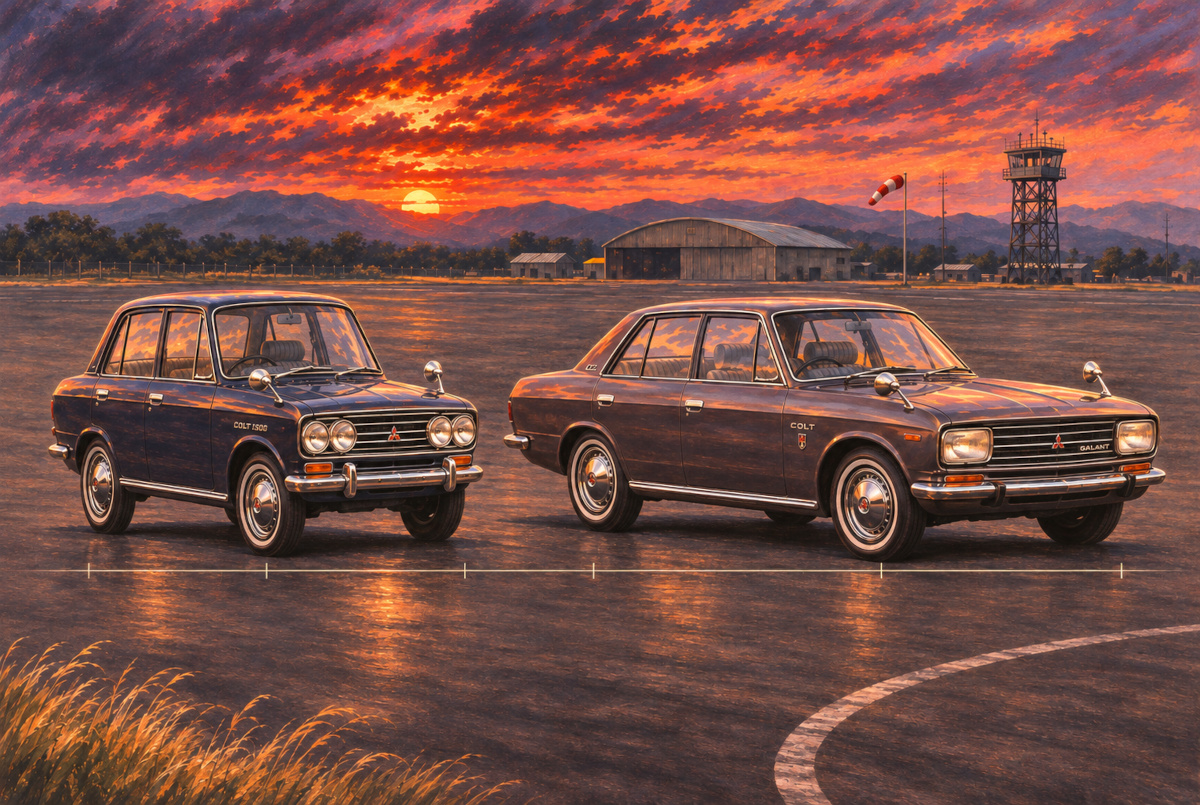
The 1965 Colt 1500 (left) and the 1969 Colt Galant (right). The front design changed from four round headlights to two rectangular units, while the body grew by 105mm in length and 70mm in width. This is an AI-generated historical illustration, not an exact scale comparison.
Was the First Galant Really Designed by Giugiaro? The Original Designer’s Account Tells a Different Story
The first Galant is often associated with Giorgetto Giugiaro, the renowned Italian designer. His involvement was real. But describing the car simply as a Giugiaro design leaves out a crucial part of its development.
Shinichi Mitsuhashi, a Mitsubishi designer who worked on the project, later published a firsthand account of the competition between Mitsubishi’s in-house team and Giugiaro’s Ital Styling operation, later known as Italdesign.
In January 1968, the two teams presented their competing designs for evaluation.
According to Mitsuhashi, most of the executives attending the review favored the Italian proposal. It was considered polished and well balanced, while Mitsubishi’s own design appeared more adventurous and less refined.
Then came the surprise.
Executive Kubo, who had the final say, chose the Mitsubishi team’s proposal as the starting point. The production design would incorporate selected strengths of the Italian model, but the fundamental direction came from the Japanese team.
Giugiaro contributed to the Galant’s development, but the claim that he designed the production car single-handedly does not match the recollection of Mitsubishi’s own designer.
This distinction matters because the Galant represented more than a new product. Mitsubishi was trying to build its own automotive design identity rather than relying entirely on established European names.
In 1969, its car-making operation was still part of Mitsubishi Heavy Industries. Yet the ambition was already that of a serious passenger-car manufacturer competing with Toyota and Nissan.
The GTO and FTO Were Related—but One Was 360mm Shorter
The Galant’s development soon produced something far more flamboyant than an ordinary family sedan.
At the 1969 Tokyo Motor Show, Mitsubishi displayed the Colt Galant GTX-1 concept. Its long hood, dramatic rear styling, and ducktail shape pointed directly toward the production Galant GTO, which went on sale in November 1970.
The GTO’s appearance was heavily influenced by the sporty American coupes of the period. Mitsubishi marketed it as a “hip-up coupe,” a phrase referring to its distinctive raised rear profile.
In December 1970, the high-performance GTO MR joined the range. Its 1.6-liter twin-cam engine produced 125 PS and marked Mitsubishi’s first production-car DOHC engine application.
Just one year later, in November 1971, Mitsubishi launched another sporting model: the Galant Coupe FTO.
At first glance, the FTO might seem like a smaller GTO. But a comparison of their dimensions reveals something more interesting.
| Model | Length | Width |
|---|---|---|
| Original Galant sedan | 4,080mm | 1,560mm |
| Galant GTO | 4,125mm | 1,580mm |
| Galant Coupe FTO | 3,765mm | 1,580mm |
The FTO was 360mm shorter than the GTO, yet both cars were exactly 1,580mm wide. It was a compact coupe with unusually broad proportions for its class.
There is an even better story behind those dimensions.
Shinichi Yamamura, who participated in the FTO’s development, recalled that the car was nicknamed “Mame Tank” within Mitsubishi—literally, “little tank.”
More importantly, his account explains why the FTO was developed so quickly.
Mitsubishi wanted to compete in Japan’s growing affordable sporty-car market, where models related to the Toyota Corolla and Nissan Sunny were already attracting buyers. But its new small passenger car, the Lancer, was not yet ready for launch.
The FTO was therefore developed partly to fill that gap until the Lancer arrived in 1973.
To shorten development time, Mitsubishi reused several Galant components. The original 1.4-liter FTO engine, however, was not the Galant’s overhead-cam Saturn unit. It was the older pushrod-operated Neptune OHV engine.
A later update replaced it with a Saturn-family OHC engine.
That makes the FTO rather more interesting than a scaled-down GTO. It was a sporty-looking solution to a very practical problem: Mitsubishi needed an appealing car for a market segment it could not afford to ignore.
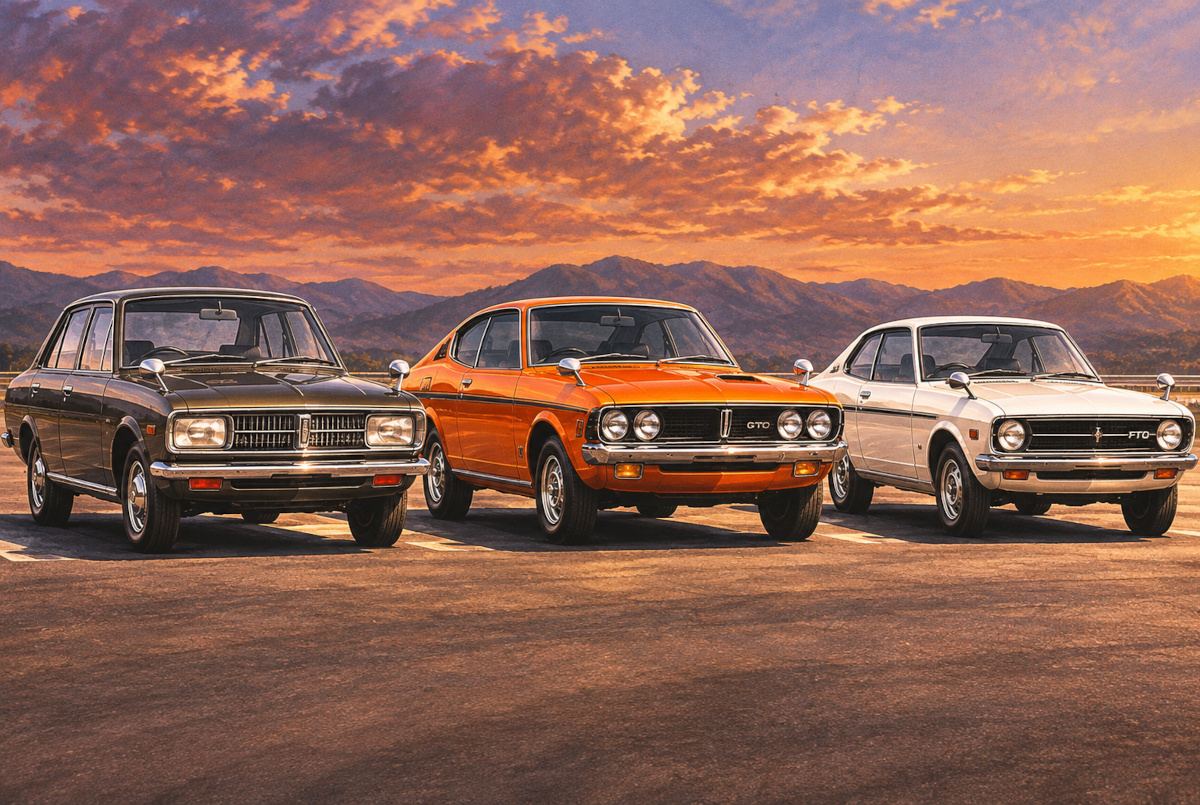
The original Colt Galant (1969, left), Galant GTO (1970, center), and Galant Coupe FTO (1971, right). The GTO and FTO shared a width of 1,580mm, although the FTO was 360mm shorter. This AI-generated illustration is not drawn to exact scale, and some grille and trim details differ from production specifications.
The Galant Won in 1972. So Why Do Mitsubishi’s 1973 Rally Records Name the Wrong Car?
The Galant’s reputation was not built entirely in showrooms. Mitsubishi was also developing an international rally program, using competition to demonstrate the durability and performance of its passenger cars.
In October 1972, Andrew Cowan drove a Galant 16L GS to overall victory in the seventh Southern Cross Rally in Australia.
One of his principal rivals was a Datsun 240Z, the Japanese sports car sold as the Nissan Fairlady Z in its home market.
According to the historical results compiled by Australian Rally History, the event covered approximately 3,200 kilometers. Cowan’s Galant finished with 90 penalty points, compared with 114 for the second-placed Datsun.
That is a difference of 24 penalty points. Mitsubishi’s own historical account describes the victory as a 24-minute margin.
So far, the record is straightforward. The problem appears when we examine the following year’s event.
Mitsubishi’s official rally-history page says in its narrative that the 1973 Southern Cross Rally was dominated by the newly introduced Lancer 1600GSR, which finished first, second, third, and fourth.
Yet the results table on that same official page identifies the winning model as the Galant 16L GS.
Which account is correct?
We compared Mitsubishi’s records with the detailed finishing order preserved by Australian Rally History.
The 1973 top four were all Mitsubishi Lancer GSRs. A Mitsubishi Galant finished seventh.
A separate Mitsubishi Motors article also identifies the Lancer as the car responsible for the first-through-fourth sweep. The historical results table therefore conflicts with both the company’s own narrative and the independent event records.
It is a small discrepancy in a large corporate archive, but it changes the story. If the table is taken at face value, the Galant appears to have continued its winning streak. The actual record shows Mitsubishi transferring its competitive strength to a different, smaller model.
There is one further distinction worth making. The Galant 16L GS also entered the 1973 Safari Rally, marking Mitsubishi’s first participation in the newly established World Rally Championship through a privately entered car.
The 1972 Southern Cross victory was an important international rally success, but it was not a WRC victory. The World Rally Championship only began in 1973.
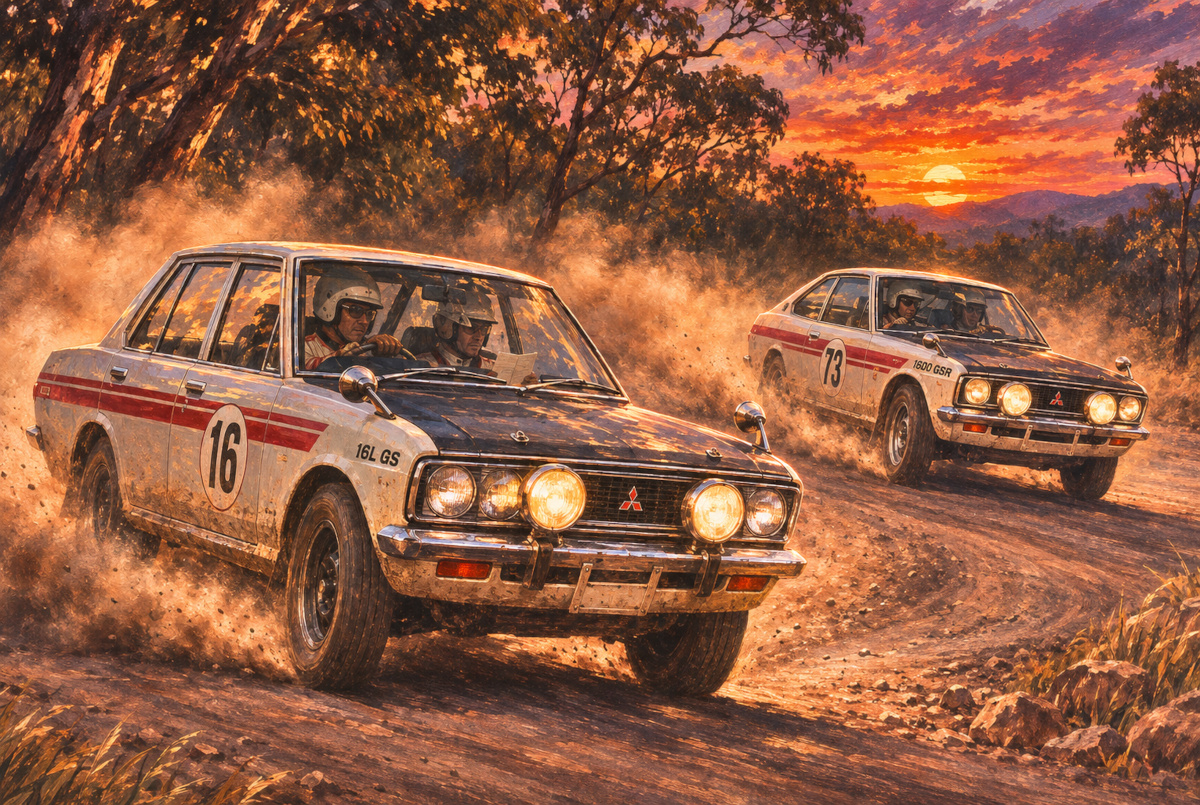
The Galant 16L GS won the 1972 Southern Cross Rally, while the Lancer 1600GSR swept the top four places in 1973. This AI-generated reconstruction places cars from different years in the same scene. The competition numbers, liveries, and driving conditions do not reproduce the actual events precisely.
In 1973, the Lancer Arrived—and the Galant Moved Upmarket
The Mitsubishi Lancer made its Japanese debut in February 1973. Four months later, the second-generation Galant arrived in June, dropping the Colt prefix from its name.
The new model, commonly called the New Galant, was larger and aimed at a more comfortable class of family motoring.
Its length increased to 4,200mm and its width to 1,600mm—120mm longer and 40mm wider than the original Galant. Engine choices included 1.6-liter, 1.85-liter, and 2.0-liter units.
The separation of roles was becoming clear.
The smaller Lancer increasingly carried Mitsubishi’s rally ambitions. The Galant continued as the company’s more spacious medium-size sedan. And in March 1975, the Lancer Celeste arrived as the successor to the Galant Coupe FTO.
What had begun as a new Colt became an independent model family, with the Galant and Lancer serving different parts of Mitsubishi’s passenger-car business.
That transition helps explain why the Galant mattered so much. It was not merely another sedan in Mitsubishi’s catalog. It helped define the structure of the company’s passenger-car range as Mitsubishi Motors established itself as an independent manufacturer.
Editor’s Note
I originally assumed the Colt Galant was just an older Colt with a little more polish. But the deeper I looked, the less convincing that idea became. Mitsubishi had developed new overhead-cam engines, put its own designers up against Giugiaro, and created a genuinely different sedan. This was not a half-hearted exercise.
The FTO story is the part I keep coming back to. Here was a good-looking little coupe that, according to someone who actually worked on it, was hurried into existence partly because Mitsubishi needed something to sell before the Lancer was ready. And the engineers called it the “little tank.” You could hardly invent a more wonderfully old-school product-development story.
Then there is the rally business. Mitsubishi finally wins with the Galant in 1972, only to shift its biggest success to the Lancer the following year. Why move away from a car that had just proved itself? Perhaps Mitsubishi’s willingness to change horses, even after a victory, is part of what made the company so distinctive.
In Part 2, we move on to the Galant Sigma, introduced in 1976. Its name suggested a culmination of Mitsubishi engineering, yet the car’s story would eventually lead to an even bigger change: the abandonment of rear-wheel drive in favor of front-wheel drive.
Terms That May Need a Quick Explanation
- OHC (Overhead Camshaft)
- An engine design in which the camshaft is mounted in the cylinder head to operate the valves. Compared with a traditional overhead-valve (OHV) arrangement using pushrods, it generally makes high-speed valve operation easier. A single overhead camshaft is usually called SOHC, while two are called DOHC.
Mitsubishi Galant: Seven-Part History Series
From the original Colt Galant and the Galant Sigma to the rally-winning VR-4, GDI technology, and the end of the Galant name. Across seven articles, we explore the cars, engineering, motorsport history, and legacy of one of Mitsubishi's defining model lines.
- Part 1: The Colt Galant Came Before Mitsubishi Motors—and Led to the GTO and FTO (Part 1)
- Part 2: The Galant Sigma Was a Hit—So Why Did Mitsubishi Abandon RWD? (Part 2) Coming soon
- Part 3: English edition Coming soon
- Part 4: English edition Coming soon
- Part 5: English edition Coming soon
- Part 6: English edition Coming soon
- Final Part: English edition Coming soon
References
- Mitsubishi Motors — Vehicle History (Japanese). Official histories and representative specifications for the Colt 1500, Colt Galant, Galant GTO, Galant Coupe FTO, and second-generation Galant.
- Mitsubishi Motors — Company History (Japanese). The establishment of Mitsubishi Motors Corporation, early engine development, and the company’s automotive business.
- Shinichi Mitsuhashi — “Colt Galant (1969),” Mitsubishi Car Design History (Japanese). A firsthand account of the competition between Mitsubishi’s designers and Giugiaro, including the final design-selection process.
- Shinichi Mitsuhashi — “Colt Galant GTO (1970),” Mitsubishi Car Design History (Japanese). Development of the GTX-1 concept, the GTO’s ducktail design, and wind-tunnel testing.
- Shinichi Yamamura — “Galant Coupe FTO (1971),” Mitsubishi Car Design History (Japanese). A firsthand account of the FTO’s hurried development, shared components, and the internal nickname “Mame Tank.”
- Web Motor Magazine — Mitsubishi Galant GTO MR (December 1970) (Japanese). Production introduction and specifications of the 125 PS DOHC model.
- GAZOO — Mitsubishi Galant Coupe FTO Model History (Japanese). The original pushrod Neptune engine and the subsequent change to the Saturn overhead-camshaft engine.
- Mitsubishi Motors — World Rally Championship History, 1967–1977 (Japanese). Official competition history, the Galant’s 1972 victory, and the transition to the Lancer.
- Australian Rally History — 1972 Southern Cross Rally (English). Finishing order, competitors, event distance, and penalty-point results.
- Australian Rally History — 1973 Southern Cross Rally (English). Detailed finishing results confirming the Lancer’s first-through-fourth sweep and the Galant’s seventh-place finish.
- Mitsubishi Motors — “Why Did Mitsubishi Motors Enter Rally Competition?” Part 1 (Japanese). Company archive discussion and period press-release evidence identifying the Lancer as the 1973 Southern Cross Rally winner.