

Why did the Toyota MR2 disappear? The usual answer is that it became another victim of the decline of Japanese sports cars in the late 1990s and 2000s.
That is part of the story, but it does not explain everything.
A more interesting pattern emerges when the MR2’s three generations are viewed together. Toyota had created something highly unusual: a genuinely attainable mid-engine sports car from one of the world’s largest mass-market manufacturers. Over time, keeping that idea affordable became increasingly difficult to justify.
The MR2 may not have disappeared because Toyota forgot how to build a mid-engine car. The harder problem was continuing to sell such a specialized car at a price ordinary enthusiasts could realistically afford.
The AW11, SW20 and third-generation MR-S were connected by the same basic mid-engine idea, but they were very different cars. Looking at each generation separately makes the MR2’s disappearance much easier to understand.
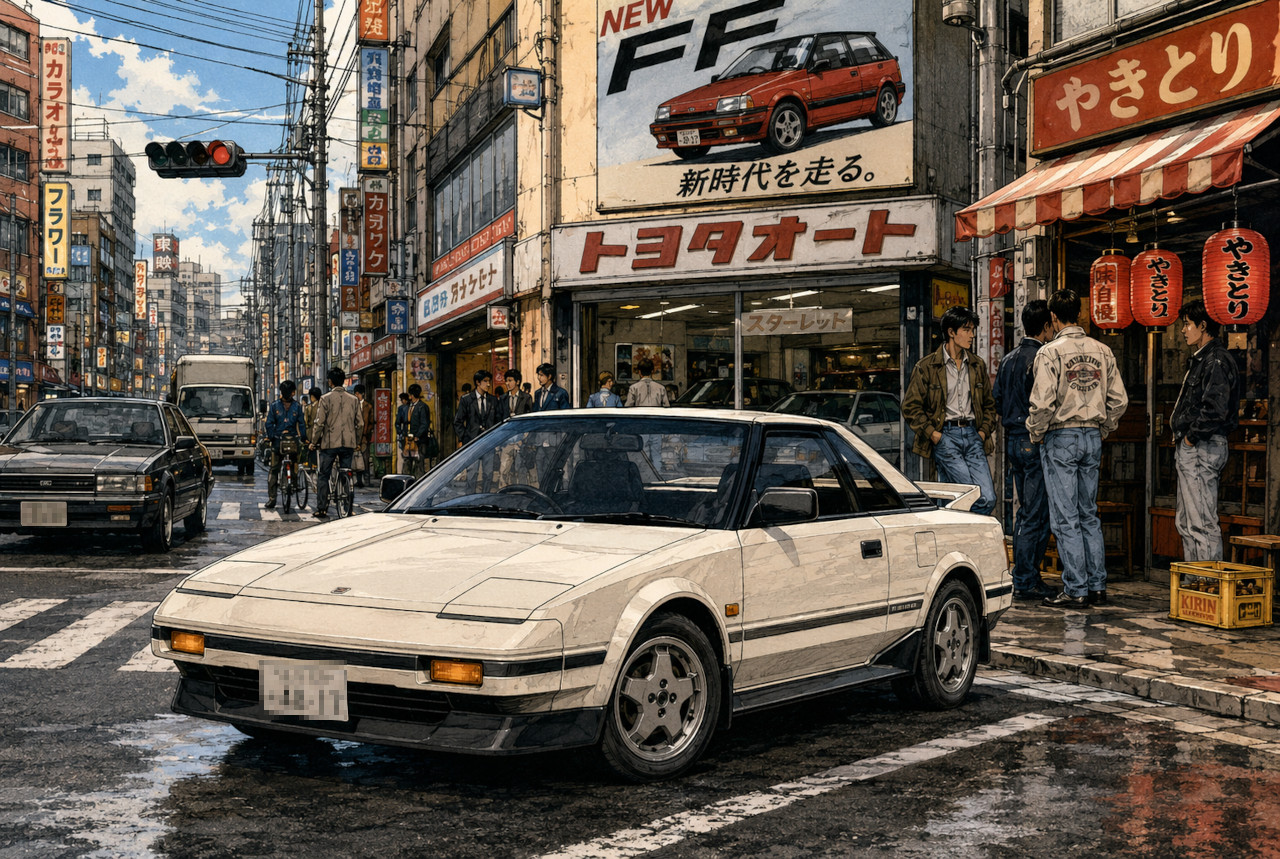 AI-generated illustration inspired by the first-generation Toyota MR2 and 1980s Japan. Vehicle proportions, body details and scenery may differ from the actual production car.
The AW11 brought the mid-engine layout down from the supercar world
When Toyota launched the first MR2 in Japan in June 1984, the company described it as Japan’s first two-seat, mid-engine sporty personal car.
The name itself explained the concept. Toyota said MR2 stood for “Mid-Ship Runabout 2-Seater.”
That description matters because the original MR2 was not designed simply as a miniature exotic car.
Toyota’s own historical material explains that the AW11 was developed with everyday usability in mind, including seating position, ease of getting in and out, and luggage capacity. Engines were related to units used elsewhere in Toyota’s mass-market range, including the Corolla.
That was the clever part.
The engine was behind the occupants and drove the rear wheels — a layout normally associated with far more expensive machinery — yet the surrounding engineering was grounded in mass-production Toyota reality.
It allowed ordinary buyers to experience something structurally exotic without buying an exotic car.
The AW11 was also small and light. Representative Japanese-market 1.6-liter versions weighed around 950 kg when the model was introduced.
For international readers, the dates differ slightly by market. The MR2 reached North America for the 1985 model year, while its Japanese launch took place in 1984. That is why American and Japanese histories sometimes appear to give different starting dates for the same first generation.
Why the first MR2 formula was so unusual
The mid-engine layout gave Toyota an instant selling point that a conventional front-engine coupe could not easily duplicate.
Today, performance cars can use sophisticated electronics, adaptive suspension, torque vectoring and enormous engine output to create their character. In the mid-1980s, simply telling a customer that the engine was mounted behind the seats was enough to make the MR2 feel exotic.
And yet the car was not huge, impossibly powerful or financially unreachable.
The AW11’s attraction was not that it behaved like a cheap Ferrari. It was that Toyota had made the basic architecture of an exotic sports car available in an entirely different price and ownership category.
That combination is one reason the first MR2 still feels special today. Modern cars are vastly faster, but very few mass-market manufacturers now sell a compact two-seat mid-engine car as an attainable enthusiast product.
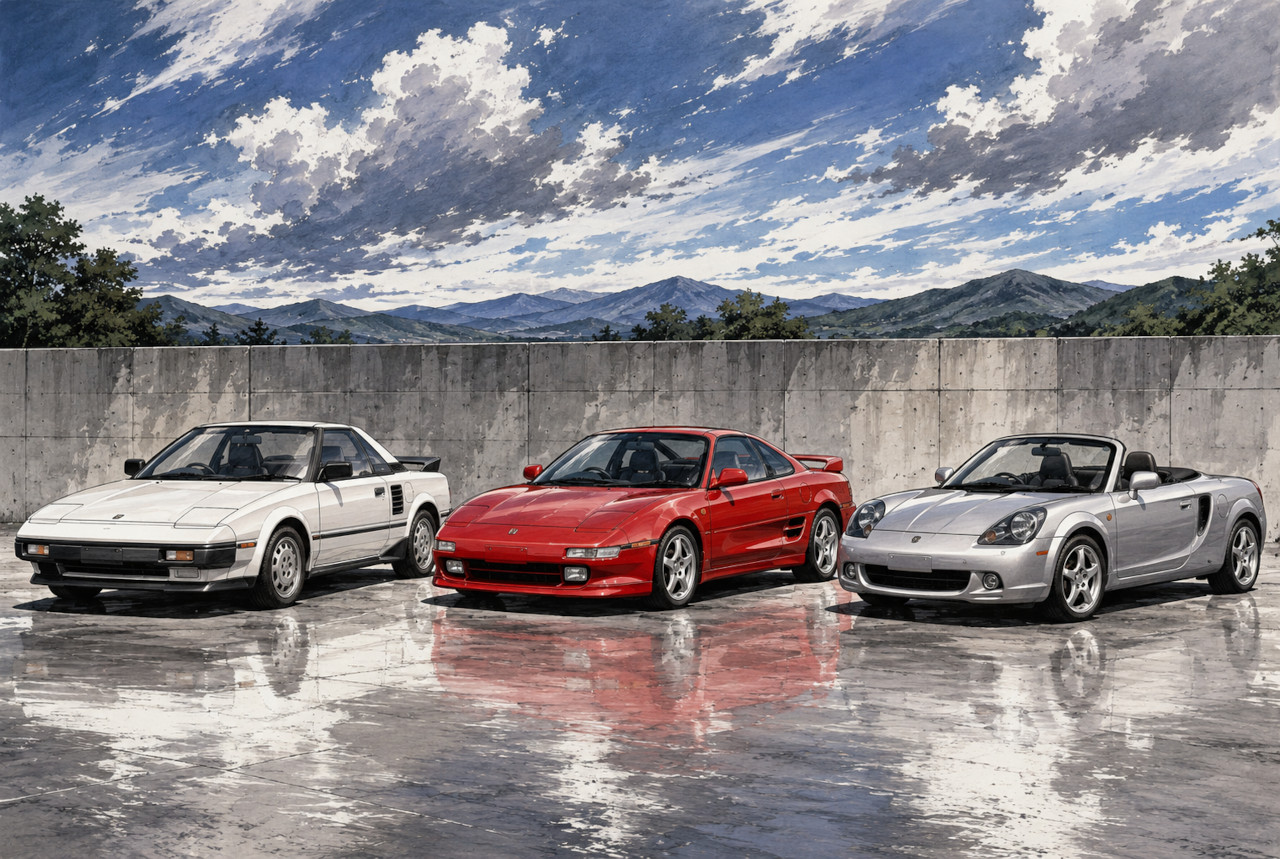 AI-generated illustration comparing the three generations of Toyota’s mid-engine sports-car lineage. It is intended to show the changing character of the models rather than serve as an exact photographic comparison.
The SW20 made the dream bigger — and more complicated
When Toyota completely redesigned the MR2 in 1989 for the Japanese market, the second-generation SW20 moved the concept noticeably upmarket.
The car became wider, more powerful and visually much more dramatic.
Where the AW11 looked like a compact wedge-shaped sports car, the SW20 carried proportions that invited comparisons with much more expensive mid-engine machinery.
Toyota itself described the new model as the evolution of a car that had challenged the assumption that the mid-engine layout belonged only to ultra-expensive sports cars.
The SW20 expanded that idea.
Turbocharged versions brought serious performance, while the styling, interior and overall character became more mature. For many enthusiasts — particularly in export markets — this is the MR2 generation that most closely resembles a traditional mid-engine exotic.
But progress came with another side to it.
Greater performance, refinement and equipment also meant more weight and complexity. The MR2 was moving away from the almost minimalist formula that had made the first generation so clever.
The SW20 was arguably a better-developed sports car, but it also showed how difficult it was for an affordable mid-engine car to keep gaining performance and sophistication without gradually becoming more expensive and complicated.
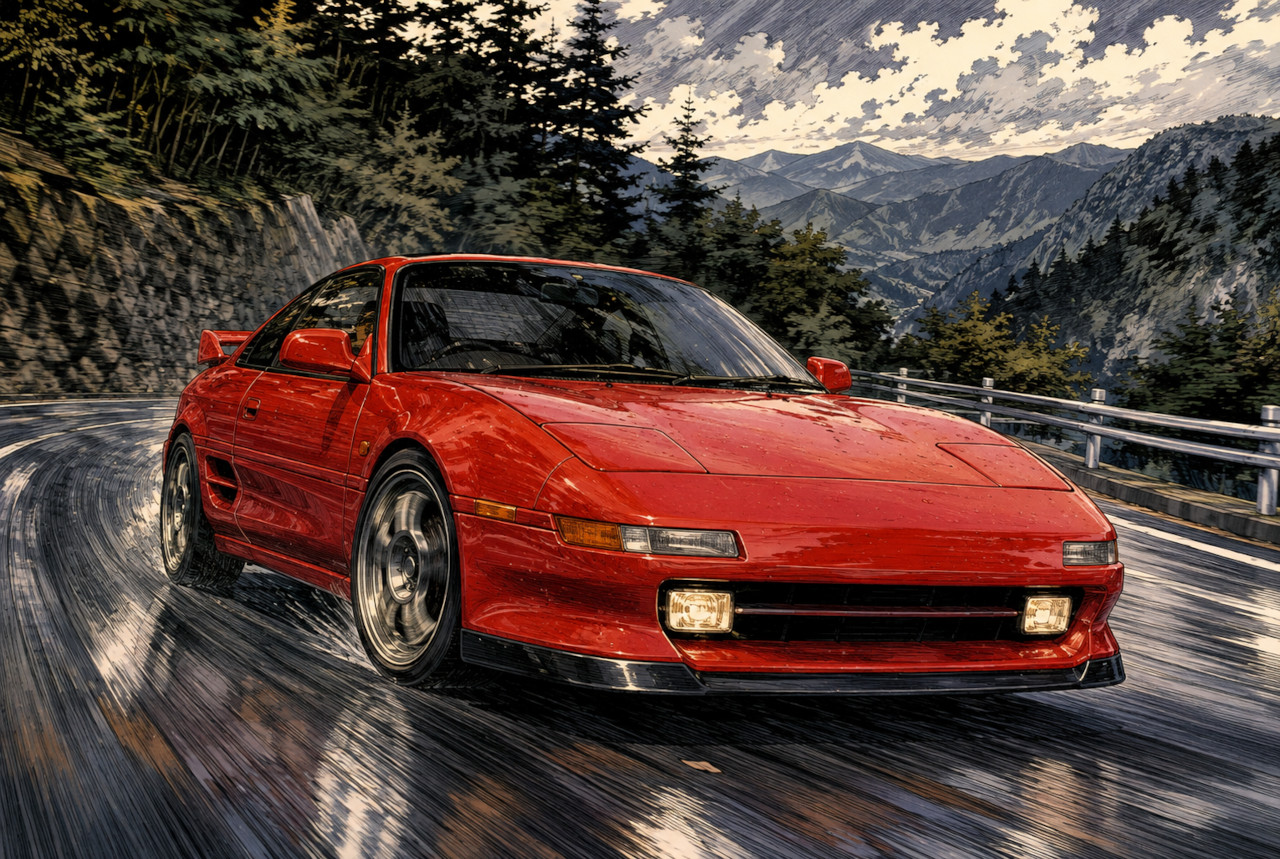 AI-generated illustration inspired by the second-generation SW20 MR2. It is not an exact reproduction of a specific production model, trim level or model year.
The MR-S was a return to simplicity — but English-speaking markets knew it by another name
In 1999, Toyota changed direction again.
In Japan, the third-generation car was called the MR-S. Toyota said the name stood for “Midship Runabout-Sports.”
For English-speaking readers, this can be confusing because Toyota did not use the MR-S name everywhere.
In the United Kingdom and other European markets, it was sold as the MR2 Roadster. In the United States, it became the MR2 Spyder.
They belong to the same ZZW30 third-generation family. So when a Japanese article talks about the MR-S, American readers can generally think of the MR2 Spyder. Toyota USA itself categorizes the 2000–2005 Spyder as the third generation of the MR2.
The car’s philosophy was also very different from the SW20.
Instead of chasing turbocharged power and the visual drama of a miniature supercar, Toyota went back toward lightness.
The Japanese-market B Edition weighed only about 960 kg at launch. The car used a naturally aspirated 1.8-liter 1ZZ-FE engine with VVT-i and a mid-engine, rear-wheel-drive layout.
Toyota’s development phrase was “NEW GENERATION LIGHT SPORT.”
Seen only through horsepower numbers, the third-generation car could look like a step backward from the turbocharged SW20.
Seen through the original AW11 philosophy, however, it makes far more sense.
The MR-S/MR2 Spyder was not really trying to become an even faster SW20. It was trying to rediscover the appeal of a light, responsive and relatively simple mid-engine sports car.
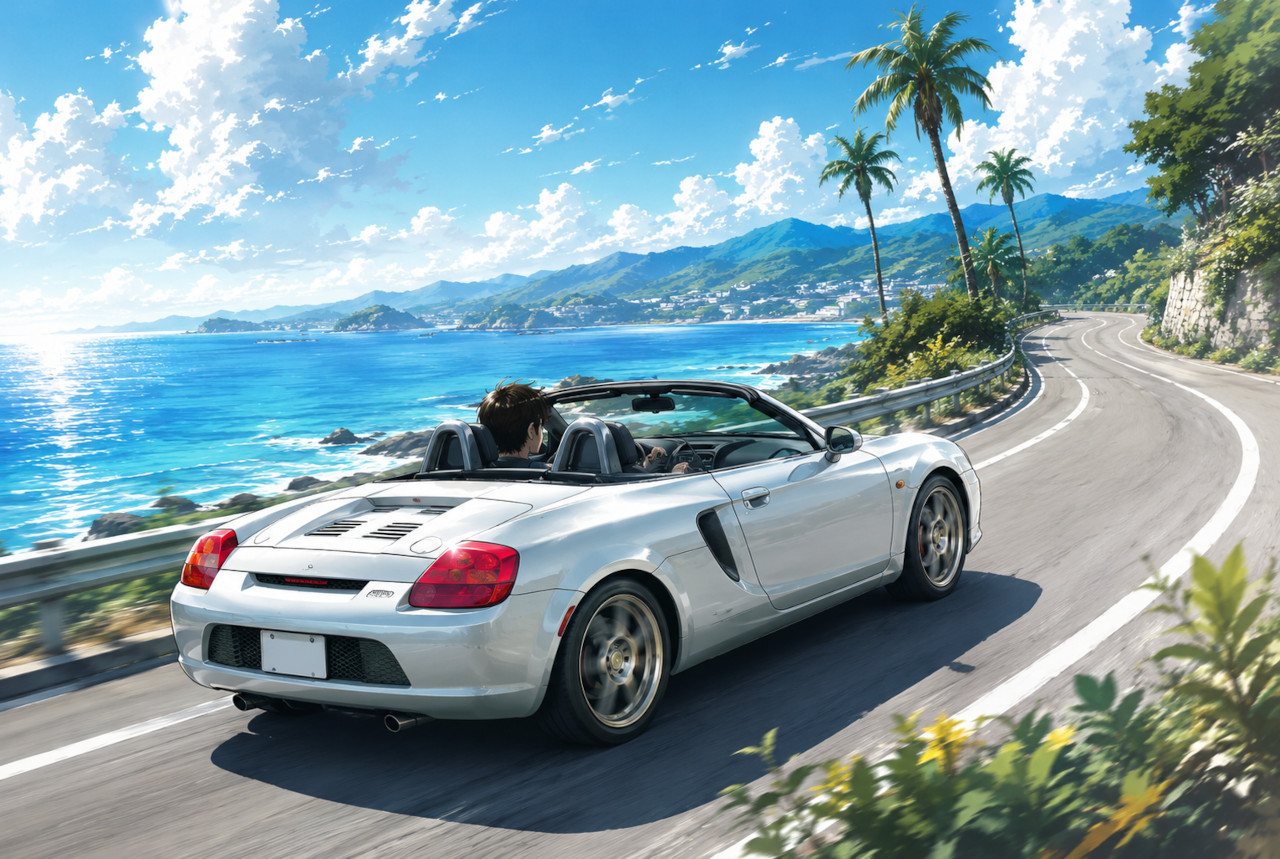 AI-generated illustration inspired by the third-generation Toyota MR-S, known as the MR2 Roadster or MR2 Spyder in several export markets. It is not an exact reproduction of a production vehicle.
If the formula was so good, why did Toyota stop?
This is where the usual explanation — “sports cars stopped selling” — becomes too simple.
The market certainly changed. By the late 1990s and 2000s, two-seat sports cars were becoming a smaller part of the mainstream automobile business, while buyers increasingly moved toward more practical vehicles.
But the MR2 also faced a structural problem that an ordinary sporty coupe did not.
A conventional front-engine sports model can potentially share more of its architecture, powertrain and manufacturing investment with higher-volume vehicles.
A compact mid-engine two-seater is much harder to disguise as anything else.
The location of the engine shapes the passenger compartment, cooling layout, cargo packaging, drivetrain arrangement and much of the basic structure of the car. The features that make a mid-engine sports car interesting also make it specialized.
That specialization is easy to justify on an expensive exotic car because the selling price can absorb the engineering cost.
It becomes much more difficult when the entire point of the product is that ordinary enthusiasts can afford it.
The contradiction at the heart of the MR2 was this: it offered an exotic layout, but its greatest appeal depended on not having an exotic price.
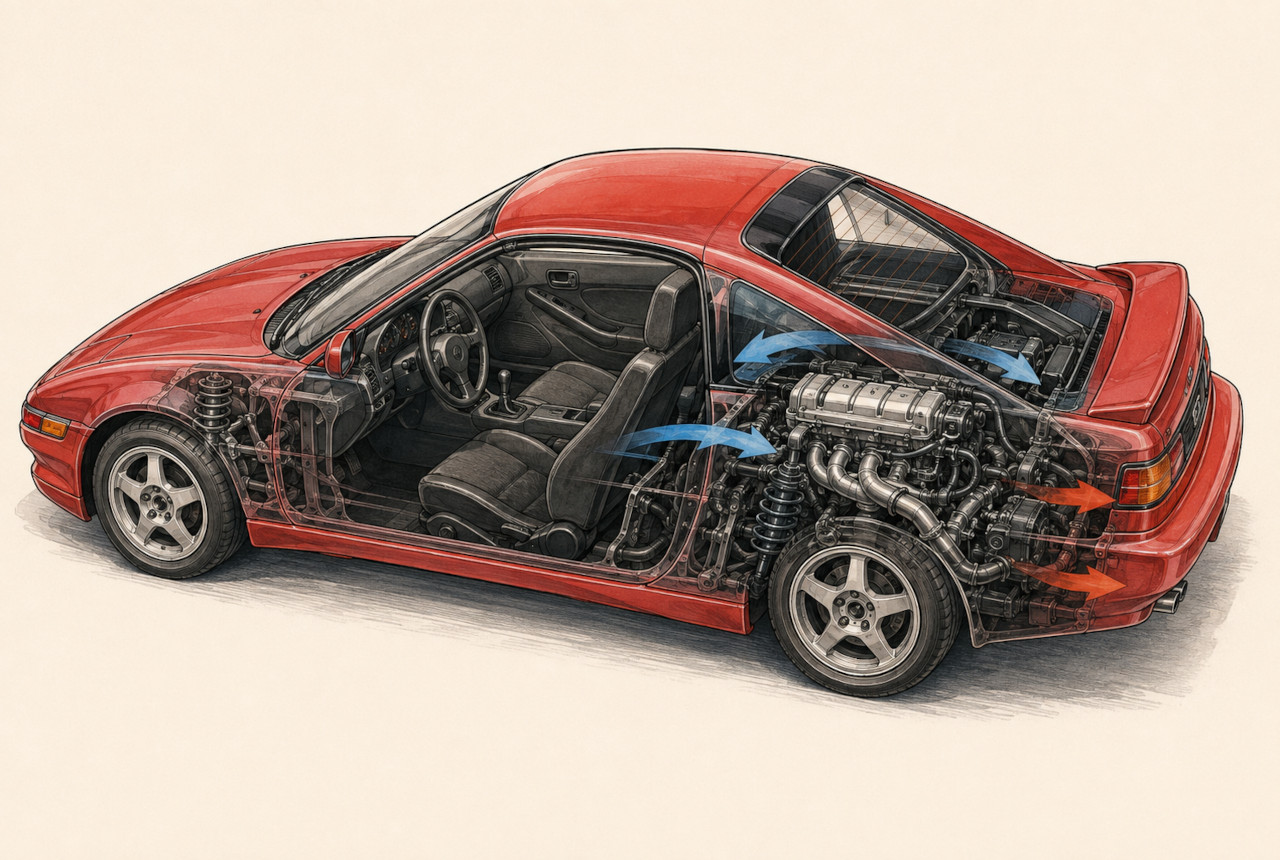 AI-generated conceptual illustration of a mid-engine vehicle layout. It is intended to explain the general packaging challenge and is not an accurate engineering diagram of a specific MR2 generation.
The enemy of the affordable mid-engine car may have been economics, not failure
There is an important distinction here.
Saying that the MR2 became harder to justify economically is not the same as claiming that nobody wanted one.
Enthusiast cars can develop intensely loyal audiences while still being difficult products for a large manufacturer to keep in continuous production.
Toyota’s own production history records more than 300,000 MR2s produced before production of the first two generations ended in 1999. The company then began MR-S production that October.
The MR-S remained in production in Japan until July 2007. Toyota even marked the end with a 1,000-unit V Edition Final Version.
So the third-generation car was not a one-year experiment that immediately failed. It remained in Toyota’s lineup for years.
But after it disappeared, Toyota did not immediately replace it with another inexpensive dedicated mid-engine sports car.
That absence may tell us more than simply labeling the MR2 “unpopular.”
Later enthusiast cars increasingly demonstrated another business model: share platforms, engines and development costs wherever possible.
From that perspective, a low-volume, dedicated, affordable mid-engine two-seater begins to look like an unusually difficult business proposition.
The MR2 disappeared, but the idea never stopped being attractive
That is also why MR2 revival rumors never seem to disappear for very long.
The basic idea remains irresistible.
A compact Toyota sports car.
Two seats.
The engine behind the driver.
Rear-wheel drive.
A price that does not require supercar money.
On paper, it still sounds brilliant.
The difficulty is recreating the last part of the formula.
Modern safety requirements, emissions targets, electrification, software development and increasingly sophisticated customer expectations have all changed the economics of producing niche cars.
Honda later proved that a mass-market Japanese manufacturer could still produce an unconventional small mid-engine sports car with the S660. But that car was a tiny Japanese kei-class model with a very different market position, and it too eventually left production.
The challenge is not proving that a mid-engine car can be engineered.
The challenge is engineering one, selling it cheaply enough to remain accessible, and producing enough of them to justify doing it again.
Why the MR2 still matters
The MR2 is more than a discontinued Toyota badge.
It represents a period when a huge mainstream manufacturer could look at an inherently impractical engineering idea and decide to put it into mass production anyway.
Each generation interpreted that idea differently.
The AW11 was compact, clever and almost defiantly attainable.
The SW20 made the concept faster, wider and more glamorous.
The MR-S — or MR2 Spyder/Roadster outside Japan — stripped the idea back toward lightness and response.
None of them was perfect, and they did not even appeal to exactly the same type of buyer.
But all three offered something that has become increasingly rare: a mid-engine layout as the centerpiece of a relatively attainable Toyota sports car.
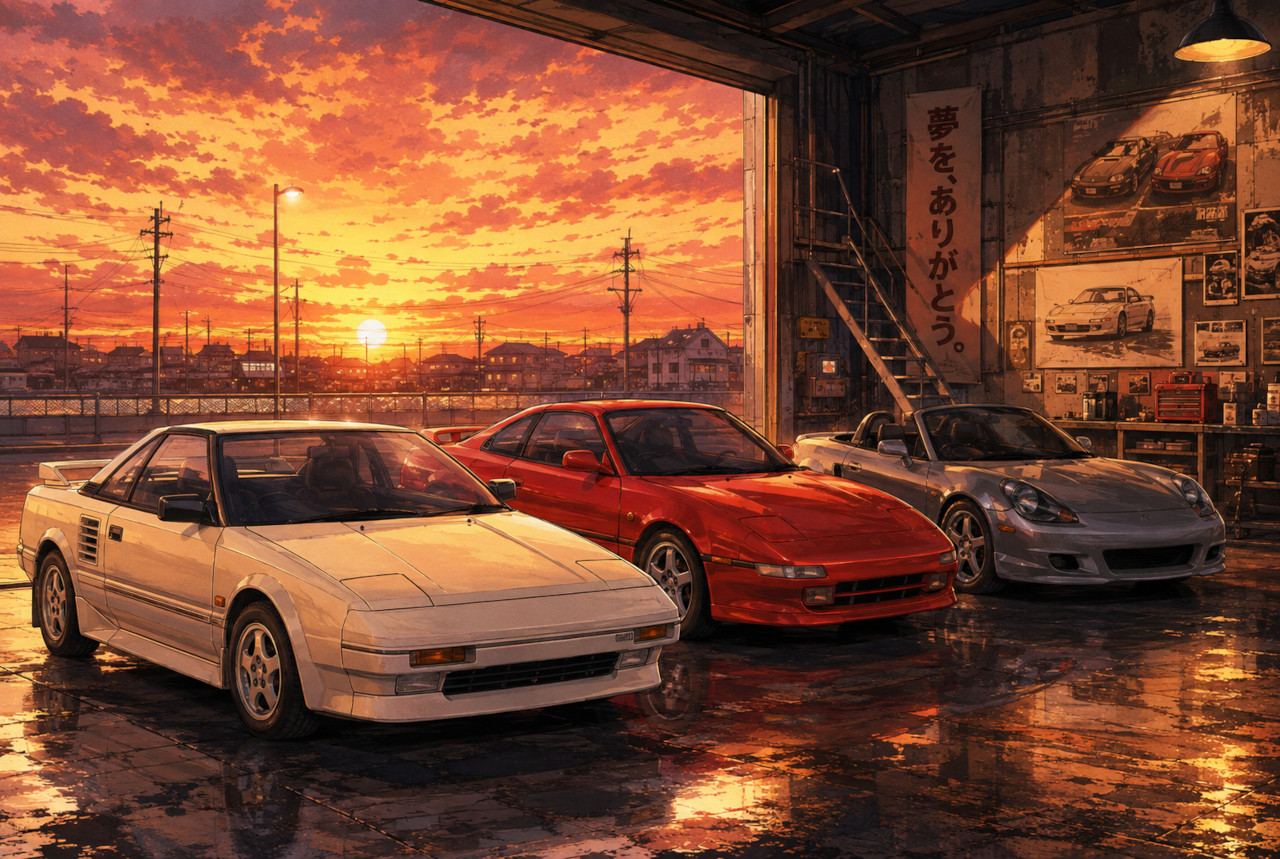 AI-generated illustration inspired by the three generations of Toyota’s MR2 family. The vehicles and setting are artistic representations rather than exact reproductions.
So perhaps the MR2 did not disappear simply because the sports-car market had a bad decade.
Its disappearance may symbolize something broader: the gradual end of an era when an ordinary buyer could choose a genuinely unusual mid-engine car from a mainstream manufacturer’s showroom.
That is also why the MR2 remains memorable.
It was a slightly unreasonable car made by an extremely rational company.
And sometimes those are the cars we miss the most.
Editor’s Note
It feels as though there used to be more strange cars that an ordinary person could just about afford by stretching the budget a little. Today, plenty of cars are faster than the old MR2, and modern performance cars are objectively more capable. But so many of the really unusual ones now live in premium price brackets.
I don’t dislike practical cars. I just miss the era when a major manufacturer could seriously build something that made you ask, “Who exactly is going to buy this?” The MR2 was one of those ideas: mid-engine, two seats, not particularly practical — and made by Toyota of all companies. That slight irrationality is exactly why it still feels valuable today.
References
- Toyota Motor Corporation — Toyota Announces the New MR2, Japan’s First Two-Seat Mid-Engine Sporty Personal Car (June 8, 1984)
- Toyota — 75 Years of Toyota: First-Generation MR2 Vehicle History and Specifications
- Toyota Motor Corporation — Toyota Completely Renews Its MR2 (October 17, 1989)
- Toyota Motor Corporation — Toyota’s MR-S: As a Sports Convertible Should Be (October 12, 1999)
- Toyota UK — Next Generation MR2 Is a True Roadster (October 15, 1999)
- Toyota USA Newsroom — 2000–2005 Toyota MR2, Third Generation
- Toyota Motor Corporation — MR-S V Edition Final Version and End of Production (November 20, 2006)