

Was Honda really a “front-wheel-drive company”?
When enthusiasts talk about Honda performance, one idea still comes up surprisingly often: “What makes a Honda special is making a front-wheel-drive car go ridiculously fast.”
There is plenty of evidence for that image. For decades, some of Honda’s most important cars — the Civic, Integra, Accord, Prelude and their performance derivatives — were built around front-wheel drive.
Then, in 1999, Honda launched the S2000: a two-seat open sports car with a longitudinally mounted engine and rear-wheel drive.
To enthusiasts who had grown up with Civics and Integras, it could almost look as if Honda had suddenly decided to build someone else’s kind of sports car.
But that interpretation only tells half the story.
The S2000 was not necessarily an un-Honda-like departure. In an important sense, it was a return to one of Honda’s oldest automotive ideas.
One terminology note may help international readers. Japanese enthusiasts commonly use FF for front-engine/front-wheel drive and FR for front-engine/rear-wheel drive. In English, those layouts are more commonly described simply as FWD and RWD.
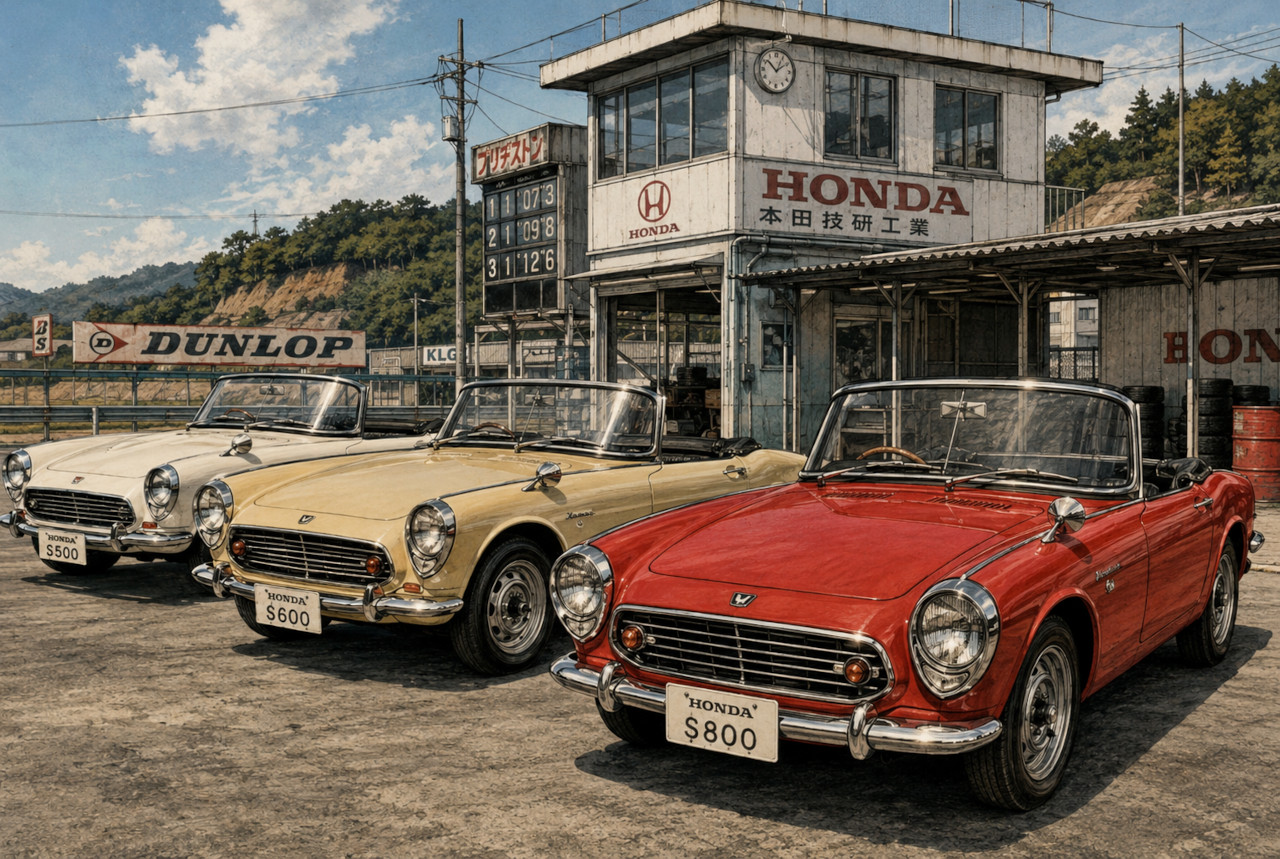 AI-generated illustration inspired by Honda’s S500, S600 and S800 sports cars of the 1960s. It is intended to show their historical relationship rather than reproduce specific production cars in exact detail.
Honda’s passenger-car story actually began with a rear-wheel-drive sports car
Honda did not begin its automotive life as a company defined by front-wheel drive.
After entering automobile production with the T360 mini truck in 1963, Honda launched the S500 later that year. The S500 became Honda’s first production passenger car — and it was a tiny open sports car.
The S500 was followed by the S600 and S800. All belonged to Honda’s original S-series sports-car lineage and used a front-engine, rear-wheel-drive layout.
The engineering was anything but conventional.
The S500 and S600 famously transmitted power from the differential to the rear wheels through chains. Honda’s own designers have since highlighted this motorcycle-influenced solution as an example of the company’s early obsession with clever packaging.
The engines were equally revealing. The S500 used a tiny water-cooled DOHC four-cylinder capable of unusually high engine speeds for its era — exactly the kind of engineering philosophy that would later become associated with much newer Hondas.
So Honda’s automotive DNA was not originally:
“Front-wheel drive above everything else.”
It was closer to:
“Make it small, make it rev, solve the engineering problem in an unusual way, and make it entertaining to drive.”
That distinction matters when we get to the S2000 decades later.
So why did rear-wheel-drive Honda sports cars disappear after the S800?
The more interesting question is not why Honda suddenly built an RWD S2000 in 1999.
It is why Honda spent so many years without a front-engine, rear-wheel-drive sports car after production of the S800 ended around 1970.
The answer is better understood through Honda’s changing business than through drivetrain ideology.
By the late 1960s and early 1970s, Honda needed to establish itself as a serious mass-market automobile manufacturer. Small enthusiast sports cars alone could not accomplish that.
Honda increasingly turned its attention toward compact, practical cars. That strategy ultimately produced the Civic in 1972.
Honda’s own corporate history describes the development of the first Civic as a project undertaken while the company faced a genuine risk of having to reconsider its future in the automobile business if the new car failed.
The Civic’s solution was dramatically different from most Japanese compact cars of the period.
Instead of the common front-engine, rear-wheel-drive three-box sedan layout, Honda chose a transverse-engine, front-wheel-drive two-box design. This allowed the company to maximize passenger room inside a very compact footprint.
That was not a sports-car decision.
It was a survival-and-growth decision.
Rather than concluding that Honda stopped building RWD sports cars because it could not build them, it makes more sense to see them as something that simply stopped being the company’s main priority.
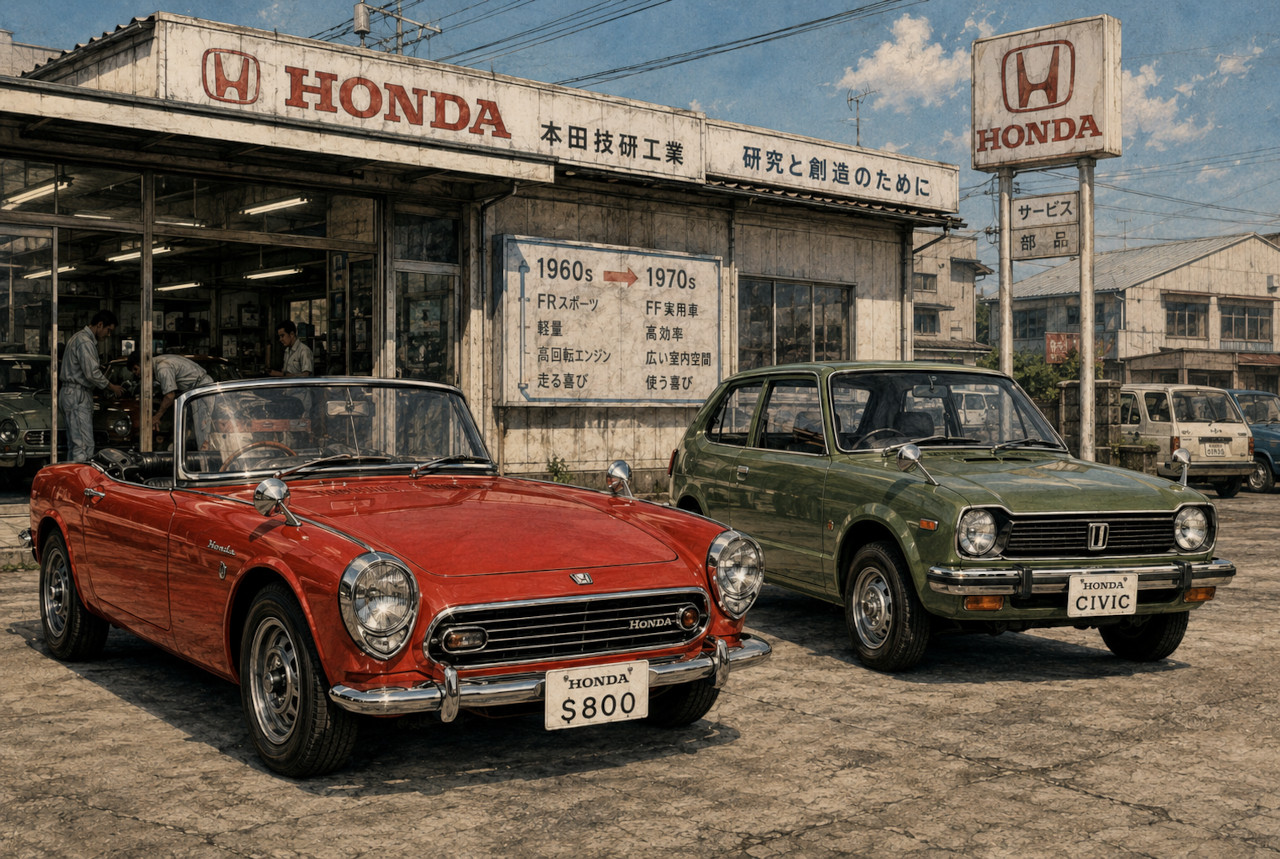 AI-generated illustration representing Honda’s shift from the S-series sports-car era toward practical front-wheel-drive models such as the Civic. It is not an exact historical scene or vehicle comparison.
Front-wheel drive stopped being a compromise and became a Honda weapon
And then something happened that may have permanently changed the public image of Honda.
Honda did not merely adopt front-wheel drive and tolerate its limitations.
It became extraordinarily good at making FWD cars interesting.
The Civic, CR-X and Integra generations gradually established a very specific Honda formula: relatively light cars, precise controls, eager engines and chassis that could make front-wheel drive feel far more entertaining than its economy-car reputation suggested.
The Type R era pushed that philosophy even further.
As a result, an entire generation of enthusiasts grew up believing that Honda’s engineering identity itself was tied to transverse engines and driven front wheels.
That reputation was understandable.
But it also obscured something older.
When the S2000 appeared, Honda was not abandoning its heritage. It was reopening a branch of the family tree that had been dormant for decades.
The S2000 was not an ordinary RWD sports car with a Honda badge
Look closely at the S2000 and it becomes difficult to argue that Honda merely copied the conventional front-engine, rear-wheel-drive sports-car formula.
The car was technically obsessive even by sports-car standards.
For the Japanese-market AP1, Honda developed the F20C, a naturally aspirated 2.0-liter DOHC VTEC four-cylinder producing 250 PS at 8,300 rpm with a 9,000 rpm maximum engine speed.
That meant approximately 125 PS per liter without turbocharging — an extraordinary specific output for a mass-production road engine at the time.
Honda also made the engine compact enough to position it behind the front axle line.
That created what Honda described as an FR behind-the-axle layout, helping the S2000 achieve an approximately 50:50 front-to-rear weight distribution.
The longitudinal engine was connected to a dedicated six-speed manual transmission, driveshaft and rear differential.
From the outside, that sounds like classic sports-car engineering.
But the execution was unmistakably Honda.
Honda took the conventional RWD sports-car layout and filled it with its own obsessions: extreme engine speed, naturally aspirated output, compact packaging, weight distribution and purpose-built engineering.
So perhaps the S2000 was not “un-Honda-like because it was RWD.”
It may have been one of the most concentrated expressions of Honda engineering precisely because the company had designed almost everything around the experience it wanted the driver to have.
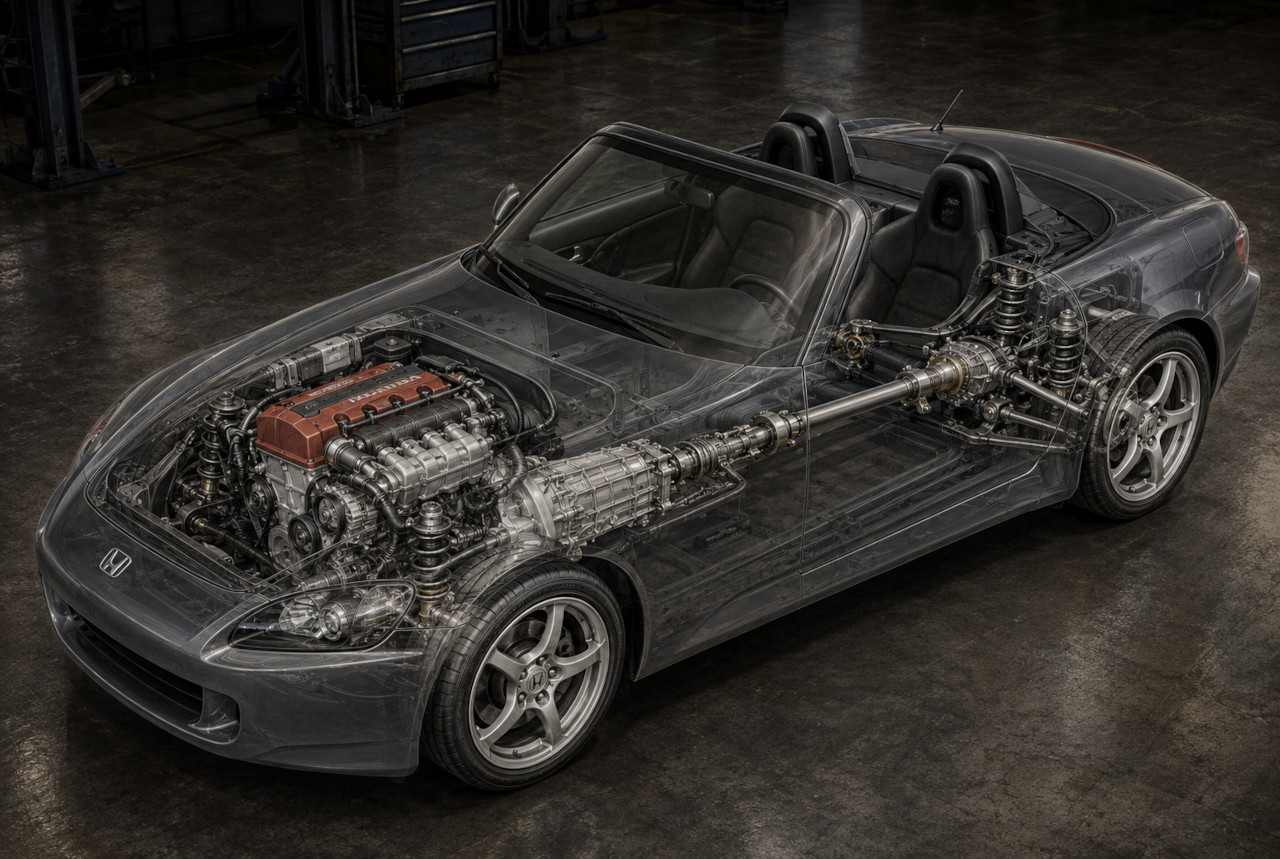 AI-generated conceptual image of the Honda S2000’s front-engine, rear-wheel-drive layout. It is intended to illustrate the general configuration and is not a technically exact cutaway of the production car.
The NSX makes the S2000 look even stranger — and more interesting
Honda had, of course, already built a world-class rear-wheel-drive sports car before the S2000 arrived: the NSX.
But the NSX was mid-engined, with its V6 mounted transversely behind the passenger compartment. In packaging terms, it still drew on Honda’s enormous experience with transverse powertrains.
The S2000 was different.
Its engine was mounted longitudinally in front of the cabin. Power then traveled through a dedicated six-speed transmission and driveshaft to a conventional rear differential.
That configuration sat much further outside the architecture Honda was using for its mainstream passenger cars.
So yes, the S2000 really was unusual within the Honda lineup of the late 1990s.
But unusual does not necessarily mean foreign to Honda.
It was an outlier whose ancestors were Honda’s own S500, S600 and S800.
That makes the S2000 less like a sudden mutation and more like a family trait that skipped several generations.
The S2000 was a modern reinterpretation of Honda’s original sports-car philosophy
If we reduce Honda history to “Honda equals FWD,” the S2000 looks like an anomaly.
If we start the story in 1963 instead, the interpretation changes dramatically.
Honda began its passenger-car history with the S500, a tiny high-revving RWD sports car packed with unconventional engineering.
It then shifted its center of gravity toward practical front-wheel-drive cars because becoming a successful mass-market manufacturer demanded different priorities.
That FWD strategy worked extremely well. The Civic and later performance models became so successful that they effectively rewrote the public definition of what a “Honda” was supposed to be.
Then came the S2000.
It did not simply resurrect an old body shape. It did not imitate the S800 visually. And it was certainly not a 1960s sports car wearing modern clothes.
Instead, Honda took an old idea — a compact, high-revving, driver-focused rear-wheel-drive sports car — and rebuilt it with the company’s late-1990s engineering knowledge.
That is a much more interesting form of heritage than retro styling.
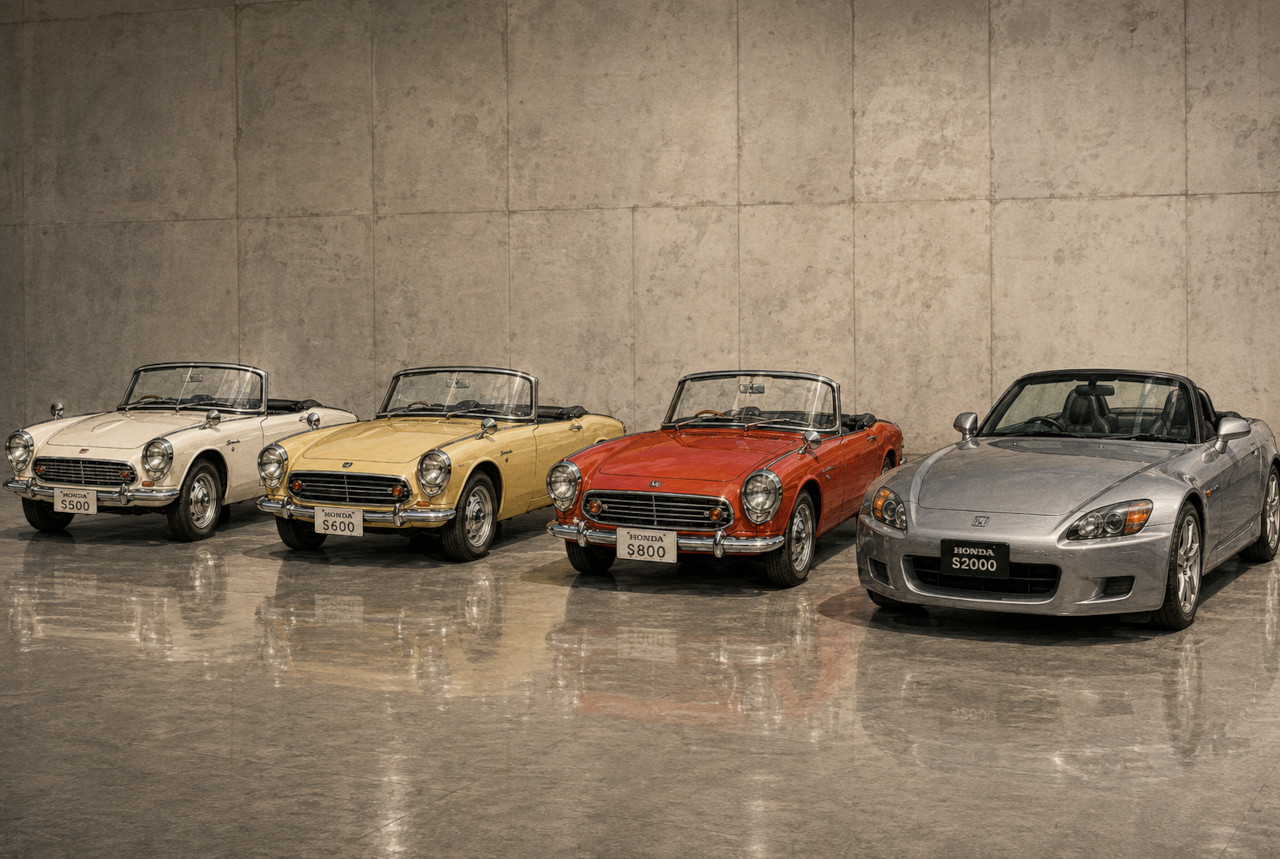 AI-generated timeline-inspired illustration connecting Honda’s original S-series sports cars with the S2000. The vehicles are conceptual representations rather than exact historical reproductions.
Why Honda’s return to RWD matters
The most interesting part of the S2000 story may be the sequence itself.
Honda started with small rear-wheel-drive sports cars.
Then it largely left that layout behind and became extraordinarily successful with front-wheel drive.
That success became so complete that enthusiasts began treating FWD as a defining characteristic of the company.
And then Honda returned to front-engine, rear-wheel-drive sports-car engineering with one of the most uncompromising cars it had ever produced.
Normally, the phrase “return to its roots” suggests nostalgia.
The S2000 was almost the opposite.
There were no deliberately retro headlights, fake 1960s instruments or styling tricks designed to make it look like an S800.
Honda did not reproduce the old car. It reproduced the old idea.
A small open sports car. A high-revving engine. Engineering solutions developed around driving pleasure. And rear-wheel drive because that layout suited the objective.
That is why the S2000 is more interesting than a simple list of specifications suggests.
It shows what Honda abandoned, what Honda mastered in the meantime, and what the company eventually decided was worth picking up again.
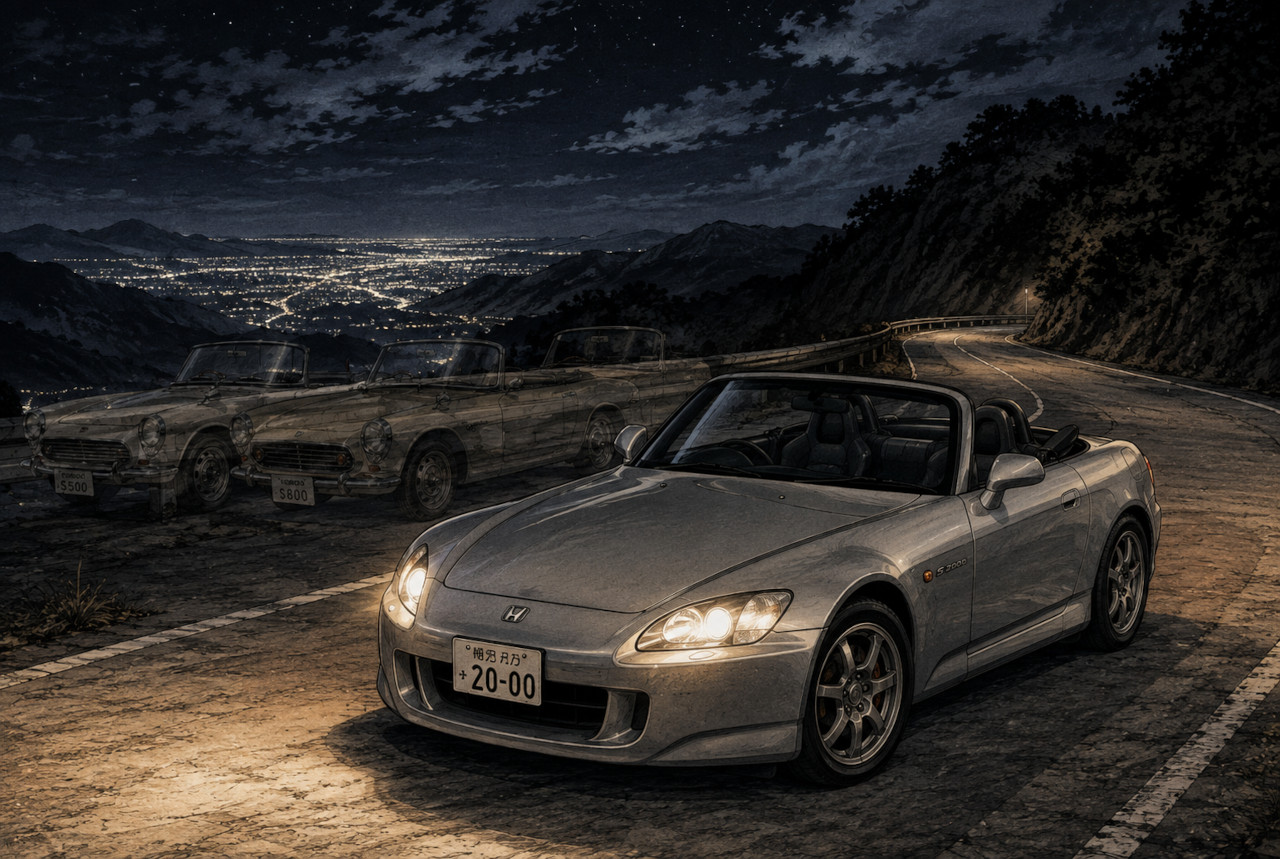 AI-generated illustration symbolizing the S2000 as a modern continuation of Honda’s early S-series philosophy. It is an artistic concept rather than a historical photograph.
Editor’s Note
I would love to see the S2000 turn out not to be the final chapter. Call the next one S3000, S1300 or something completely different — the badge matters less to me than the idea.
If I could choose purely for fun, I would still want something light, naturally aspirated, manual and rear-wheel drive. Today, that combination is increasingly difficult to justify with ordinary business logic. Electrification, safety requirements, emissions rules and development costs all push manufacturers in other directions.
But that is precisely why another Honda like this would be interesting. The S2000 showed that returning to an old philosophy does not have to mean rebuilding an old car. Honda took the spirit of its earliest sports machines and interpreted it with contemporary technology. If Honda ever decides to do that again, I would rather see a new answer than a nostalgic replica.
References
- Honda Global — 60th Anniversary of Honda Sports Cars: The Fundamental Concept Behind the S Series
- Honda Global — 75 Years of Honda History: The Road to Producing Automobiles
- Honda Global — Announcing the Civic: Development of Honda’s Front-Wheel-Drive Compact Car
- Honda Global — Honda Announces the S2000 Prototype
- Honda Global — Development of the F20C 125 PS-per-Liter Engine
- Honda Global — Honda S2000 Production History and Specifications