

Japan’s Showa-era legend: “McDonald’s burgers were made from worms”
Long before social media, one strangely persistent rumor circulated among schoolchildren and teenagers in Japan:
“McDonald’s doesn’t really use beef in its hamburgers. The patties are made from earthworms.”
Depending on where you heard the story, the alleged mystery meat might instead have been rats, cats or some other disturbing substitute. There is no credible evidence that McDonald’s secretly used earthworms as hamburger meat. The story belongs firmly in the world of urban legend.
But the false claim itself may be less interesting than the way it traveled.
In Japan, versions of the rumor became familiar during the later decades of the Showa era — the period that ended in 1989. There was no Twitter, Facebook, YouTube or household internet connection to send a ridiculous claim across the country in a few hours.
And yet remarkably similar stories could be heard from children and teenagers far beyond Tokyo.
So how did a fast-food rumor spread across Japan before anyone could press a “share” button?
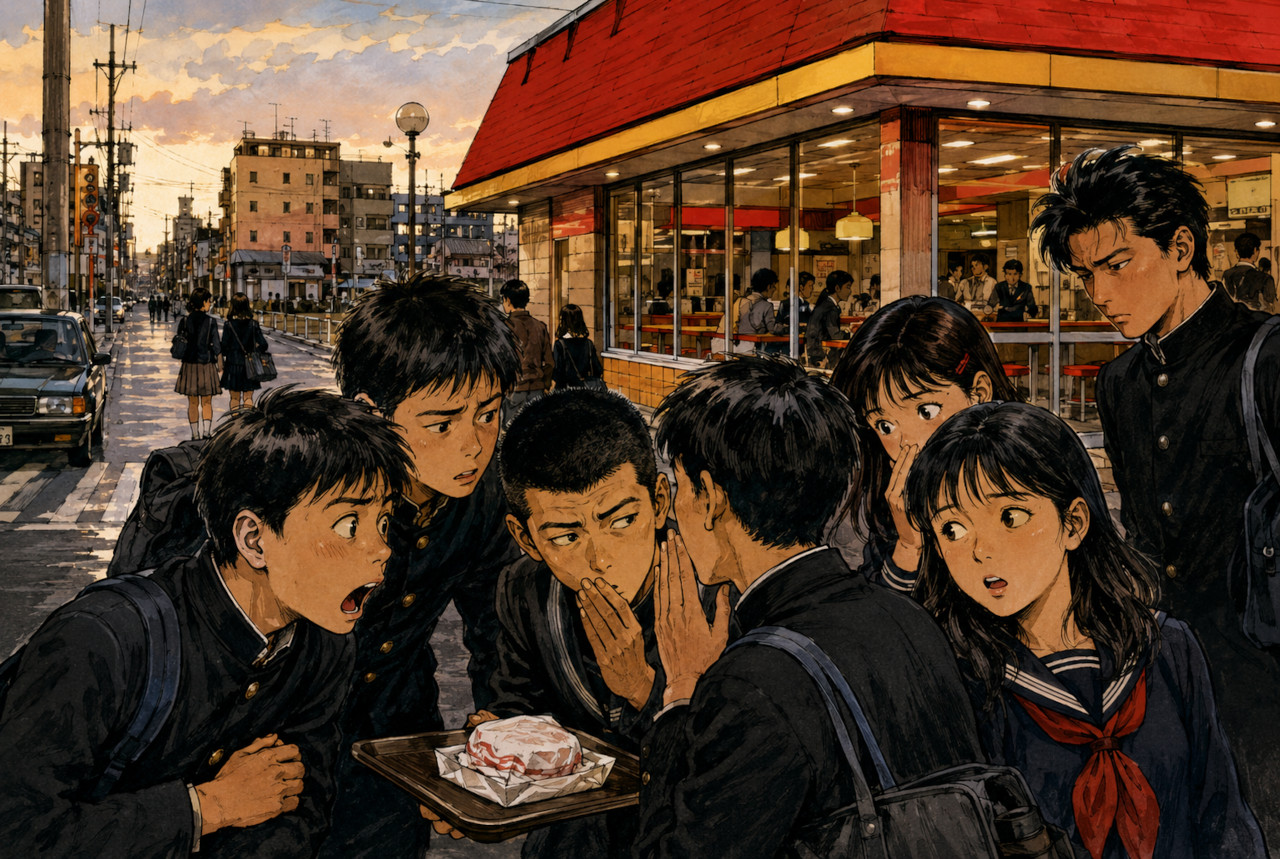 AI-generated illustration inspired by the atmosphere of Japanese fast-food culture in the late Showa era. It does not depict an actual McDonald’s kitchen, restaurant or documented incident.
The worm-burger rumor did not originate in Japan
The trail leads back across the Pacific.
American folklorist Gary Alan Fine studied what he called mercantile legends — stories in which large companies become the targets of rumors about contaminated, deceptive or disturbing products.
His research is particularly useful here because the worm-burger story was not originally attached exclusively to McDonald’s.
The rumor circulated in the United States in the late 1970s and was initially associated with Wendy’s. Over time, however, the story migrated toward McDonald’s.
Why?
Fine argued that dominant corporations act almost like magnets for existing legends. People remember the disturbing claim but may forget exactly which company was supposed to be responsible. When the story is retold, the best-known company in the category can replace the original target.
McDonald’s was the obvious candidate.
In other words, the rumor does not appear to have begun because someone discovered something suspicious at McDonald’s. The disturbing story came first, and the world’s most recognizable hamburger company eventually became attached to it.
This is a useful reminder of how urban legends work. The name of the company can change while the emotional core of the story survives almost untouched.
Why worms?
Of all the possible fake ingredients, why did earthworms become so memorable?
Part of the answer may lie in the anxieties surrounding modern processed food.
A hamburger patty is ground meat. The customer cannot look at it and immediately identify the original cut. Fast-food restaurants also produce enormous quantities of identical food at high speed and relatively low prices.
For consumers encountering this style of eating as something new, that combination creates fertile ground for suspicion:
Cheap. Mass-produced. Ground up. Prepared somewhere out of sight. Sold by an enormous corporation.
That is almost a perfect recipe for a food legend.
McDonald’s entered Japan in 1971, opening its first Japanese restaurant on July 20 on the ground floor of the Ginza Mitsukoshi department store in Tokyo.
During the following decade the chain expanded quickly. For many Japanese consumers, especially children, hamburgers represented a relatively new American-style food culture.
The very things that made fast food exciting also made it mysterious.
Where did all that meat come from? How could so many identical hamburgers be made so quickly? Why were they inexpensive?
Most people did not know how a large restaurant supply chain worked. A grotesque explanation could therefore be more memorable than a boring logistical one.
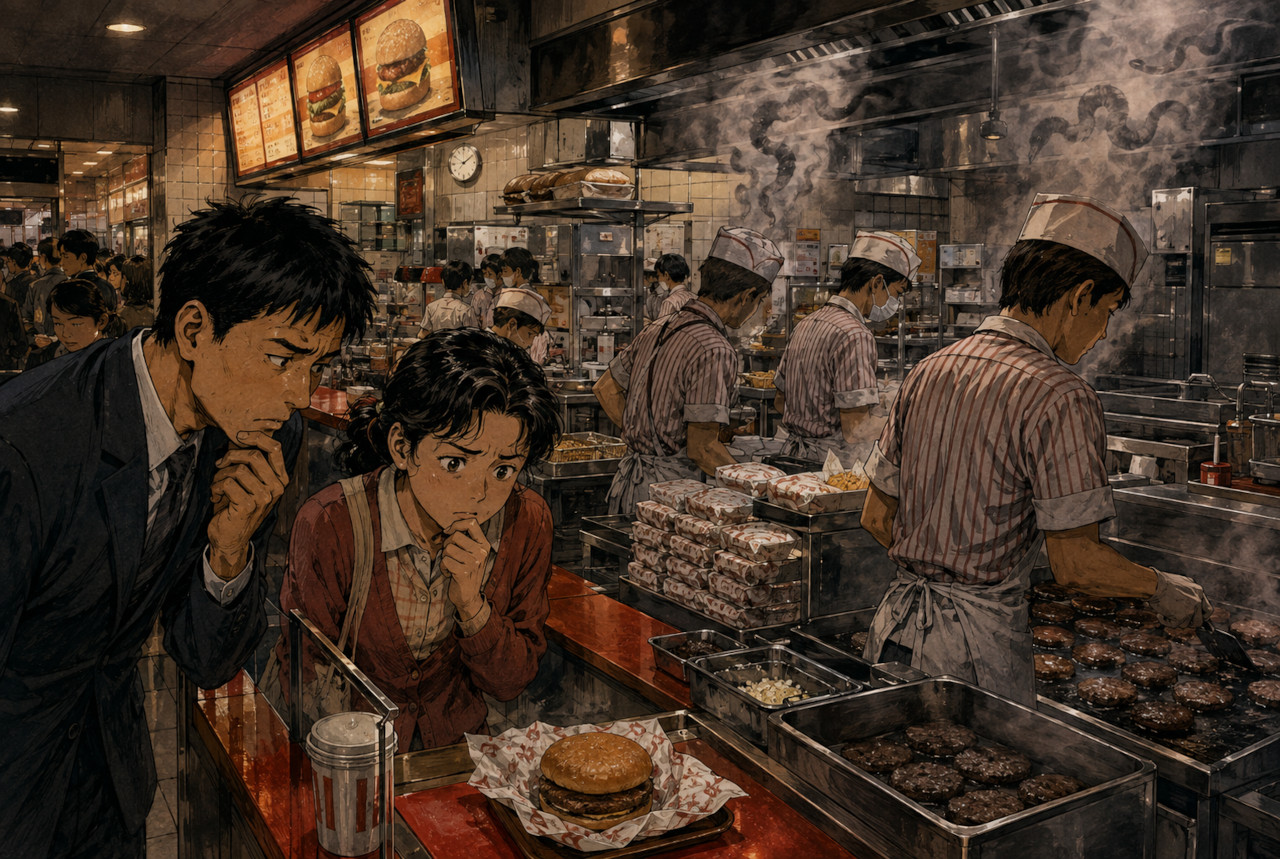 AI-generated conceptual illustration. It represents the cultural atmosphere surrounding the growth of fast food in Japan rather than a documented McDonald’s restaurant or historical event.
How did an American rumor become a Japanese schoolyard story?
This is the part where certainty becomes difficult.
We can trace the American worm-burger legend to the late 1970s, but there is no neat historical record showing the exact moment one person translated the story into Japanese and introduced it to the country.
Rumors rarely leave customs declarations.
What we can observe is that the basic structure survived remarkably well.
By the time versions circulated among Japanese children, they often came with a supposed eyewitness attached:
“My friend’s older brother works at McDonald’s and saw it.”
“Someone I know saw the factory.”
“They talked about it on television.”
Almost nobody telling the story claimed to have personally watched earthworms being turned into hamburger patties.
The witness was usually one step further away.
A friend. A friend’s brother. A cousin. A part-time employee known by someone else.
That distance is extremely useful to an urban legend.
A claim from a complete stranger is easy to dismiss. A claim from your best friend may require proof. But “my friend’s brother saw it himself” sits in a strangely convincing middle ground.
Close enough to feel real.
Far enough away that nobody can actually question the witness.
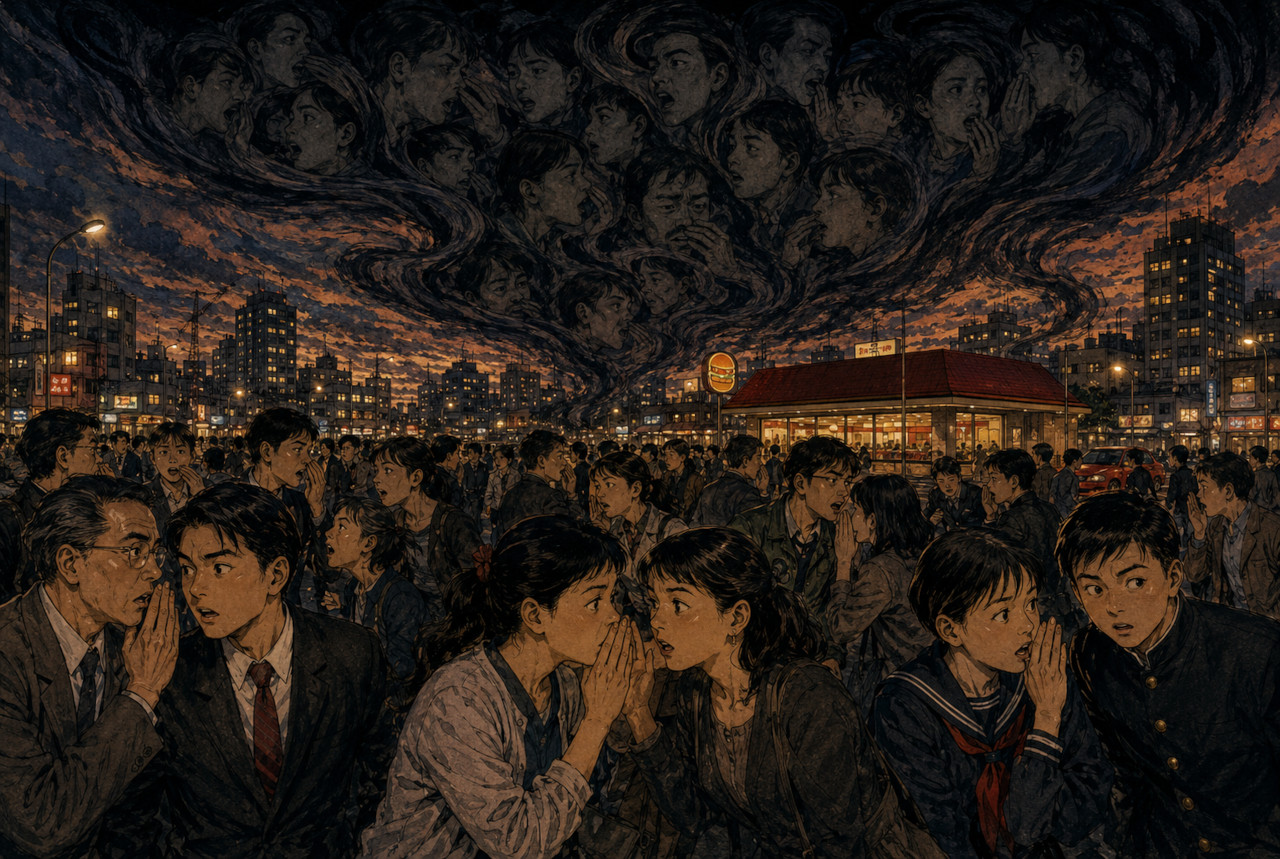 AI-generated illustration representing word-of-mouth rumor transmission among children before the internet era. It does not depict identifiable individuals or an actual documented incident.
Before social media, people themselves were the network
Today, we tend to imagine information spreading through technology.
In the 1980s, the network was human.
Schools connected hundreds of children. Sports clubs connected different age groups. Cram schools brought students from different neighborhoods together. Families traveled. Relatives visited each other. Teenagers worked part-time jobs. People moved between companies and cities.
A rumor did not need to reach millions of people at once.
It only needed to move from one small social group to another, again and again.
The process was slower than social media, but it had one enormous advantage: every transmission came from a real person the listener already knew.
A modern anonymous post might say:
“I heard McDonald’s uses worms.”
An old-school rumor effectively said:
“Someone connected to our group knows this is true.”
That social connection gave weak information an artificial sense of credibility.
Every retelling gave the rumor a free update
There was another important difference between oral rumors and today’s searchable internet.
There was no permanent original version.
Each person could edit the story without leaving an edit history.
A simple claim — “They mix worms into the hamburger meat” — could gradually acquire additional details.
There might be a secret worm farm.
A part-time employee supposedly discovered it.
The company allegedly paid someone to remain silent.
Someone supposedly challenged a restaurant employee by asking for a “worm burger” and was immediately taken into the back room.
The stranger the story became, the more memorable it could become.
An urban legend transmitted by word of mouth is not a file being copied. It is a story being rewritten every time someone tells it.
Details that make the story more disgusting, frightening or entertaining have a better chance of surviving the next retelling.
“I saw it on TV” was remarkably difficult to fact-check
Another classic feature of Japanese rumors from the pre-internet era was the phrase:
“They showed it on television.”
Today, such a claim can often be checked within minutes. Search the program name, look for an archived clip, find contemporary reporting or check a fact-checking site.
That was far more difficult in the Showa era.
If a classmate told you on Monday that some television program had exposed McDonald’s on Saturday night, what exactly could an ordinary child do?
There was no search box.
No streaming archive.
No social-media discussion from viewers who had watched the broadcast.
Unless someone happened to have recorded the program on videotape or was willing to search newspaper and television listings, the claim was difficult to verify.
Having less information did not necessarily protect people from misinformation. It also meant having fewer convenient tools for disproving it.
McDonald’s was an ideal target precisely because everyone knew the name
This connects remarkably well with Fine’s “Goliath Effect.”
For an urban legend to travel widely, the audience needs to understand the setting immediately.
If the story names a tiny restaurant that exists in only one American town, it becomes less useful when repeated in another country.
McDonald’s has the opposite property.
Its name requires almost no explanation.
Once McDonald’s expanded throughout Japan, a child in Tokyo and a child hundreds of kilometers away could hear essentially the same story and instantly understand the setting.
The corporation’s enormous visibility helped the rumor survive.
That creates a strange paradox:
The more famous and standardized a company becomes, the easier it can be to attach the same standardized rumor to it.
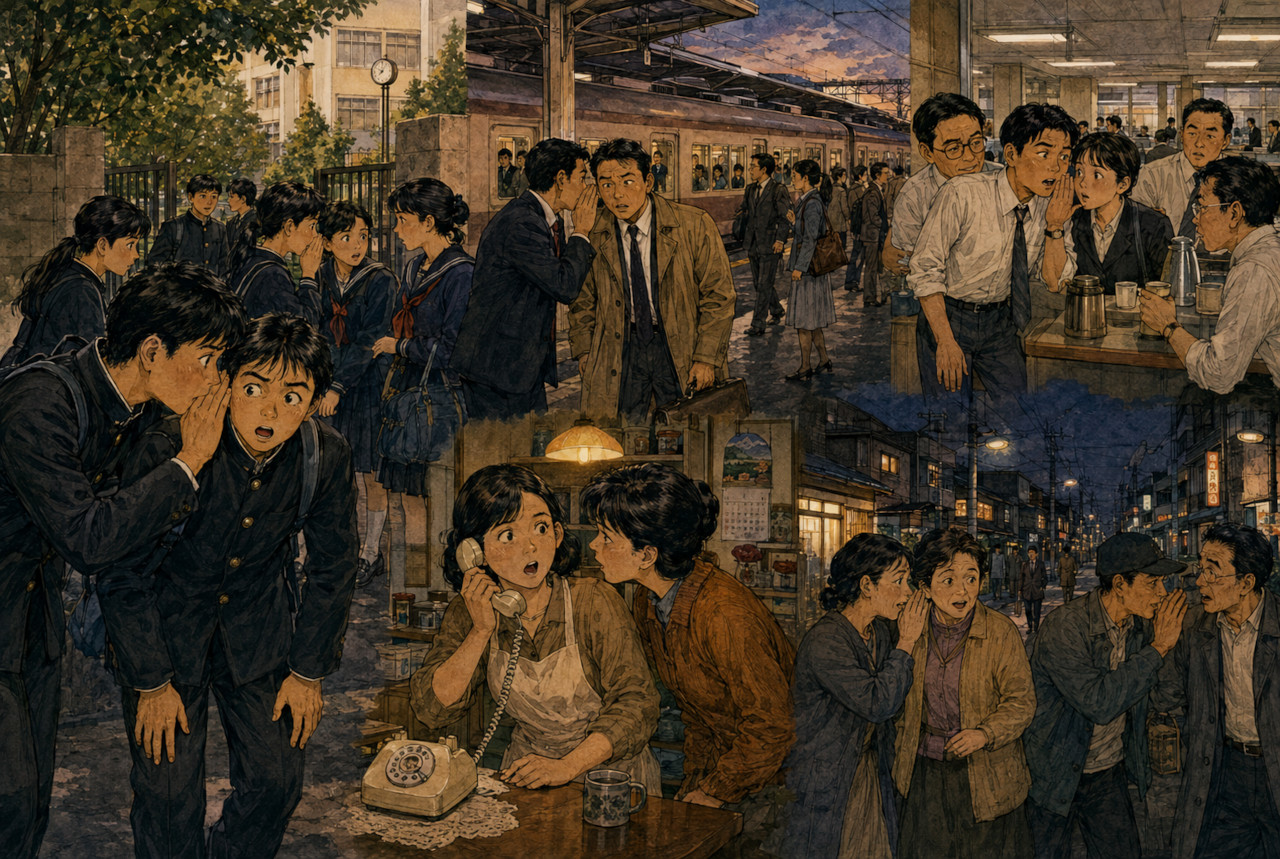 AI-generated conceptual illustration showing rumor transmission across pre-internet Japan. It does not represent a measured historical transmission route or documented map of individual cases.
There is still no evidence that the burgers were made from worms
The important factual point should not get lost in the folklore.
There is no credible evidence that McDonald’s secretly replaced beef with earthworms in its hamburger patties.
McDonald’s denied the rumor when it circulated in the United States, and contemporary reporting described the claim as an unsubstantiated rumor. The company today states that its U.S. burger patties are made from 100% beef without fillers or additives.
The economics behind the story were also questionable from the beginning. Contemporary discussions of the rumor pointed out the absurdity of using commercially supplied earthworms as a cheap substitute for hamburger meat when the worms themselves could cost considerably more.
So as an investigation into hamburger ingredients, the story ends rather quickly.
As an investigation into human behavior, however, it becomes much more interesting.
The real subject of the worm-burger legend was not worms
The McDonald’s worm-burger rumor existed before Facebook, X, TikTok, YouTube and the World Wide Web.
Yet it had many of the features we now associate with viral misinformation.
It had an emotional hook.
It targeted a famous organization.
It relied on supposedly trustworthy secondhand witnesses.
It became more dramatic as people repeated it.
And attempts to verify it were much less exciting than the accusation itself.
Social media did not invent those mechanisms.
It industrialized them.
The technology changed the speed and scale of rumor transmission. The human instinct that powers it was already there.
That may explain why this ridiculous story could cross borders, change corporate targets, survive translation and eventually become part of childhood folklore in Japan.
The worms were imaginary.
The communication network was not.
It was us.
Editor’s Note
I remember hearing my own elaborate version of this story when I was in elementary school in Japan. According to the version passed around among children, someone’s relative had walked into McDonald’s and jokingly asked for a “worm burger.” The staff supposedly took him into the back room and gave him ten hamburgers as hush money.
As a child, I heard that story as if it were completely plausible. I went home and told my parents. Their response was essentially: “That’s ridiculous.” End of investigation.
Looking back, that wonderfully unsophisticated answer was probably the most accurate fact-check available to me. What fascinates me now is how polished the story already was. It had an eyewitness, a secret, corporate intimidation and even hush money. Nobody needed an algorithm to make it viral. Kids could do the job perfectly well on their own.
References
- Gary Alan Fine — “The Goliath Effect: Corporate Dominance and Mercantile Legends,” Journal of American Folklore, Vol. 98, No. 387 (1985) — Academic analysis of corporate urban legends, including the movement of the worm-burger rumor from Wendy’s toward McDonald’s.
- The Christian Science Monitor — “Rumors: Business Works Hard Trying to Set the Public Straight” (May 25, 1982) — Contemporary discussion of the 1978 worm-hamburger rumor and how rumors shifted between fast-food companies.
- McDonald’s Holdings Japan — Corporate History — Official history confirming the opening of Japan’s first McDonald’s restaurant in Ginza, Tokyo, on July 20, 1971.
- McDonald’s USA — “What Kind of Beef Does McDonald’s Use in Your Burgers?” — Current official information stating that McDonald’s U.S. hamburger patties are made from 100% beef without fillers, additives or preservatives.