

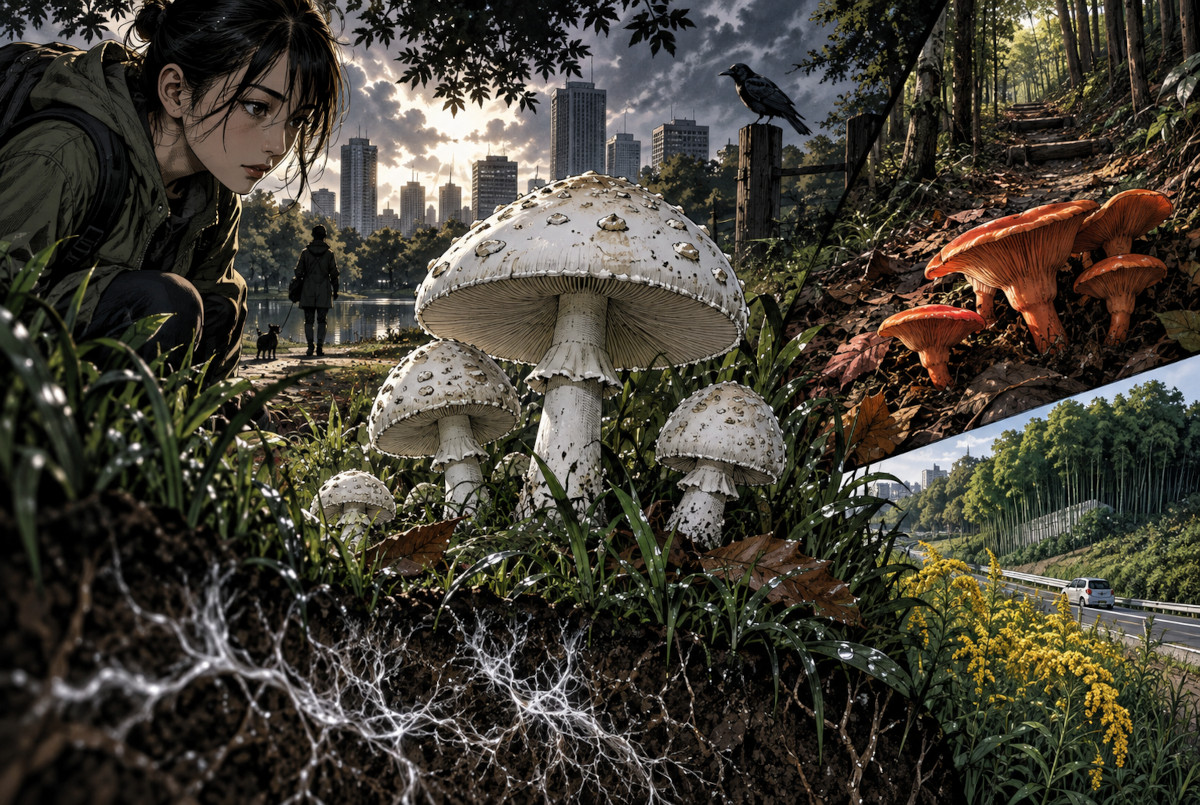
Large white mushrooms suddenly covering a public lawn may sound like something from a remote forest. But in September 2026, clusters of toxic Chlorophyllum molybdites were found in an ordinary public park in Okazaki, Aichi Prefecture, central Japan. Some of the mushrooms reportedly reached around 15 centimeters across.
This was not a wilderness area. It was the kind of urban green space where children play, people walk their dogs, and families spend their weekends.
City authorities removed the mushrooms after they were discovered. Eating Chlorophyllum molybdites can cause severe gastrointestinal symptoms including vomiting, abdominal pain, and diarrhea. Japan has also recorded previous food-poisoning cases in which people collected the mushroom from public green spaces and were hospitalized after eating it.
The worrying part is not simply that a toxic mushroom appeared in a park. It is that a species associated with tropical and subtropical climates is now becoming increasingly familiar in the lawns and grassy areas of Japanese cities.
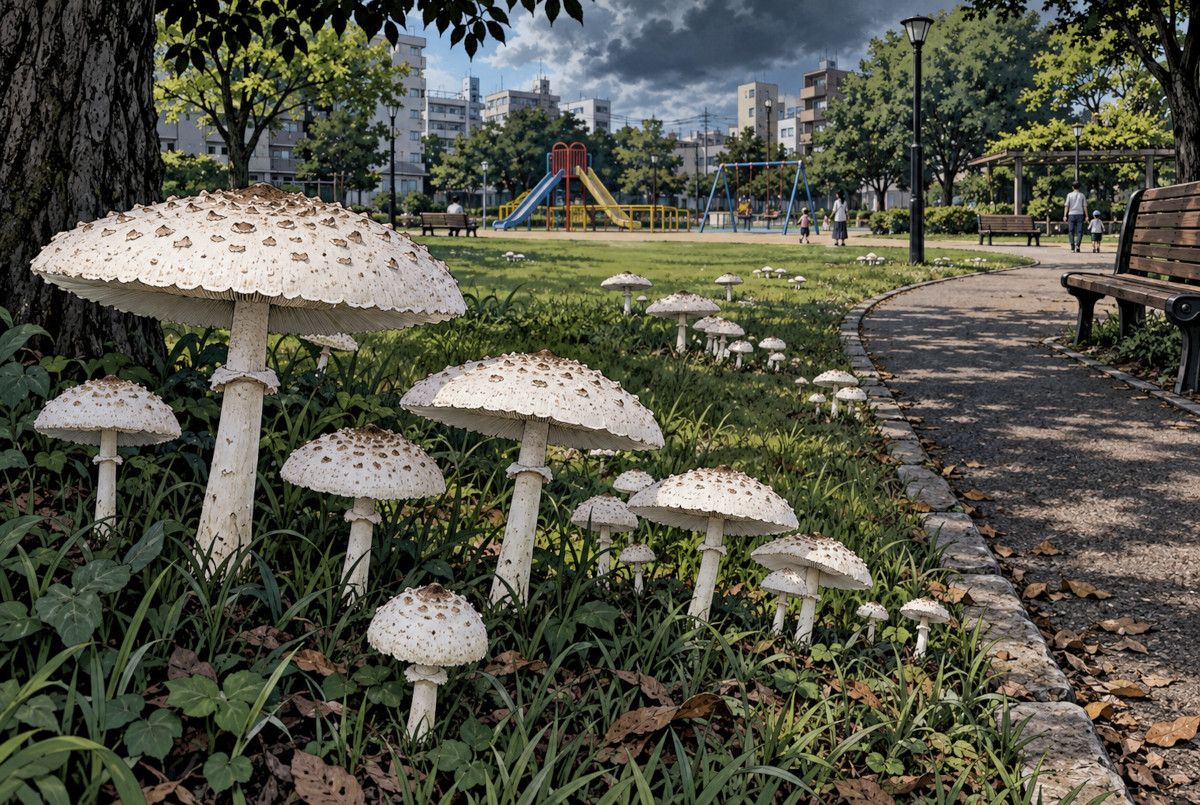 AI-generated illustration. This is not a photograph of the actual mushrooms and should not be used for species identification.
A Mushroom That Originally Favored Warmer Climates
Chlorophyllum molybdites, known in Japan as Ooshiro-karakasatake, is widely distributed in tropical and subtropical regions. Japan’s Forestry and Forest Products Research Institute notes that the species was first reported in Japan in 1954.
In other words, it is not something that suddenly appeared in Japan this year. What has changed is how commonly it is now being seen.
According to the research institute, the mushroom has become relatively common in areas from the Kanto region westward in recent years. Tokyo’s public health authorities also note that it is now frequently seen in lawns, roadside grass, and other urban green spaces, and point to climate warming as one factor behind its growing presence.
Climate change did not suddenly create these mushrooms in 2026. A better way to understand the trend is that areas suitable for a warmth-loving species have gradually expanded over time.
This also helps explain why long-time residents sometimes say, “I have lived here for decades and never saw anything like this before.” The species may have existed in Japan for years, while the environmental conditions that favor it have slowly become more common.
Rain May Act as the Trigger That Makes Them Suddenly Visible
Why, then, can dozens of mushrooms appear almost overnight?
Experts commenting on the 2026 outbreak in Okazaki pointed to a combination of high temperatures, repeated rainfall, lawns, and nutrient-rich soil. Similar outbreaks were also reported in parks in Osaka, where warm conditions and high rainfall were discussed as possible factors behind the unusually visible growth.
There is an important biological point here. What we casually call a “mushroom” is not the entire organism.
The main body of a fungus exists as a network of thread-like structures called mycelium, usually hidden in soil or organic material. When temperature, moisture, and other conditions become favorable, the fungus produces the visible reproductive structure known as the fruiting body.
That means a lawn can look completely normal one day and produce ten, twenty, or more mushrooms shortly after a period of rain.
A sudden mass appearance does not necessarily mean the fungus suddenly invaded the area that week. The mycelium may already have been present underground, waiting for the right combination of warmth and moisture.
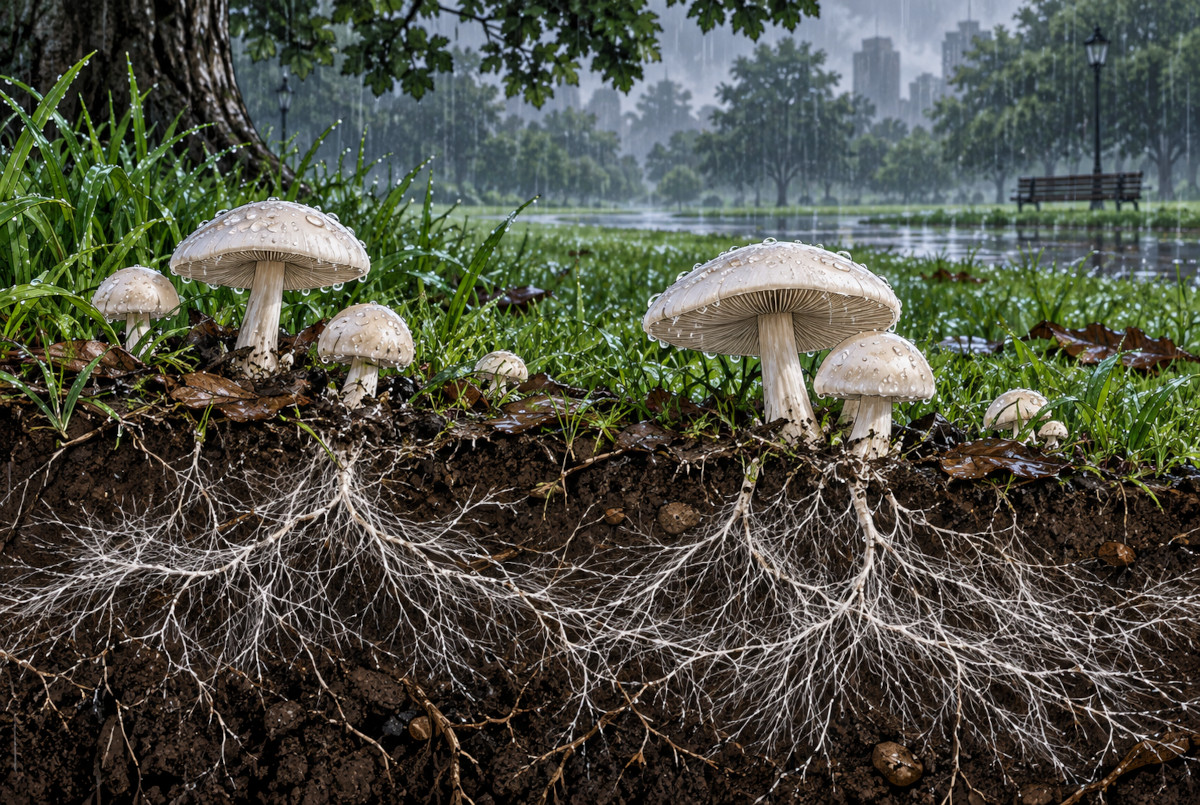 AI-generated concept illustration. It visualizes the relationship between underground mycelium and visible mushrooms and does not reproduce the underground structure of a specific location.
Urban Parks May Be Better Habitats Than They Look
When people hear the words “toxic mushroom,” they may imagine a damp mountain forest far from human activity. Chlorophyllum molybdites is different. It is often found in lawns, parks, gardens, roadsides, and other places close to everyday human life.
The Forestry and Forest Products Research Institute explains that the species feeds on organic matter in soil and commonly appears in lawns and grasslands. Parks and landscaped areas can contain decaying grass, fallen leaves, compost, or fertilizer—all potential sources of organic material.
A neatly maintained public lawn may therefore be comfortable for people while also providing suitable conditions for certain fungi.
The mushroom has not “come down from the mountains.” In some cases, human-made urban green spaces themselves provide the kind of habitat in which it can thrive.
Another Dangerous Fungus Is Also Being Watched Near Human Activity
Japan has another fungus that receives far more serious warnings: Kaentake (Podostroma cornu-damae), sometimes translated as the “fire coral fungus.”
It has an unmistakable appearance, with red to orange finger-like growths rising from the ground. It is highly toxic, and Japanese government agencies advise people not to collect it or handle it with bare hands.
Kaentake has often been reported in broadleaf forests affected by a phenomenon known in Japan as nara wilt, a large-scale decline of oak-family trees caused by a combination of wood-boring beetles and pathogenic fungi.
Japan’s Ministry of Land, Infrastructure, Transport and Tourism has warned that Kaentake may appear in areas where nara wilt has caused large numbers of trees to die.
However, this relationship should not be oversimplified. The Forestry and Forest Products Research Institute states that there is still not enough evidence to claim a direct cause-and-effect relationship between nara wilt and Kaentake outbreaks.
One possibility is that large-scale tree death changes the fungal community in the forest, creating conditions in which certain species become more visible.
Its ecology is different from that of Chlorophyllum molybdites, but the message is similar: a familiar green space is not automatically free of hazardous fungi.
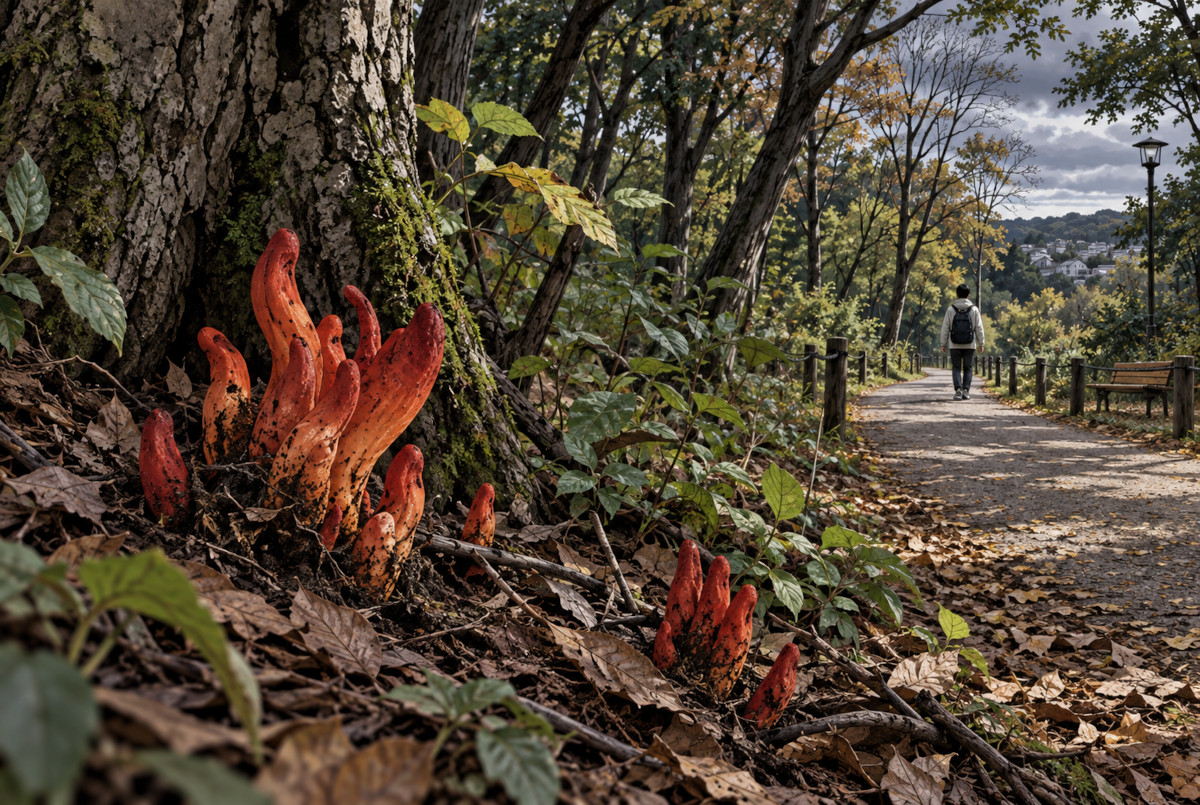 AI-generated illustration. The appearance of Kaentake varies, and this image should not be used to identify mushrooms in the field.
The Landscape Is Changing in More Ways Than One
Mushrooms are only one part of the story. The plants seen along Japanese roadsides, rivers, parks, and vacant lots are also changing.
One example is Nagami-hinageshi (Papaver dubium), an orange-flowered poppy native to the Mediterranean region. It now appears widely along roads, in vacant lots, and around developed areas in Japan. The plant produces large numbers of seeds, allowing it to spread rapidly.
Some Japanese municipalities also advise caution when handling the plant because sap from damaged stems or leaves contains alkaloids and may irritate the skin of sensitive individuals.
Another familiar-looking species is Oookinkeigiku (Coreopsis lanceolata), a bright yellow flower once planted in Japan for landscaping and erosion control. It spread so aggressively that it is now designated as an Invasive Alien Species under Japanese law. Cultivation, transport, and distribution are restricted.
Japanese waterways face their own invasive plant problems, including species such as alligator weed, water lettuce, and giant water primrose. These plants can affect native ecosystems, agriculture, drainage systems, and water management.
But it would be misleading to blame all of these changes on climate warming.
Some species were introduced through gardening. Others spread through landscaping, transportation, trade, agriculture, or accidental movement by humans. Changes in land management can also help certain species expand.
Climate change is not the only driver. A combination of warming, human movement, urbanization, land-use change, and declining maintenance is gradually changing which organisms can survive and spread in Japan.
Even Japan’s Bamboo Landscape Could Move North
A striking example comes from research into bamboo.
Japan’s National Institute for Environmental Studies and collaborating researchers modeled the future distribution of two common bamboo groups, including moso bamboo and madake bamboo.
Under stronger warming scenarios, suitable habitat could expand significantly northward. In one projection, areas climatically suitable for bamboo could shift by as much as roughly 500 kilometers and reach close to Wakkanai, the northernmost city in Hokkaido, by the end of this century.
Bamboo is not poisonous. The issue is ecological and practical.
Abandoned bamboo groves can spread into surrounding woodland, shade out other vegetation, and make satoyama landscapes more difficult to manage. “Satoyama” is a Japanese term for traditionally managed rural landscapes where forests, farmland, villages, and grasslands exist side by side.
Toxic mushrooms, invasive plants, and expanding bamboo groves may seem like separate issues. But they have something in common.
Organisms that once seemed unusual in a particular region can gradually become part of the ordinary landscape.
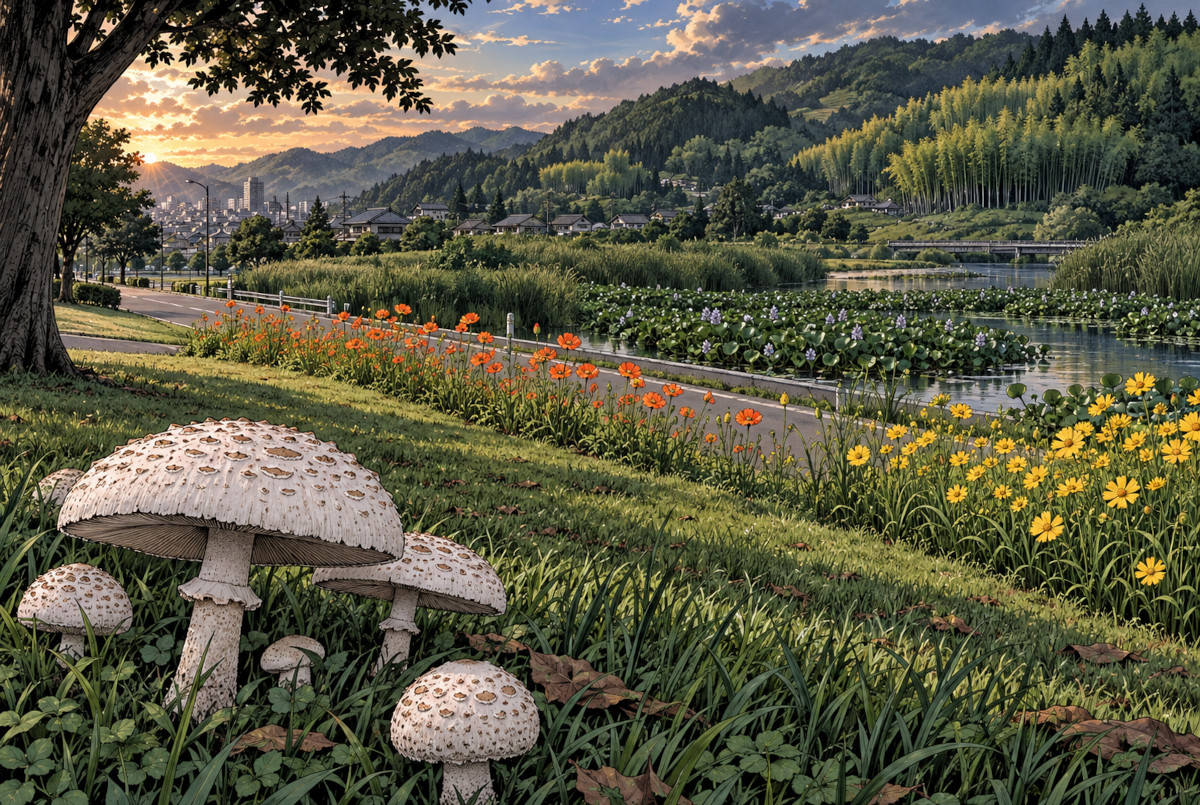 AI-generated concept illustration. Several environmental changes are combined symbolically in one scene and do not represent a single real-world location.
The Most Unsettling Change May Be When the Unusual Stops Looking Unusual
It would be easy to dismiss the Okazaki outbreak as a simple case of “a rainy year producing lots of mushrooms.” That explanation is not entirely wrong, but it misses the larger picture.
Chlorophyllum molybdites was already recorded in Japan in 1954. Decades later, it is becoming increasingly familiar in urban parks across much of the country’s warmer regions. Add prolonged heat and heavy rainfall, and the hidden fungus can suddenly become impossible to ignore.
The unsettling part is not that one toxic mushroom appeared. It is that something people once considered unusual may eventually become so common that nobody notices it anymore.
Japan’s natural environment is not changing in one dramatic moment. It is changing quietly—in roadside flowers, public lawns, riverbanks, woodland paths, and the edges of suburban neighborhoods.
Editor’s Note
Mushrooms are strange things when you do not know exactly what you are looking at. They appear overnight, some look harmless, and a few can make you seriously ill. What bothers me most is not finding one deep in the mountains. It is finding them somewhere a child could reach without even leaving the neighborhood. Maybe the creepiest environmental changes are not the dramatic ones. They are the ones that quietly become normal.
References
- Forestry and Forest Products Research Institute — “Tropical Mushrooms Expanding Their Range in Japan” — Background on Chlorophyllum molybdites, its 1954 first report in Japan, recent range expansion, and its occurrence in lawns and grasslands.
- Tokyo Metropolitan Government — Chlorophyllum molybdites — Information on habitat, food-poisoning symptoms, and the increasing frequency of sightings in Tokyo.
- Nagoya TV / Me-Tele News — Toxic Mushrooms Found in Large Numbers in an Okazaki Park — Coverage of the September 2026 outbreak in Okazaki, city removal efforts, and expert comments on weather and habitat conditions.
- Kansai TV — Large Numbers of Chlorophyllum molybdites Reported in Osaka Parks — Coverage of 2026 outbreaks in Osaka and discussion of rainfall and warm weather conditions.
- Ministry of Land, Infrastructure, Transport and Tourism — Nara Wilt Damage and Countermeasures in the Rokko Mountains — Public warning regarding Kaentake in areas affected by nara wilt.
- Forestry and Forest Products Research Institute — Q&A on Nara Wilt and Broadleaf Forest Management — Discussion of the limited evidence for a direct causal relationship between nara wilt and Kaentake outbreaks.
- Kawagoe City — Guidance on Nagami-hinageshi — Information on the plant’s spread, reproduction, and handling precautions.
- Ministry of the Environment, Kanto Regional Environment Office — Oookinkeigiku — Information on its designation as an Invasive Alien Species and related restrictions.
- Ministry of the Environment — List of Invasive Alien Species in Japan — Includes invasive aquatic plants such as alligator weed, water lettuce, and giant water primrose.
- National Institute for Environmental Studies — Bamboo May Expand Northward in Japan Under Climate Change — Research on the projected northward expansion of suitable habitat for moso and madake bamboo.