

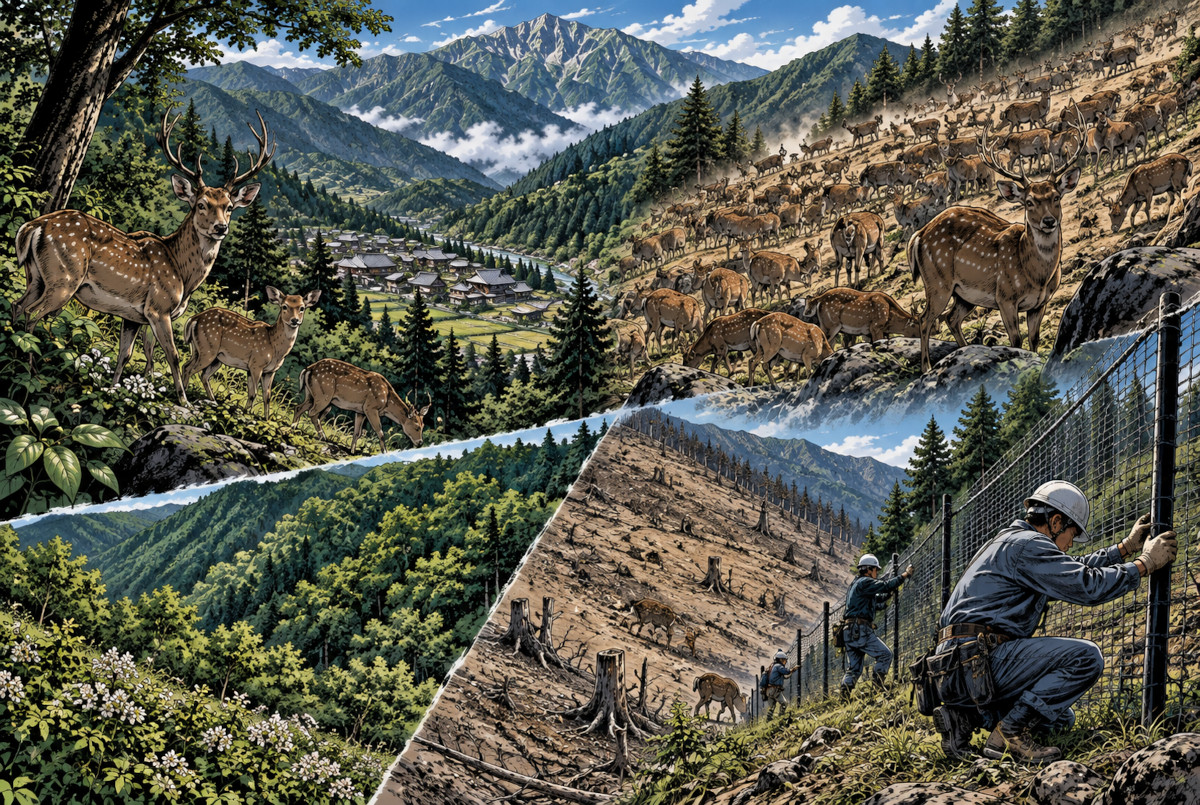
A dark mass seemed to move across a mountainside in Nagano Prefecture. Look more closely, and the “moving ground” turned out to be sika deer. In August 2026, a helicopter crew spotted and filmed hundreds of deer gathered on a slope near the border between Oshika Village and Ina City in Japan’s Southern Alps.
For Japanese readers, the location makes the story sound almost like a joke. The village name is written 大鹿, two characters that can literally be understood as “big deer.” So the obvious reaction is: “Well, of course there are deer in a place called Oshika.” But the history is more interesting than that. The connection between Oshika Village and deer is real, but not in the simple way the name suggests.
Oshika Village was not named after a giant deer
Oshika Village first came into being in 1874 when two older settlements, Ogawara and Kashio, were merged. They were separated again in 1882 and then reunited in 1889, forming the municipality that continues today.
The name “Oshika” was created from the written characters of the two older place names: the character 大 from Ogawara and 鹿 from Kashio. Put together, they form 大鹿, read “Oshika.” In other words, the village was not officially named because an unusually large deer once lived there.
The more intriguing part is Kashio. The place name is much older than modern Oshika Village and appears in historical records dating back to Japan’s medieval period. The district is also known for Kashio Onsen, where naturally saline spring water emerges from the mountains.
Local tradition links deer to that spring. One legend says people discovered the salt content after noticing deer repeatedly licking or drinking from the water. Another local explanation associates the name Kashio with both the presence of wild deer and the unusual salty spring. These stories do not prove a single definitive etymology, but they do show something important: deer have been part of the landscape, folklore, and identity of this area for centuries.
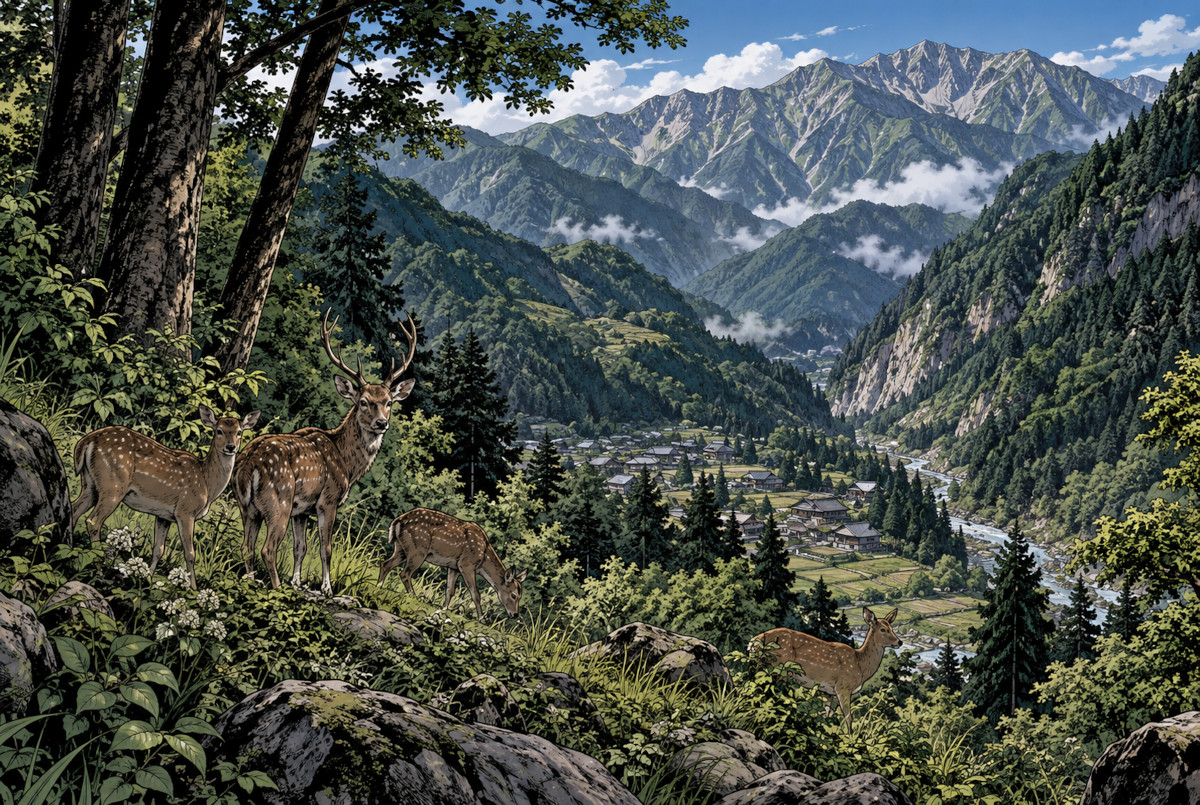 AI-generated illustration inspired by the landscape around Oshika Village and its long relationship with sika deer. It does not reproduce a specific real-world location.
But hundreds of deer in one place is not an everyday sight
On August 1, 2026, a helicopter transporting supplies spotted a huge concentration of sika deer on a slope at an elevation of roughly 1,900 meters near the north side of Futagoyama, close to the boundary between Oshika Village and Ina City.
News reports described the herd as numbering in the hundreds. An official involved in nature conservation also commented that the number was far beyond what had been expected.
This distinction matters. Deer are common in and around Oshika Village, but that does not mean residents normally see several hundred animals standing together on a single mountainside. The footage was striking because it made something that usually remains scattered across vast forests suddenly visible. It offered a rare visual glimpse of just how dense the deer population has become in parts of the Southern Alps.
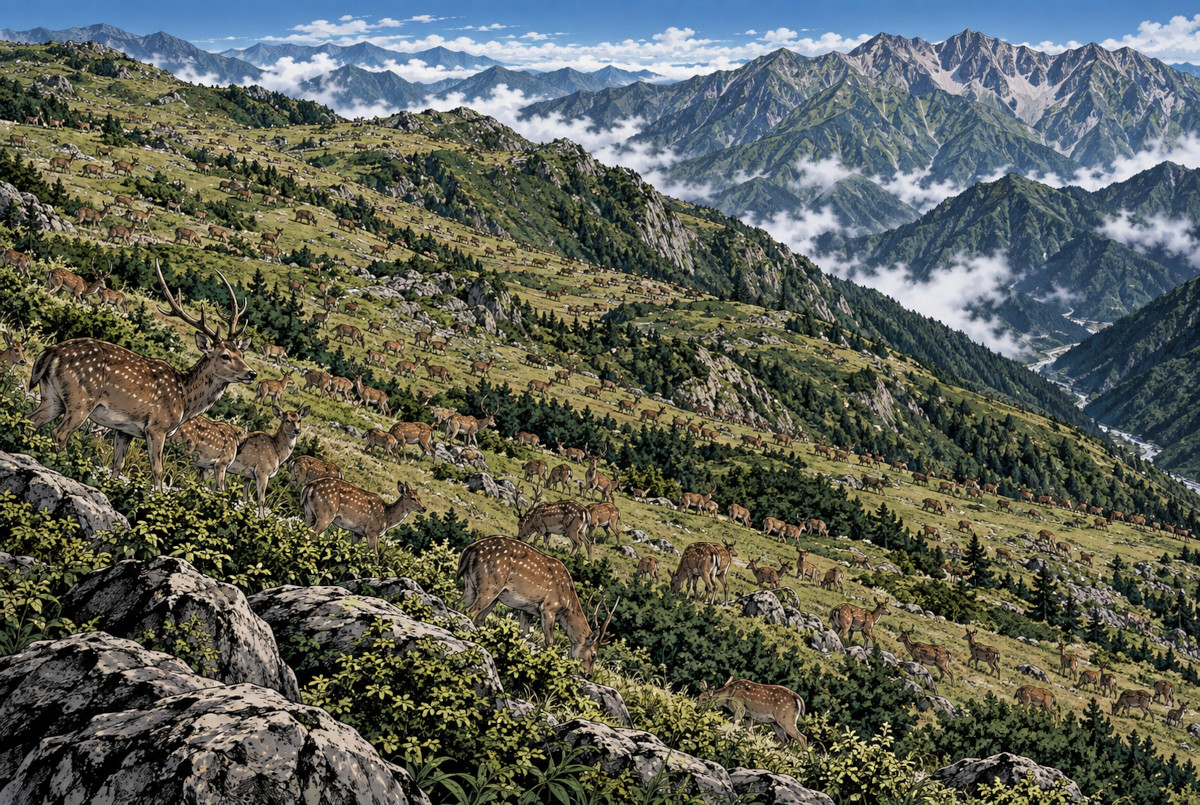 AI-generated illustration based on reports of the large deer herd seen near the Oshika Village–Ina City border in August 2026. It is not a reconstruction of the original news footage.
An estimated 50,000 deer in the Southern Alps management area
The numbers put the aerial footage into perspective. According to Nagano Prefecture’s Sixth Sika Deer Management Plan, the median estimate for the prefecture’s deer population at the end of fiscal 2024 was 221,230 animals. Because wildlife population estimates always contain uncertainty, the prefecture gives a broader estimated range of roughly 149,000 to 337,000.
Within the Southern Alps management unit, the median estimate was 50,392 deer, with an estimated average density of 21.12 animals per square kilometer.
This does not mean 50,000 deer live inside Oshika Village itself. The figure covers a much larger management area across the Southern Alps. Even so, it shows that the mountains surrounding Oshika are part of one of Nagano’s major high-density deer regions.
The longer-term trend is just as important. Nagano Prefecture’s median estimate rose from roughly 150,000 deer at the end of fiscal 2016 to more than 220,000 at the end of fiscal 2024. That represents an increase of around 70,000 animals in eight years.
When deer become too numerous, the mountain itself begins to change
When most people think about deer damage in Japan, they picture animals wandering onto roads or eating vegetables and crops. Those problems are real, but the ecological effects in the Southern Alps run much deeper.
Sika deer feed on alpine plants, grasses, young trees, leaves, shoots, and even bark. At low densities, that is simply part of a natural ecosystem. At high densities, however, repeated feeding and trampling can alter the vegetation itself.
Japan’s Ministry of the Environment has documented areas around Mt. Shiomi where alpine flower meadows were severely reduced by deer grazing and trampling. In some places, vegetation disappeared to the point that bare soil and exposed mountain surfaces remained.
That matters for more than scenery. Once ground-covering plants and their roots disappear, soil becomes more vulnerable to erosion. Recovery is also slow in harsh alpine environments, where the growing season is short. Changes in vegetation can then affect insects, birds, and other species that depend on those plants.
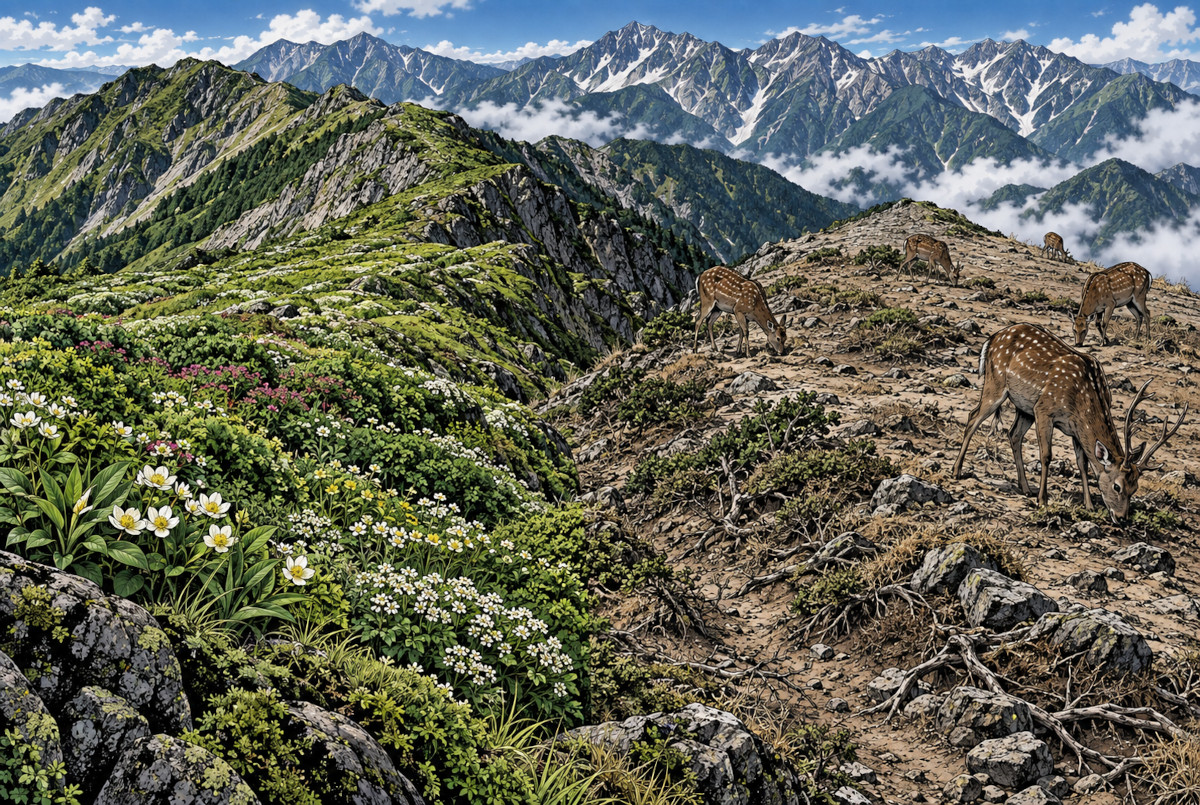 AI-generated conceptual illustration showing how heavy deer grazing and trampling can change alpine vegetation. This is not a before-and-after photograph of the same real location.
Even removing 9,000 deer a year does not end the problem
Nagano Prefecture has set an annual removal target of 9,000 deer for the Southern Alps management unit alone. Across the prefecture, the current management target is 40,000 animals per year. In fiscal 2024, a total of 33,435 deer were actually captured.
Even that is not necessarily enough to reverse the trend everywhere. Prefectural modeling indicates that if current removal levels simply continue, deer numbers may still increase in some regions. More strikingly, the prefecture estimates that roughly 50,000 deer would need to be removed annually to place the overall population on a clear downward trajectory. The official target remains 40,000, taking into account practical limits such as manpower and capture capacity.
There is no single reason deer have increased. Government studies point to a combination of factors: reduced snow depth in some areas, changes in vegetation and food availability, abandoned farmland, declining rural populations, and fewer active hunters.
Japan’s sika deer are also highly adaptable animals with strong reproductive potential. When winter mortality falls, human activity retreats from mountain areas, and hunting pressure decreases, conditions can become unusually favorable for population growth.
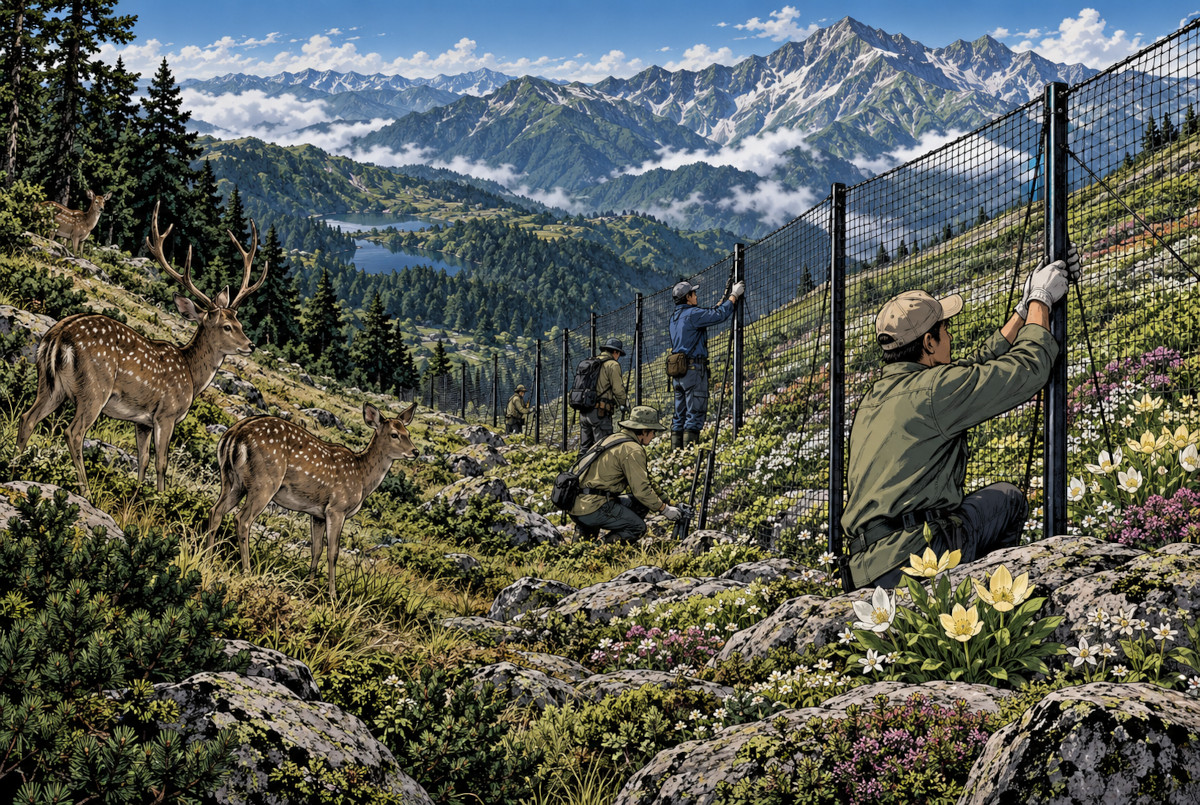 AI-generated illustration inspired by deer-exclusion fencing and vegetation protection measures used in Japan’s Southern Alps. It does not depict a specific real work site.
The joke about “Oshika means big deer” stops being funny
The modern name Oshika was not created because the area was overrun by giant deer. It was formed from the names of two older villages. Yet one of those older place names, Kashio, has long-standing traditions connecting wild deer with the local landscape and its saline springs.
Today, however, the scale is different. The Southern Alps management unit is estimated to contain around 50,000 sika deer. In remote mountain areas, people now build deer-exclusion fences around alpine vegetation, conduct large-scale population control, and take measures to reduce soil erosion where vegetation has disappeared.
A mountain with deer is not the same thing as a mountain with too many deer. The hundreds of animals seen from the helicopter looked unsettling not because deer are inherently frightening, but because the image exposed a change that normally happens far from human eyes.
Nothing suddenly appeared on that mountainside in August 2026. The animals were already there. The more disturbing possibility is that the ecological shift had been progressing quietly for years, and a helicopter simply happened to reveal it all at once.
Editor’s Note
When I first heard that hundreds of deer had been seen near Oshika Village, my first reaction was embarrassingly simple: “Well, it’s called Oshika — basically ‘big deer.’ What did we expect?” But the more I looked into it, the less funny that became.
There is a huge difference between a mountain where deer have always lived and a mountain where humans have to remove thousands of them every year just to keep the ecosystem from drifting further out of balance. Most of us never see this happening because it takes place deep in the mountains, far from ordinary daily life.
That is what stayed with me about the footage. It was not a video of deer suddenly appearing. It was a moment when something that had been changing quietly for years became visible. Deer are beautiful animals. They belong in these mountains. But even a native animal can become destructive when the balance shifts too far. Nature is not simply “wild animals plus forests.” It is a system held together by numbers, relationships, and limits — and those limits are easier to break than they look.
References
- Oshika Village — History of Oshika Village — Official chronology covering the merger, separation, and reunification of Ogawara and Kashio.
- Oshika Village — Kashio Onsen and Koshibu Onsen — Official information on Kashio’s saline spring and local legends connecting the spring with deer.
- Nihon Rekishi Chimei Taikei — Kashio Village — Historical place-name reference noting “Ogawara Kashio” in the 1186 entry of the Azuma Kagami.
- Nagano Prefecture — Sixth Sika Deer Management Plan — Population estimates, management-unit density figures, capture results, and annual removal targets.
- Ministry of the Environment — Conservation Measures in Minami Alps National Park — Deer-exclusion fencing, population control, and measures to reduce soil loss in damaged alpine areas.
- Ministry of the Environment, Kanto Regional Environment Office — Alpine Plant Protection Work on Mt. Shiomi — Field report on vegetation loss caused by sika deer grazing and trampling.
- Ministry of the Environment — Factors Behind the Increase in Sika Deer — Background material on snow conditions, abandoned farmland, changes in hunting pressure, and other population drivers.
- NBS Nagano Broadcasting — “Hundreds of Deer Cover the Mountainside” (August 31, 2026) — Report on the large herd filmed near the Oshika Village–Ina City border.