
When the R35 NISSAN GT-R arrived in 2007, some longtime fans had an immediate reaction: “This is not a Skyline GT-R.” Technically, they were right. The R35 did not carry the Skyline name, it did not use the RB26DETT straight-six, it did not offer a six-speed manual transmission, and its body was no longer derived from the Skyline range.
So the real question is this: if the R35 was no longer a Skyline, was it still truly a GT-R? Once the earlier generations are examined closely, that question becomes less about one model and more about what the name “GT-R” actually means.
Tracing the Skyline GT-R — 5-Part Series
The GT-R did not evolve in a straight line. Across five articles, we examine its birth, disappearance, revival, transformation into a legend, and eventual independence from the Skyline name.
- Part 1: Why the Nissan Skyline GT-R Became a Legend — Defeat, Disappearance and a 16-Year Comeback
- Part 2: How the R32 Skyline GT-R Was Engineered to Win Group A — and Became a Legend
- Part 3: Was the R33 GT-R Really the Weak Link? Why the R34 Became a Legend
- Final Part: Is the R35 Really a GT-R? Why Nissan Made It a Standalone Model
- Special: What Happened to the Skyline During the GT-R’s 16-Year Absence? From the Four-Cylinder R30 RS to the R32 Revival Coming soon
The next GT-R had already stopped being a Skyline before the R34 was gone
One important point is often overlooked: Nissan did not suddenly remove the Skyline name after R34 production ended. At the 2001 Tokyo Motor Show, while the R34 GT-R was still on sale, Nissan unveiled a next-generation concept simply called the NISSAN GT-R Concept.
Then came the GT-R PROTO in 2005. Nissan described the upcoming GT-R as the first in the lineage to use a dedicated body rather than being derived from a sedan-based Skyline platform. At the same time, styling elements such as the four round taillights deliberately preserved a visual connection with earlier GT-Rs. The structural link to the Skyline was being cut, but the connection to GT-R history was not.
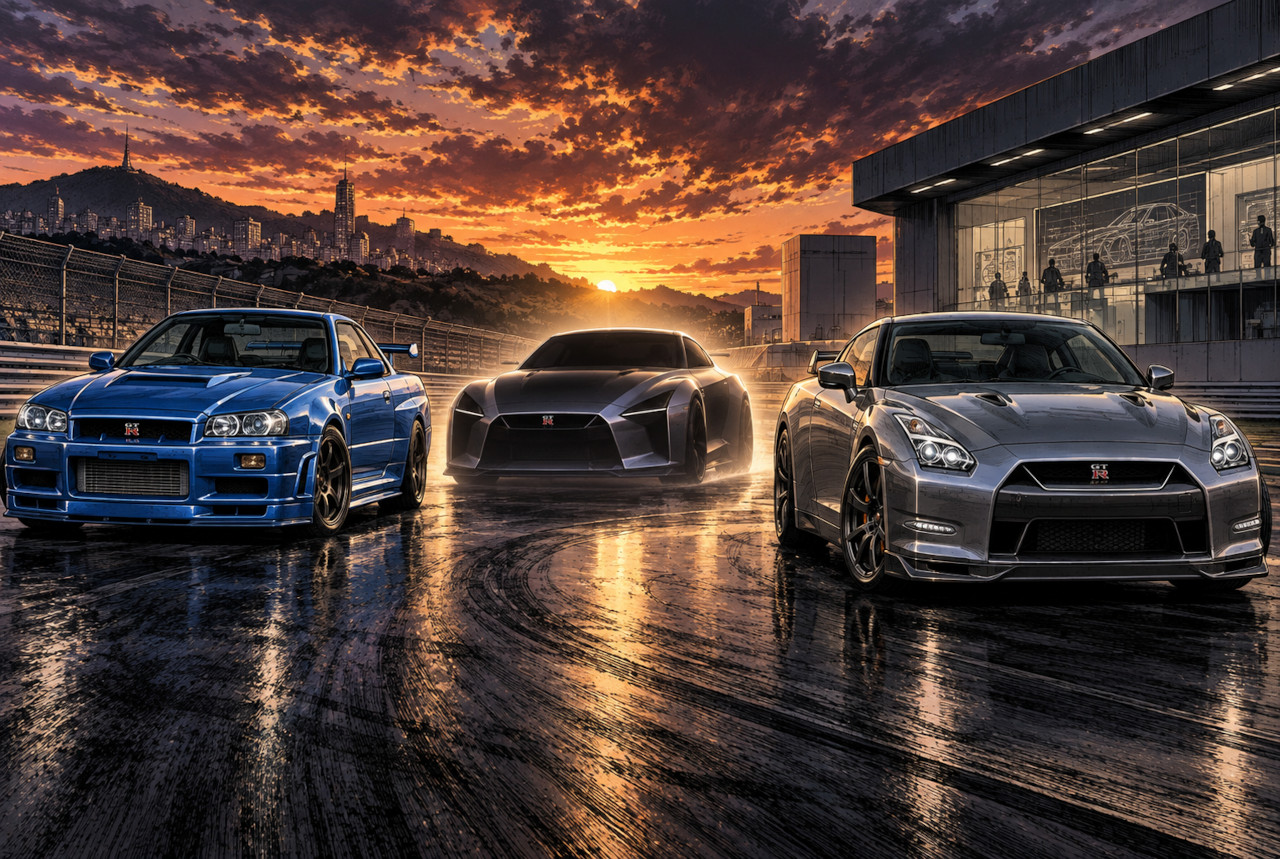 AI-generated illustration showing the transition from the R34 Skyline GT-R to the standalone NISSAN GT-R. The center vehicle is not an exact reconstruction of the 2001 GT-R Concept or 2005 GT-R PROTO.
No RB26, no manual gearbox — so what still made it a GT-R?
For anyone who grew up with the R32, R33, or R34, the R35 was a dramatic break with tradition. The R34 used the 2.6-liter RB26DETT twin-turbo straight-six with a six-speed manual gearbox. The R35 switched to the 3.8-liter VR38DETT twin-turbo V6, a six-speed dual-clutch transmission, and a unique all-wheel-drive layout with the transmission mounted at the rear.
But defining a GT-R by the RB26 creates an obvious problem. The original Hakosuka GT-R used the 2.0-liter naturally aspirated S20 straight-six and was not all-wheel drive. The RB26, twin turbos, ATTESA and a manual gearbox were defining traits of one era of GT-R history, not universal requirements for every GT-R ever built.
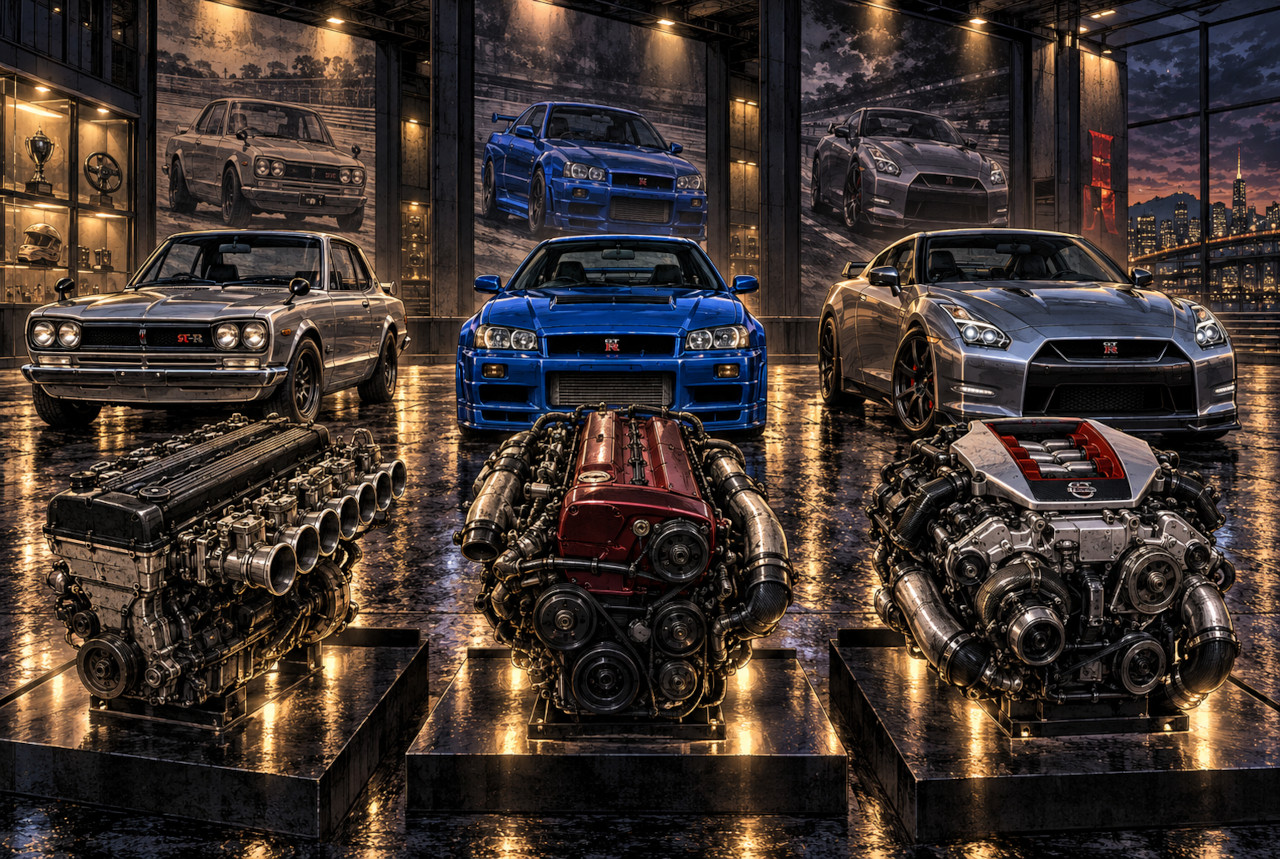 AI-generated symbolic comparison of the S20, RB26DETT and VR38DETT. It is not intended as an engineering diagram or an exact reproduction of engine component layouts.
The R35 redefined both the “GT” and the “R”
The earliest GT-Rs were closely tied to touring-car racing, and the R32 was engineered with Group A competition firmly in mind. By the R35 era, however, the relationship between the road car and the racing car had changed.
SUPER GT versions of the R35 used engines and chassis specifications that differed substantially from the production car. The GT3 version retained the VR38DETT but was converted to rear-wheel drive to comply with racing regulations. In other words, the R35 road car was no longer simply a homologation-minded machine designed around one racing category.
Instead, Nissan described the road-going R35 as a multi-performance supercar: a car intended to deliver extreme performance in many different conditions, not just on a circuit. It had four seats, usable luggage space, all-wheel drive, a dual-clutch transmission and sophisticated electronic controls. Rather than maximizing only the “Racing” side of the badge, the R35 attempted to combine grand-touring usability with serious performance.
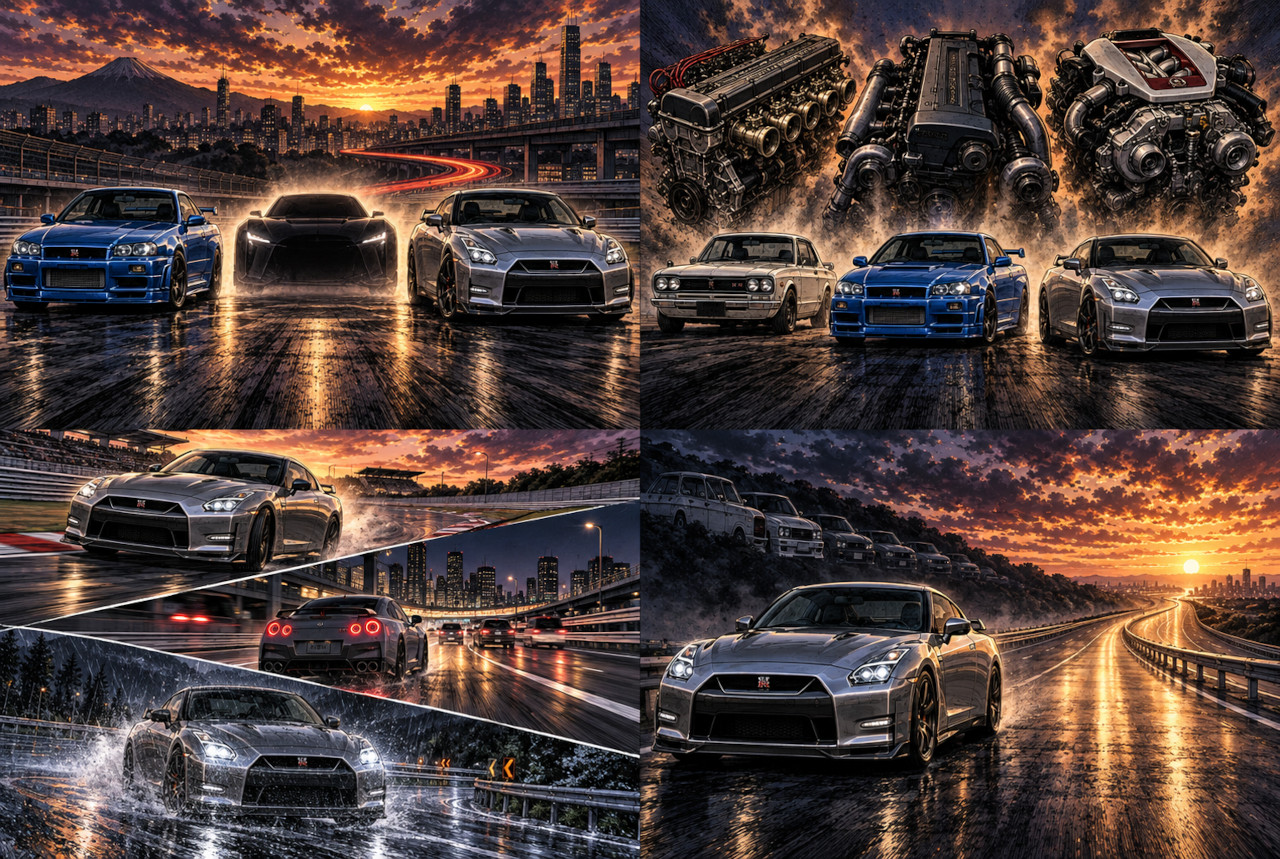
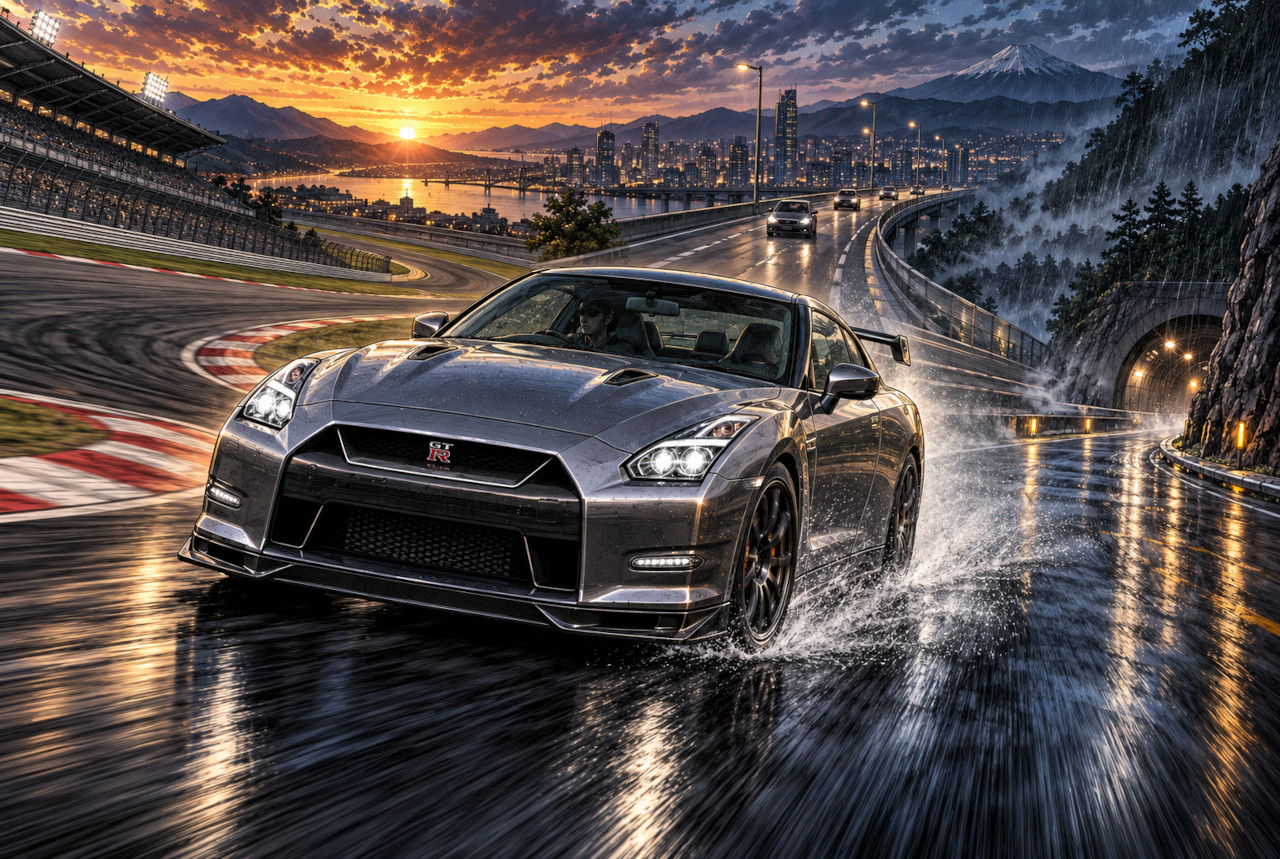 AI-generated illustration combining racetrack, expressway and wet-road environments to represent the R35 GT-R’s multi-performance philosophy.
The GT-R separated from the Skyline — and became a global flagship
The R35 was developed from the beginning for global sales. It transformed the GT-R from the highest-performance version of the Skyline into a standalone model representing Nissan itself. It was developed and tested at the Nürburgring, competed successfully in SUPER GT and GT3 racing, and remained in production from 2007 through 2025 while receiving continuous updates.
Production finally ended in August 2025 after approximately 48,000 R35s had been built. Today, there is once again no current GT-R available as a new production model. Nissan has said that this is not a permanent farewell, but a concrete successor has not yet been finalized.
The R35 was not a Skyline GT-R. It was the model that separated the GT-R name from the Skyline and rebuilt it as Nissan’s standalone interpretation of its highest-performance road car. Seen that way, the R35 was not an outsider to GT-R history. It may have been the generation that most aggressively forced people to reconsider what the GT-R name actually stood for.
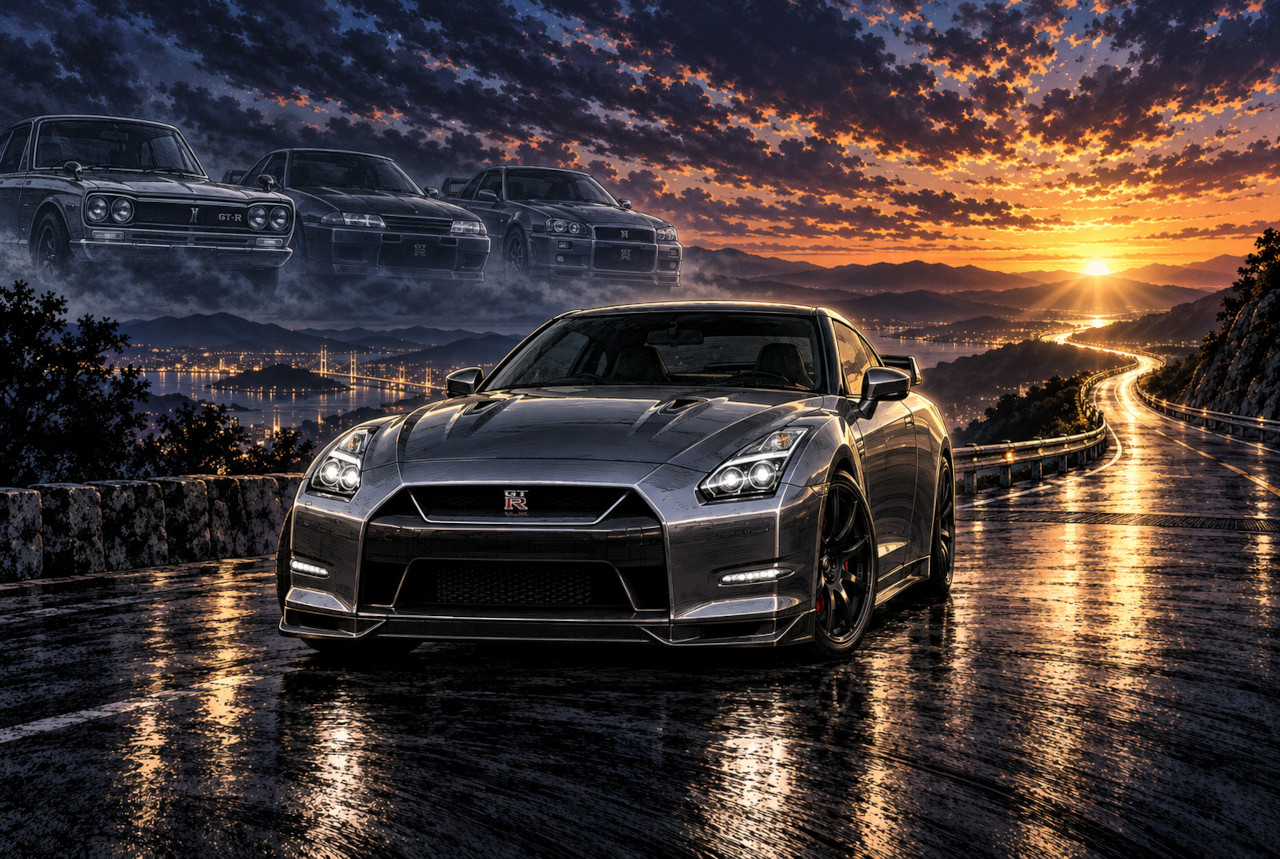 AI-generated illustration representing the GT-R lineage and the gap following the end of R35 production. The road and light in the distance do not represent any confirmed next-generation GT-R design.
Editor’s Note
When I hear “GT-R,” I still picture the R32 or R34 first — straight-six engine, manual gearbox, that unmistakable Skyline shape. So I completely understand why some people looked at the R35 and thought, “Is this really a GT-R?” I used to feel some of that myself.
But once you go all the way back to the Hakosuka, the definition starts falling apart. The first GT-R did not have an RB26. It was not all-wheel drive either. At that point, I started thinking that GT-R might not be a list of parts at all. Maybe it is Nissan’s idea of building the strongest performance car it can for a particular era, while still keeping enough everyday usability to remain a real road car.
Seen that way, I no longer think the R35 “abandoned” the Skyline. I think it separated the GT-R from the Skyline and allowed the name to become something larger than one model family. That interpretation makes far more sense to me now.
References
- Nissan: “Nissan Unveils GT-R PROTO at Tokyo Motor Show” (2005)
- Nissan Heritage Collection: NISSAN GT-R (2007)
- Nissan Heritage Collection: Skyline GT-R V-spec II (R34)
- Nissan Heritage Collection: Skyline 2000GT-R (PGC10)
- Nissan: GT-R History
- NISMO: R35 GT-R in SUPER GT
- NISMO: NISSAN GT-R NISMO GT3
- Nissan Heritage Collection: GT-R NISMO N-Attack Package Test Car
- Nissan: End of R35 GT-R Production (2025)