
The Nissan Skyline GT-R is often remembered as a car that was simply unbeatable from the beginning. Follow the real history, however, and a much stranger story appears. The legend actually began five years before the first GT-R was built — and the Skyline did not even win that race.
The GT-R did not become a legend simply because it kept winning. It lost, won, disappeared and came back. That broken, interrupted history is part of what made the GT-R special.
Tracing the Skyline GT-R — 5-Part Series
The GT-R did not evolve in a straight line. Across five articles, we examine its birth, disappearance, revival, transformation into a legend, and eventual independence from the Skyline name.
- Part 1: Why the Nissan Skyline GT-R Became a Legend — Defeat, Disappearance and a 16-Year Comeback
- Part 2: How the R32 Skyline GT-R Was Engineered to Win Group A — and Became a Legend
- Part 3: Was the R33 GT-R Really the Weak Link? Why the R34 Became a Legend
- Final Part: Is the R35 Really a GT-R? Why Nissan Made It a Standalone Model
- Special: What Happened to the Skyline During the GT-R’s 16-Year Absence? From the Four-Cylinder R30 RS to the R32 Revival
The GT-R legend began on the day Skyline lost to Porsche
In 1964, Prince Motor Company entered the Skyline GT in the second Japanese Grand Prix at Suzuka Circuit. Its main rival was the Porsche 904 Carrera GTS, a much more exotic and purpose-built sports racing car.
During the race, Japanese driver Tetsu Ikuzawa briefly put his Skyline GT ahead of the Porsche. The moment became famous in Japan. But the final result is important: the Porsche 904 won, while Skyline GTs finished from second through sixth.
So the familiar story that a Skyline “passed a Porsche” is true. The idea that Skyline actually defeated Porsche in that race is not.
Yet the loss created something unusually powerful. To Japanese spectators in the mid-1960s, the Skyline still looked like a relatively ordinary four-door domestic sedan. Seeing such a car challenge a sophisticated European racing machine was enough to create a new image around the model.
A 1965 Skyline catalog even used the expression “a wolf in sheep’s clothing,” reinforcing the idea that an ordinary-looking sedan could hide serious performance underneath.
The Skyline myth therefore began not with an overwhelming victory, but with an underdog taking on a stronger opponent and almost stealing the spotlight.
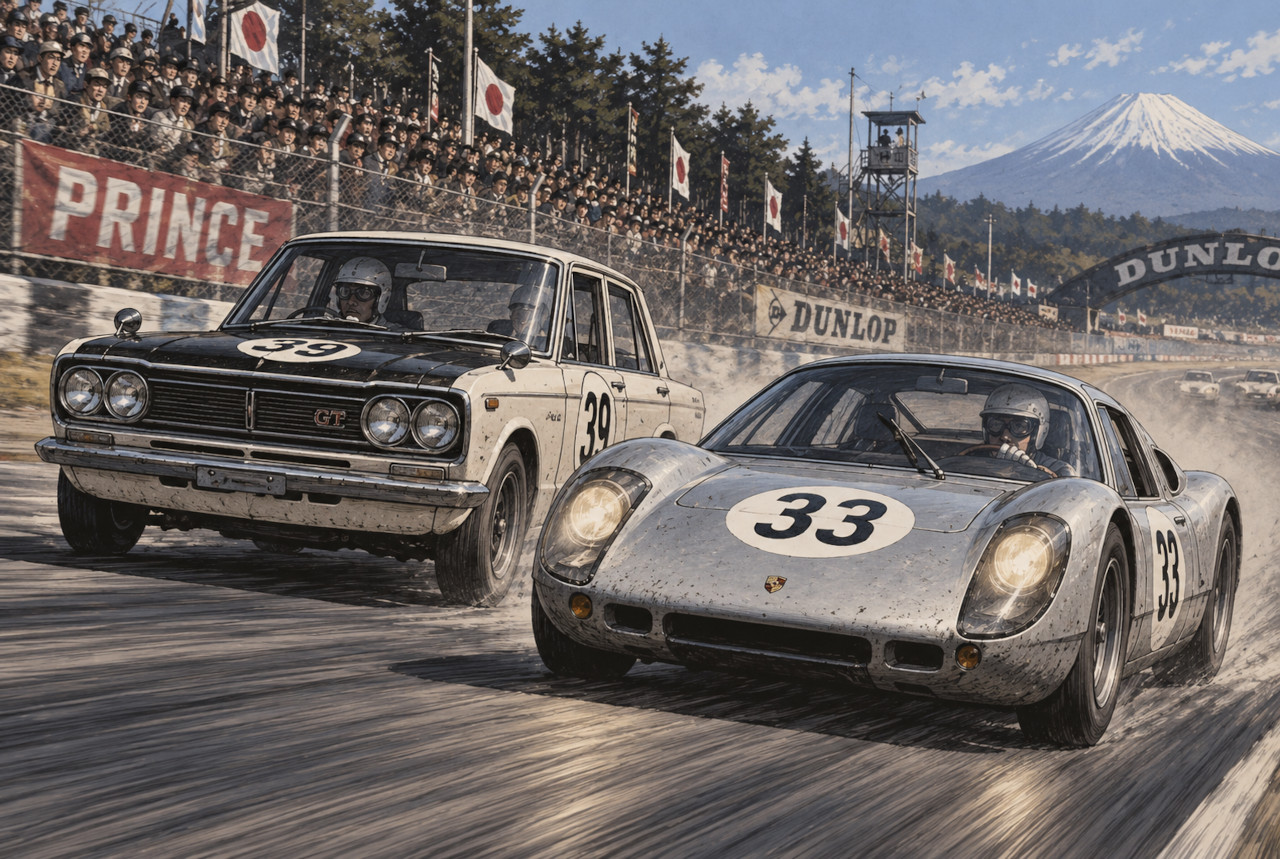 AI-generated illustration inspired by the second Japanese Grand Prix in 1964. Tetsu Ikuzawa briefly passed the Porsche in Skyline GT No. 41, but this image is not intended as an exact reconstruction of the real cars, racing numbers or historical photograph.
The Hakosuka GT-R turned the story into a real racing record
The GT-R name itself first appeared in 1969 with the PGC10 Skyline 2000GT-R.
Today, Japanese enthusiasts commonly call the C10-generation Skyline Hakosuka. The nickname combines the Japanese word hako, meaning “box,” with an abbreviation of Skyline. It refers to the car’s square, boxy body shape and is now widely used even outside Japan among JDM enthusiasts.
Under the hood was the S20, a 1,989cc inline-six DOHC engine developed using technology connected to Nissan’s R380 racing program. This was not simply a cosmetic performance package. The GT-R was designed with serious competition in mind.
Comfort equipment was minimal by normal passenger-car standards. Items such as a heater and radio were not necessarily part of the standard equipment, and the GT-R cost considerably more than an ordinary Skyline 2000GT.
Its racing debut was not a perfect fairy tale either.
At the 1969 JAF Grand Prix, the Skyline GT-R crossed the finish line behind a Toyota 1600GT. The Toyota was later penalized for obstruction, which promoted the GT-R to first place in the official result.
After that complicated beginning, however, the GT-R began building the competition record that would define the name. The original four-door model was eventually joined by a shorter-wheelbase two-door hardtop, and the Skyline became one of the dominant machines in Japanese touring-car racing.
What do the famous “49 consecutive wins” and “52 victories” really mean?
The numbers most closely associated with the early GT-R are 49 consecutive victories and 52 total credited wins.
Nissan and NISMO have used those figures in their own historical material, and they are an important part of GT-R folklore. But they are also easy to misunderstand when repeated without context.
The published GT-R victory records cover different events, classes and teams. They include victories credited to both factory-supported and non-factory entries, and some results were class wins rather than outright overall victories.
That means the famous record should not be interpreted as, “A GT-R entered 49 consecutive races and won every single one overall.” Historical race results show a more complicated picture.
That clarification does not make the achievement less impressive. Quite the opposite: even after separating legend from shorthand, the early GT-R still had an extraordinary competition record for a Japanese touring car of its era.
The Hakosuka GT-R transformed the story created in 1964 — the idea of a surprisingly fast Skyline — into a reputation supported by genuine racing success.
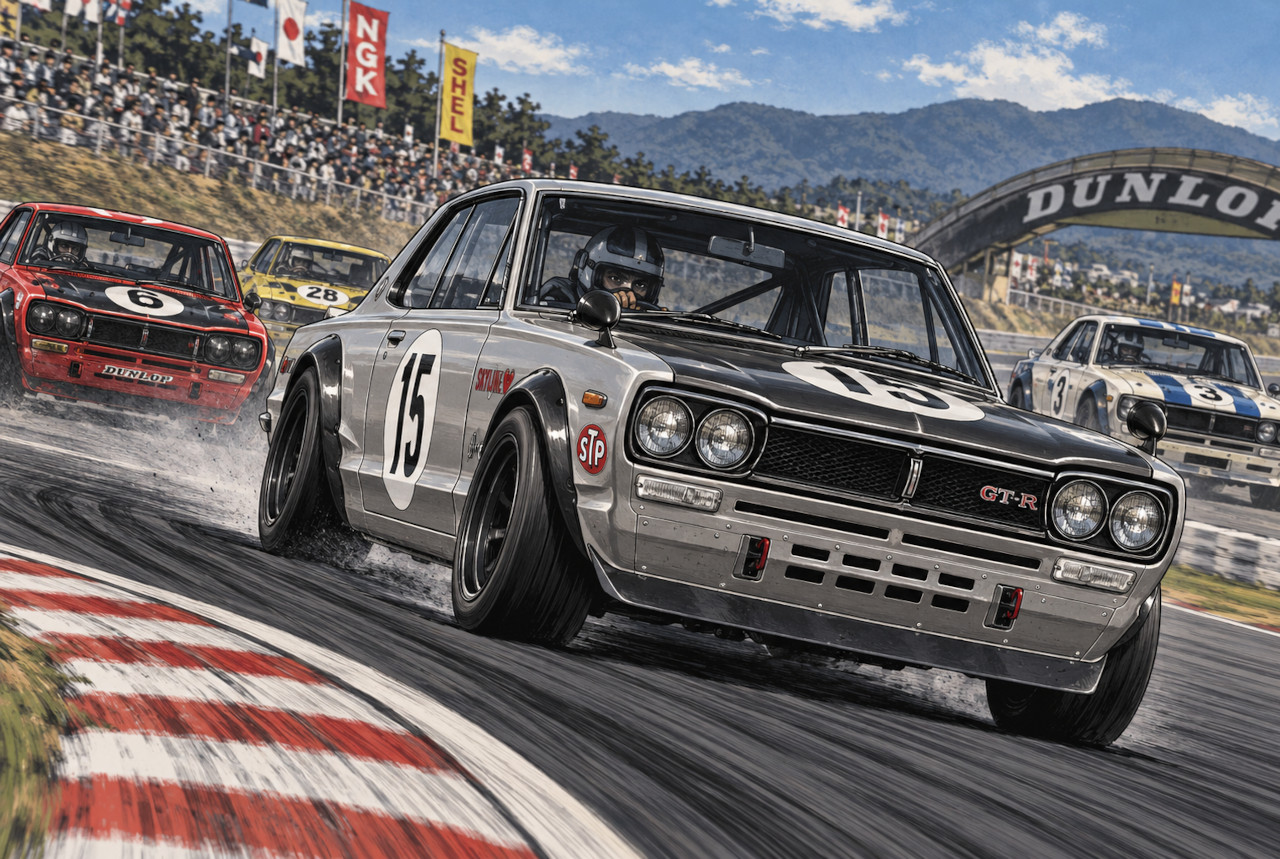 AI-generated illustration inspired by Japanese touring-car racing around 1970. It does not reproduce a particular historical race, driver, car number or photograph.
Why did the Kenmeri GT-R become legendary without ever racing?
The next GT-R, the KPGC110 introduced in 1973, followed a completely different path.
In Japan, this generation is commonly known as the Kenmeri Skyline. The nickname comes from Nissan’s famous “Ken and Mary” advertising campaign, which presented an idealized young couple traveling through Japan in a Skyline. The campaign became so strongly associated with the car that “Kenmeri” eventually became the model’s unofficial name.
The GT-R version was produced for only a few months, from January to April 1973. Nissan historical material states that fewer than 200 were built, while the figure of 197 cars is also commonly cited.
More remarkably, the Kenmeri GT-R never competed in touring-car racing.
A racing version was shown publicly, making it appear that the new GT-R would continue the competition legacy of the Hakosuka. That program never reached actual racing.
This is also where one of the most repeated explanations in GT-R history deserves a closer look.
Many simplified histories say that the Kenmeri GT-R disappeared because of the 1973 oil crisis. The timing does not fit very well. Production had already ended in the spring of 1973, while the Fourth Arab-Israeli War — the event that triggered the first oil shock — began in October.
A more accurate explanation is that Japanese automakers were already being forced to devote increasing engineering resources to exhaust-emission controls, fuel economy and changing environmental requirements. The oil crisis later accelerated the industry’s move toward fuel efficiency, but it is too simple to say that an October oil shock directly killed a GT-R that had stopped production months earlier.
The Kenmeri GT-R did not become a “phantom GT-R” because it won. It became one because it never got the chance to race.
A racing specification existed. The expectation existed. Then the story suddenly stopped.
That left enthusiasts with one of the most powerful ingredients in any legend: the unanswered question, “What if?”
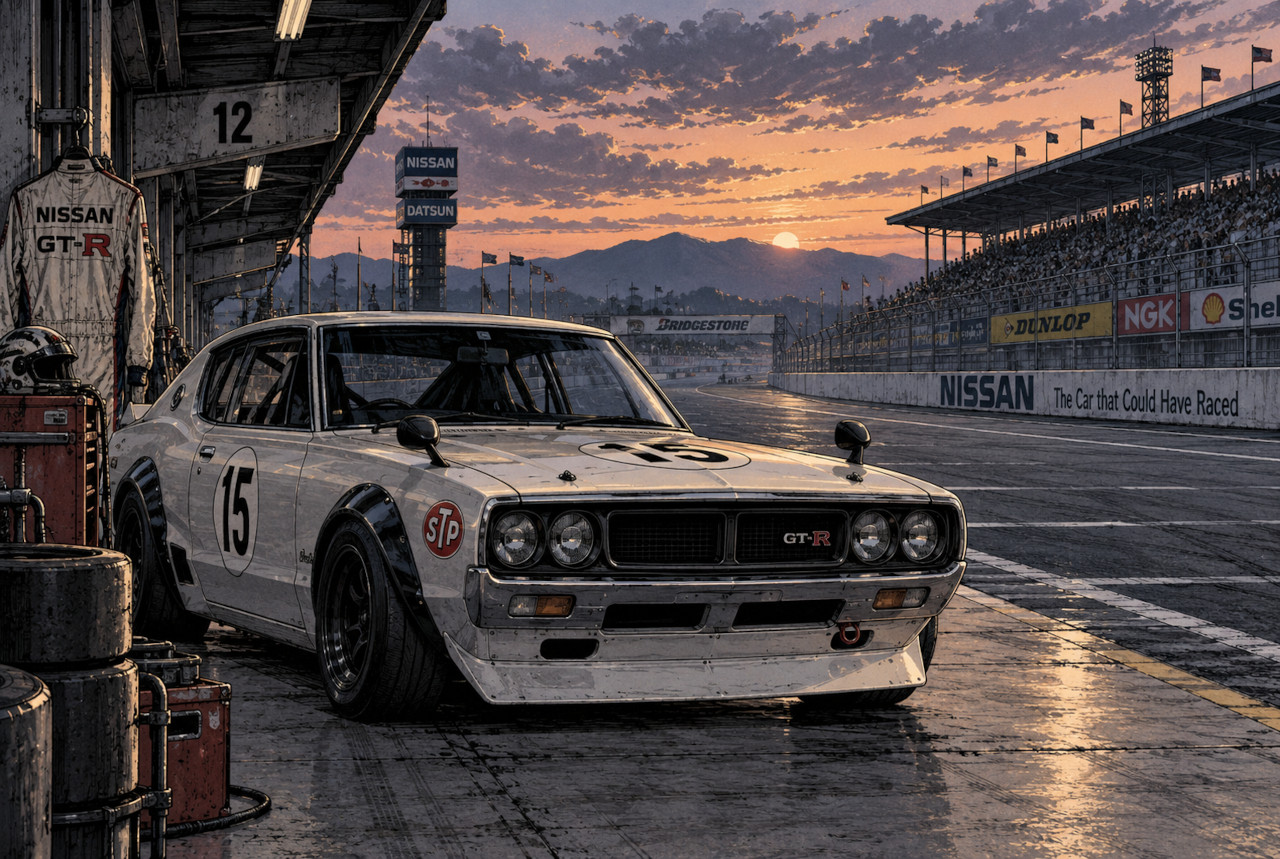 AI-generated illustration representing the unrealized racing future of the 1973 Kenmeri Skyline GT-R. The production GT-R never competed in touring-car racing.
What disappeared for 16 years was the GT-R badge — not the fast Skyline
After the GT-R disappeared in 1973, the badge did not return until 1989. That gap of roughly 16 years is sometimes described as if Nissan had abandoned high-performance Skylines altogether.
It had not.
During the 1980s, the DR30 Skyline RS and turbocharged RS models carried the performance side of the Skyline family. Later, Nissan developed the HR31 Skyline GTS-R with Group A touring-car competition in mind.
For readers outside Japan, this distinction matters. Skyline continued to evolve as a performance model even while the GT-R badge itself was absent.
What disappeared for 16 years was not the idea of a fast Skyline. What disappeared was the name “GT-R.”
Turbocharging, racing development and high-performance engineering continued during the gap. That accumulated experience eventually led to the car that changed the meaning of GT-R again.
In August 1989, Nissan launched the BNR32 Skyline GT-R with the RB26DETT twin-turbo inline-six and the electronically controlled ATTESA E-TS all-wheel-drive system.
The R32 was technically sophisticated, but what transformed its return into a major event was the name attached to it.
After 16 years without a GT-R, Nissan was not simply launching another fast Skyline. It was reviving a badge that enthusiasts had already turned into history.
There is no convincing evidence that Nissan deliberately kept the GT-R name dormant for 16 years in order to make it more legendary. The more reasonable interpretation is that the long absence unintentionally increased the emotional value of the badge.
The R32 did not merely continue the legend — it restarted it
The R32 quickly justified the decision to bring the GT-R name back.
Its RB26DETT engine was officially rated at 280 PS in Japan, while ATTESA E-TS electronically controlled torque distribution between the front and rear wheels. Nissan also developed the chassis specifically with Group A competition in mind.
In the Japanese Touring Car Championship, the R32 GT-R became brutally successful. Nissan’s historical material records 29 victories from 29 races across the championship seasons from 1990 through 1993.
For a new generation of enthusiasts, this became the second great GT-R era.
The original Hakosuka had established the GT-R as a racing name. The R32 added turbocharging, electronic control and all-wheel drive to that identity.
But the 16-year absence made the return feel different from an ordinary model change.
If Nissan had sold a GT-R continuously throughout the 1970s and 1980s, the R32 might simply have been remembered as another generation. Instead, it arrived as a resurrection.
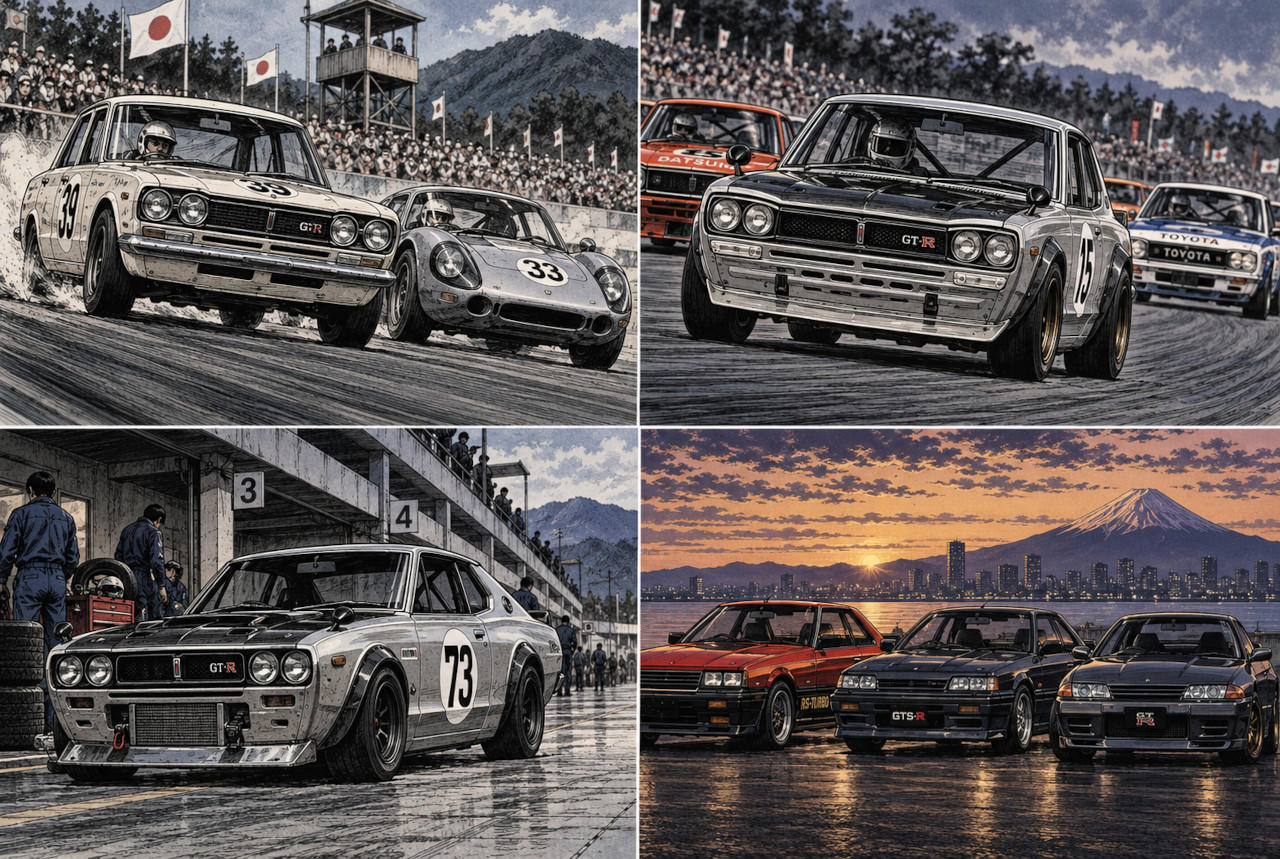
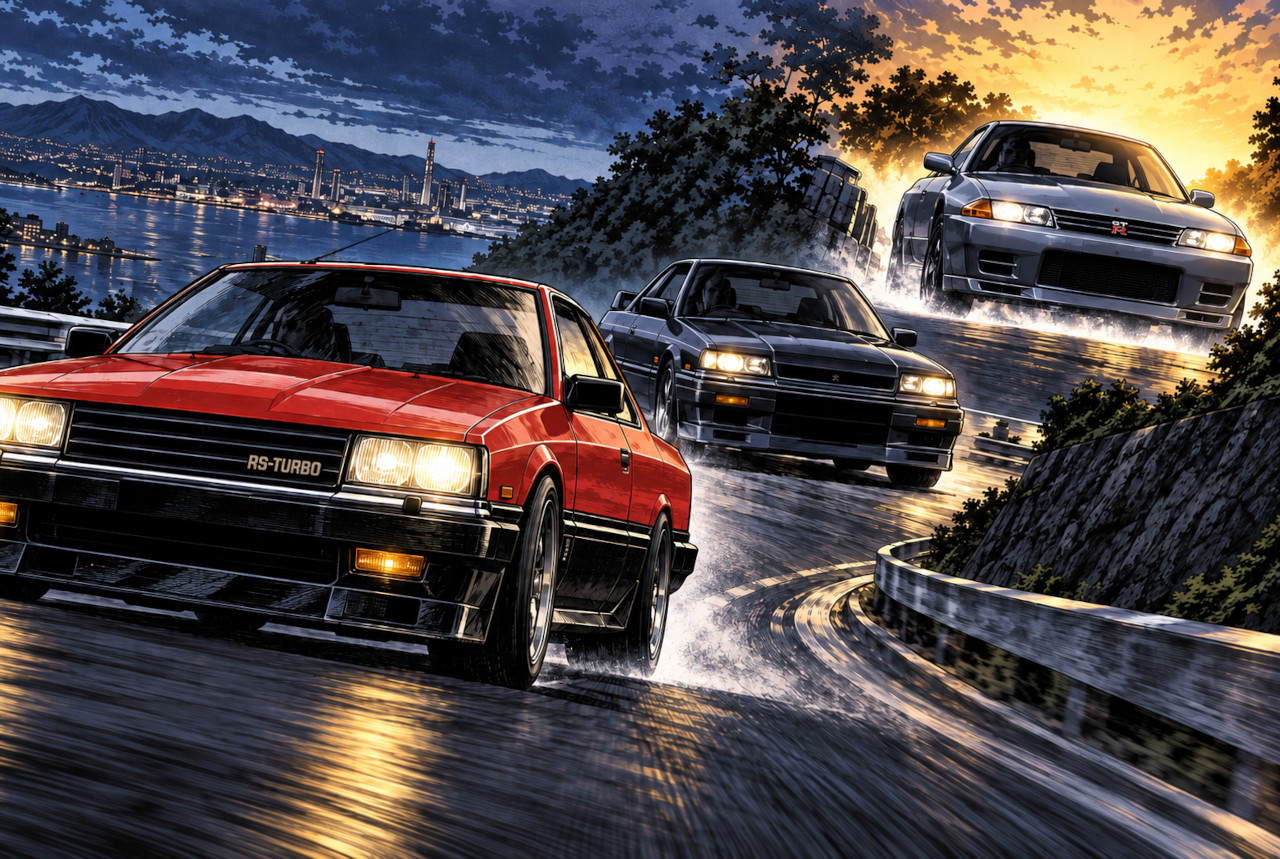 AI-generated illustration showing the performance lineage from the DR30 and HR31 Skylines to the return of the R32 GT-R in 1989.
The GT-R may be one of the rare cars made stronger by disappearing
After the R32, the GT-R name continued through the R33 and R34 generations. Then, when R34 production ended in 2002, the GT-R disappeared once again.
Five years later, the badge returned on the 2007 R35.
There was one major difference: it was no longer officially called the Skyline GT-R. Nissan separated the GT-R from the Skyline family and turned it into the standalone Nissan GT-R, designed as a global high-performance model.
Seen as a complete story, GT-R history is not a straight line.
It begins with a defeat in 1964. Then came the racing success of the Hakosuka. The Kenmeri appeared but never raced. The GT-R name disappeared for 16 years. The R32 revived it. The R33 and R34 continued it. Then the name disappeared again before returning without the Skyline badge at all.
The GT-R became legendary not simply because it was fast, but because its story seemed to end several times — and each return gave the name a new meaning.
Many famous cars can be explained through horsepower, lap times or production numbers.
The Skyline GT-R is harder to explain with a specification sheet alone.
Its reputation was built from performance, certainly. But it was also built from defeat, rarity, absence, unrealized racing plans and dramatic returns.
Sometimes a missing chapter makes a story more memorable.
Editor’s Note
I don’t think a car becomes legendary simply because it is fast. The deeper I looked into the GT-R story, the more interesting its contradictions became. It lost races. It disappeared. The Kenmeri GT-R never raced at all. Yet those apparent weaknesses eventually became part of the value of the name. The 49 consecutive victories and 52 credited wins are remarkable, but I think the 16 years when there was no GT-R may have mattered just as much. Without that long gap, the R32’s arrival in 1989 would have been another model change rather than a comeback. Car legends are not created by specifications alone. Sometimes they are created by the way the story is interrupted.
References
- Nissan Heritage Collection — Prince Skyline GT
- Japan Automobile Federation — 2nd Japan Grand Prix GT-II Results
- Nissan Heritage Collection — The 2nd Japan Grand Prix and the Skyline 2000GT
- NISMO — The Beginning of the GT-R Legend and 52 Victories
- Nissan Heritage Collection — Skyline 2000GT-R (KPGC110)
- Agency for Natural Resources and Energy — Japan’s Two Oil Crises
- Ministry of the Environment, Japan — Automotive Emissions and Industry Response
- NISMO — Prelude to the Revival of the GT-R
- Nissan Heritage Collection — Nissan Skyline GT-R (1989)
- Nissan Heritage Collection — Nissan GT-R (2007)