
“If you need to research something, go to the library.” That used to be ordinary advice. For many everyday questions, it no longer is.
Today, the moment a question occurs to us, we reach for a phone. We search Google. We ask an AI assistant. Within seconds, we can get definitions, timelines, comparisons, summaries and suggestions for where to look next.
The distance between a question and a usable answer has become astonishingly short.
So has the library become obsolete?
At first glance, it might seem that way. But a better way to describe what has happened is this:
The library has not disappeared from research. For some kinds of serious research, it has moved from the first stop to the last.
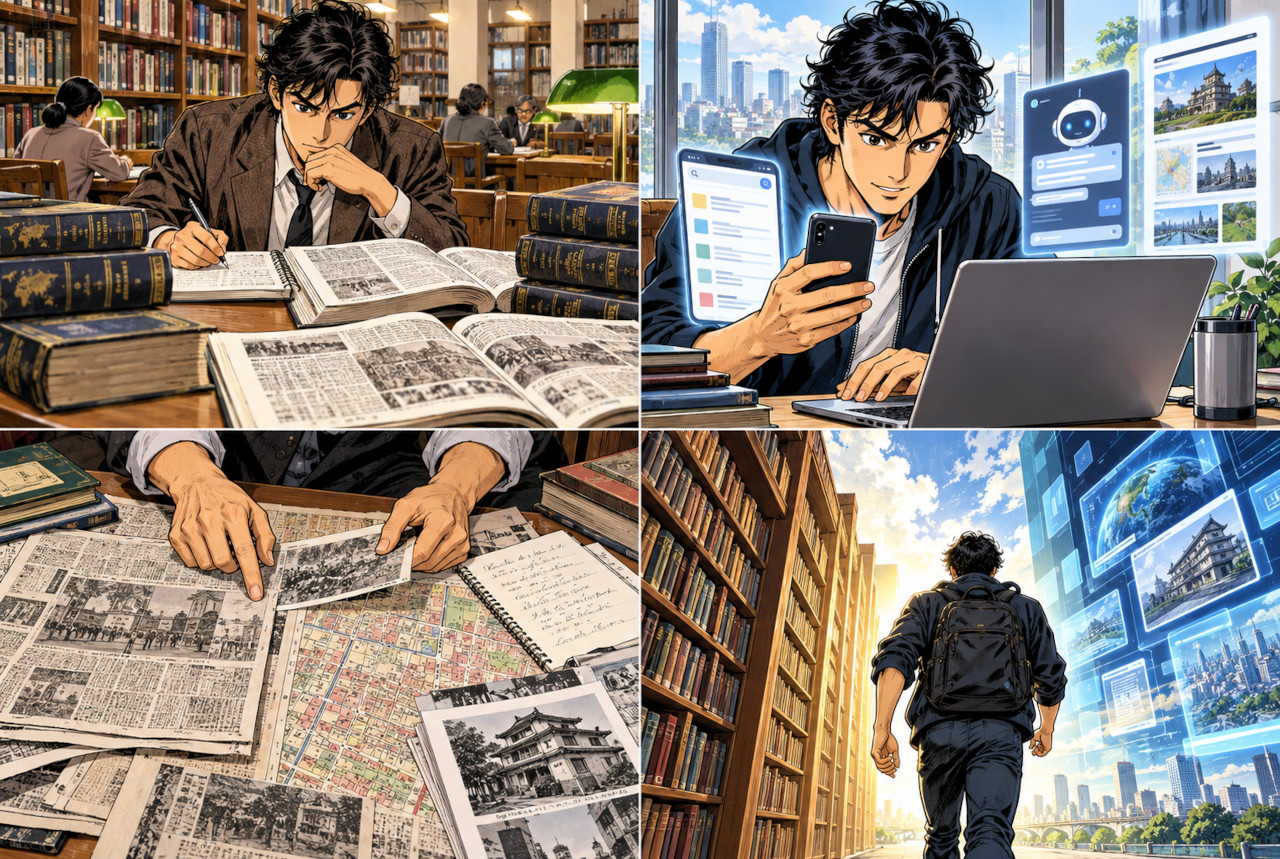
 AI-generated conceptual illustration representing research before internet search became the normal starting point.
The library used to be the entrance to information
Before widespread internet access, research often began with a physical journey.
You went somewhere that had the information.
A library might contain encyclopedias, local histories, old magazines, newspaper archives, maps, directories, government publications and reference books that simply did not exist in your home.
Even reaching the first useful fact required work.
You searched a catalog.
You followed classification numbers.
You checked an index.
You pulled several books from a shelf and discovered that only one actually contained what you needed.
By modern standards, this seems painfully inefficient.
But there was an interesting side effect.
The route by which you discovered information was part of the research itself.
You saw neighboring books on the shelf. You encountered sources you had not searched for. You learned which publications existed, which dates were missing and which authors kept appearing in bibliographies.
The inconvenience sometimes taught you something.
Search engines — and now AI — reversed the order
Search engines changed that process dramatically.
Smartphones changed it again.
Generative AI has pushed the change even further.
For an ordinary question, it is now perfectly reasonable to begin digitally.
What does this term mean?
When did this event happen?
What are the major theories?
What keywords should I search?
Which government agency is likely to have the original record?
An AI system can often provide a map of the subject before the researcher has opened a single book.
That changes the structure of research.
In the past, we often collected fragments first and assembled the big picture ourselves.
Now we increasingly receive a rough big picture first, then investigate the pieces that matter.
The starting point has shifted from gathering material to orienting ourselves inside the subject.
For many jobs, that is enormously useful.
 AI-generated conceptual illustration representing search engines and AI as modern starting points for research.
But AI is not a magic door into every document ever created
This is where the popular image of AI can become misleading.
A language model can be extraordinarily good at explaining, organizing and connecting information.
That does not mean it has access to every document in the world.
If an obscure local newspaper from 1974 has never been digitized, indexed or supplied to the system, an AI assistant cannot reliably inspect that newspaper for you.
If the only surviving record of a closed business is sitting inside a local-history folder or a box in an archive, asking the same question ten different ways will not magically put the document online.
Worse, large language models can sometimes generate incorrect information or fabricate details when reliable information is missing — the problem commonly called hallucination.
Researchers therefore need to distinguish two very different questions:
“Can AI give me a plausible answer?”
and:
“Can I establish what the surviving evidence actually says?”
For casual questions, the first may be enough.
For historical, investigative or publishable work, the second is often where the real job begins.
A surprising amount of the world is still not online
It is easy to forget this because the internet feels enormous.
But major archival institutions openly acknowledge that large parts of their collections remain unavailable as digital images.
The Library of Congress states that although much material is available digitally, a majority of its collections have not yet been digitized.
The U.S. National Archives gives a similar warning. It holds an enormous volume of historical records, and digitization continues, but only a fraction of the total holdings can be accessed online.
Some materials can be found in an online catalog but still require an in-person visit to see the actual item.
That distinction is crucial:
Searchable does not always mean readable online.
A catalog entry may tell you that a document exists.
It does not necessarily give you the document.
Japan has an especially interesting example: residential maps
One Japanese research tool deserves an explanation for international readers.
Japan has detailed commercial residential maps, often called jūtaku chizu, that show individual buildings and may identify houses, shops, offices and other occupants in remarkable detail.
For anyone investigating the history of a neighborhood, a vanished shop or the previous use of a particular building, old editions can be extremely useful.
The National Diet Library of Japan says its Map Room contains approximately 80,000 volumes of residential maps covering almost all areas of Japan.
Its holdings include maps dating back to the 1960s for Tokyo’s 23 wards and to the 1970s for some other regions.
Not all of these materials are simply available to browse from home.
This is exactly the kind of source that demonstrates why physical collections still matter.
Suppose you are researching a restaurant that disappeared from a Japanese town in 1981.
Google may give you nothing.
AI may summarize later references to it.
An old residential map may show you exactly where it stood.
Then an old local newspaper may tell you when it opened.
A town history may reveal what occupied the site before it.
Suddenly, a dead search result becomes a trail.
Old newspapers are another layer the open web does not always expose
Historical newspapers create a similar problem.
Many newspapers have excellent digital archives.
Many do not.
Some years are available only on microfilm, in bound volumes or through databases that require institutional access.
Japan’s National Diet Library, for example, maintains a Newspaper Reading Room containing national, regional, trade, specialist and sports newspapers in formats that include original paper issues, reduced editions and microfilm.
It even advises researchers to contact their local library first, because local libraries may already hold the material they need.
That is an important point.
“Go to the library” does not always mean traveling to a gigantic national institution.
A municipal library may preserve precisely the obscure local material that a global search engine has almost no reason to prioritize.
Once digital research fails, the library starts to feel like detective work
This is the part of research I find most interesting.
You have already asked AI.
You have searched the web.
You have checked official websites.
You know the basic timeline.
But one piece still does not fit.
Now you go to the library.
You compare newspapers from several dates.
You place two editions of an old map beside each other.
You search magazines published before the story became famous.
You notice that a person’s name is spelled differently in an earlier source.
You discover that an event commonly dated to 1984 was already being reported in 1982.
Or you realize that a story repeated online for twenty years appears to trace back to one later article rather than a contemporary source.
At that point, you are no longer merely “looking something up.”
You are comparing evidence.
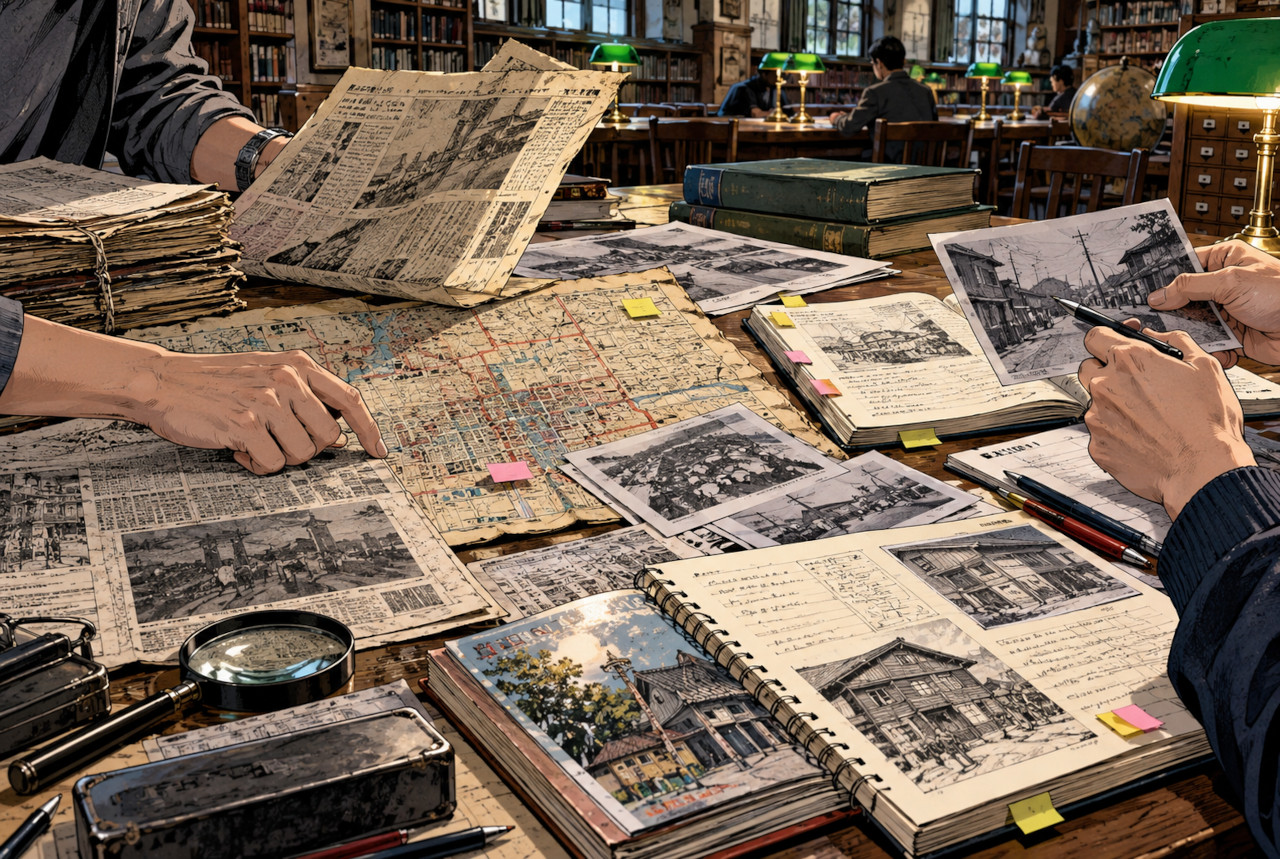 AI-generated conceptual illustration representing archival verification: comparing multiple physical sources rather than relying on a single summary.
The library becomes most valuable when sources disagree
A simple fact rarely needs this much effort.
If you want to know the population of a country, the current specifications of a product or the date of a famous event, there is little reason to spend half a day searching shelves.
The library becomes more interesting when the answer is uncertain.
One source says 1978.
Another says 1980.
A later article says “around the late 1970s.”
AI gives you the most frequently repeated date.
Which one is actually supported by contemporary evidence?
Now you have a research problem.
Older newspapers, trade publications, municipal documents, archived advertisements, maps and first editions become valuable precisely because they can take you closer to the event before later retellings simplified it.
This is one reason physical and archival research remains difficult to automate completely.
The difficult part is often not finding another sentence about the subject.
It is deciding which surviving piece of evidence deserves more weight.
AI can actually make libraries more useful, not less
There is another way to look at this.
AI does not have to compete with libraries.
Used properly, it can make a library visit much more efficient.
Before leaving home, you can use AI and web search to identify:
- possible dates and alternative spellings;
- names of people, companies and organizations connected to the subject;
- likely newspapers or magazines to search;
- technical or historical terms that may have changed over time;
- which claims remain unsupported;
- which kind of primary source could settle the question.
Then instead of arriving at a library and asking, “Do you have anything about this?” you can arrive with a much sharper question:
“I need local newspaper coverage between March and June 1983, and I want to check whether this company was already operating at this address.”
That is an entirely different research session.
AI handles the reconnaissance.
The catalog tells you what may exist.
The librarian helps navigate the collection.
The original material provides the evidence.
Far from killing library research, AI can reduce the boring part and leave more time for the interesting part.
A practical research workflow for the AI era
For the kind of investigative articles I work on, the most effective process is increasingly a hybrid one.
Step 1: Use AI to understand the territory.
Ask for terminology, timelines, competing explanations and possible primary sources. Treat this as orientation, not proof.
Step 2: Search the open web.
Look for official documents, contemporary journalism, academic papers, databases and institutional archives. Check whether the AI’s claims survive contact with real sources.
Step 3: Write down what is still missing.
Do not keep searching randomly. Turn the gaps into precise questions.
Step 4: Search library and archive catalogs.
Look for newspapers, maps, magazines, local histories, directories, microfilm, unpublished collections and material unavailable online.
Step 5: Compare the oldest and strongest evidence you can obtain.
A later summary may be useful, but when dates or claims conflict, contemporary documents can change the story completely.
This is slower than simply accepting the first AI answer.
It is also where research stops being merely efficient and starts becoming original.
A modern library is not simply a warehouse of books
There is also a larger reason the “AI makes libraries unnecessary” argument is too narrow.
The IFLA-UNESCO Public Library Manifesto, updated in 2022 for the digital era, describes public libraries as institutions providing both physical and digital access to information, supporting literacy and education, and preserving local and Indigenous knowledge and heritage.
In other words, even the professional definition of a modern public library has moved beyond:
“a building where people borrow printed books.”
Libraries provide digital databases, internet access, research assistance, community information and collections that may exist nowhere else.
The librarian’s role has changed as well.
When information was scarce, the problem was finding enough of it.
When information is abundant, the problem is often identifying what is reliable, what is original and what is missing.
That arguably makes information professionals more relevant to serious research, not less.
The more digital research becomes, the more valuable the analog final step can be
There is a nice irony here.
Technology has made it possible for almost anyone to reach a competent general answer extremely quickly.
That means the difference between an ordinary article and an unusually useful one increasingly appears after that point.
Everyone can find the Wikipedia-level history.
Everyone can ask AI for the standard explanation.
Everyone can find the same ten highly ranked webpages.
The interesting question becomes:
What can you find that those sources have not already repeated?
Sometimes the answer is in a local newspaper.
Sometimes it is in a forgotten magazine.
Sometimes it is on microfilm.
Sometimes it is in a map that has never been scanned.
And sometimes the most important discovery is simply that the original evidence does not say what the internet has been saying for years.
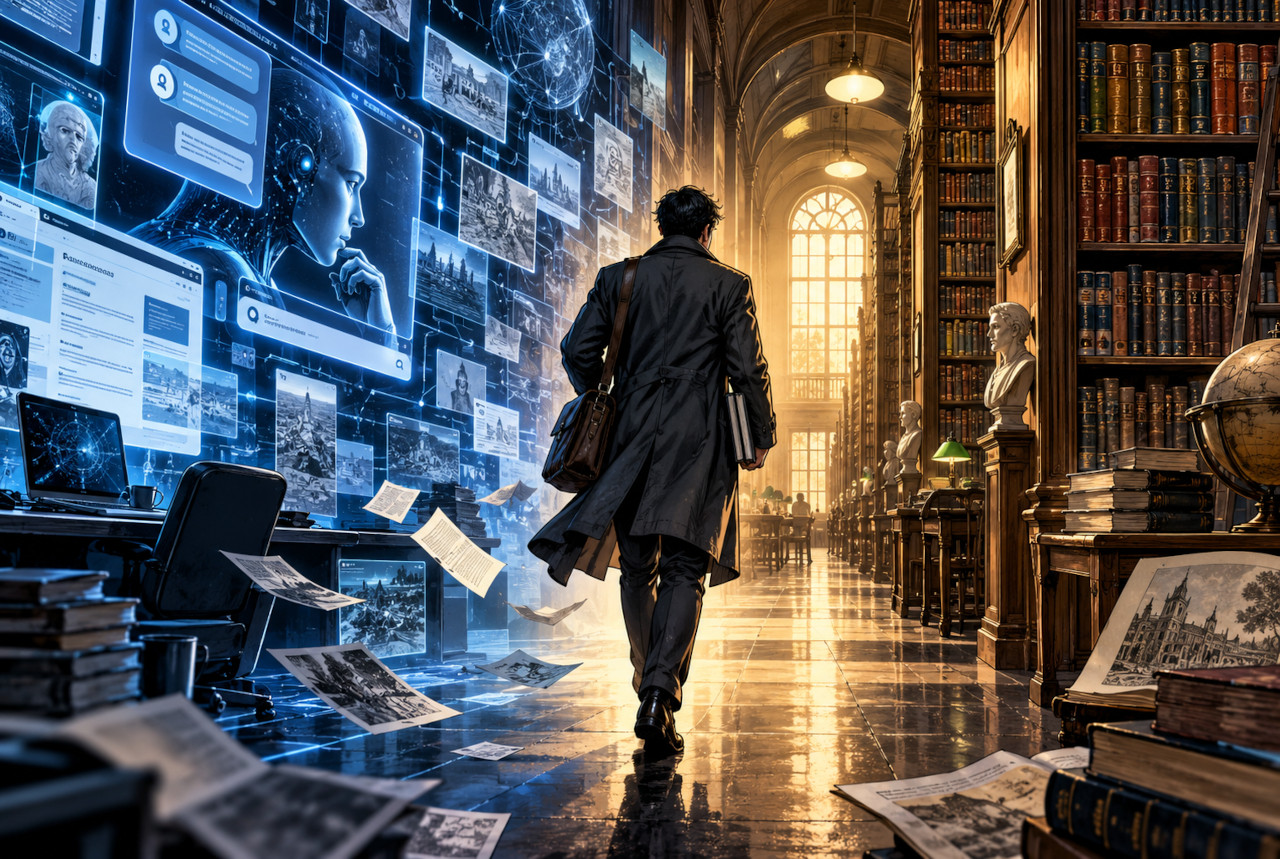 AI-generated conceptual illustration symbolizing the shift from fast digital research to deeper verification using physical and archival sources.
Conclusion: the library may no longer be the first stop — and that may make it more interesting
Not every question deserves a library visit.
That would be nostalgia masquerading as research advice.
If AI and reliable online sources can answer a question accurately in five minutes, spending half a day hunting through microfilm does not automatically make the result better.
But there is another category of question.
The vanished shop.
The obscure local event.
The disputed date.
The first appearance of a rumor.
The building that changed names three times.
The quotation everyone repeats but nobody can trace.
Those are the questions for which the physical library, archive or special collection suddenly becomes interesting again.
Search and AI have not necessarily made libraries obsolete. They have made it much easier to discover exactly when we need one.
Perhaps that is the modern library’s strangest transformation.
It used to be where research began.
Now, for the hardest questions, it may be where the real investigation finally starts.
Editor’s Note
Of course, some people never stopped going to libraries. They like paper books, quiet rooms and the slightly obsessive pleasure of following a trail through shelves and indexes. There is nothing wrong with that.
But I no longer think the choice is “AI or the library.”
If AI can solve the first 80 percent in a few minutes, good. Let it.
What interests me is the stubborn final part that refuses to appear on a screen.
There is a peculiar satisfaction in spending half a day with old newspapers and maps and finally finding one small detail that the internet could not give you.
AI makes research faster. The library can still make it deeper.
References
- IFLA-UNESCO Public Library Manifesto 2022 — International framework describing the modern public library’s roles in access to information, education, digital literacy and the preservation of local knowledge and cultural heritage.
- Library of Congress — Discover the Library of Congress — Explains that although substantial material is available digitally, a majority of the Library’s collections have not yet been digitized and may need to be located through catalogs and finding aids.
- U.S. National Archives — Frequently Asked Questions — Explains why not all archival records can be placed online and why the scale, cost and physical nature of historical holdings make complete digitization impractical.
- National Institute of Standards and Technology — “Hallucination Detection in Large Language Models Using Diversion Decoding” — Research discussing the tendency of large language models to generate factually incorrect or fabricated information and methods for detecting uncertainty.
- National Diet Library of Japan — Map Room — Official information on the NDL’s map holdings, including approximately 80,000 volumes of residential maps covering almost all parts of Japan.
- National Diet Library of Japan — Newspaper Reading Room — Information on Japanese national, regional, trade, specialist and sports newspapers preserved in original, reduced, reproduced and microfilm formats.