

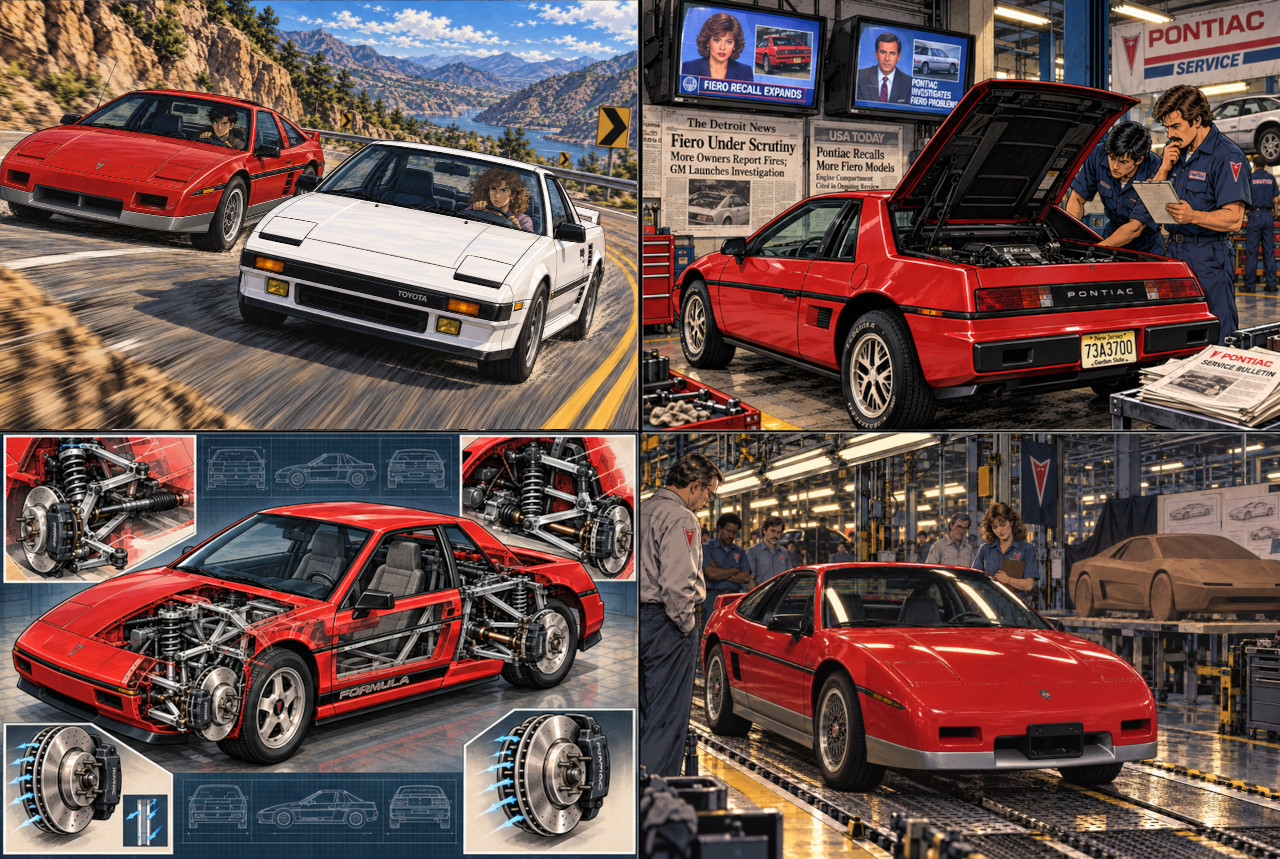
When the Pontiac Fiero arrived for 1984, it was an immediate hit, with 136,840 cars produced in its first model year. But the momentum did not last. Production fell to 83,974 units for 1986, then to 46,581 in 1987. By the final 1988 model year, output had dropped to roughly 26,400 cars.
Yet the Fiero was not simply a flawed car that disappeared without improvement. In fact, the opposite happened. Pontiac kept correcting its weaknesses year after year, and just as the Fiero finally became something close to the mid-engine sports car it had always promised to be, GM decided to kill it.
The Strange Life of the Pontiac Fiero — 3-Part Series
From its underpowered commuter-car origins to its final 1988 transformation and its strange second life as a replica-car platform, this three-part series follows the Pontiac Fiero from birth to afterlife.
- Part 1: Why Was the Pontiac Fiero So Slow? — The Mid-Engine Sports Car That Had to Pretend It Was a Commuter
- Part 2: Why Did the Pontiac Fiero Disappear Just as It Got Good? — Fires, the MR2, and the 1988 Overhaul
- Final Part: Why Did the Pontiac Fiero Become a Ferrari? — How America’s Mid-Engine Oddball Became the King of Replicas Coming soon
A V6 Arrived, and the Fiero Finally Looked the Part
The original 2.5-liter four-cylinder produced only 92 hp, which was hardly enough to satisfy buyers expecting sports-car performance from a mid-engine two-seater. Pontiac responded in 1985 with an optional 2.8-liter V6 rated at 140 hp. For 1986, the now-iconic fastback Fiero GT arrived, followed by a five-speed manual transmission for V6 models.
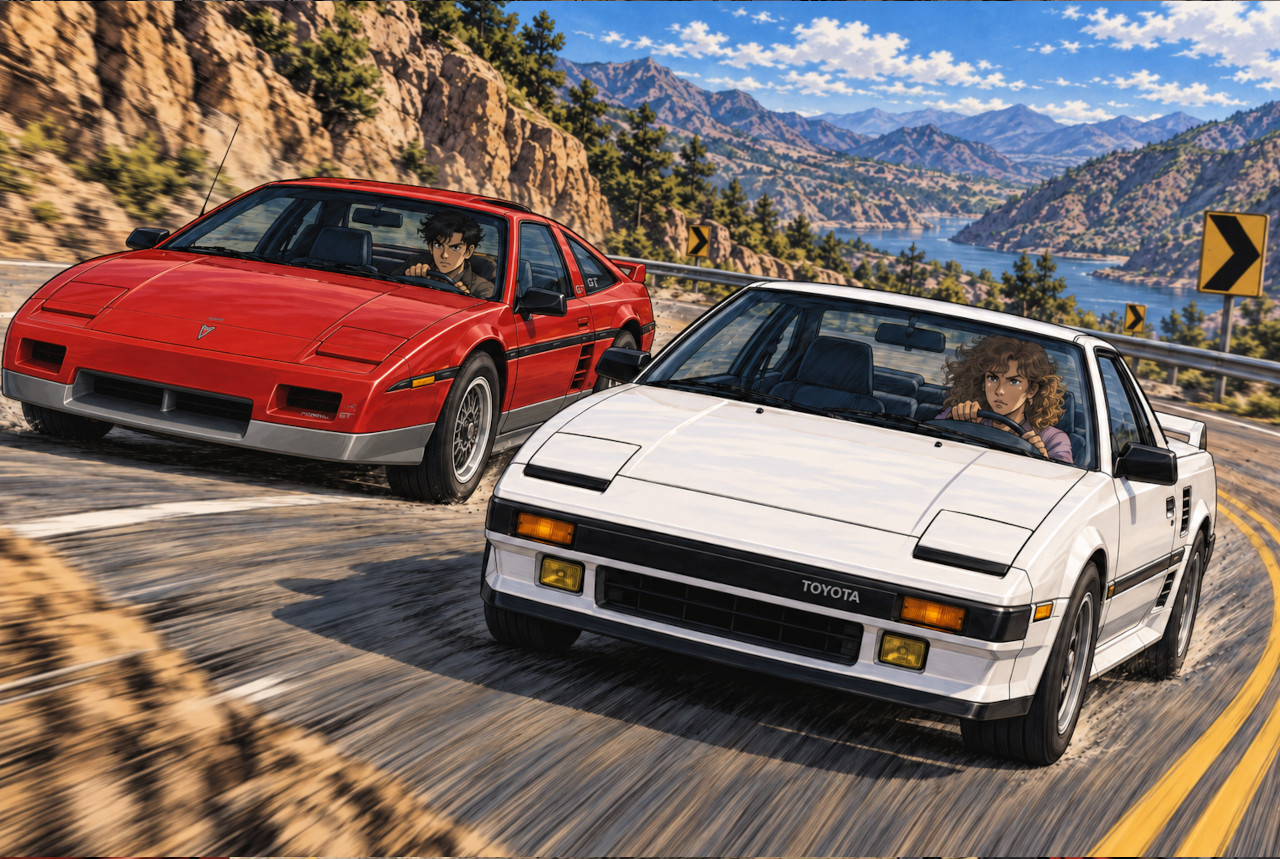
Pontiac was clearly trying to fix the car rather than abandon it. Power improved, and the styling became more convincing. But the chassis still carried compromises inherited from the original low-cost program. When Car and Driver tested the 1986 Fiero GT, it praised some of the improvements but remained critical of its weight, steering feel, and handling compared with the lighter and more agile Toyota MR2.
Then Came the Reputation for Engine Fires
More damaging than the Fiero’s modest performance was the engine-fire problem associated with early four-cylinder cars. In 1987, GM announced a major recall affecting 1984 Fieros. The issue was not the result of one simple defect. Low oil levels could contribute to engine failure, while leaking fluids could reach extremely hot exhaust components and create a fire risk.
That makes two popular explanations equally misleading. It is inaccurate to claim that “all Fieros caught fire easily,” but it is also too simplistic to blame the problem entirely on owners who failed to maintain their cars. Later recalls expanded fire-related corrective measures across four-cylinder Fieros.
The greater commercial problem was the phrase that stuck in people’s minds: “the Fiero catches fire.” Engineering fixes could be installed. A damaged reputation was much harder to repair.
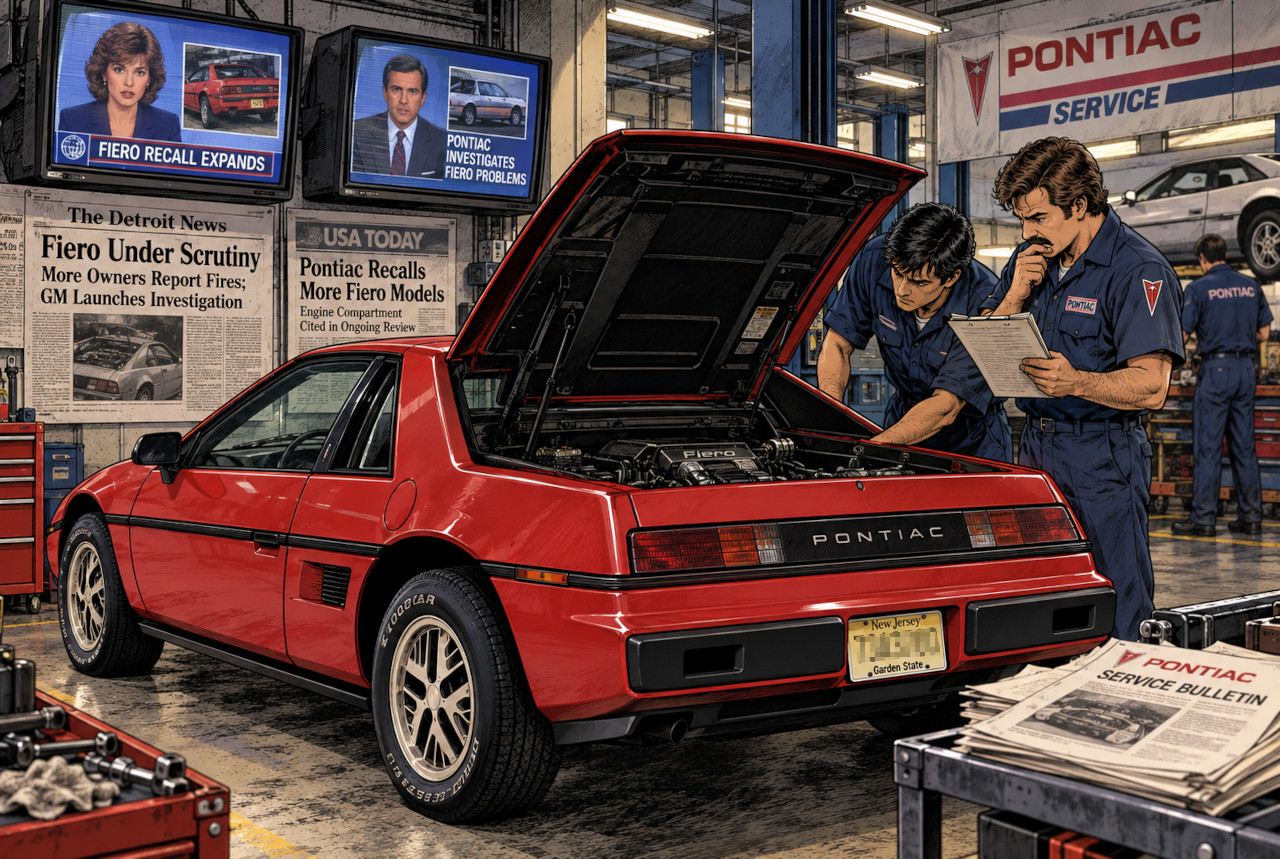 AI-generated illustration representing the Fiero fire issue and the spread of media coverage. The newspapers and television screens do not reproduce actual published reports.
In 1988, Pontiac Finally Reworked the Chassis
Pontiac still refused to give up. For 1988, the Fiero received a major chassis redesign reportedly costing around $30 million. The front suspension geometry was reworked, the rear adopted a new tri-link arrangement, and the braking system was upgraded to four-wheel vented discs.
Pontiac also introduced the Fiero Formula, combining the GT’s V6 and upgraded suspension with the lighter notchback body. The Formula was arguably the purest expression of what the Fiero could have been from the beginning: relatively affordable, mid-engined, V6-powered, and finally equipped with a chassis designed to take advantage of its layout.
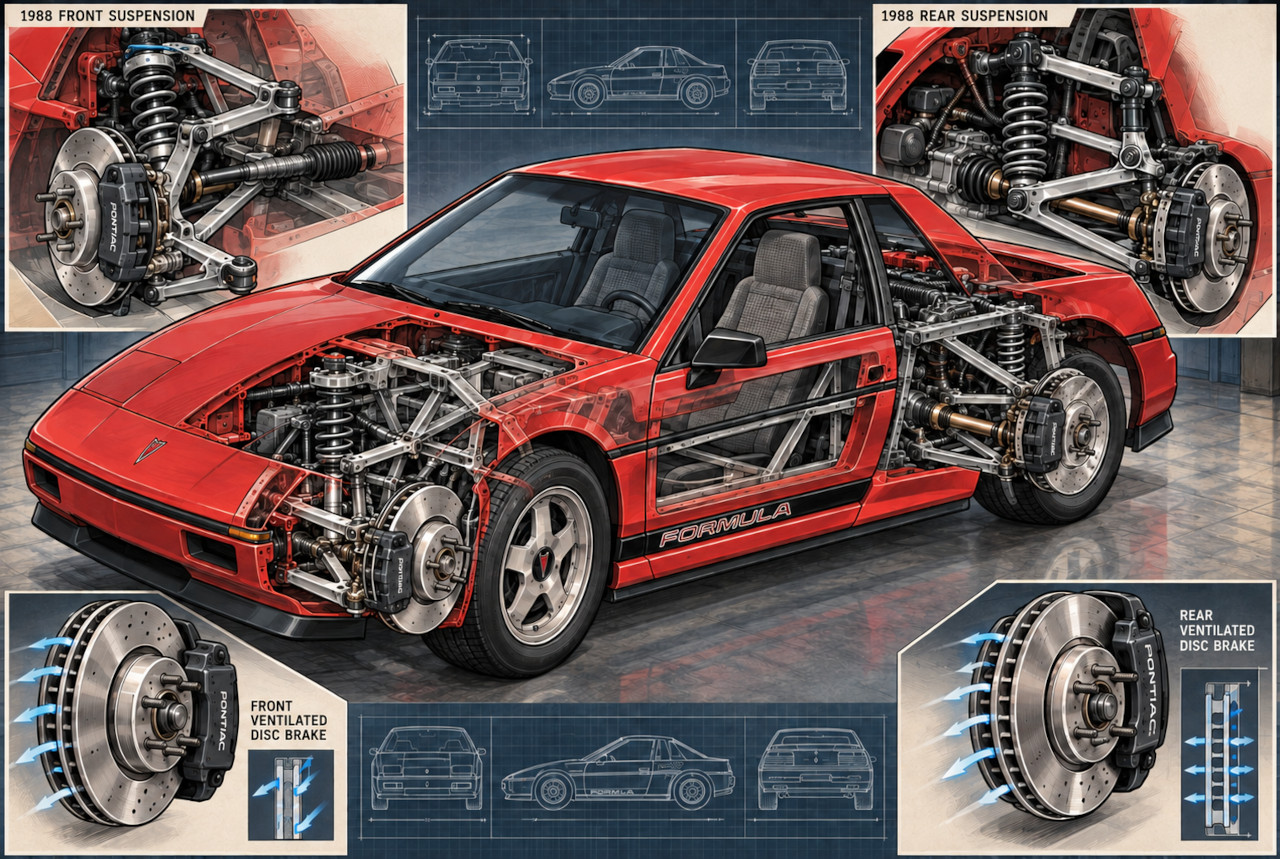 AI-generated technical visualization of the 1988 Fiero’s suspension and brake upgrades. Component shapes, locations, and labels are not intended as an exact reproduction of factory service diagrams.
It Finally Became Faster Than the CRX and MR2 — and Still Finished Third
In 1988, Car and Driver compared the Fiero with the Toyota MR2 and Honda CRX. The Fiero finished third overall. But the raw test numbers tell a more interesting story. The Fiero recorded 0–60 mph in 7.9 seconds and a top speed of 123 mph, making it the fastest of the three. Contemporary development history also records the Fiero posting the best results in skidpad, slalom, and road-course testing.
That was a remarkable reversal. In the first part of this series, the original 2.5-liter Fiero could not even outperform the much smaller front-wheel-drive CRX. Four years later, the Fiero had evolved far enough to beat the CRX and MR2 in several objective performance measurements.
Yet it still did not win the comparison. Its rivals had not stood still, and years of criticism over weight, steering feel, refinement, and overall reputation could not be erased by one improved model year.
The Best Fiero Became the Last Fiero
In March 1988, GM announced that Fiero production would end after that model year. The official reason was declining sales. GM officials said the dedicated assembly operation needed roughly 50,000 units per year to remain viable, and Fiero sales had already fallen below that level in 1987. Rising prices, insurance costs, and the limited size of the two-seat sports-car market also worked against it.
The strangest part is that the people actually building and developing the Fiero were still preparing for its future. According to contemporary reporting by the Los Angeles Times, just one day before the cancellation announcement, 12 skilled workers had been called back to begin work related to tooling for a redesigned 1990 Fiero. Power steering and GM’s Quad 4 engine were among the ideas being considered for the next generation.
You can repair a car. You cannot rewind the commercial life of a product. The Fiero’s five-year history makes that painfully clear. Had the car launched in 1984 with something closer to the engineering quality of the 1988 model, its story might have been very different. We will never know.
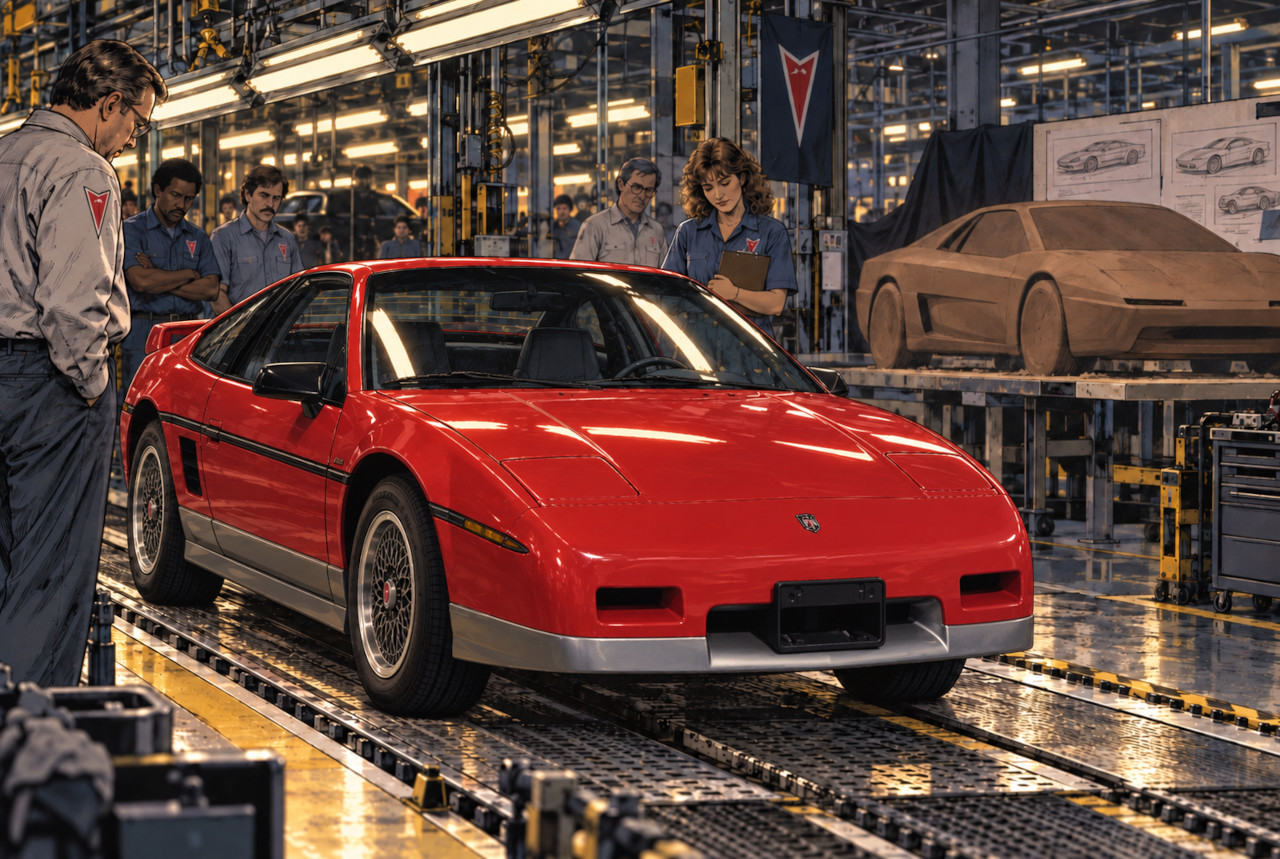 AI-generated illustration representing the end of Fiero production and the next-generation program that was still being explored at the time. The clay model is not an exact reproduction of an actual prototype.
Editor’s Note
If I had to sum up the Fiero story, I would not simply say, “It failed because it did not sell.” My reaction is more like: you finally fixed all of that, and then you killed it? It began as a 92-hp mid-engine car that could be embarrassed by a CRX, then gained a V6, better styling, and finally a properly reworked chassis. By 1988 it could post performance numbers that beat the MR2 and CRX in several areas — and then production ended. Pontiac was even preparing the next version. The Fiero always seemed to be one step away from becoming what it should have been, which is exactly why I still find it so fascinating.
References
- Car and Driver, “Remember the Fiero” — Fiero development, the 1988 comparison test, and production history
- Car and Driver, “1986 Pontiac Fiero GT Archive Test” — Contemporary evaluation of the V6 Fiero GT and comparison with the Toyota MR2
- Hemmings, “Perfecting Pontiac’s P-Shooter — 1988 Pontiac Fiero GT” — The major 1988 suspension redesign
- Hemmings, “Pontiac Saved the Best for Last With the 1988 Fiero GT” — Technical improvements and final-year production
- Los Angeles Times, “GM to Stop Making Sporty Fiero” — GM’s 1988 cancellation announcement and declining sales
- Los Angeles Times, “FIERO: CAR TROUBLE AT GM” — Internal GM issues, the planned 1990 Fiero, and events immediately before cancellation
- Los Angeles Times, “GM to Recall All 4-Cylinder Fieros” — Fire-related recall action involving four-cylinder Fieros
- Gary Witzenburg, Fiero: Pontiac’s Potent Mid-Engine Sports Car — Development history and records of the 1988 comparison testing