

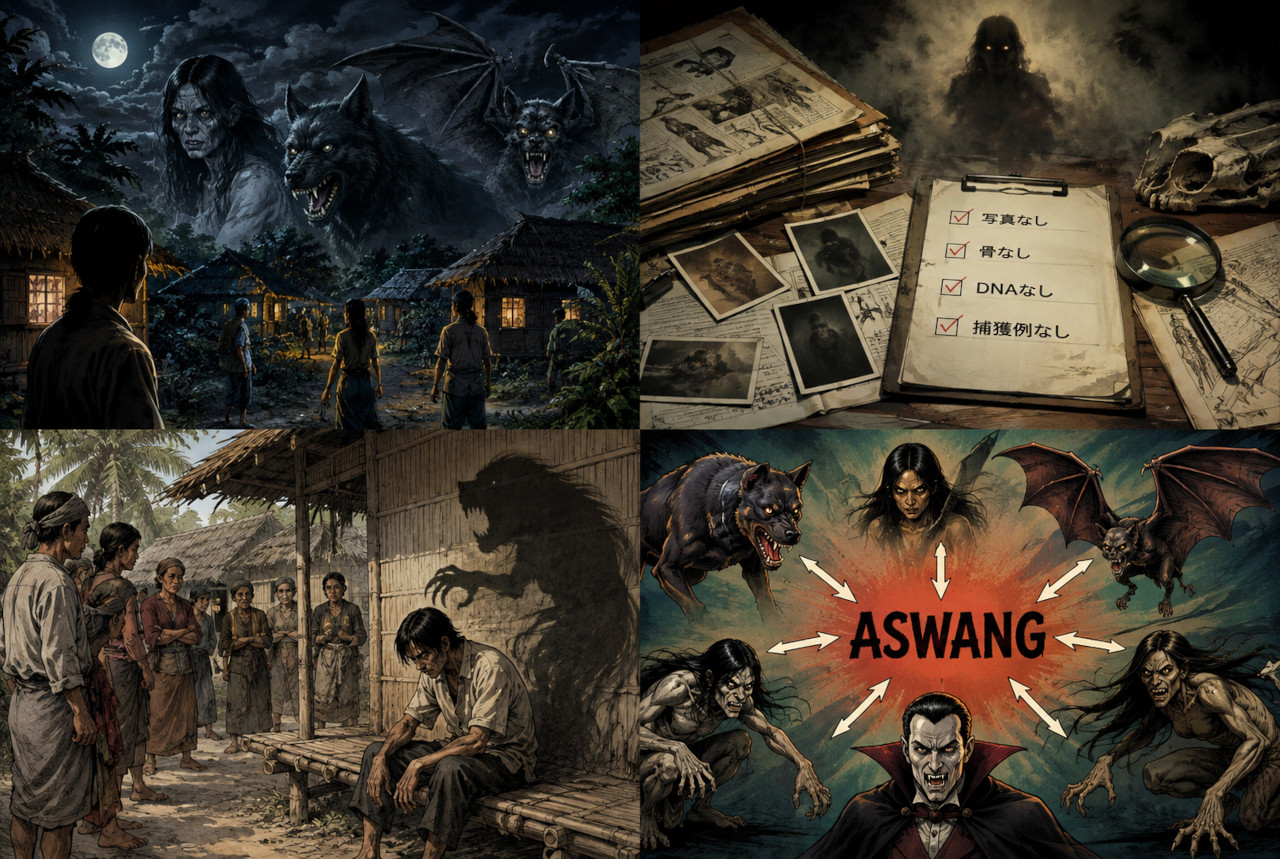
The Philippines has a monster that people have feared for centuries.
Its name is the aswang.
Depending on the story, it drinks blood, eats human organs, transforms into animals such as dogs, flies through the night, or lives quietly among ordinary people during the day. On paper, it sounds like an exceptionally nasty cryptid.
But once you start looking into the aswang seriously, a strange problem appears.
There is no single agreed-upon form of the aswang.
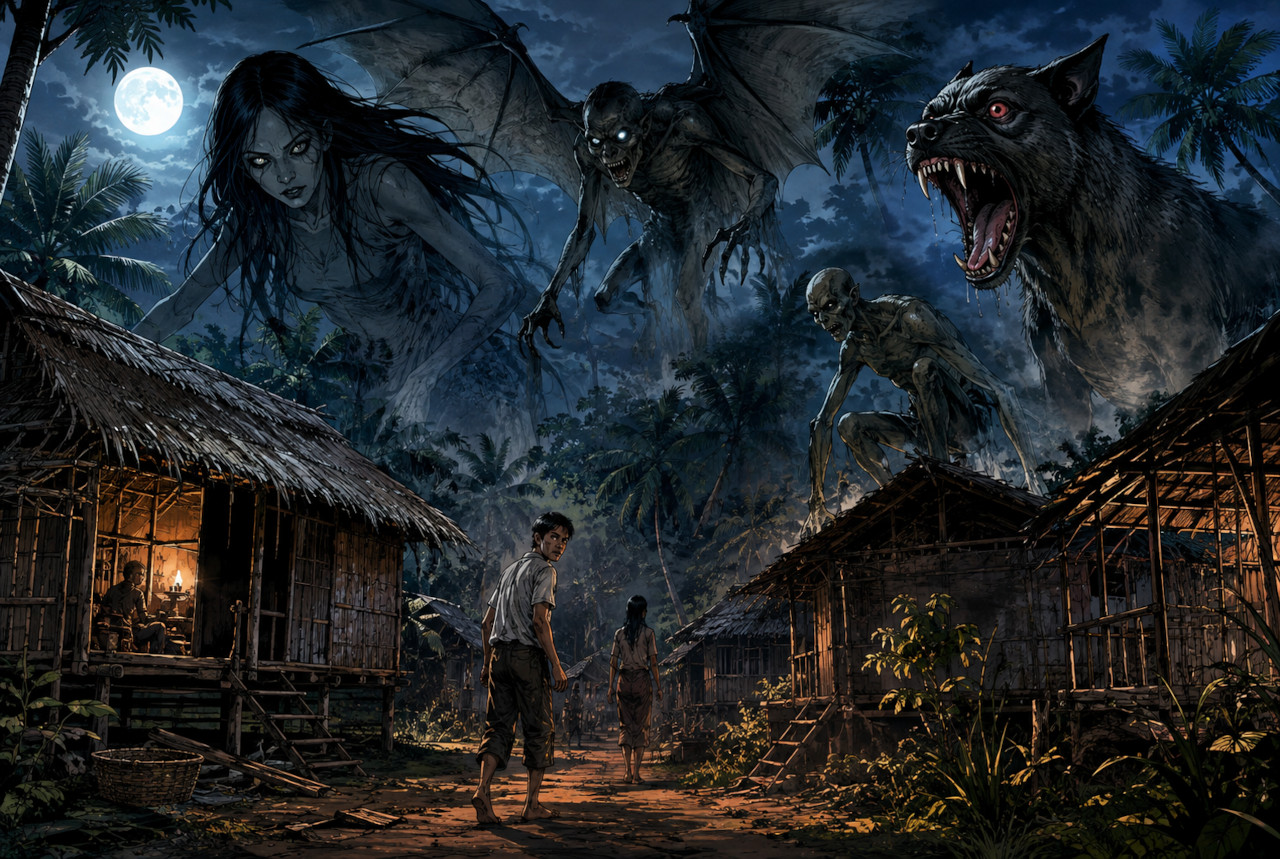 AI-generated illustration visualizing several forms associated with aswang folklore. It does not depict an actual sighting.
Centuries of Stories, but No Fixed Appearance
The aswang is not a modern internet urban legend. Accounts from the Spanish colonial period show that beliefs involving beings called aswang were already being recorded in parts of the Visayas in the 17th century.
For anyone hoping this means a centuries-old unknown animal is waiting to be discovered, that sounds promising.
Then things get complicated.
Depending on the region and story, the label can cover blood-drinking creatures, corpse-eaters, witch-like figures, human beings who transform into animals, and other supernatural beings.
In other words, someone searching for one unknown species may have been dealing with several different traditions grouped under one convenient name from the beginning.
Bigfoot, at least, usually retains one basic identity: a large, humanlike primate. The aswang does not even give investigators that courtesy.
There Are Sightings. The Evidence Does Not Accumulate.
Stories of people seeing an aswang, hearing one outside a house, or encountering something believed to be an aswang have continued into modern times.
But centuries of stories have not produced a scientifically verified specimen, skeleton, DNA sample or captured animal establishing the aswang as an unknown biological species.
A believer can always say that this is exactly what makes the creature mysterious. Fair enough. But if something physical has been entering human settlements for generations, one might expect it to leave something more substantial behind eventually.
Perhaps the reason nobody can catch an aswang is that there was never one biological animal to catch.
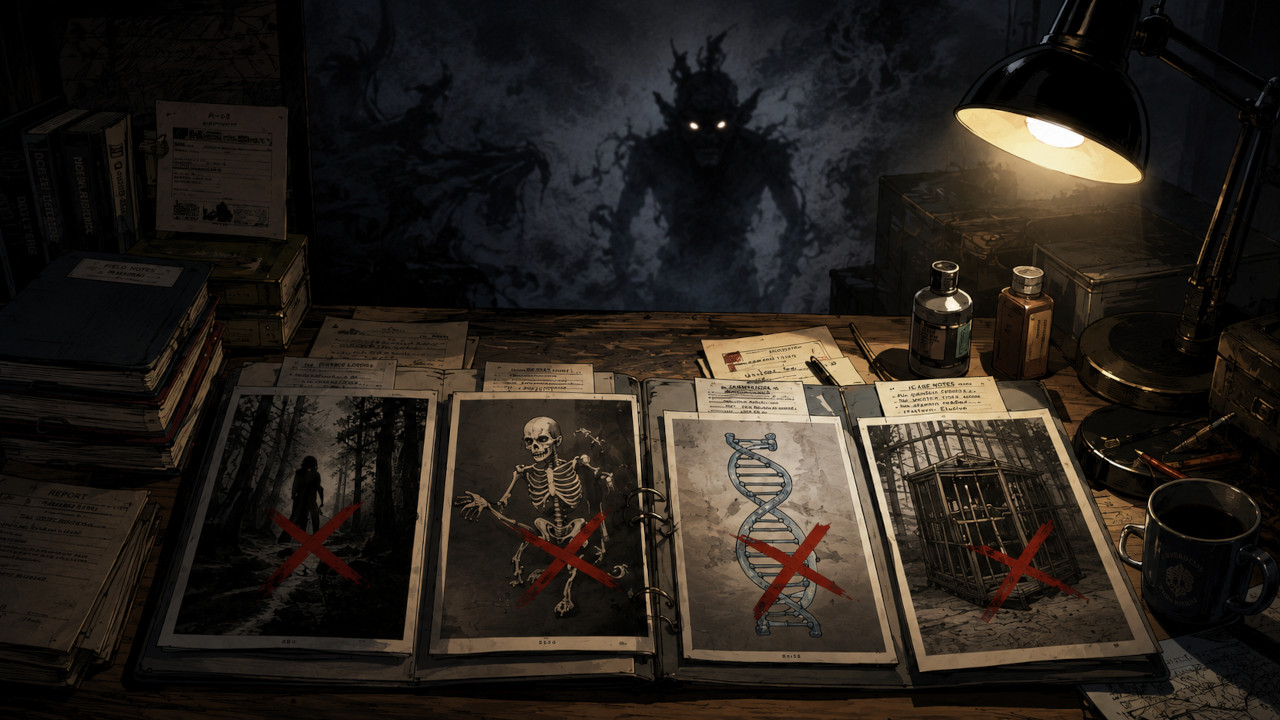 AI-generated conceptual illustration. The materials shown are symbolic and are not actual scientific evidence or case files.
When Nocturnal Animals Become Monsters
Aswang folklore sometimes includes an eerie nighttime sound described as tiktik, traditionally associated with the approach of the creature.
The Philippines, of course, is also home to birds, bats, dogs and other animals active after dark.
Imagine a village before modern street lighting. Something cries from the trees. A shadow moves between houses. An animal disappears before anyone can identify it properly.
Now add a story everyone has heard since childhood.
If the monster already exists in your mind, an unidentified sound or shape has a ready-made name.
That mechanism is hardly unique to the Philippines. Folklore around the world has repeatedly turned unexplained sounds, animals and nighttime encounters into something supernatural.
Could Illness Have Added to the Legend?
There is another intriguing piece of the puzzle. Panay—the island strongly associated with aswang traditions—is also closely associated with a rare inherited neurological disorder called X-linked dystonia-parkinsonism, or XDP.
Epidemiological studies have found XDP to be particularly concentrated in people with ancestry from Panay, with historically high prevalence reported in Capiz province.
The disorder can cause dystonia, including involuntary muscle contractions, twisting movements and abnormal postures, as well as parkinsonian symptoms.
That sounds tempting as an explanation for old stories about people behaving or moving in frightening ways.
But there is an important line that should not be crossed here: XDP has not been proven to be “the cause” or “the true identity” of the aswang.
The folklore is too old, too widespread and too varied for one medical condition to explain all of it.
Still, in an era with little medical knowledge, unusual movements or unexplained illness could certainly have been interpreted through an existing supernatural belief system rather than through neurology.
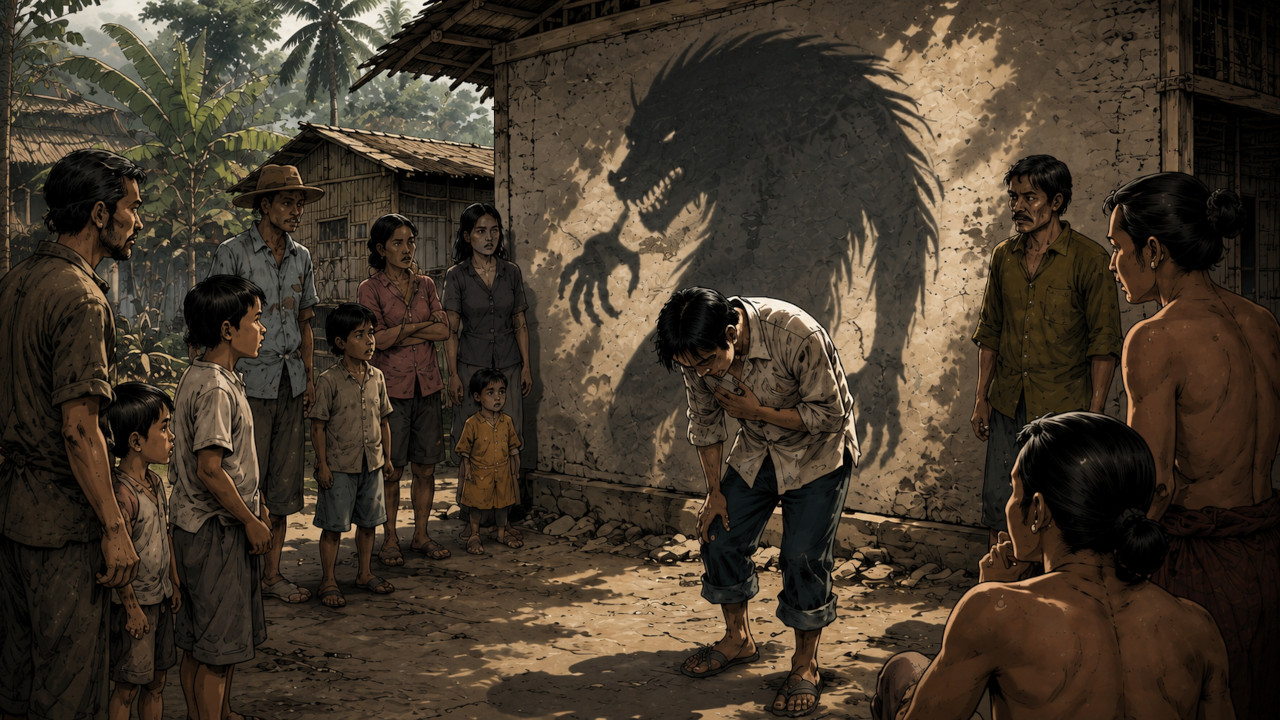 AI-generated conceptual illustration. It symbolizes social interpretation of illness and difference; it does not depict a real patient or historical event.
The Most Unsettling Aswang Looks Completely Human
This is where the aswang becomes very different from the usual cryptid.
In many traditions, an aswang can live as an apparently ordinary person during the day.
You do not need to hike into a remote forest to look for one.
The person living next door might supposedly be the aswang.
Anthropological research in Capiz has documented something especially revealing: real people living within communities who were described by others as aswang.
At that point, the subject stops looking like zoology.
A person may be socially isolated, physically different, ill, unusually private, or simply surrounded by rumors. Once a community already possesses the aswang story, suspicion can provide the rest.
“That person becomes something else at night” is a claim almost designed to resist verification.
In that sense, the phenomenon is closer to accusations of witchcraft—or old Japanese beliefs in kitsune-tsuki, possession by a fox spirit—than to a conventional search for an undiscovered animal.
Almost Anything Can Become an Aswang
The very vagueness of the aswang may be one reason the legend has survived so well.
A flying creature? It can be an aswang.
A strange dog? An aswang in animal form.
A blood-drinking monster? Aswang.
An ordinary-looking human being? That works too.
Every attempt to disprove one version can simply lead to another version.
“Maybe it was only a dog.”
“The aswang transformed into a dog.”
“But that person looked completely normal.”
“Of course. An aswang looks human during the day.”
Biologically, this makes identification almost impossible—not necessarily because the creature is extraordinarily good at hiding, but because the category itself can expand to absorb contradictory descriptions.
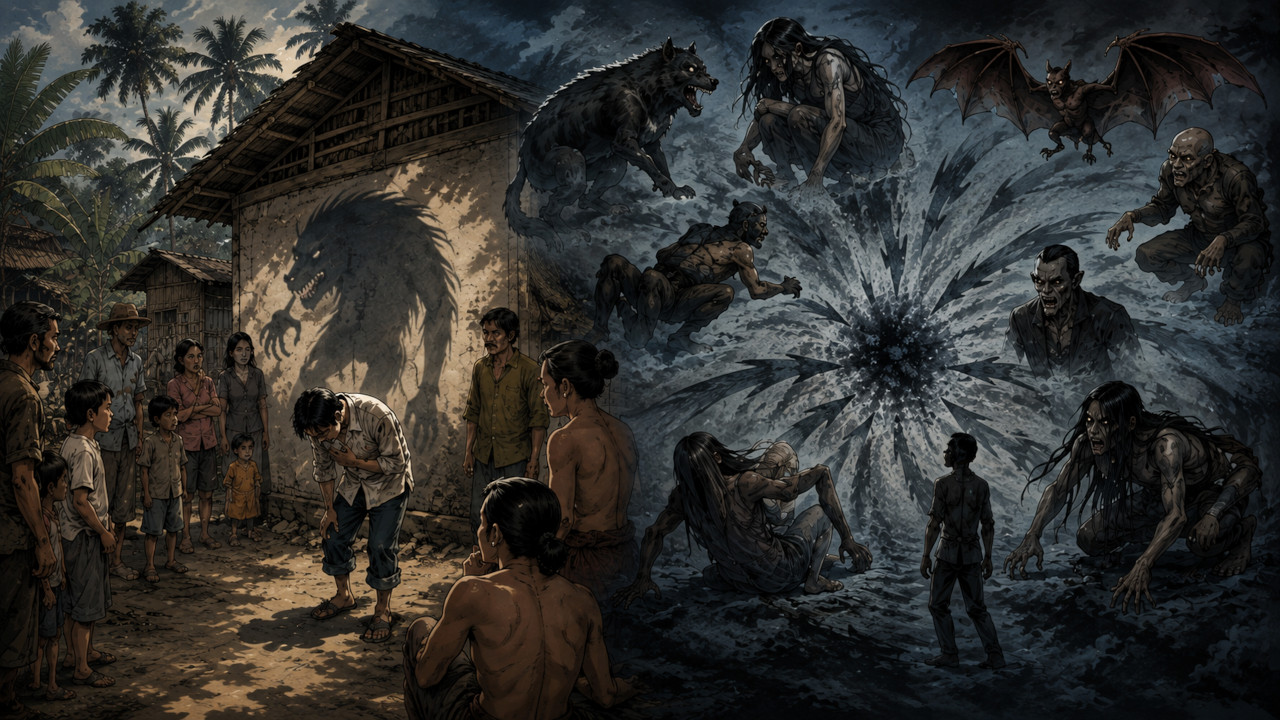 AI-generated conceptual illustration showing how very different beings and appearances can be grouped under the single label “aswang.”
Maybe the Monster Was Never Hiding in the Forest
If the aswang is approached purely as a cryptid, the story becomes familiar: people report sightings, but decisive physical evidence never appears.
Look at folklore, medicine and community life together, however, and a different picture begins to emerge.
Night animals. Unexplained illness. Suspicion toward other people. Village rumors. Old supernatural traditions. Later, films, television and popular culture keep recycling the image.
None of those elements alone explains every aswang story.
Together, however, they can help explain how a monster survives for centuries without ever settling into one biological form.
And that may be why nobody catches it.
The thing people were trying to catch may never have been one creature in the first place.
We started by looking for an unknown animal.
What we ended up finding was something rather more familiar: the human tendency to turn the unexplained, the unfamiliar and sometimes even other people into monsters.
Seen that way, the aswang is more troublesome—and much more interesting—than a simple question of whether a cryptid is “real.”
Editor’s Note
Words like “developed” and “developing” countries feel increasingly crude these days, yet a centuries-old belief like the aswang can still trigger that old image of a place where folklore remains unusually close to everyday life. Then again, Japan still sells omamori protective charms, worries about yakudoshi “unlucky ages,” and loves a good ghost story. Modernization changes roads, phones and buildings much faster than it changes the part of us that wants a supernatural explanation. Maybe that part of humanity never really upgrades.
References
- Francisco Ignacio Alcina, Historia de las Islas e Indios de Bisayas (1668), Chapter 18, “Concerning Witches, Unglos and Other Such in Their Antiquity; Whether Such Still Exist Now.” English/Spanish text republished in Philippiniana Sacra, Vol. 46, No. 136, 2011.
- Kentaro Azuma, “Witchcraft in Daily Life of Living as a Witch: The Case of ‘aswang’ in L. Village, Capiz, Panay in the Philippines,” Journal of Lifology, Vol. 7, 2002, pp. 45–55. DOI: 10.24528/lifology.7.0_45.
- Allan N. Derain, “May Tiktik sa Bubong,” Reading the Regions 2: Philippine Folk and Oral Traditions, National Commission for Culture and the Arts / Ateneo de Manila University repository, 2021.
- National Center for Biotechnology Information, GeneReviews: X-Linked Dystonia-Parkinsonism.
- MedlinePlus Genetics, “X-linked dystonia-parkinsonism,” U.S. National Library of Medicine.
- GMA News Online, “Investigating the Monster in ‘The Aswang Phenomenon,’” 2013.