

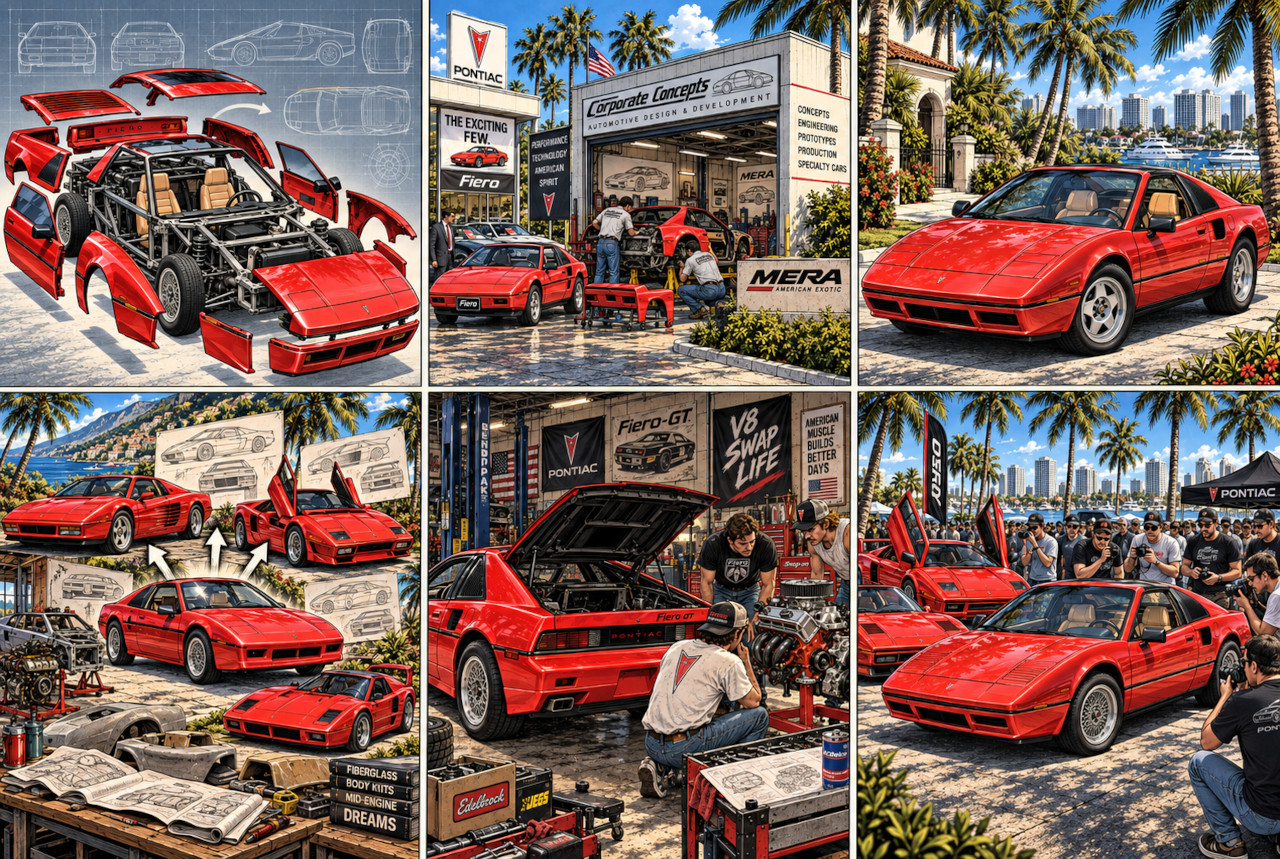
Pontiac ended production of the Fiero in 1988. But the strange life of America’s mass-produced mid-engine two-seater did not end there. If anything, the Fiero became even more interesting once it entered the used-car market. It became a Ferrari, a Lamborghini, and sometimes even received a V8. A car that had struggled to establish itself as a serious sports car suddenly became one of the most convenient platforms for pretending to be a much more exotic one.
Why the Fiero? The answer is surprisingly simple: its construction made transformation unusually easy.
The Strange Life of the Pontiac Fiero — 3-Part Series
From its underpowered commuter-car origins to its final 1988 transformation and its strange second life as a replica-car platform, this three-part series follows the Pontiac Fiero from birth to afterlife.
- Part 1: Why Was the Pontiac Fiero So Slow? — The Mid-Engine Sports Car That Had to Pretend It Was a Commuter
- Part 2: Why Did the Pontiac Fiero Disappear Just as It Got Good? — Fires, the MR2, and the 1988 Overhaul
- Final Part: Why Did the Pontiac Fiero Become a Ferrari? — How America’s Mid-Engine Oddball Became the King of Replicas
You Could Remove the Body and It Was Still a Fiero
The Fiero used a steel space-frame structure covered by non-structural composite body panels. Unlike a conventional unibody car, the exterior panels were not the main structural shell of the vehicle. That meant the body could be replaced while leaving the underlying chassis largely intact.
The basic proportions also happened to suit exotic-car conversions remarkably well: two seats, a transverse mid-engine layout, a low roofline, and compact overhangs. The Fiero’s wheelbase was 93.4 inches, or about 2,373 mm. The Ferrari 308 GTB measured 2,340 mm. That is a difference of only about 33 mm. The Fiero did not merely look suitable for a 308-style conversion; its basic dimensions were unusually compatible with one.
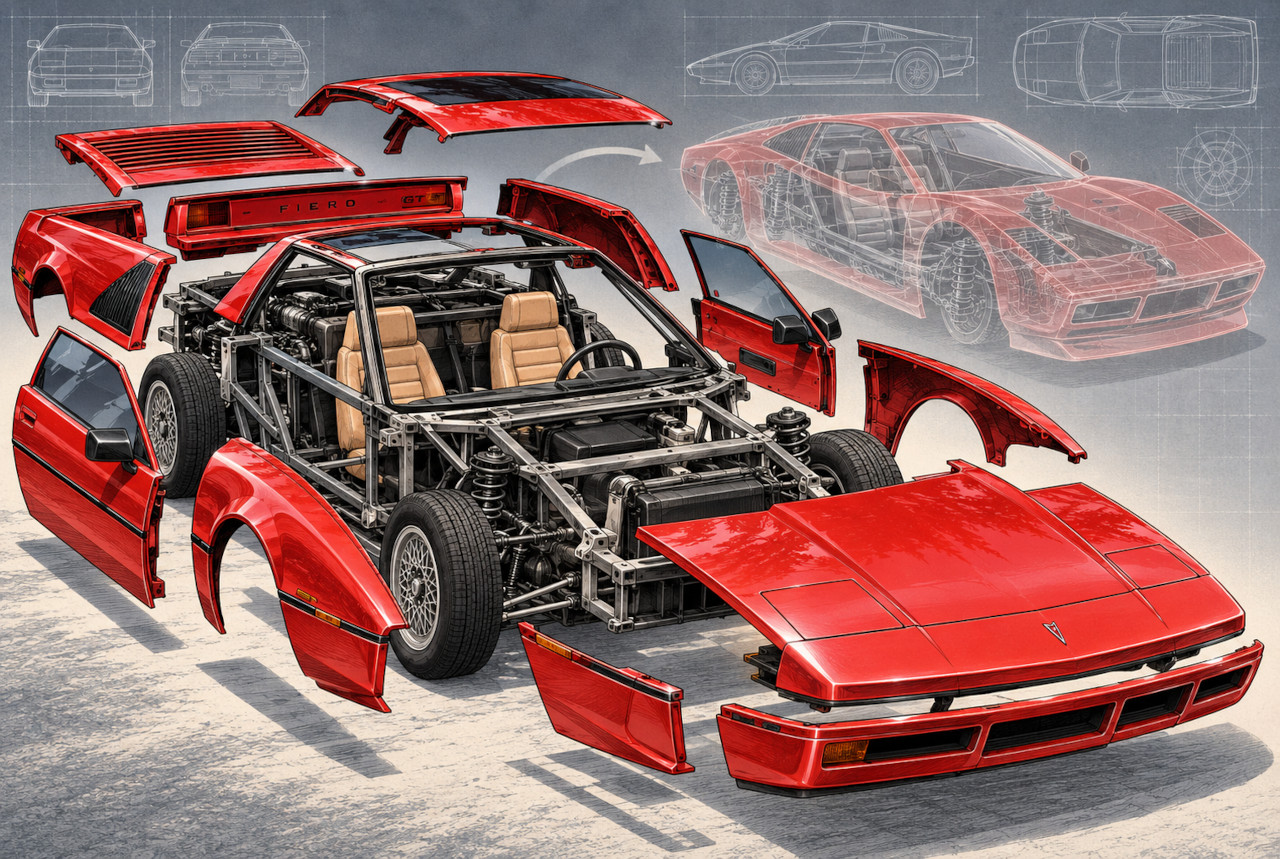 AI-generated illustration showing the relationship between the Fiero space frame and its removable composite body panels. Component shapes and locations are not intended as an exact factory service diagram.
Then Came the Fiero Mera
The most famous example appeared in 1987: the Fiero Mera. Michigan-based Corporate Concepts Limited took brand-new Fieros, removed their factory body panels, and installed fiberglass bodywork that strongly evoked the Ferrari 308.
The Mera was not simply a mail-order kit that owners installed in their garages. A customer ordered a new Fiero through a Pontiac dealer, the car was sent to Corporate Concepts for conversion, and the completed Mera was then delivered as a finished vehicle. The example tested by Car and Driver in 1987 carried a price of $24,995. This was not exactly a bargain-basement fake Ferrari. It was an expensive, professionally converted Fiero.
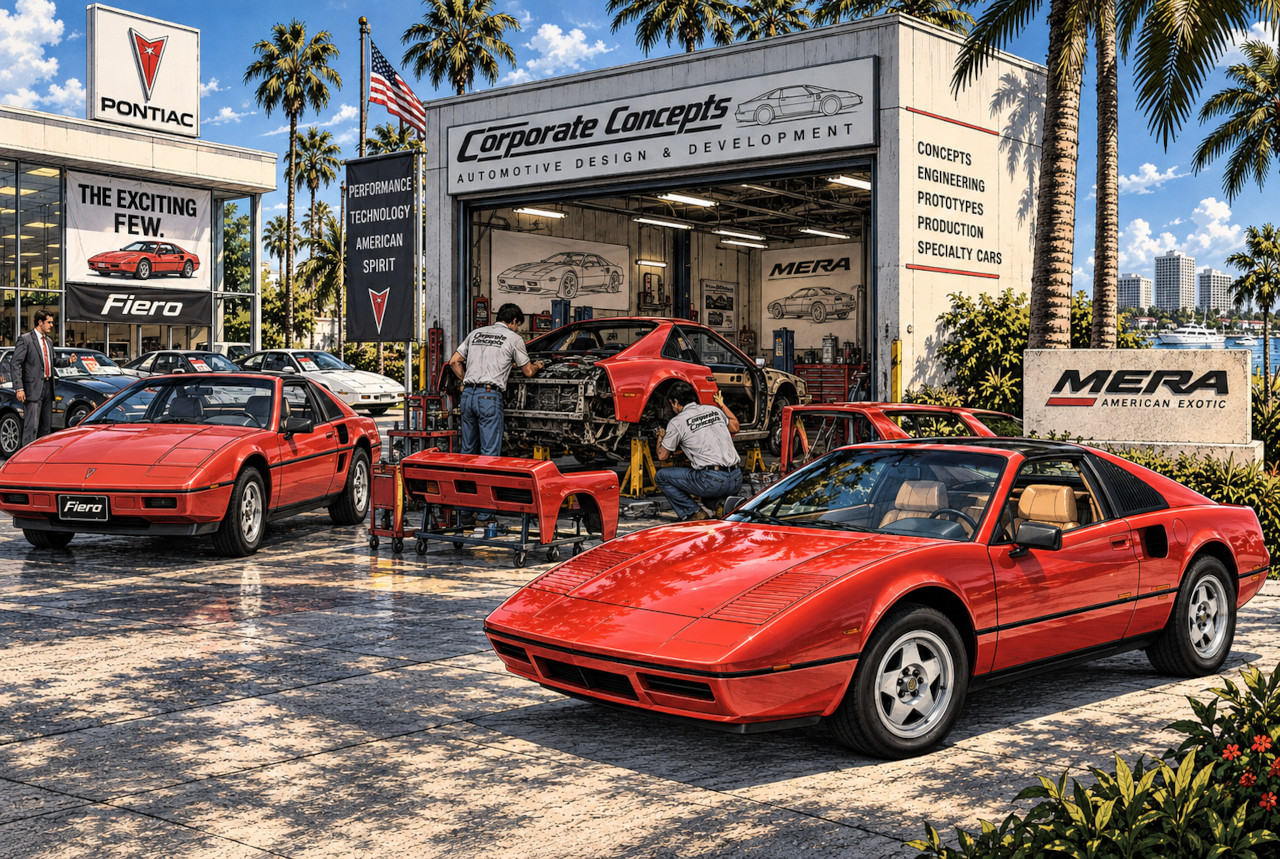 AI-generated illustration representing the Fiero Mera conversion process. It does not reproduce an actual Corporate Concepts facility or dealership scene.
“Not a Ferrari” — Even Though Everyone Knew What It Resembled
Corporate Concepts did not officially position the Mera as a replica of another manufacturer’s car. It was marketed as its own model. Yet even Car and Driver treated that claim with some amusement, because the inspiration behind the styling was hardly mysterious.
Most sources place total Mera production at 247 cars across 1987 and 1988. Production is generally understood to have ended after legal action from Ferrari. One important detail is often lost in simplified retellings: Ferrari’s dispute was not with Pontiac itself, but with Corporate Concepts, the company carrying out the conversion.
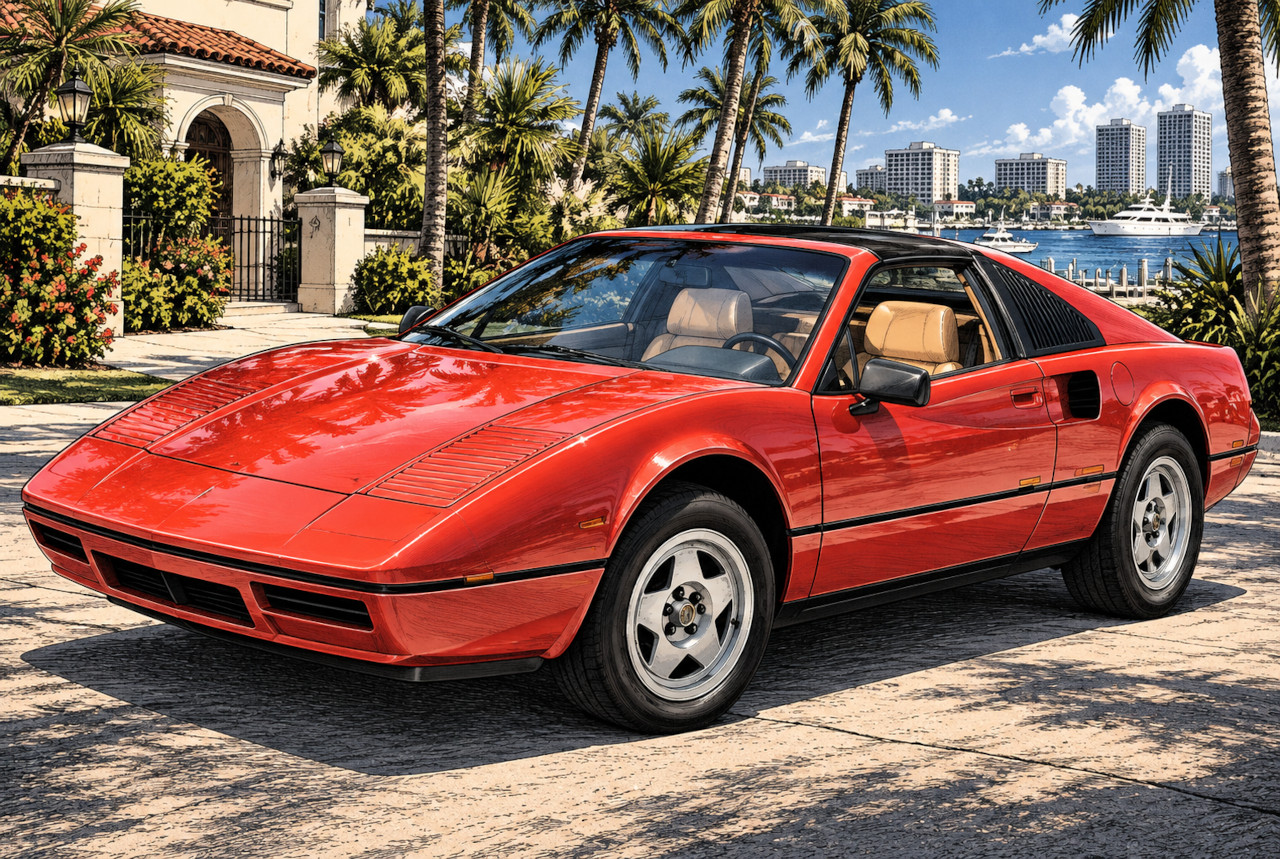 AI-generated image inspired by the appearance of the Fiero Mera. It is not an exact reproduction of every production detail and does not depict a genuine Ferrari.
The Fiero Died, but the Transformation Culture Kept Growing
Once Pontiac stopped building the Fiero, hundreds of thousands of used cars gradually entered the secondhand market. Total production reached roughly 370,000 units. That created an ideal donor-car formula: affordable used examples, a mid-engine layout, two seats, and body panels that were relatively easy to replace.
The result went far beyond 308-style cars. Fiero-based conversions appeared with styling inspired by the Ferrari Testarossa and F40, as well as the Lamborghini Countach and Diablo. Some Countach-style conversions even stretched the Fiero chassis to achieve proportions closer to the real supercar.
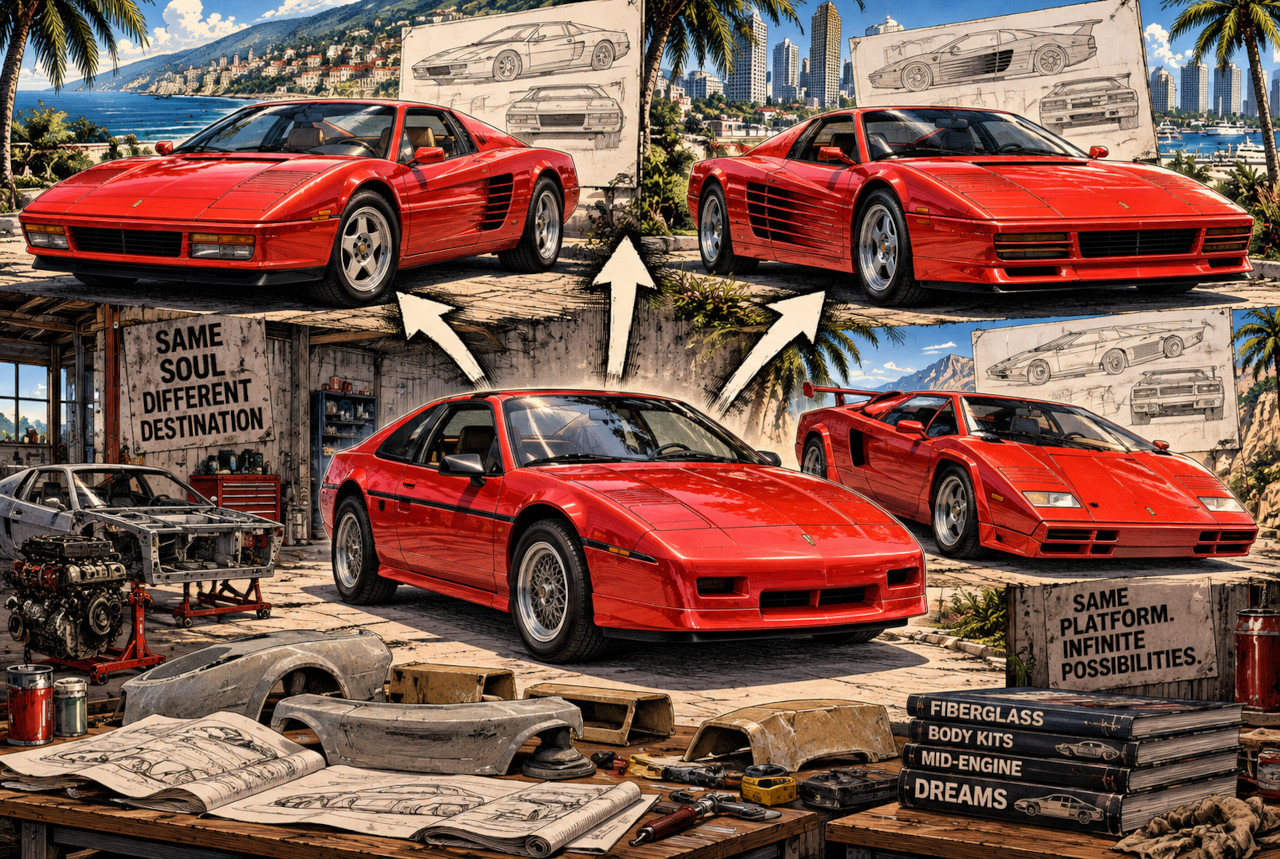 AI-generated illustration representing the Fiero-based replica-car scene. It does not reproduce any specific commercial body kit exactly.
Looking Exotic Was Not Enough — So People Started Installing V8s
Once a Fiero looked like a supercar, another problem became obvious: the engine still sounded and performed like a Fiero. The earliest cars had started life with the 92-hp Iron Duke four-cylinder. American customizers naturally found a solution: engine swaps.
One of the best-known names in this world is Archie Archambault, better known as “V-8 Archie.” According to his own history, he installed a 327-cubic-inch Chevrolet V8 from a 1967 Camaro into a 1984 Fiero, completing the project in 1986. Demand from other enthusiasts eventually led him to sell V8 conversion kits.
Over the years, Fieros received small-block Chevrolet V8s, supercharged 3800 V6s, and a variety of other GM performance engines. The cheap mid-engine commuter had effectively become a blank canvas.
A car once mocked for combining a mid-engine layout with only 92 hp eventually became a platform that owners stuffed with V8s. By that point, the Fiero had become something very different from what Pontiac had originally imagined.
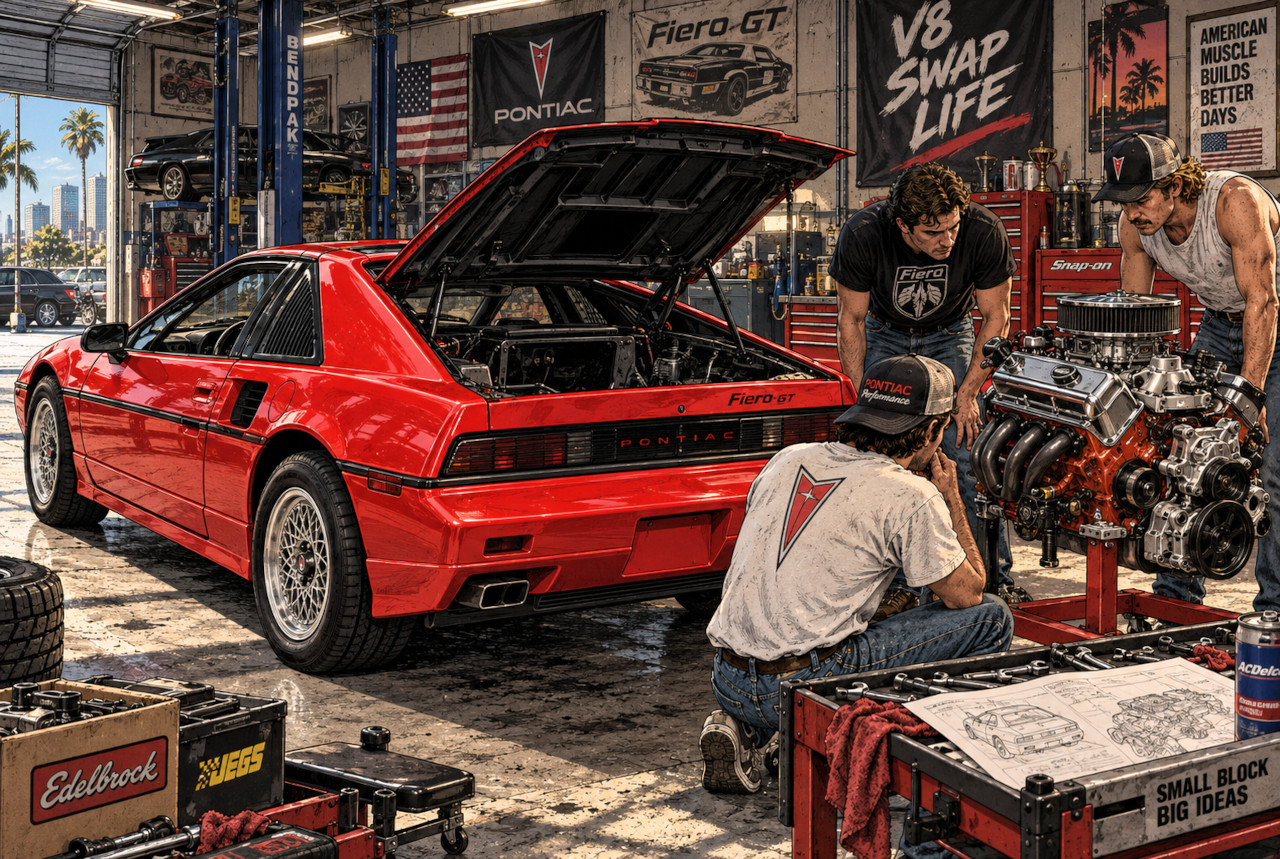 AI-generated illustration representing Fiero V8-swap culture. It is not intended as a technical guide or set of conversion instructions.
And Now the Unmodified Fieros Are the Interesting Ones
The final irony is what has happened decades later. There was once a time when an inexpensive used Fiero was valuable precisely because someone could remove its body, stretch the chassis, and turn it into something more exotic. Today, collectors increasingly appreciate the opposite: Fieros that still look and feel like Fieros.
V6 cars and the heavily revised 1988 models are particularly attractive to enthusiasts. That does not mean every Fiero is suddenly worth a fortune. Values vary dramatically depending on model, condition, mileage, and originality. But surviving low-mileage and largely unmodified cars now have an appeal that would have seemed strange when Fieros were cheap donor cars for replica projects.
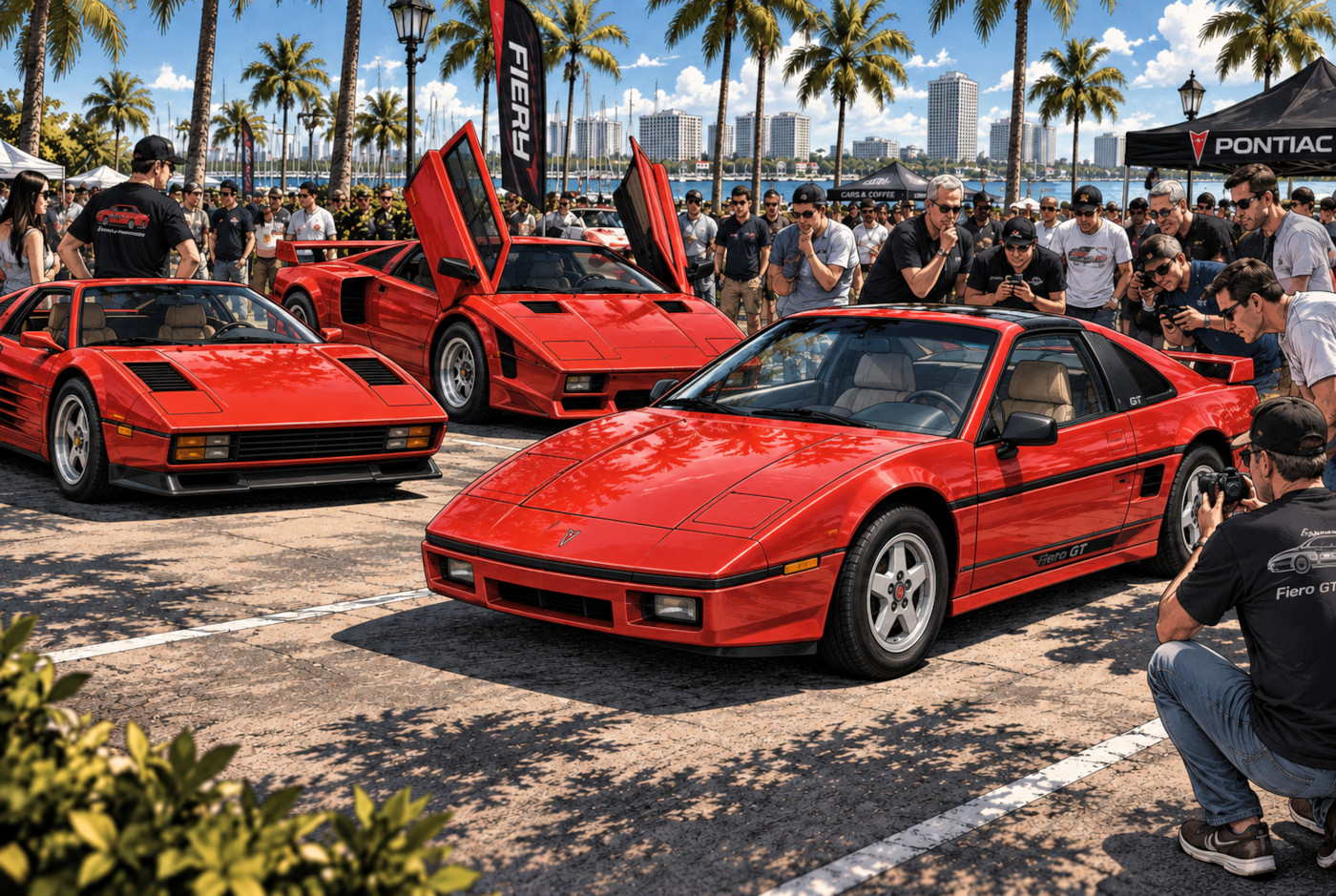 AI-generated illustration contrasting Fiero replica culture with the modern appreciation of original, unmodified Fieros.
The Fiero became a Ferrari. It became a Lamborghini. It received V8 engines. Yet nearly four decades later, the version that can be hardest to replace is the one that never became anything other than an ordinary Fiero.
Perhaps the Fiero’s greatest talent was never outright speed. It was something stranger: the ability to stop being a Fiero. That unusual quality helped keep the car alive culturally long after Pontiac stopped building it.
Editor’s Note
I still remember a Japanese car magazine describing the Fiero as “a sheep in wolf’s clothing.” That should have been an insult, but somehow it only made the car more interesting to me. I once went out of my way to visit specialty car shops in Tokyo because I wanted to see Fiero-based replicas more than the genuine exotic cars they were imitating. Perfect authenticity is not always what makes car culture fun. Cheap imitations, questionable conversions, and slightly ridiculous ideas have their own energy. That B-movie side of car culture is part of what made the Fiero scene so fascinating.
References
- Car and Driver, “The Mera Was an ’87 Pontiac Fiero Cosplaying as a Ferrari” — Mera sales and conversion process, $24,995 test-car price, and the Fiero’s 93.4-inch wheelbase
- MotorTrend, “Pontiac Fiero History and FAQ” — Total Fiero production, the Mera, replica-car conversions, and engine-swap culture
- Ferrari Official, “308 GTB” — Ferrari 308 GTB specifications, including its 2,340 mm wheelbase
- Museum of Intellectual Property, “Vehicle Designs” — Ferrari’s legal response to replica manufacturers and material concerning Corporate Concepts and the Mera
- V-8 Archie, “About V-8 Archie” — History of the 327-cubic-inch V8 Fiero conversion and the development of Fiero V8-swap culture
- Hagerty Valuation Tools, “1988 Pontiac Fiero GT” — Current market context and collector interest in later V6 and 1988 Fieros