

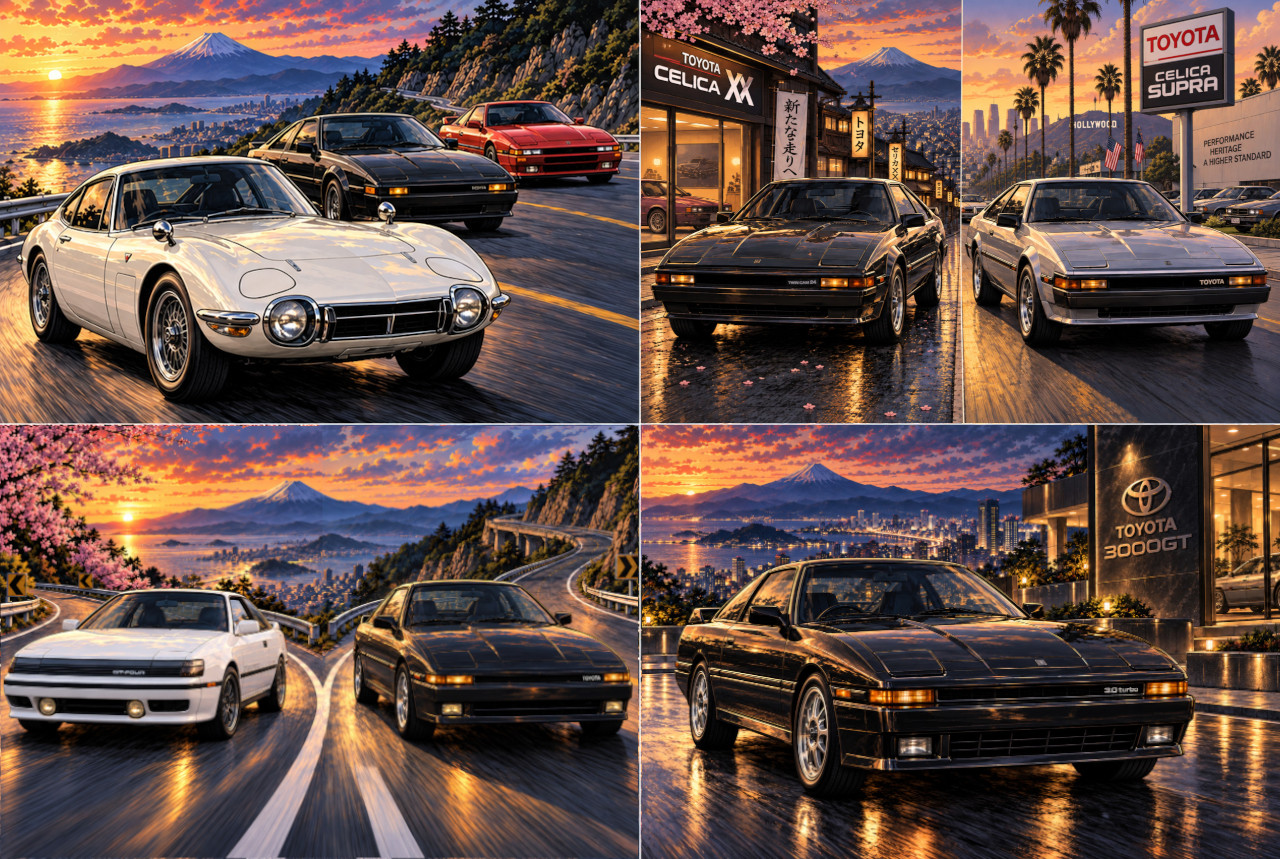
Most histories of the Toyota Supra jump straight to the A70 or the now-iconic A80. That makes sense if the goal is to talk about performance legends, but it skips the stranger part of the story. Japan did not officially get a car called “Supra” until 1986. By then, however, Toyota’s global lineage already counted the new model as the third generation of a name that had been developing overseas for years.
The first two generations had been hiding in plain sight under a different Japanese badge: Celica XX. And behind even that sits the Toyota 2000GT—not as a direct predecessor, but as an important reference point for Toyota’s idea of a serious inline-six, rear-wheel-drive grand tourer. This first part follows that thread from the 2000GT through the Celica XX and into the early A70 Supra.
Toyota Supra — 3-Part Series
From the Toyota 2000GT and Celica XX roots to the A70’s shift from the M-series to the JZ era, and finally the A80 legend and the Supra’s long-awaited return, this three-part series traces how the Supra evolved across generations.
- Part 1: Toyota Supra: Why Japan’s First Supra Was Already the Third Generation
- Part 2: How the A70 Supra Changed Its Bloodline: Turbo A to 1JZ Coming soon
- Final Part: Why the Toyota Supra Became a Legend During Its 17-Year Absence Coming soon
The 2000GT Was Not the First Supra—But It Was Not Irrelevant Either
The first thing to get straight is that the Toyota 2000GT was not the first Supra. Its chassis code was MF10, not part of the A40, A60 or A70 family associated with the Supra lineage. Calling the 2000GT “the original Supra” would therefore be historically sloppy, especially in front of anyone who knows Toyota model codes.
That does not mean the connection is imaginary. The 2000GT established an important Toyota formula: front-engine, rear-wheel drive, an inline-six engine, and the idea of a high-performance grand tourer capable of representing the company at a much higher level than an ordinary coupe.
There is also an interesting mechanical thread. The 2000GT used the 3M engine, while later Celica XX models used engines such as the 4M and 5M, and the A70’s 3.0-liter turbo flagship would eventually use the 7M-GTEU. The chassis codes do not form a direct family tree, but the M-series inline-six lineage gives the story a more tangible connection than simple nostalgia. The Supra did not suddenly invent Toyota’s six-cylinder GT idea in 1986.
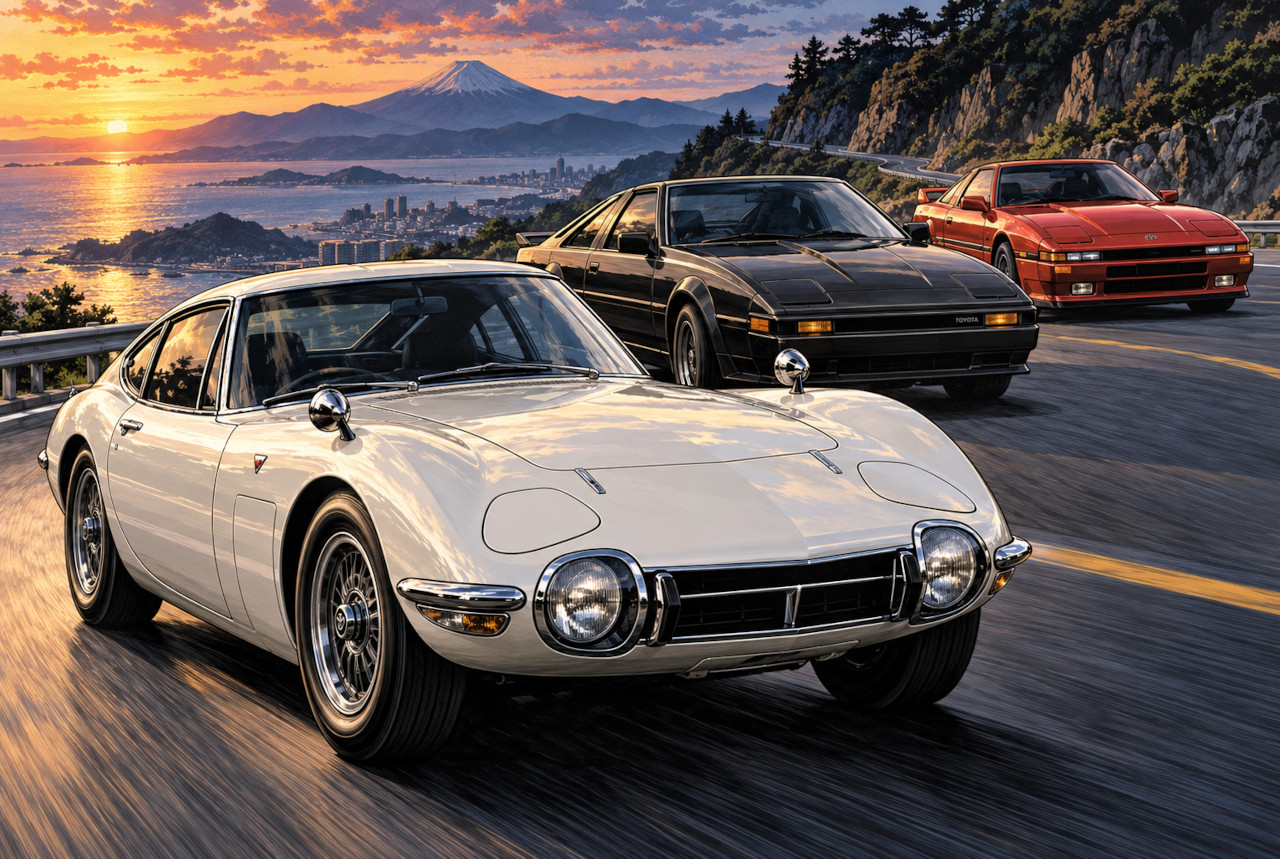 AI-generated illustration showing the 2000GT, Celica XX and A70 Supra as a visual representation of Toyota’s GT lineage. It is not a period photograph.
In Japan It Was the Celica XX. Overseas, It Was Already a Supra
The direct Supra story begins in 1978 with the first-generation Celica XX. Toyota stretched the Celica Liftback platform, increased the wheelbase and overall length, and installed an inline-six engine to create a more upscale specialty GT. One of the important targets was the North American market, where Nissan’s Z-car had already established a strong position.
The name is where things get interesting. In Japan, the car was sold as the Celica XX. In North America, it was marketed as the Celica Supra. In other words, the Supra name existed long before Japanese buyers saw it on the trunk lid of an A70.
That difference became even more obvious with the second-generation A60 Celica XX, introduced in 1981. Its pop-up headlights, sharp wedge-shaped body and inline-six layout gave it the unmistakable look of an early-1980s Japanese GT. Japan still knew it as the Celica XX, while overseas buyers knew the same basic lineage as the Celica Supra.
So when Toyota finally launched the Supra name in Japan in 1986, the company was not introducing a completely new identity. Globally, it was already moving into the third generation.
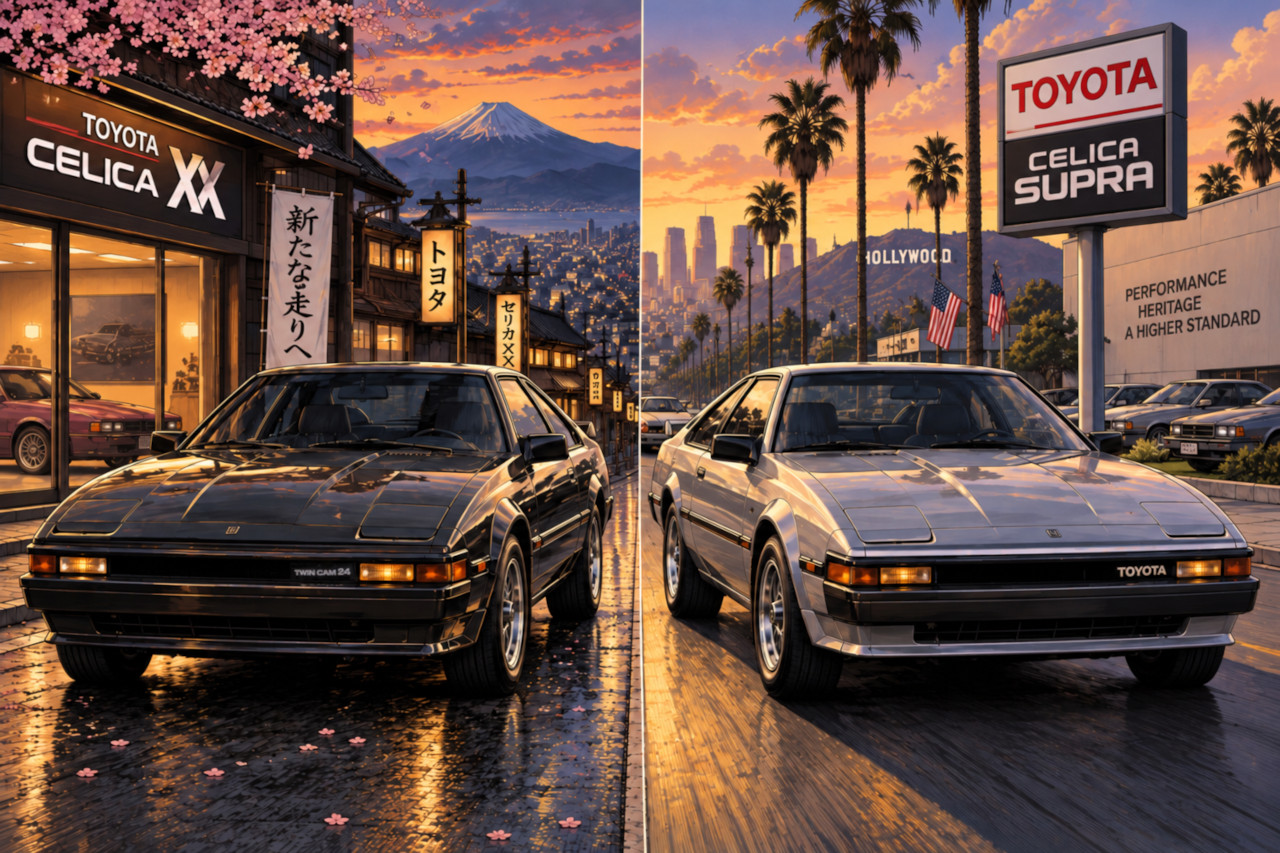 AI-generated illustration contrasting the Japanese Celica XX name with the overseas Celica Supra identity. It is an illustrative reconstruction, not a historical photograph.
When the Celica Went Front-Wheel Drive, the XX Could No Longer Follow
In 1985, the fourth-generation Celica made a major technical break with its past. The regular Celica moved from rear-wheel drive to a front-wheel-drive-based layout, reflecting the direction Toyota was taking with its mainstream sporty coupe.
The Celica XX had a different problem. Its character had been built around a longitudinally mounted inline-six engine, rear-wheel drive and the proportions of a long-nose GT. Simply following the regular Celica into the same architecture would have meant giving up much of what made the XX distinctive.
That split created the conditions for the Supra to become a separate model rather than merely the expensive six-cylinder version of a Celica. The Celica and the Supra could now move in different directions: one toward a new generation of compact sporting coupes, the other continuing as Toyota’s larger six-cylinder GT.
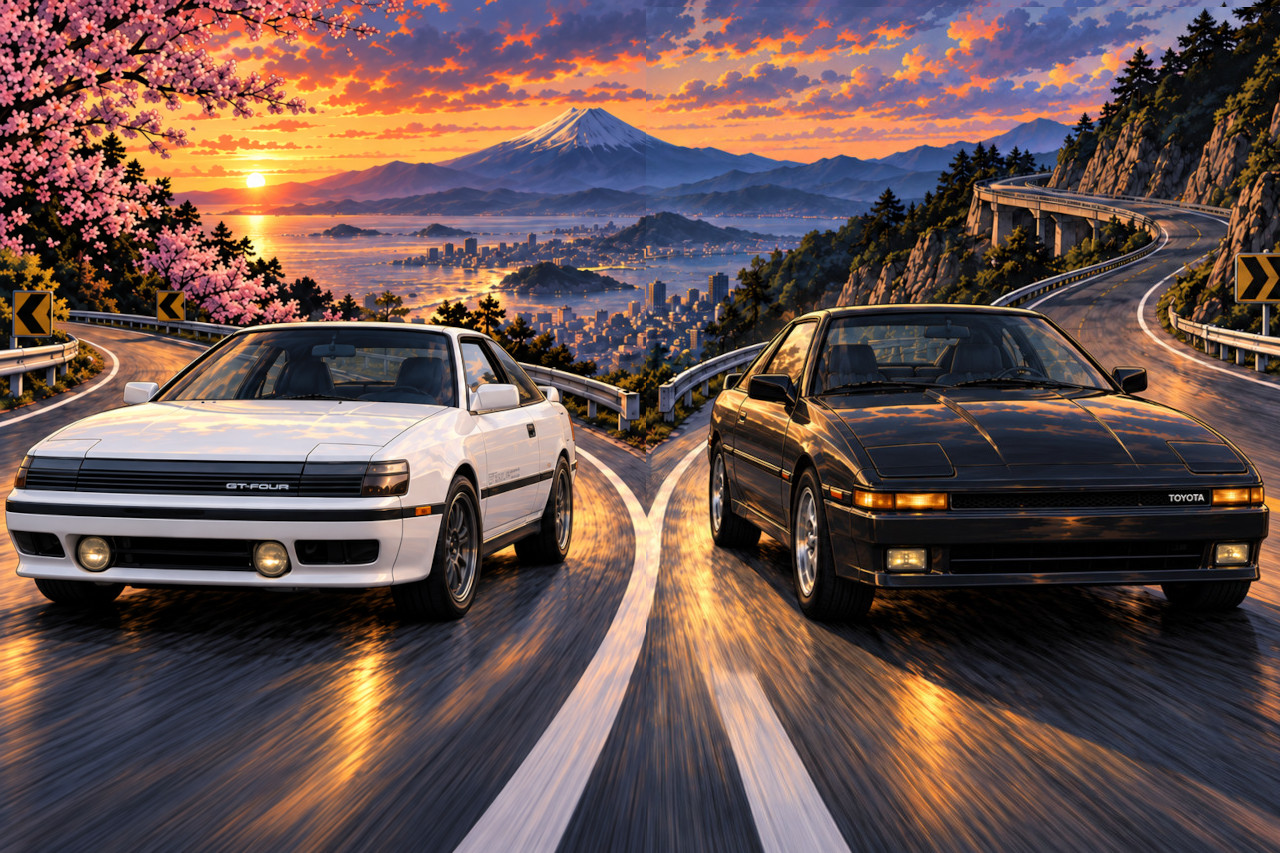 AI-generated illustration symbolizing the model split. The pictured Celica GT-Four was all-wheel drive, but belonged to the fourth-generation Celica family built around Toyota’s new front-drive-based architecture.
The A70 Arrived in Japan as the “TOYOTA 3000GT”
In February 1986, the A70 Supra arrived. For Japan, this was the first Toyota officially sold under the Supra name. Engine choices included 2.0-liter 1G-series units and, at the top of the range, the 3.0-liter 7M-GTEU.
The 3.0GT Turbo used an intercooled, DOHC 24-valve inline-six producing 230 PS. The A70 also featured four-wheel double-wishbone suspension, four-wheel disc brakes and an equipment level that positioned it less as a lightweight sports car and more as a high-performance grand tourer.
One of the most revealing parts of its launch was not the specification sheet but the advertising. Toyota promoted the A70 with the phrase “TOYOTA 3000GT.” It was not the official model name, but the reference to the 2000GT was hardly subtle. Toyota was deliberately surrounding the new Supra with the aura of its most famous earlier GT.
That makes the A70 more interesting than a simple Celica XX replacement. Toyota was not merely introducing a new badge. It was positioning the Supra as the return of a serious, high-level Toyota GT.
The early A70 was still very much a grand tourer rather than a stripped-down sports machine. A removable-roof Sport Roof version followed in 1986, and in 1987 a wide-body version appeared, giving the Supra more of the muscular stance many people now associate with the model. The earliest cars, however, began with the cleaner narrow-body look.
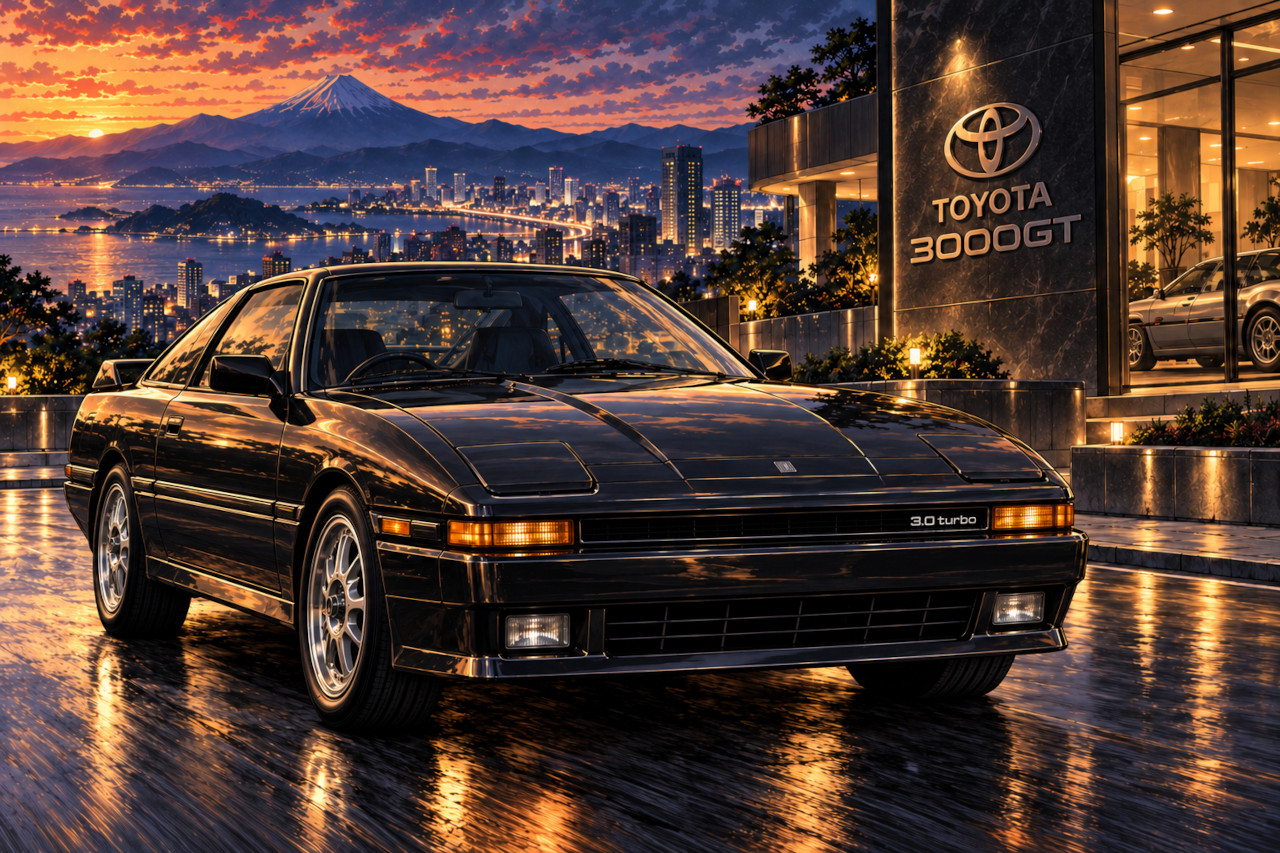 AI-generated illustration inspired by the A70 Supra’s 1986 launch campaign. “TOYOTA 3000GT” was an advertising expression, not the car’s official model name.
The A70 Was Not a Supra That Appeared Out of Nowhere
Looking only at the early A70 makes one thing clear: the Supra did not suddenly appear in 1986 as a brand-new idea. Toyota had already established a high-performance GT image with the 2000GT. The Celica XX had developed the six-cylinder grand-touring formula further, while the Celica Supra name had already gained years of recognition outside Japan.
When the Celica itself moved to a new front-drive-based architecture, the six-cylinder rear-wheel-drive GT finally had a reason to stand on its own. The A70 was therefore less the beginning of the story than the point where several older threads were finally tied together under one name.
That is why Japan’s “first Supra” can also be described as the third-generation Supra globally. The badge was new to Japan, but the idea behind it had already been developing for years.
In Part 2, the focus shifts to what happened after the A70 matured: the 1988 facelift, the competition-oriented Turbo A, and the later evolution that pushed the 70-series Supra much further than its original 1986 form.
Editor’s Note
Back in my student days, I drove a later 2.0-liter naturally aspirated Supra. A close friend went from a late 2.0-liter Celica XX to an early 2.8GT. This was long before you could type a model name into a search box and have everything handed to you. We hunted through magazines and brochures, memorized specifications and talked about these cars far more than was probably necessary. For me, the Supra and XX are not just old cars. They are also memories of the pleasure of digging into a subject until you really knew it.
References
- Toyota Global: Toyota 2000GT vehicle lineage
- Toyota Global: First-generation Celica XX / Celica Supra vehicle lineage
- Toyota Global: Second-generation Celica XX / Celica Supra vehicle lineage
- Toyota Global: Fourth-generation Celica vehicle lineage
- Toyota Global: A70 Supra vehicle lineage
- Toyota Global: 1986 advertising record — “Toyota 3000GT Supra debut campaign”
- GAZOO: A70 Supra brochure feature (Japanese)
- GAZOO: Supra feature (Japanese)