

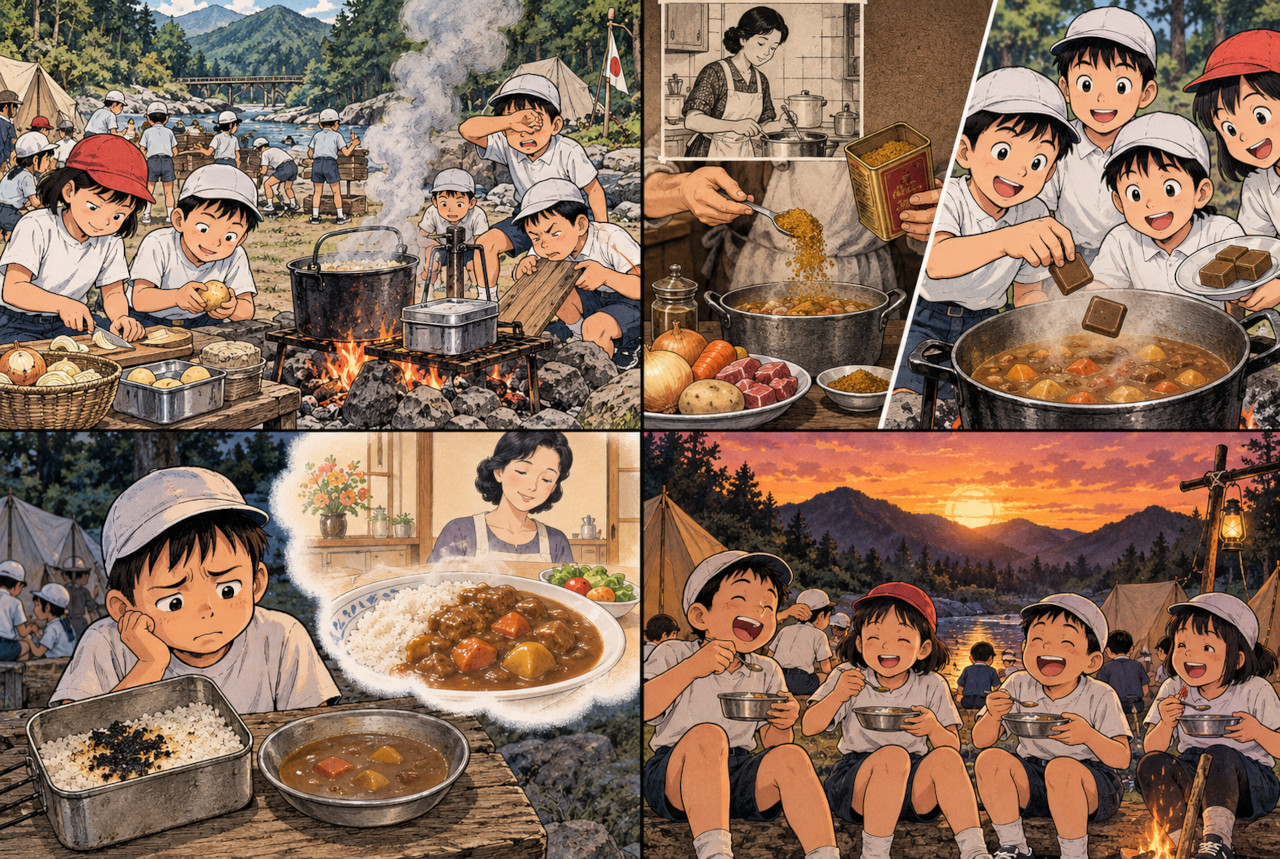
Go on a Japanese school camping trip and a strangely familiar scene tends to appear: students split into small groups, gather firewood, start a fire, cook rice in metal mess tins—and somewhere beside it all, a large pot of curry begins to simmer.
Why curry? It could just as easily be yakisoba, pork-and-vegetable soup, or some other simple meal. Yet generations of Japanese children, in different regions and different decades, have somehow ended up in the mountains chopping potatoes for curry.
There was never a nationwide rule saying, “School camps must serve curry.” A better explanation is that once you list everything a school needs from an outdoor group-cooking activity, curry starts looking suspiciously close to the perfect answer.
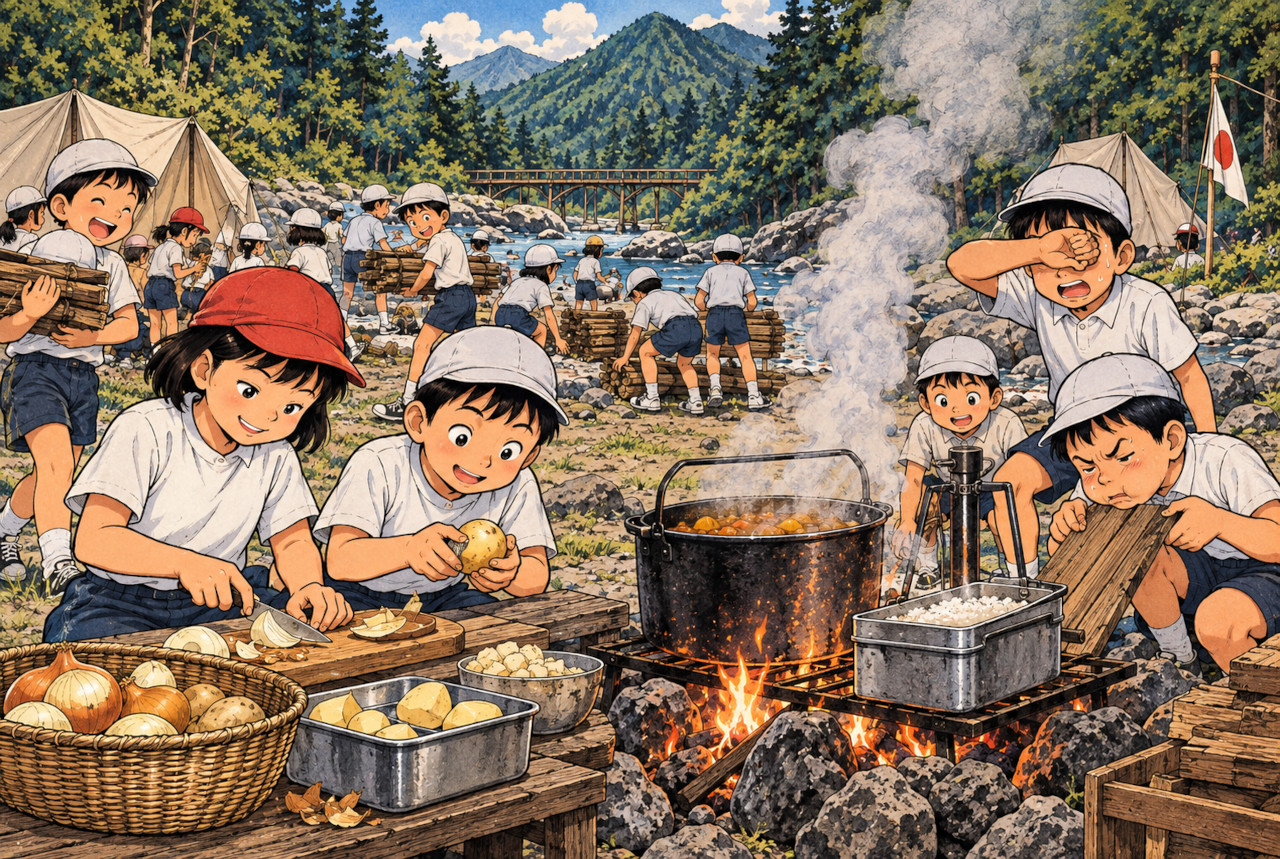 AI-generated illustration depicting a typical Japanese school-camp cooking scene; it is not a photograph of a specific historical event.
School camps existed long before curry became part of the image
Japan has a long history of organized outdoor activities for children. One particularly Japanese form is the rinkan gakkō, literally “forest school,” generally referring to a school-organized residential trip or outdoor education program in a natural setting.
According to the Japan Camping Association, school- and local-government-sponsored outdoor programs were already being held before World War II. Statistics from the former Ministry of Education show that the number of summer residential programs, including forest schools and camps, increased from 178 locations in 1918 to 1,384 in 1923.
That does not mean children across Japan were already standing around giant pots of curry in the 1920s.
The major expansion came after World War II. In 1953, Japan’s Ministry of Education published a guide for camp leadership, and in 1955 it began a national training program for educational-camp leaders. By the 1970s, training for school-camp instructors and the development of organized outdoor education had further strengthened the idea of camping as an educational activity rather than simply a recreational trip.
Then curry became much harder to mess up
At roughly the same time, Japanese curry itself was becoming dramatically easier to prepare.
Japanese curry is usually thicker and milder than many South Asian curries and is commonly served over rice. Today, home cooks can make it with blocks of ready-made curry roux, but that convenience was not always taken for granted.
S&B Foods launched a full-fledged solid instant curry product in 1954. House Foods followed with its first solid curry roux, Indian Curry, in 1960. In 1963, House introduced Vermont Curry, developed around the idea of making curry mild enough for children and adults to enjoy together.
In other words, by the late 1950s and early 1960s, making curry no longer had to mean building the sauce from curry powder, flour, fat, and seasoning. Cook meat and vegetables, add prepared roux, simmer, and you have something that is very difficult not to recognize as curry.
Solid roux did not single-handedly invent the school-camp curry tradition. But it certainly made large-batch curry easier, more consistent, and much more forgiving for inexperienced cooks.
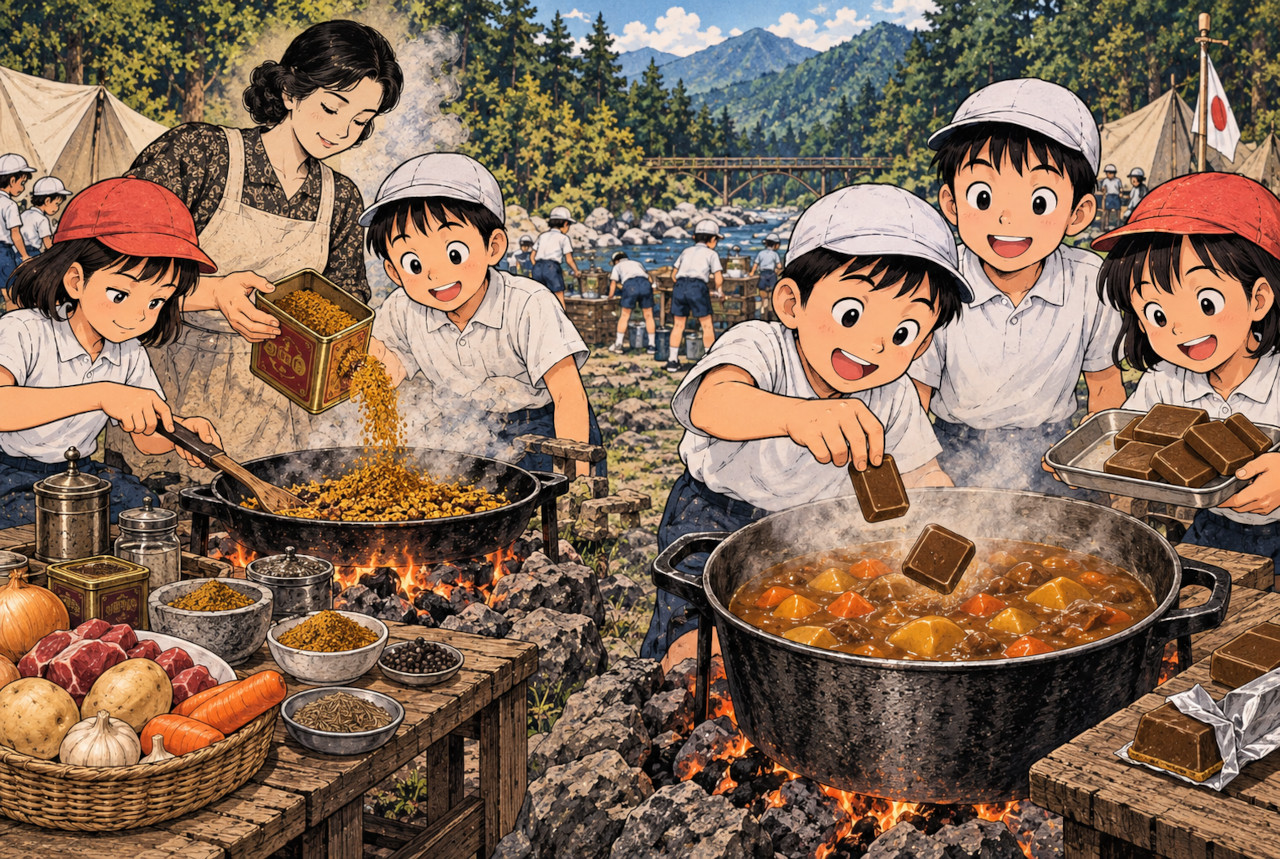 AI-generated conceptual illustration comparing curry preparation methods. It is not a reconstruction of a specific historical scene.
From a school’s point of view, curry is almost too convenient
The real strength of curry may have less to do with flavor than with how easily the work can be divided.
Someone washes the rice. Someone cleans the vegetables. Someone cuts the potatoes. Someone gathers firewood. Someone watches the fire. Someone stirs the pot.
A school camp typically divides students into small groups, or han, and curry gives almost everyone a job. The potatoes can be uneven. The onions can look as if they were attacked rather than sliced. The carrots can be absurdly large. The meal will usually survive.
A single large pot can feed an entire group, and curry happens to pair perfectly with rice cooked in a hangō, the metal mess tin traditionally associated with Japanese outdoor cooking.
Seen this way, curry is not merely camp food. It is an unusually effective piece of group-work equipment that happens to be edible.
Try the same exercise with hamburg steaks and every portion has to be shaped and cooked properly. Deep-frying introduces hot oil. Grilling individual fish makes it harder to divide the work evenly. Curry is different: most of the ingredients eventually end up in the same pot, and simmering covers a surprising number of minor mistakes.
But was the curry actually that good?
This is where nostalgia probably deserves a little resistance.
Smoke gets in your eyes. The rice burns at the bottom. Some potatoes remain suspiciously hard. Somebody adds too much water and the curry turns thin. One carrot chunk is somehow three times the size of every other vegetable in the pot.
Then a teacher says, “Food always tastes better when you cook and eat it together outside.”
Maybe. But a child could also be forgiven for thinking, “Honestly, my mother’s curry at home tastes better than this.”
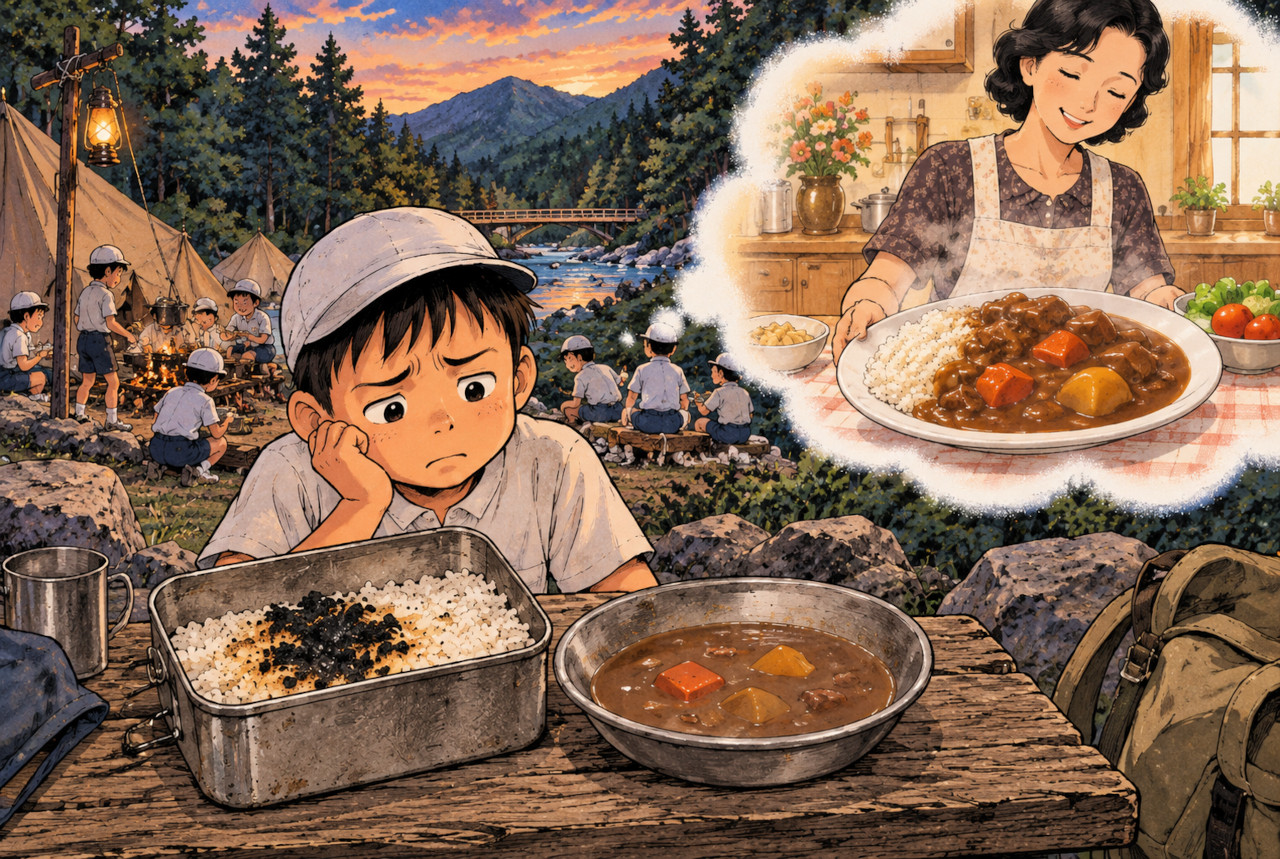 AI-generated illustration emphasizing the humorous contrast between imperfect camp cooking and an idealized homemade meal.
The point was never to produce restaurant-quality curry
That sounds obvious once you say it out loud. A school camp is not a cooking school.
The fire refuses to start. Someone has to find more wood. The group argues about how much water the rice needs. The vegetable team falls behind, so the curry does not get enough time to simmer. Somehow, the group still has to turn all of this into dinner.
Judged purely on taste, an experienced adult cooking in a proper kitchen has an enormous advantage. But the educational value comes from completing one meal together in an inconvenient place with limited equipment and uneven skills.
That also helps explain why curry has survived for so many decades as a natural fit for Japanese outdoor education.
It is relatively inexpensive. It scales well. It tolerates mistakes. The work can be divided. It fills people up. And when everything is finally finished, the entire group eats from the same batch.
Perhaps the classic curry at a Japanese school camp is not really a national camping dish at all. It may be something closer to one of Japanese group education’s most practical inventions: a cooperative exercise disguised as dinner.
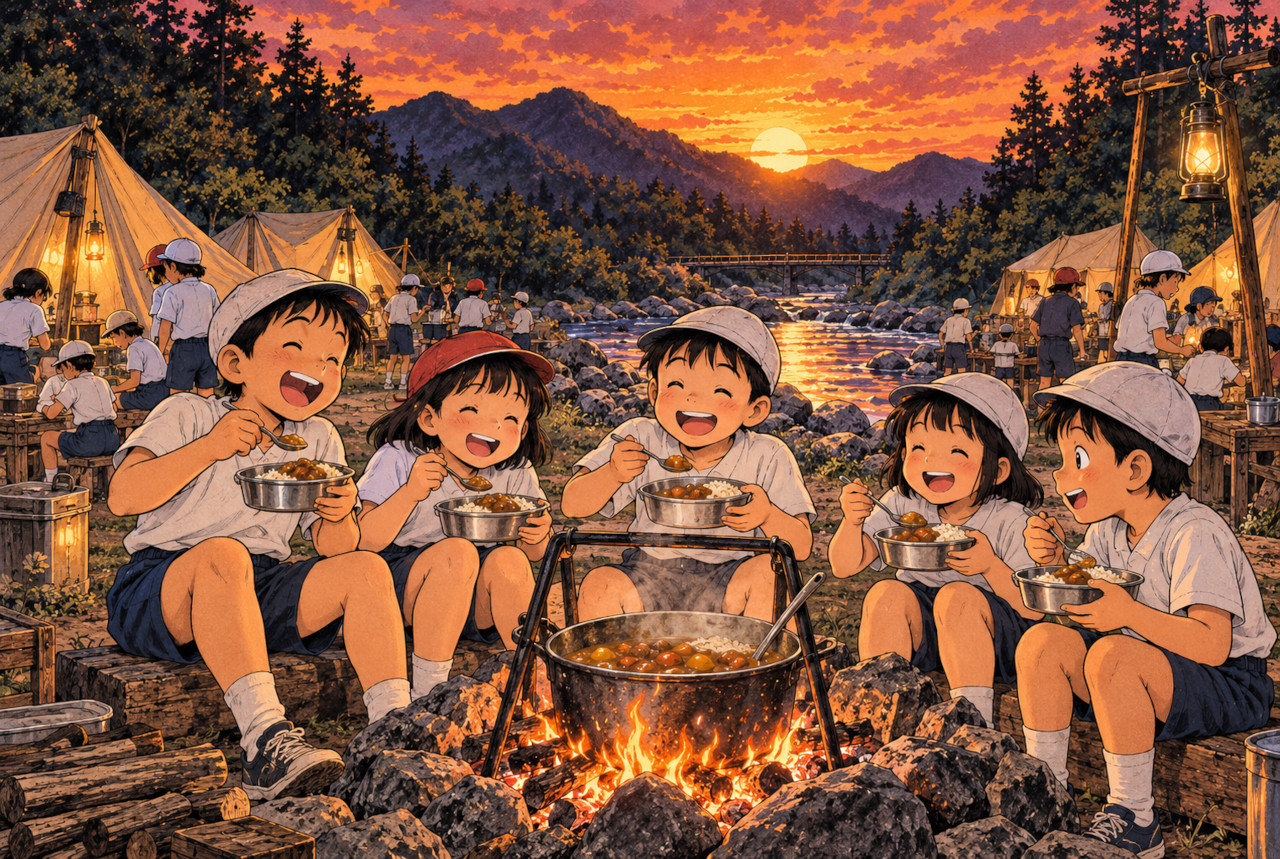 AI-generated illustration of a school camping meal, emphasizing teamwork and shared experience rather than culinary perfection.
Editor’s Note
Curry is one of those foods that relatively few kids object to, but today things are more complicated. Food allergies and different dietary needs mean the old “everyone eats from the same pot” approach is not always so simple anymore. The logistics are messier. Still, looking back, there was something almost luxurious about that low-tech chaos: light a fire, ruin the rice a little, argue over the potatoes, then sit down and eat the result together. It was clumsy communication, but it was communication.
References
- Japan Camping Association — “History of Camping.” Official overview of the development of organized and educational camping in Japan, including prewar forest schools, the 1918 and 1923 participation-site statistics, and postwar Ministry of Education camp-leader programs.
- Japan Camping Association — Organizational History. Official chronology noting the association’s establishment in 1966 and the start of school-camp instructor training in 1971.
- S&B Foods Inc. — Corporate History. Official company chronology recording the 1954 launch of its solid instant curry product.
- House Foods Group Inc. — Group History. Official corporate history recording the 1960 launch of Indian Curry, the company’s first solid curry roux, and the 1963 launch of Vermont Curry.
- House Foods Group Inc. — Vermont Curry. Official English-language brand history explaining that Vermont Curry was launched in 1963 as a milder curry designed for children and adults to enjoy together.