

Somewhere beneath a mountain in Japan, the Tokugawa shogunate supposedly left behind 3.6 million ryō in hidden treasure. If that story were true, this would not be the kind of discovery that merely pays off a mortgage or funds an early retirement. It would be one of the most extraordinary treasure finds in Japanese history.
There is only one problem. People have been searching for the so-called Tokugawa buried treasure since the Meiji era, and in the 1990s Japanese television even brought heavy excavation equipment into the hunt. Yet no cache of gold has ever been conclusively identified as treasure hidden by the Tokugawa shogunate.
So perhaps the question should not begin with, “Where is it?” Before worrying about the exact spot on Mount Akagi, there is a more awkward question: did the shogunate really have 3.6 million ryō available to hide—and could it have moved that much money without everyone noticing?
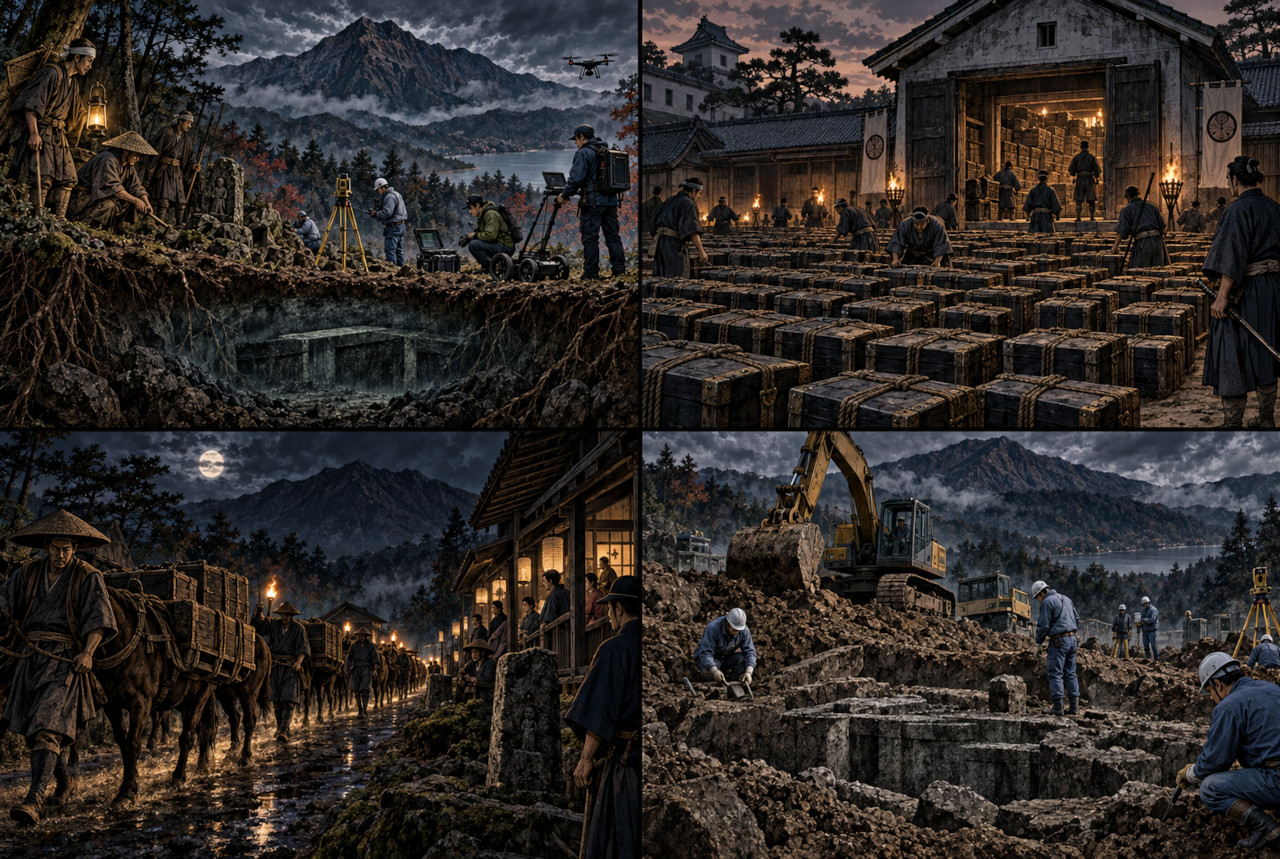
 AI-generated conceptual illustration. It represents different periods of the search and does not show a confirmed underground treasure chamber or actual discovery.
The Famous 3.6 Million Ryō Would Mean 3,600 Treasure Chests
The best-known version of the Tokugawa buried-treasure legend places an enormous cache somewhere around Mount Akagi in Gunma Prefecture. According to the story, money belonging to the collapsing Tokugawa shogunate was secretly removed near the end of the Edo period so that it would not fall into the hands of the new government.
A historical publication from Maebashi City discusses the famous figure of 3.6 million ryō and notes that, if divided into traditional 1,000-ryō chests known as senryōbako, the supposed fortune would require about 3,600 chests. Once the legend is expressed as physical cargo rather than an abstract number, its scale becomes much easier to understand.
One name repeatedly attached to the story is Oguri Tadamasa, also known as Oguri Kozukenosuke. He was not a fictional “treasure keeper” invented after the fact. Oguri actually served in senior shogunate posts, including kanjō bugyō, or commissioner of finance. The National Diet Library credits him with work on the Yokosuka Iron Foundry, tariff negotiations, military reform, and the shogunate’s extremely difficult financial affairs during the final years of Tokugawa rule.
In other words, the part of the story in which Oguri had access to the machinery of shogunate finance is historically grounded. That does not prove he buried anything, but it helps explain why his name became so attractive to later treasure hunters.
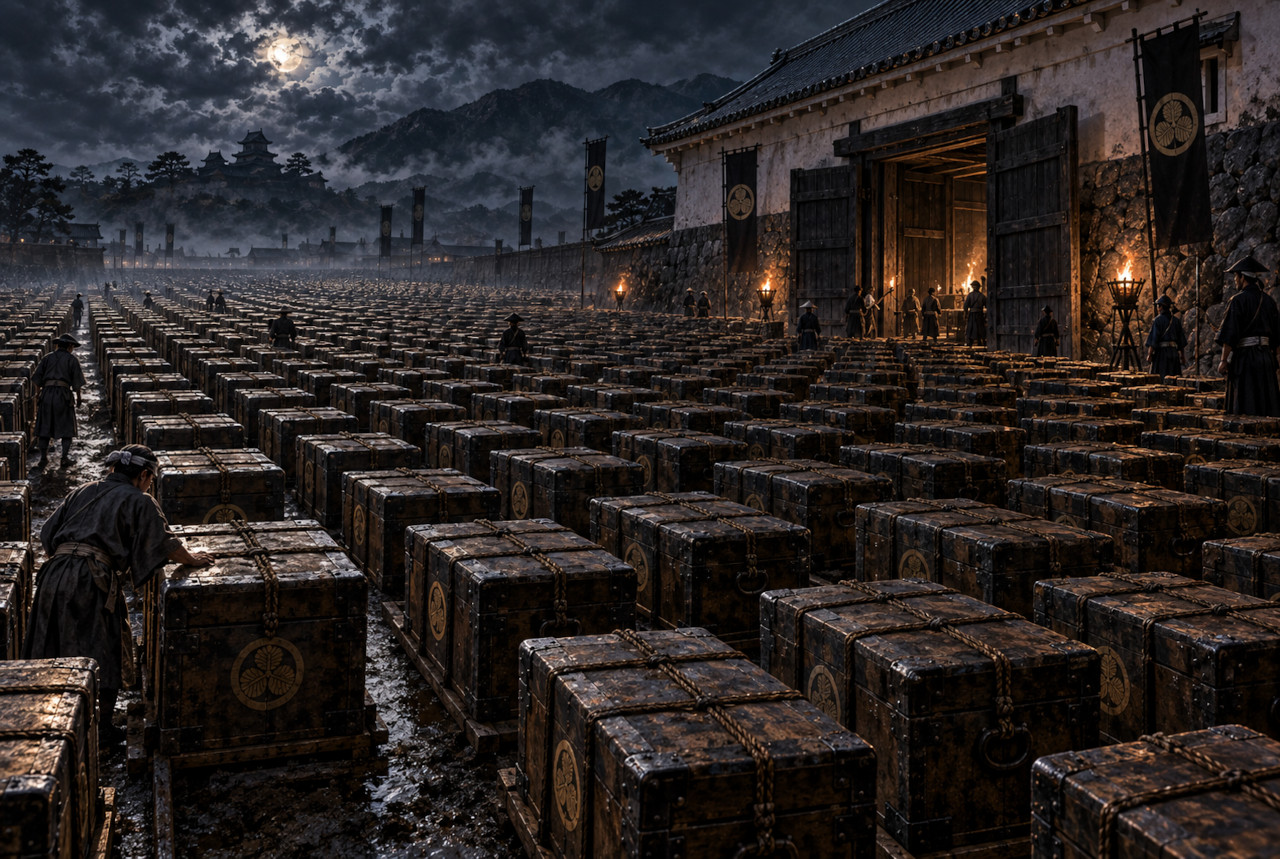 AI-generated conceptual illustration showing the scale of 3,600 chests. It does not imply that the Tokugawa shogunate actually stored 3.6 million ryō in this form.
Then the Numbers Produce an Unexpected Problem: It Is Not Obviously Too Heavy
The obvious reaction is that 3.6 million ryō must have been far too heavy to move. That sounds reasonable—until the coins themselves are examined.
According to the Currency Museum of the Bank of Japan, a late-Edo Man’en koban weighed about 3.3 grams. If we make a deliberately simplified calculation and imagine all 3.6 million ryō as one-ryō Man’en koban coins, the result is:
3,600,000 × 3.3 grams = 11,880 kilograms, or about 11.9 metric tons.
This needs an important qualification. A ryō was a monetary unit, not a fixed unit of physical weight, and Edo-period coinage changed considerably over time. The supposed treasure was never proven to consist entirely of Man’en koban. The 11.9-ton figure is therefore a thought experiment, not the measured weight of a real treasure cache.
Still, the calculation produces an interesting result. Twelve tons is a huge load for men and horses, but it is not an impossible amount of material for an organized government to move. Edo Japan already had extensive systems for transporting official travelers and cargo along major roads.
So “the treasure was simply too heavy to move” is not as strong an objection as it first appears.
Unfortunately for the legend, solving the weight problem creates a much bigger one.
The Hard Part Is Not Moving It. The Hard Part Is Keeping It Secret
Moving thousands of boxes from Edo toward the mountains of what is now Gunma would require horses, porters, handlers, escorts, food, rest stops, and organization. Edo-period post stations operated a relay system known as tsugi-okuri, in which people and horses transferred official baggage from one station to the next.
The Ministry of Land, Infrastructure, Transport and Tourism notes that major Tokaido post stations were eventually required to maintain 100 horses and 100 porters for official transport. In other words, the Tokugawa state certainly understood large-scale logistics.
But that is precisely where the buried-treasure story becomes awkward.
Ordinary cargo could pass through a transport system openly. A secret reserve worth millions of ryō could not. The larger the operation became, the more porters, horse handlers, officials, guards, and local witnesses would potentially know that something unusual was moving through the country.
Transporting 3.6 million ryō may have been easier than hiding the fact that 3.6 million ryō was being transported.
Rumors and later testimony certainly exist. What remains missing is firm documentation showing when the supposed fortune left Edo, who moved it, which route it followed, and exactly what was transported.
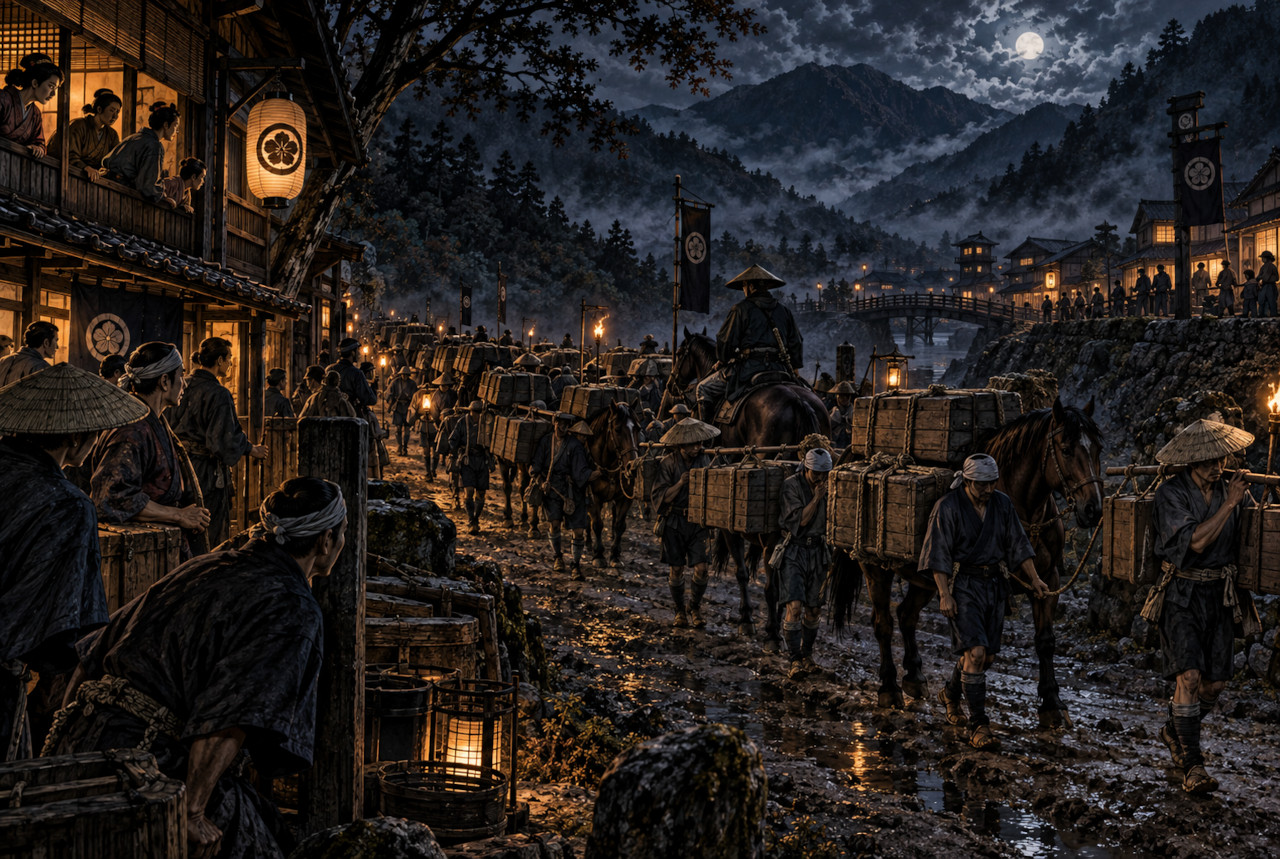 AI-generated conceptual illustration. It represents the logistical difficulty of concealing a large shipment and does not depict a documented Tokugawa treasure convoy.
There Is an Even More Basic Question: Did the Shogunate Still Have That Much Money?
The physical movement of the treasure is only half the problem. The other half is whether such a gigantic reserve was available to be hidden in the first place.
An educational publication from Takasaki City describes the shogunate’s official treasury around the time of the return of political authority as essentially empty. Maebashi City’s historical material likewise points to the severe financial strain facing the Tokugawa government, including repeated disasters, famine, and persistent deficits, and argues that a huge reserve available for burial is difficult to reconcile with that situation.
The Bank of Japan’s Currency Museum adds another revealing piece of context. During the late Edo period, the shogunate repeatedly reformed and debased coinage, with profits from recoinage being used in part to cover fiscal deficits.
That image is very different from the popular fantasy of 260 years of Tokugawa gold sitting untouched in a giant vault beneath Edo Castle.
Before asking where 3.6 million ryō was buried, we first have to ask whether the shogunate actually possessed 3.6 million ryō that it could afford to make disappear.
None of this proves that every hidden reserve was impossible. Governments in crisis do strange things, records can disappear, and not every transaction survives in an archive. But the legend has a burden of proof that becomes heavier the closer we look at the shogunate’s finances.
And Yet People Kept Digging
The financial doubts did not kill the story. Searches around Mount Akagi continued from the Meiji period onward, and the Mizuno family became particularly well known for pursuing the treasure over several generations.
Then television turned an old regional legend into something close to a national obsession.
TBS states that its Tokugawa buried-treasure series began in 1991 and continued for more than a decade. The project examined old documents, investigated finds from the site, returned to Mount Akagi repeatedly, and eventually used modern survey technology in later searches. Even after years of excavation, however, the broadcaster acknowledged that it had not recovered the legendary gold.
The remarkable part is not simply that nothing definitive appeared. It is that the excavations produced just enough mystery to keep the story moving: unusual finds, ambiguous underground features, old documents, and one more reason to try again.
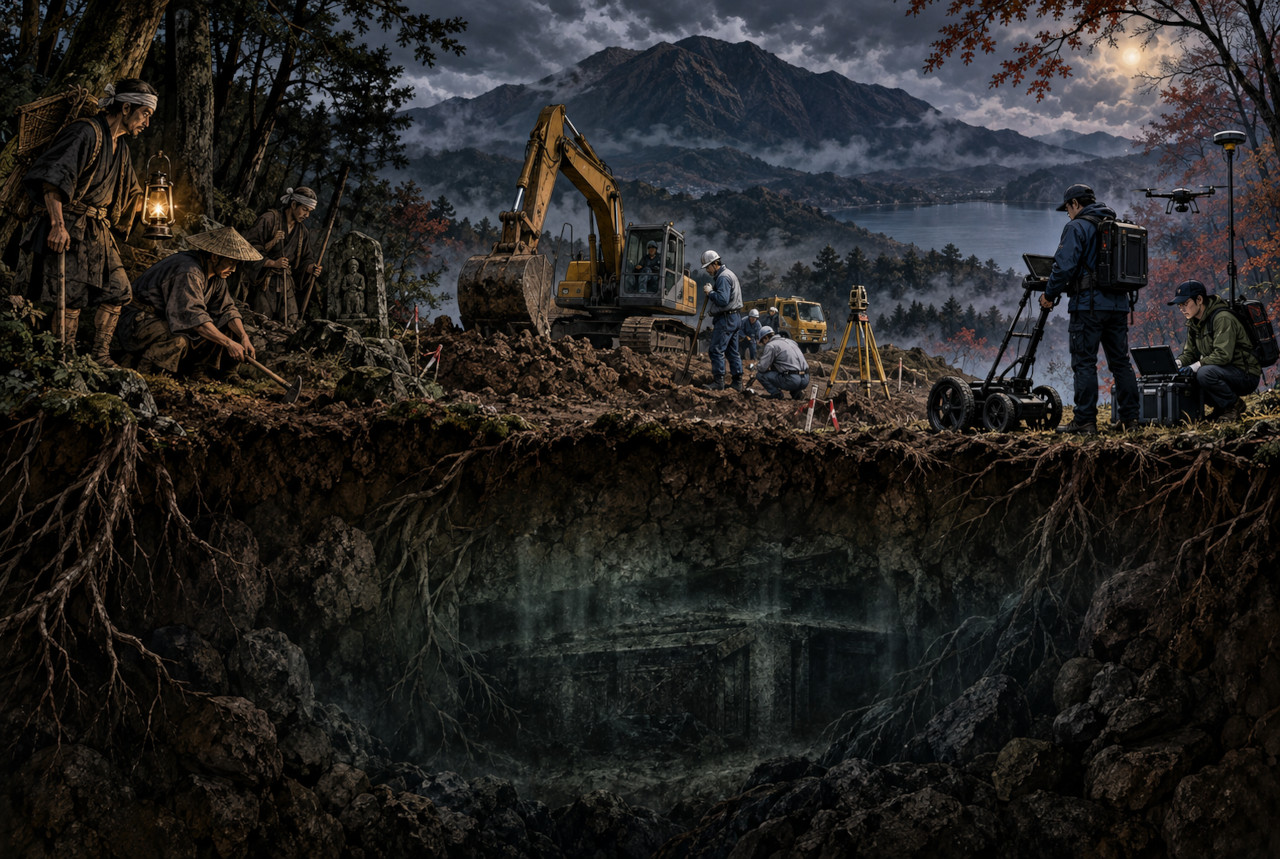
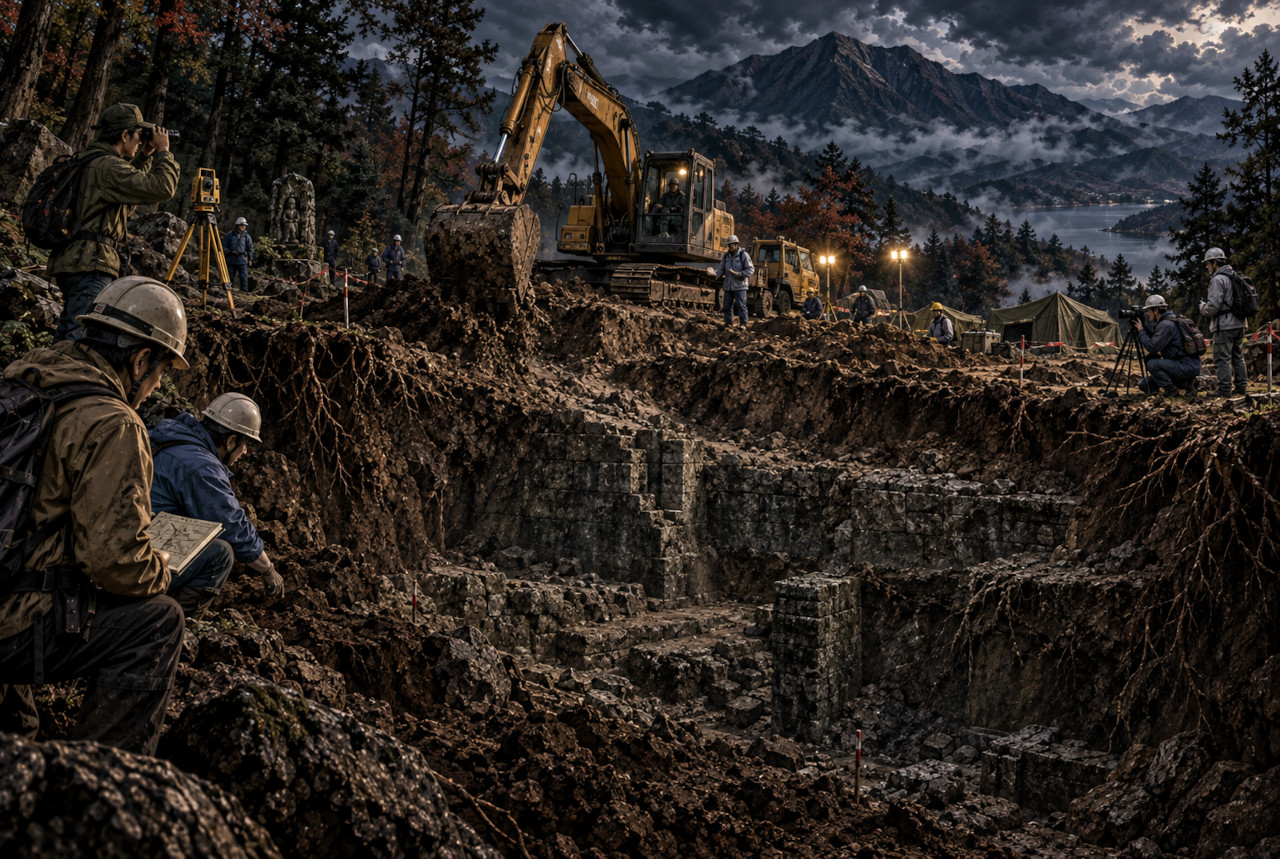 AI-generated conceptual illustration inspired by large-scale treasure searches. The stone structures shown are not a reconstruction of a confirmed archaeological discovery.
Buried Treasure Has a Strange Advantage: Failure Does Not Kill the Story
This may be the most interesting part of the Tokugawa treasure legend.
Normally, repeated failure weakens a hypothesis. Dig in one place and find nothing, and confidence should decline. But buried treasure has an escape route built into the idea itself.
Perhaps the hole was a few meters off. Perhaps the treasure was deeper. Perhaps the clue referred to another slope. Perhaps Mount Akagi was only a decoy. Every unsuccessful dig can generate another location instead of ending the story.
Not finding the treasure does not necessarily destroy the legend. It can actually extend its life.
Based on the surviving evidence, there is no strong reason to say that 3.6 million ryō is definitely waiting beneath Mount Akagi. Yet proving that absolutely nothing was ever hidden anywhere in the region is almost impossible.
That tiny gap between “unlikely” and “impossible” is where buried-treasure legends thrive.
If the Tokugawa treasure really is still out there, no modern treasure hunter has managed to claim the discovery.
For anyone with even a slightly unhealthy interest in lost money, that is a dangerously attractive sentence.
Editor’s Note
I am still firmly on the “probably not there” side of the Tokugawa treasure story. But the irritating part is what happens when you actually run the numbers. Turn 3.6 million ryō into hypothetical Man’en koban and you get roughly 12 tons. That is enormous, but it is not some physically impossible mountain of metal. And that little bit of possibility is exactly what keeps the story alive. If it were completely impossible, the fun would be over. If I were walking around Mount Akagi and saw the corner of a very old wooden box sticking out of the ground? Well… I suspect dinner plans would suddenly become much less important.
References
- Maebashi City — historical material discussing the Tokugawa buried-treasure legend and arguments against it (Japanese)
- Takasaki City — educational material on Oguri Tadamasa and the Tokugawa buried-treasure legend (Japanese)
- National Diet Library, Japan — “OGURI Tadamasa,” Portraits of Modern Japanese Historical Figures
- Currency Museum, Institute for Monetary and Economic Studies, Bank of Japan — “How Much Is One Ryō in Today’s Money?” (Japanese)
- Currency Museum, Bank of Japan — permanent exhibition catalog on late-Edo coinage reforms and shogunate finances (Japanese)
- Ministry of Land, Infrastructure, Transport and Tourism, Kanto Regional Development Bureau — Edo-period relay transport using horses and porters (Japanese)
- TBS Television — 2016 program archive on the Tokugawa buried-treasure investigation (Japanese)