

Part 1 traced the Supra story from the Toyota 2000GT and Celica XX to the arrival of the A70 in 1986. But the A70 did not simply spend the next seven years getting a few cosmetic updates. The deeper you go into its later years, the more it starts to look like a different car wearing the same basic body.
The engine tells the story best. The early flagship used the 7M-GTEU, part of the long-running M-series family that could be traced back through earlier Toyota six-cylinder GTs. Near the end of the A70’s life, that engine disappeared and the new 1JZ-GTE took its place. Within a single generation, the Supra effectively crossed from the old M-series era into the JZ era that would define the A80. The second half of the A70 story is much more than a simple “pre-facelift versus facelift” comparison.
Toyota Supra — 3-Part Series
From the Toyota 2000GT and Celica XX roots to the A70’s shift from the M-series to the JZ era, and finally the A80 legend and the Supra’s long-awaited return, this three-part series traces how the Supra evolved across generations.
- Part 1: Toyota Supra: Why Japan’s First Supra Was Already the Third Generation
- Part 2: How the A70 Supra Changed Its Bloodline: Turbo A to 1JZ
- Final Part: Why the Toyota Supra Became a Legend During Its 17-Year Absence Coming soon
In 1988, the A70 Changed More Than Its Face
In August 1988, Toyota gave the A70 a major update. The front and rear styling changed, all 3.0-liter versions adopted the wide body, and engine output increased. The 7M-GTEU 3.0-liter turbo rose to 240 PS, while the 2.0-liter twin-turbo 1G-GTEU reached 210 PS. Compared with the original 230 PS 3.0GT Turbo launched in 1986, the A70 had already become noticeably more serious.
Today, many enthusiasts picture the A70 Supra with the swollen fenders of the wide-body cars. But the earliest versions were much narrower and visually cleaner. Even the shape many of us now think of as the “typical” A70 was something the car grew into during its production life.
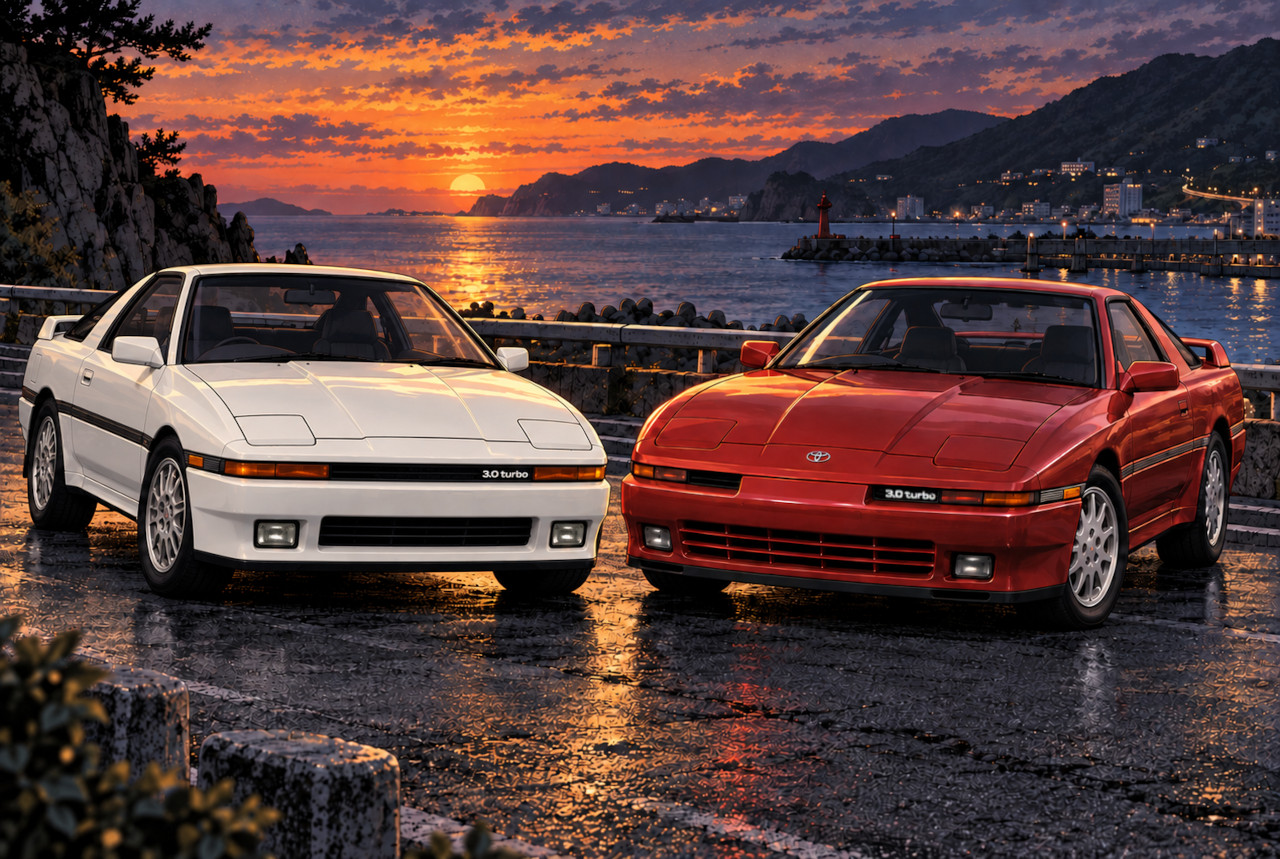 AI-generated illustration comparing the early narrow-body A70 with a later wide-body version. It is intended as a visual guide rather than a period photograph.
The 500-Car Turbo A Was More Than Just the “Top Model”
The same 1988 update also brought one of the most famous A70 variants: the 3.0GT Turbo A. Production was limited to 500 cars, and its 7M-GTEU was rated at 270 PS—30 PS above the regular 3.0-liter turbo.
The reason for the car mattered just as much as the number. Toyota explicitly described the Turbo A as a model intended to improve competitiveness in domestic and international motorsport. The A70 had already won on its Japanese Touring Car Championship debut at SUGO in 1987, but that early success did not turn into a long run of victories. The Turbo A was an attempt to make the existing package more effective in competition.
There is one detail that often gets simplified in retellings. It is common to describe the Turbo A as a 500-car special “built so the Supra could enter Group A.” That is not quite right. The turbocharged MA70 had already received FIA Group A homologation in July 1987, more than a year before the Turbo A appeared. So it is more accurate to view the Turbo A as an evolution-style model designed to strengthen a Group A program that already existed.
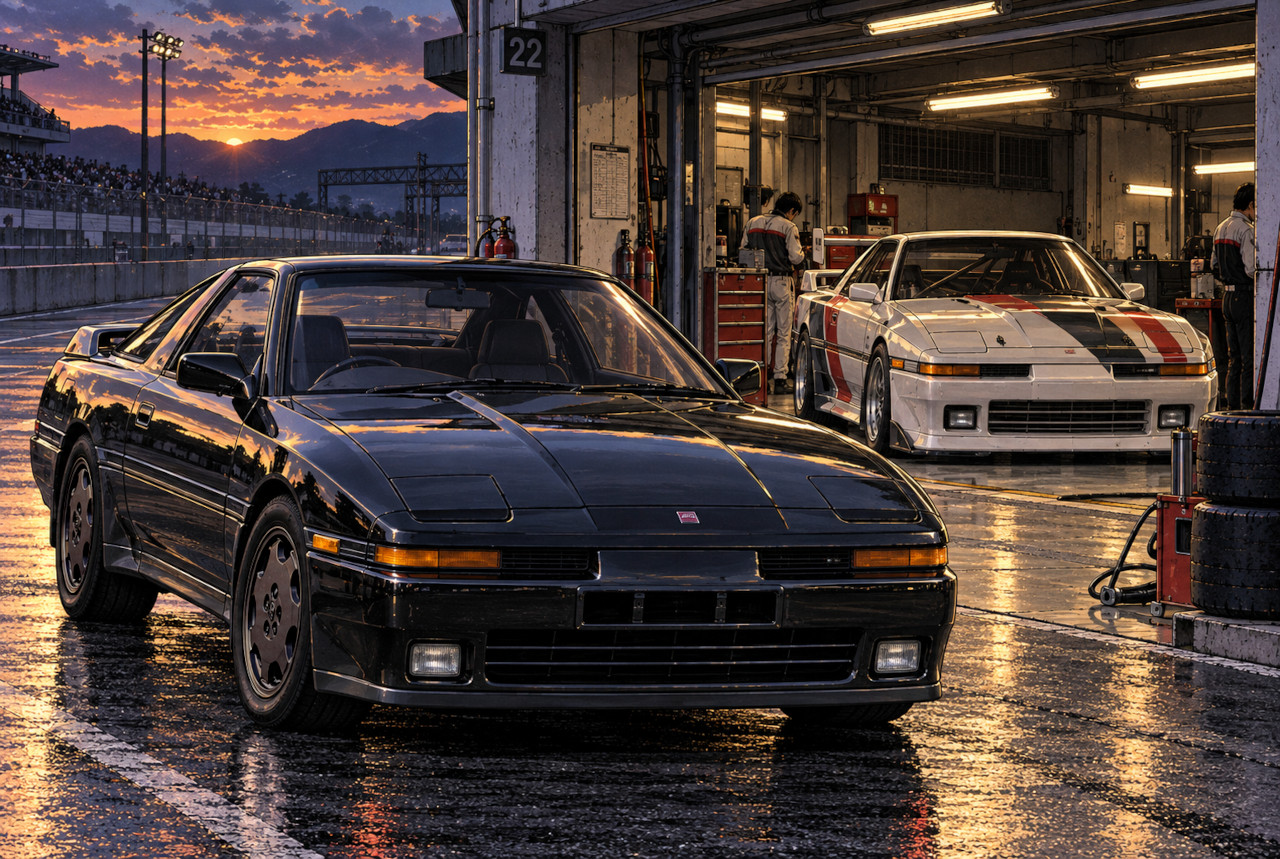 AI-generated illustration showing the relationship between the road-going Turbo A and Group A competition. It does not reproduce a specific historical race photograph or individual race car.
Toyota Dropped Half a Liter—and Gained 40 PS
Then came the most interesting change of all. In August 1990, the 3.0-liter 7M-GTEU left the Japanese A70 lineup and Toyota introduced the new 2.5-liter twin-turbo 1JZ-GTE.
| 7M-GTEU | 1JZ-GTE | |
|---|---|---|
| Displacement | 2,954cc | 2,491cc |
| Maximum output | 240 PS / 5,600 rpm | 280 PS / 6,200 rpm |
| Maximum torque | 35.0 kg·m / 3,200 rpm | 37.0 kg·m / 4,800 rpm |
The arithmetic is almost comically simple. Displacement fell by 463cc, yet maximum output increased by 40 PS. The regular-production 2.5-liter 1JZ car even exceeded the 270 PS figure of the limited-edition Turbo A by 10 PS.
Of course, displacement alone does not determine performance. The 1JZ-GTE belonged to a newer engineering generation and used twin ceramic turbochargers. Still, if your idea of a serious GT was shaped by the 1980s notion that “bigger engine equals higher rank,” the reversal is hard not to enjoy. The A70 became more powerful by shrinking from 3.0 liters to 2.5.
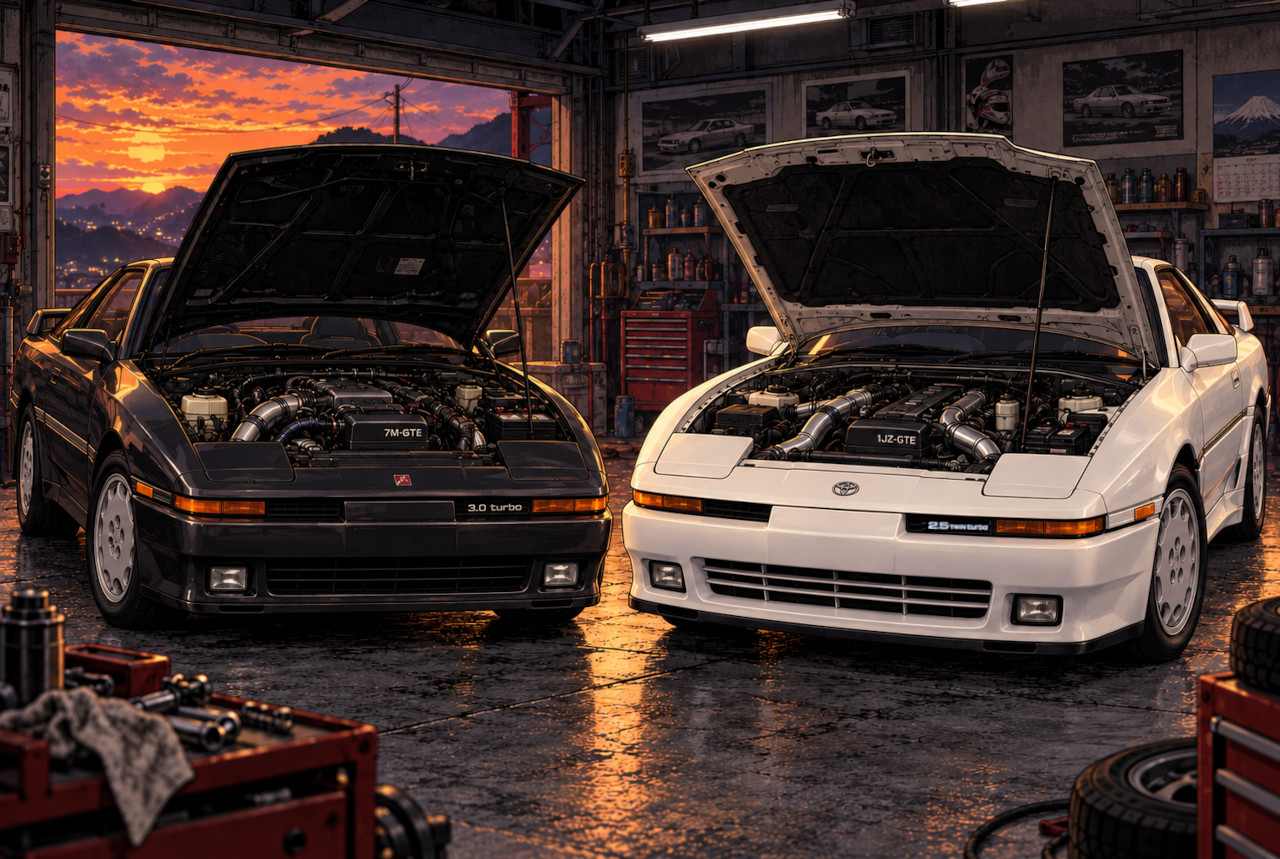 AI-generated illustration representing the change from the 7M-GTE to the 1JZ-GTE. The engine bays are illustrative and should not be treated as technical diagrams.
This Is Where the Supra Went from “M” to “JZ”
In Part 1, we followed the thread from the Toyota 2000GT’s 3M engine through the 4M and 5M used in the Celica XX, and then to the A70’s 7M. Seen that way, the 1990 change is more important than it first appears. The M-series era finally ended at the top of the Supra range, and the JZ era began.
The chassis codes make the transition almost embarrassingly obvious. A 7M-powered Supra is an MA70. A 1JZ-powered version is a JZA70. Same basic generation, same “70” identity—but even the first part of the chassis code changed with the engine family.
In hindsight, this makes the late A70 look like a preview of what was coming. The engine most closely associated with the next-generation A80 would be the 2JZ-GTE. The A70 therefore sits in an odd and interesting position: it carried the last stage of Toyota’s older M-series GT lineage while also becoming the first Supra generation to step into the JZ world.
The Twin Turbo R Was Not the Only A70 on the Street
The most enthusiast-focused expression of the 1JZ-era A70 was the 2.5GT Twin Turbo R. In addition to its 280 PS output, it came with equipment such as RECARO seats, Bilstein shock absorbers, a Torsen limited-slip differential and a MOMO steering wheel. Compared with the luxury-oriented “TOYOTA 3000GT” image of the 1986 launch, the late A70 had moved noticeably toward a harder-edged performance-GT character.
But this is also where modern classic-car coverage can distort the past. Read enough retrospective articles and it starts to sound as if every A70 on Japanese roads was either a Turbo A or a 280 PS Twin Turbo R.
It was not. Even after 1990, Toyota still sold the 210 PS 2.0-liter twin-turbo as well as the naturally aspirated 2.0GT, rated at 150 PS. There were perfectly ordinary 2.0-liter Supras on the street too. The history of an old car cannot be reduced to whichever version now brings the biggest auction price or gets the most attention online.
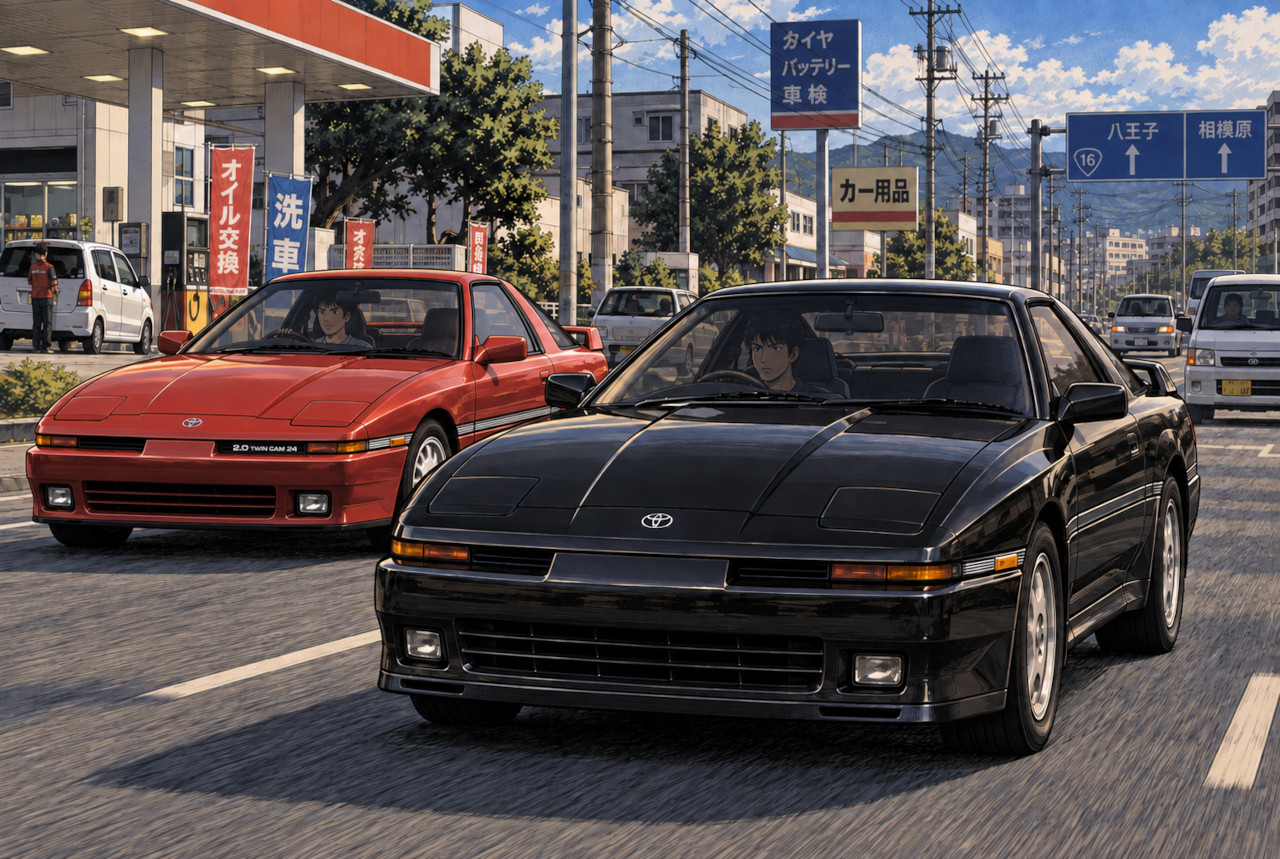 AI-generated illustration recreating the atmosphere of an early-1990s Japanese street. It is not a photograph of a specific location or event.
The A70 Crossed from the 1980s into the 1990s Without Changing Generations
Look only at the flagship engine figures and the transformation is obvious: the A70 began with a 230 PS 7M, moved to 240 PS, produced the 270 PS Turbo A, and finally reached 280 PS with the 1JZ. The body evolved from narrow to wide, while the car’s character shifted from an upscale 1980s GT toward the harder performance machines of the early 1990s.
That is why dismissing the A70 as simply “the Supra before the A80” misses the interesting part. It received the older lineage inherited from the 2000GT and Celica XX, changed engine families halfway through its life, and then handed that new direction to the next generation.
In 1993, the JZ family continued in 3.0-liter 2JZ form with the A80. From there, the Supra would become something stranger: a Japanese performance GT that grew even more famous after production ended. That is where Part 3 begins.
Editor’s Note
The later A70 I drove as a student was a naturally aspirated 2.0-liter car. Today, the Turbo A and 1JZ versions naturally get most of the attention, but Japanese roads back then were not packed with monster-spec Supras. There were slower ones too—and they still looked fantastic. Classic-car history gets a bit warped when we remember only the rarest and fastest versions. Sometimes the ordinary car you actually saw every day tells you more about the era.
References
- Toyota Motor Corporation: 1988 Supra model update and 3.0GT Turbo A announcement
- FIA Historic Database: Toyota Supra Turbo MA70 Group A homologation
- GAZOO: Toyota Supra A70 motorsport history (Japanese)
- Toyota Motor Corporation: 1990 Supra update and introduction of the 1JZ-GTE
- GAZOO: Late-model A70 Supra catalog and specifications (Japanese)
- Toyota Motor Corporation: 1993 A80 Supra launch