


Whenever time machines come up, there is one question that seems more immediate than relativity, wormholes, or equations:
If someone really invents a time machine in the future, shouldn’t people from the future already be showing up here?
It could happen in the year 3000, or 10,000. If traveling into the past ever becomes as routine as tourism, historical events should be irresistible destinations: the age of the dinosaurs, the building of the pyramids, famous turning points in history—and, sooner or later, the twenty-first century.
And yet, no person has ever been scientifically verified as a visitor from the future. Does that mean a time machine will never be invented?
 AI-generated conceptual illustration.
If time tourists were common, surely one of them would get caught
Start with a deliberately crude thought experiment. Suppose time travel is available from the year 3000 through the year 10,000, and during those 7,000 years just one person per day decides to visit the twenty-first century.
That would produce roughly 2.56 million visits.
Obviously, this is an invented scenario, not a prediction. But if millions of time travelers passed through our era, it becomes difficult to imagine every one of them behaving like a flawless intelligence operative. Somebody should lose something. Somebody should get into a traffic accident. Somebody should post something stupid online. Somebody, somewhere, should end up explaining themselves to the police.
The complete absence of a scientifically verified time traveler is at least awkward for the idea of unrestricted tourism into the past.
Stephen Hawking actually threw a party for time travelers
Stephen Hawking played with almost exactly this idea.
On June 28, 2009, he held a reception for time travelers at the University of Cambridge. There was food. There was champagne. A specific time and place had been arranged.
The trick was that the invitations were not sent out until after the party was over.
The logic was beautifully mischievous. If people in the future eventually gained the ability to travel backward through time, they could discover the invitation later and simply return to the correct date.
No verified visitor from the future turned up.
Then, in 2013, astronomer Robert Nemiroff and Teresa Wilson took a more digital approach. They searched Internet records—including Twitter—for signs of people mentioning information before it should have been publicly known. They also tried soliciting messages that, if sent by a future time traveler, would have to appear before the request itself.
They found no time travelers. But the researchers were careful about the result: a failed search does not prove that backward time travel is impossible.
 AI-generated illustration. It does not recreate the actual venue or exact time of Hawking’s 2009 reception.
Here is the annoying loophole: a time machine that cannot reach us
This is where the argument turns around.
In 1988, physicists Michael Morris, Kip Thorne and Ulvi Yurtsever examined a remarkable possibility: if the laws of physics allowed an advanced civilization to create and maintain a traversable wormhole, that wormhole might in principle be converted into a time machine.
One version of the idea involves moving one mouth of the wormhole at very high speed, producing a difference in elapsed time between the two mouths because of relativistic time dilation. The result would be two connected entrances whose clocks no longer agree.
But this is not the familiar science-fiction machine where you type in a year and casually select “Ancient Egypt” from the menu.
In this kind of wormhole setup, the relevant time connection only exists once the wormhole and its time offset have been established. If humanity creates such a machine in the year 3000, that does not automatically create an entrance waiting for us in 2026—or in the age of the dinosaurs.
So even if people in the year 10,000 could use some form of wormhole time machine, they might still be unable to visit us.
That means these two statements are not equivalent:
“No future humans ever visit 2026.”
“No time machine will ever exist.”
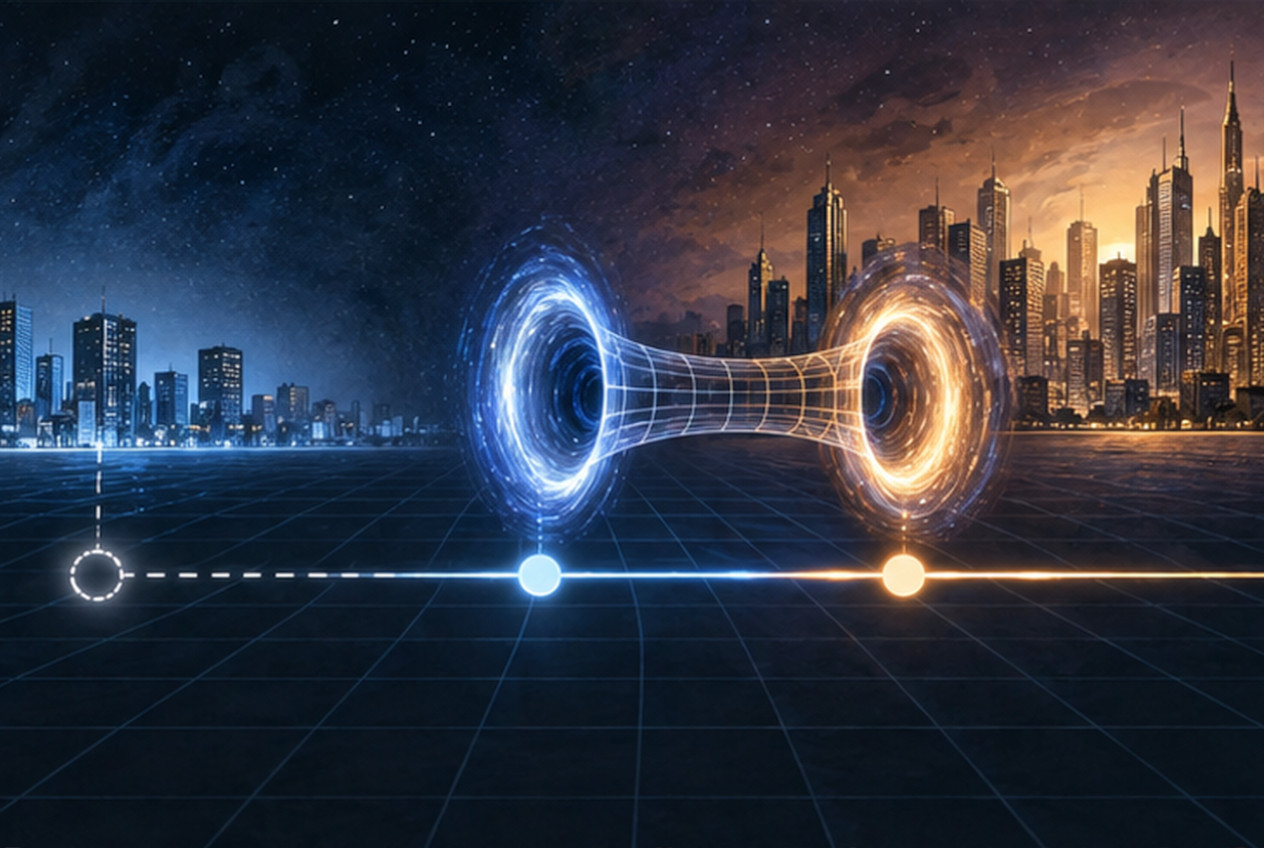 Simplified conceptual illustration of a wormhole time-machine scenario. It is not a reproduction of a scientific diagram.
General relativity does not simply throw time travel out
Things get stranger still. General relativity includes mathematical spacetime solutions containing what physicists call closed timelike curves, or CTCs—paths through spacetime that can loop back toward an earlier point in their own history.
That does not mean engineers can build one.
A mathematical solution is not the same thing as a practical machine. Traversable wormholes raise unresolved questions about whether the required exotic negative-energy conditions can exist in a usable form, whether the structure could remain stable, and whether quantum effects or gravitational backreaction would destroy the arrangement before it became a functioning time machine.
In 1992, Hawking proposed his famous Chronology Protection Conjecture: roughly speaking, the laws of physics may contain mechanisms that prevent closed timelike curves—and therefore usable machines for traveling into the past—from forming in the real universe.
It is tempting to describe this as the universe installing an anti-time-machine safety lock.
But the important word is still “conjecture.” The question has not been completely settled, particularly because a full theory of quantum gravity remains beyond us.
So what does the absence of time travelers actually tell us?
Before looking into this, the obvious answer seems almost embarrassingly simple: nobody from the future has appeared, so perhaps the whole idea is impossible.
That still might be the correct answer.
Backward time travel may simply be forbidden by nature. Humanity might disappear before ever developing the required technology. A machine might technically be possible but demand such absurd resources that it never becomes anything remotely resembling tourism.
But the most interesting escape route is the one hidden inside the physics itself: at least for the wormhole-type time machine discussed here, creating a time machine in the future does not necessarily give future travelers access to times before that system existed.
“There are no time travelers here, therefore time machines can never exist” sounds wonderfully decisive. Physics is less cooperative. It leaves open the far more annoying possibility of a time machine whose passengers simply cannot reach us.
Editor’s Note
I started with a much less sophisticated argument: if people 10,000 years from now can casually visit the past, surely at least one of them should have been arrested by now.
I still think that is a fair problem for the Hollywood version of time travel—the kind where you can punch any year into a machine and go sightseeing.
What I did not expect was the quieter loophole: perhaps a time machine could exist, but could not take anyone back beyond the point when the “door” was first created. In other words, maybe nobody from the future is visiting us simply because we happen to live before the entrance exists.
Somehow, I find that more unsettling than being told time travel is impossible.
References
- Michael S. Morris, Kip S. Thorne and Ulvi Yurtsever, “Wormholes, Time Machines, and the Weak Energy Condition,” Physical Review Letters 61, 1446 (1988)
- Kip S. Thorne, “Warping Spacetime,” in The Future of Theoretical Physics and Cosmology (2003)
- S. W. Hawking, “Chronology Protection Conjecture,” Physical Review D 46, 603 (1992)
- Stephen Hawking Estate, “Biography” — including the time-traveler reception
- Science Museum Group, “Time Travellers invitation”
- Robert J. Nemiroff and Teresa Wilson, “Searching the Internet for Evidence of Time Travelers” (2013)
- Scientific American, “How to Build a Time Machine” — discussion of wormhole time-machine constraints
- Stanford Encyclopedia of Philosophy, “Time Travel and Modern Physics” — closed timelike curves and the status of chronology protection