
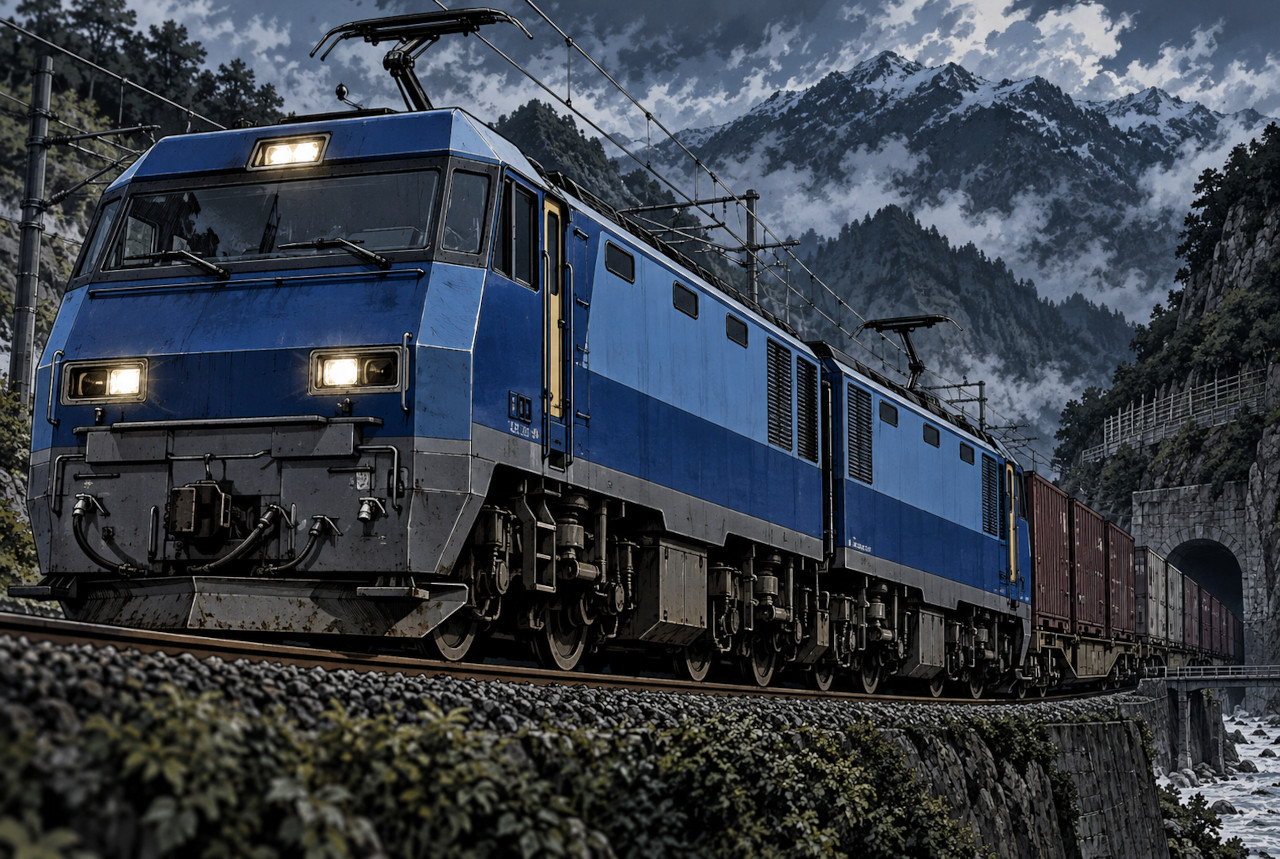
Early on September 19, 2026, I was watching freight trains at Ōtsuki Station when one locomotive in particular caught my attention: JR Freight’s EH200 “ECO-POWER Blue Thunder.”
From the front, it looks like a fairly conventional electric locomotive. From the side, though, something is odd. It is very long, and the body is visibly divided in the middle. At first glance, it almost looks as if two locomotives have been joined together. So why did JR Freight build it this way instead of using a conventional single-section body?
The more I looked into it, the more it became clear that the key to understanding the EH200 is not really “two bodies.” It is “eight powered axles.”
“It Replaced Two EF64s” Is True — But It Does Not Explain Everything
The EH200 is a DC electric freight locomotive developed in 2001. JR Freight lists its rated output at 4,520 kW and its maximum speed at 110 km/h. It has been used on steep-gradient routes including the Chūō Main Line, Shinonoi Line and Jōetsu Line. Japan’s Ministry of Land, Infrastructure, Transport and Tourism also notes that a single EH200 has enough performance to haul trains that had previously required two older JNR-era electric locomotives working in multiple.
That makes an obvious explanation tempting: perhaps JR Freight simply got tired of using two EF64s and built the equivalent of two locomotives in one package. Put the numbers side by side, however, and that explanation starts to look a little too neat.
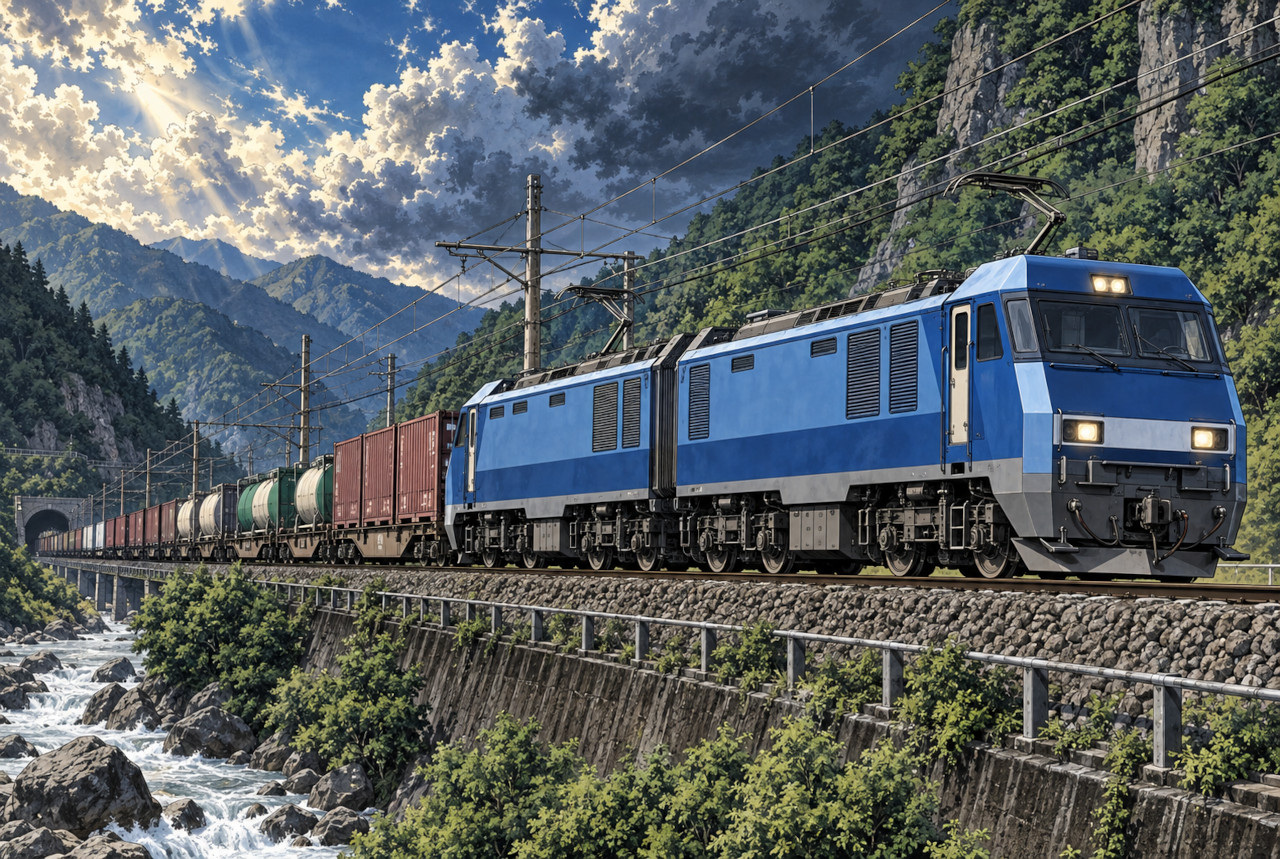 AI-generated structural illustration. It is not an actual photograph or an exact engineering drawing of the locomotive.
An EF64 weighs 96 metric tonnes, has a one-hour rated output of 2,550 kW, and has six powered axles. Two together therefore come to a simple total of 192 tonnes, 5,100 kW and 12 powered axles. The EH200, by comparison, weighs 134.4 tonnes and has eight powered axles, with a one-hour rating of 4,520 kW. Toshiba’s technical documentation gives a short-time maximum rating of 5,120 kW and describes its performance as equivalent to a pair of EF64s.
There is an important caveat here: the EF64 figure of 5,100 kW is a combined one-hour rating, while the EH200 figure of 5,120 kW is a short-time maximum rating. They are not directly comparable as if this were a simple horsepower contest. The weight comparison is still revealing, though. At 134.4 tonnes, the EH200 weighs only about 70 percent as much as two 96-tonne EF64s. It is clearly not just “two old locomotives stuffed into one machine.”
With the EH200, the “H” Is the Interesting Part
Japanese electric locomotive class names inherited a system from the former Japanese National Railways. In this convention, the “F” in EF indicates six powered axles, while the “H” in EH indicates eight. The EH200’s axle arrangement is (Bo-Bo)-(Bo-Bo): four powered axles in each of its two body sections, eight in total.
Toshiba’s documentation is unusually helpful here. It says that the eight-axle configuration was adopted to provide stable starting performance on gradients and greater redundancy. The locomotive also uses individual vector control for each axle to improve adhesion performance.
This is where railway engineering begins to behave rather differently from the usual automotive spec-sheet mentality. A more powerful motor does not automatically mean a locomotive can pull a heavier train. Ultimately, all that electrical power still has to pass through the tiny contact patches between steel wheels and steel rails. If the wheels spin, extra power does not move the train forward.
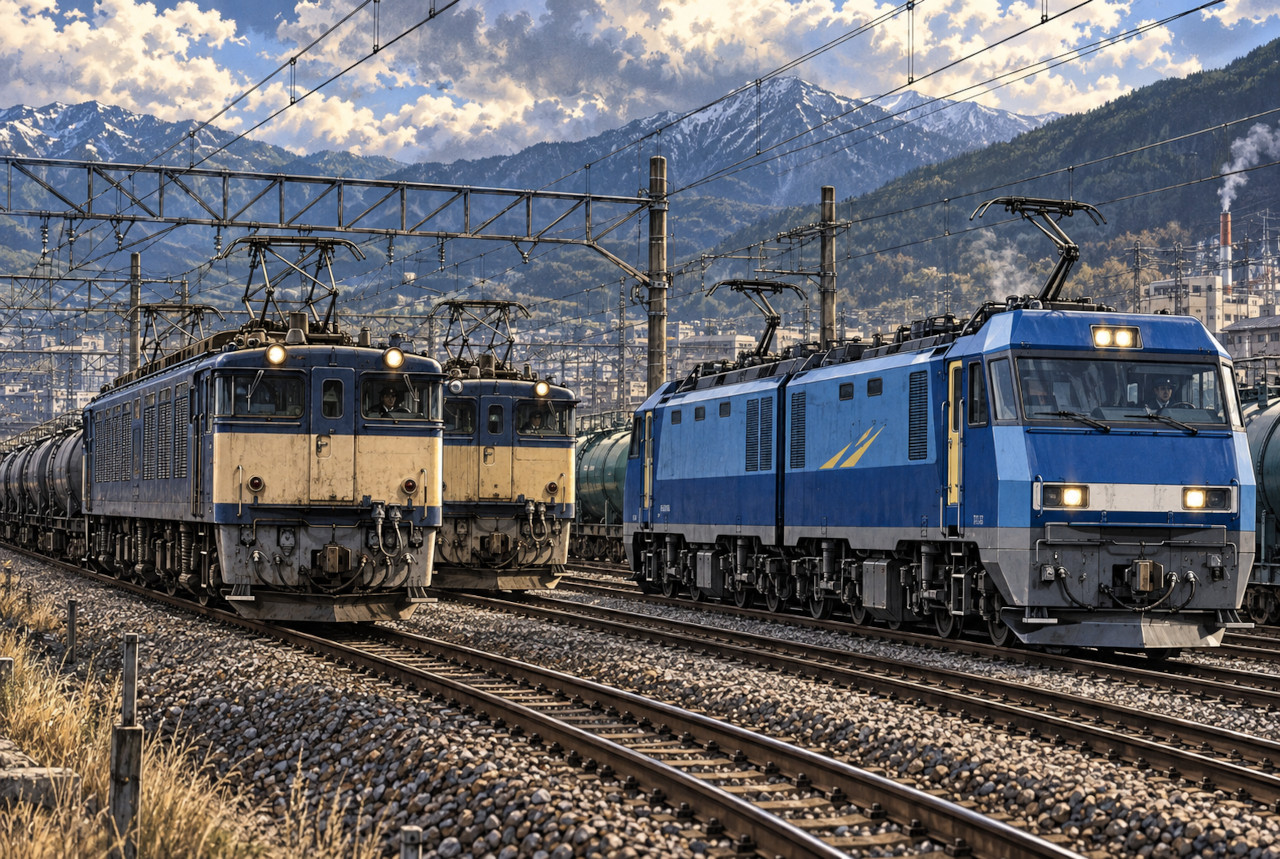 AI-generated comparison illustration. It is not an exact technical drawing of the EF64 or EH200, and fine details of the bogies and axle arrangement should not be treated as engineering reference material.
Divide 134.4 Tonnes by Eight and Something Interesting Appears
Divide the EH200’s operating weight of 134.4 tonnes by eight axles and the average comes to 16.8 tonnes per axle. An EF64 works out at 96 tonnes divided by six, or 16 tonnes per axle. In other words, the EH200 does not achieve its performance simply by placing an extreme amount of weight on each axle.
A history of JR Freight locomotive development published by the Japan Society of Mechanical Engineers explains that the earlier EH500 adopted eight axles instead of six so that greater tractive effort could be obtained without increasing axle load. The EH200, developed in 2001, then adopted the same basic two-section, eight-axle configuration for DC operation.
This makes the design easier to understand if we reverse the usual question. JR Freight did not necessarily start with “let’s build something that looks like two locomotives” and then decide to give it eight axles. The technical requirement for eight powered axles came first, and the distinctive two-section locomotive was the result.
It is sometimes casually explained that the EH200 was divided into two sections simply because a very long rigid locomotive would have trouble on curves. That sounds plausible, but the JR Freight, Toshiba and Japan Society of Mechanical Engineers material checked for this article does not identify curve negotiation alone as the principal reason for the EH200’s two-section design. With railway lore, the explanations that sound most obvious are often the ones worth checking twice.
Even Eight Powered Axles Could Not Make Wheel Slip Disappear
Even after adding eight powered axles and sophisticated traction control, the basic battle between wheel and rail did not go away. Japan’s Railway Technical Research Institute used an EH200 for full-scale adhesion tests, deliberately spraying water near the wheels to create slippery rail conditions.
When a new re-adhesion control method that also accounted for axle-load transfer was applied, the tests recorded an average reduction of about 20 percent in wheel-slip events and an increase of about 4 percent in average tractive effort compared with the conventional control method.
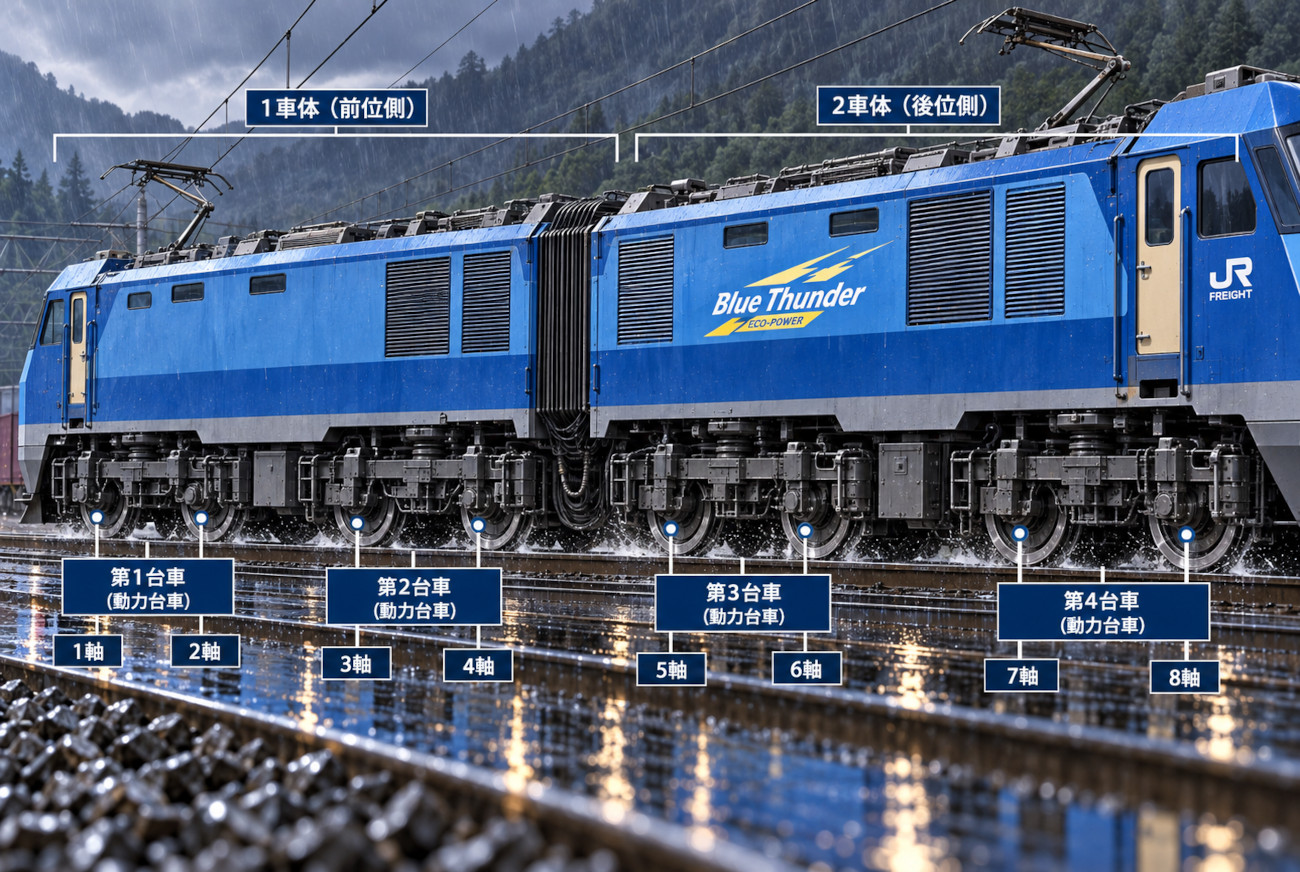 AI-generated structural illustration showing the EH200’s basic two-section, four-bogie and eight-powered-axle configuration. It is not an engineering drawing, and details of bogies, underfloor equipment, piping and body markings do not exactly reproduce the real locomotive.
An old-school Japanese railway magazine might have stopped at something like, “A 5,120 kW monster!” But the harder engineering problem is not simply producing that power. It is getting thousands of kilowatts through eight steel-wheel contact points without wasting the effort in wheel slip. For a locomotive called Blue Thunder, its ultimate opponent turns out to be something rather less dramatic: friction.
The “Two Locomotives Joined Together” Look Is the Result, Not the Starting Point
Before looking into the EH200, I assumed the logic was simple: the railway used to need two EF64s, so someone eventually built the equivalent of two locomotives as a single machine. The technical documents suggest a slightly different order of events.
JR Freight needed one locomotive capable of work comparable to an EF64 pair. To achieve reliable starts on steep gradients without simply increasing axle load, it used eight powered axles and controlled them individually. The unusual two-section EH200 is what that engineering solution looks like from the outside.
Nor was the idea of a two-section, eight-axle locomotive a sudden experiment. JR Freight had already used the concept on the EH500, and the broader Japanese lineage of H-class eight-powered-axle electric locomotives reaches back to the JNR-era EH10. The EH200 may look unusual, but in engineering terms it belongs to a long-running Japanese answer to the problem of hauling heavy freight.
Editor’s Note
When I saw the real locomotive at Ōtsuki, my first reaction was much less sophisticated: “Why did they bother splitting the thing in the middle?” Two EF64s coupled together have an obvious brute-force appeal. You can look at them and immediately understand that the railway has brought two locomotives because one is not enough.
The EH200 hides much of that brute force inside power electronics and traction control. What I like most is that after digging through all the impressive figures, the story does not end with 5,120 kW. It ends with the question of whether a steel wheel will slip on a steel rail. However sophisticated the electronics become, the locomotive still has to win that tiny mechanical argument at ground level. In the end, that is where the whole thing lives or dies.
References
- JR Freight — Rolling Stock Development — EH200 output, maximum speed and operating routes. Japanese-language official source.
- Ministry of Land, Infrastructure, Transport and Tourism (MLIT) — Rolling Stock Introduction — EH200 performance in relation to trains previously hauled by pairs of older JNR electric locomotives. Japanese-language official source.
- Toshiba Review Vol.61 No.9 — “Locomotive and Freight EMU Systems Supporting Modern Logistics” — EH200 output, axle load, eight-axle configuration, individual vector control and redundancy.
- Japan Society of Mechanical Engineers, Vol.115 No.1118 — “Technological Development in Rail Freight Transportation” — development history of the EH500 and EH200 and the two-section, eight-axle configuration.
- Railway Technical Research Institute — Re-Adhesion Control for Locomotive Wheel Slip Considering Axle-Load Transfer — full-scale EH200 tests under artificially reduced adhesion conditions. Japanese-language research source.
- Japan Freight Forwarders Association — Basic Information on JR Freight — reference data based on JR Freight materials, including the EF64’s 96.0-tonne weight and 2,550 kW output. Japanese-language PDF.