
A teacher gets stuck on a question in the middle of class. Maybe a computer setting will not cooperate. Maybe a specialized term refuses to come to mind. Maybe the teacher simply does not know the answer.
Then a student says it.
“Why not ask AI?”
A few years ago, that might have sounded a little cheeky. Today, it increasingly sounds like a perfectly practical suggestion.
That small exchange points to a much bigger change in education. The examples and data in this article come from Japan, but the underlying question is hardly Japan-only: what happens when the teacher is no longer the only obvious place to go for an answer?
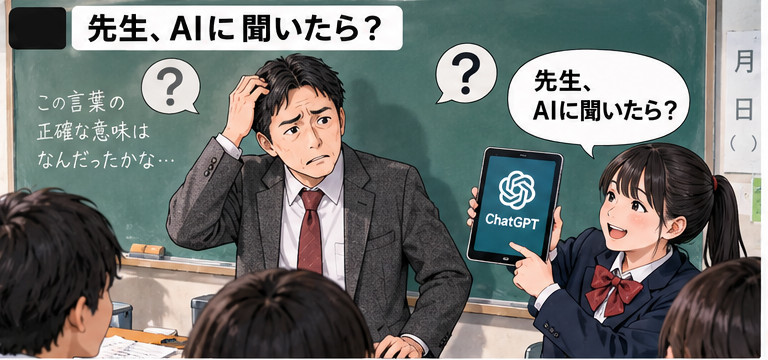 AI-generated illustration of a hypothetical classroom scene.
From “Ask the Teacher” to “Ask AI”
For generations, if a student did not understand something at school, the obvious response was to ask the teacher.
Then the internet arrived. “Look it up” joined the list of options. Smartphones pushed that change further because students no longer had to wait until they got home or reached a computer room. The answer, or at least a search for it, was already in their pocket.
Generative AI changes the process again. Instead of simply returning a list of links, it can respond to a question with a direct explanation, rewrite that explanation in simpler language, give examples, and answer follow-up questions.
From a student’s point of view, that means there is now one less reason why every unknown fact has to pass through the teacher first.
That sounds obvious when written down, but it is a fairly dramatic change.
For a long time, one of the teacher’s unspoken advantages was being the person in the room who knew the most. AI has now walked into that arrangement through the screen of a laptop, tablet, or phone.
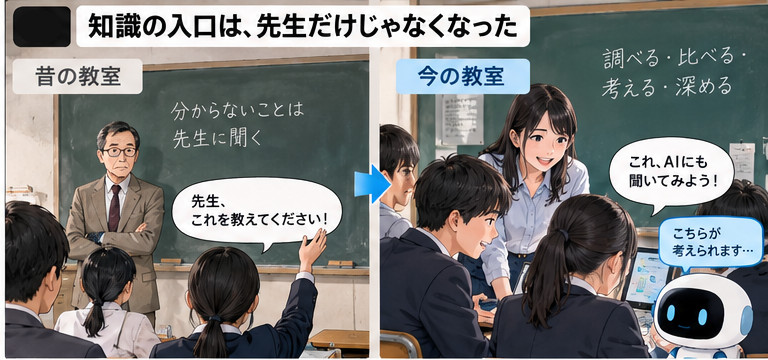 AI-generated comparison illustrating how access to information in the classroom has changed.
Is It a Defeat If the Teacher Uses AI?
This creates a slightly awkward question.
If a teacher does not know something and turns to AI, does that make the teacher look less competent? Is a teacher supposed to be the person who gives the answer rather than the person who asks for one?
That idea depends on a fairly old-fashioned image of teaching.
No teacher knows everything. An English teacher does not need to be an expert in physics. A mathematics teacher does not need to memorize every new computer setting or software feature. Even within a teacher’s own subject, there will always be obscure details, unusual questions, and things that simply slip the mind.
If a tool can help find or organize information in seconds, there is no sensible reason why teachers alone should be forbidden from using it.
The more important problem is not whether a teacher uses AI. It is whether the teacher treats whatever AI produces as automatically correct.
Japan’s Ministry of Education, Culture, Sports, Science and Technology—usually shortened to MEXT—has taken a similar direction in its guidance. Rather than calling for a blanket ban, it emphasizes human-centered use of generative AI and stronger information literacy. For teachers and staff, the guidance stresses using AI within a range where they can judge whether the generated content is appropriate.
The Teacher’s New Job May Be to Challenge the Answer
Generative AI is useful, but it can also be confidently wrong.
That may actually create a more interesting kind of lesson.
A student asks AI a question. An answer appears. The teacher reads it and says:
“Is this actually right?”
Now the class has somewhere to go. Check the source. Compare another explanation. Look for the original document. Ask whether the wording is misleading. See whether a number applies to the right year, country, or group of people.
In other words, the AI answer becomes material to investigate rather than an answer sheet to copy.
There is a good argument that this kind of exercise matters more in today’s information environment than the older routine of a teacher writing the approved answer on the board while students copy it into notebooks.
MEXT’s own guideline notes that erroneous output from generative AI cannot be completely prevented. That makes the ability to verify an answer more than a nice extra skill. It is part of the basic problem of using the technology at all.
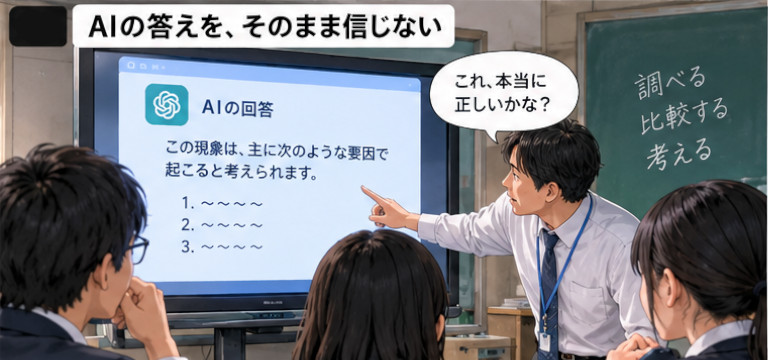 AI-generated illustration of a class treating an AI response as something to verify rather than simply accept.
The Real Problem May Be Teachers Who Cannot Say “I Don’t Know”
AI does not make a teacher’s knowledge or experience worthless. If anything, expertise becomes useful in a different way.
A knowledgeable teacher is more likely to notice when an answer feels suspicious, when a source is weak, when an explanation skips an important condition, or when the question itself has been badly framed.
What changes is the value of raw recall.
Trying to compete with AI simply by remembering more isolated facts is increasingly beside the point. The more useful abilities are knowing what to ask, spotting what does not make sense, finding better evidence, and deciding how much confidence an answer deserves.
Seen that way, the teacher who struggles most in the AI era may not be the teacher who uses AI.
It may be the teacher who cannot say, “I don’t know.”
Students now have their own ways to check an explanation. If something sounds wrong, they can search it, ask another AI system, or compare several sources. The old classroom advantage of being difficult to fact-check is disappearing fast.
“Why Not Ask AI?” May Stop Sounding Rude
None of this means that students should hand every piece of work to AI.
If a student asks AI before thinking, lets it write every essay, and lets it solve every calculation without understanding the process, the technology can simply become a more sophisticated way to avoid learning.
But trying to keep AI outside the school gates is also increasingly out of step with reality.
In a November 2025 survey published by Gakken, 73.7% of the high school students surveyed said they used conversational generative AI. The most common reported purpose was help with homework or studying, at 42.3%.
That does not mean every Japanese classroom already looks like the illustrations in this article. It does show that AI is already part of the information environment many students live in.
MEXT’s approach reflects the same reality. Its guidance does not simply frame generative AI as something schools must either embrace completely or ban completely. It calls for attention to students’ developmental stage, the risks of the technology, and the need to strengthen information literacy.
So the more realistic lesson may be to teach students that AI can be wrong, sources matter, answers should be compared, and a confident sentence is not the same thing as verified information.
“Why not ask AI?”
A classroom where that sentence is common does not necessarily mean the teacher has become unnecessary.
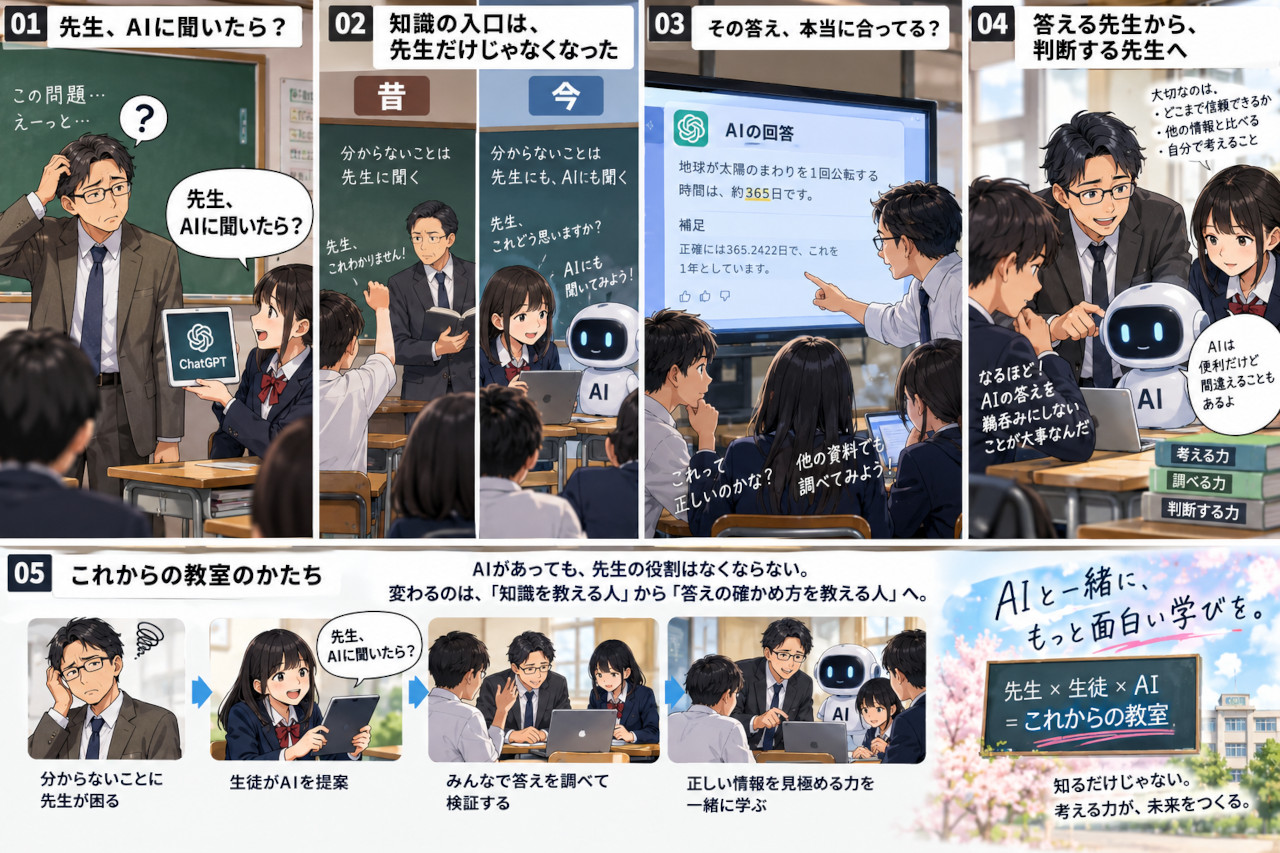
It may mean that the teacher’s job is shifting from “the person who knows the answer” to “the person who teaches you how to find out whether the answer is any good.”
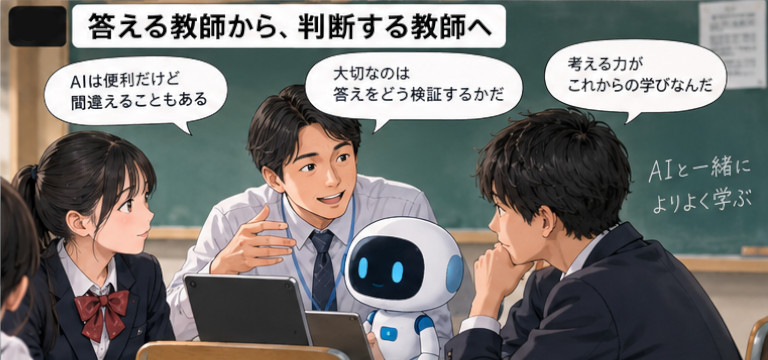 AI-generated conceptual illustration of a teacher guiding students in evaluating AI-generated information.
Editor’s Note
Unless a teacher insists on staying completely analog, this could get wonderfully messy. Teachers bring years of subject knowledge and life experience, then add AI on top. Sooner or later, the teacher’s AI and the student’s AI will give different answers and the whole class will have to settle the dispute. Which source holds up? Which answer falls apart? That sounds less like the death of learning and more like a first-rate workout for the brain.
References
- Ministry of Education, Culture, Sports, Science and Technology (MEXT) — Use of Generative AI in School Settings (Japanese source page; includes the official guidelines and related materials). Official provisional English translation: Guideline for the Use of Generative AI in Elementary and Secondary Education Ver.2.0
- Gakken — High School Student White Paper, November 2025 Survey: Use and Purposes of Generative AI (Japanese)