
There is a persistent rumor in Japan: when a truly catastrophic earthquake or national emergency is coming, the government and the Imperial Family already know—and the people at the top quietly get out first.
It is an unusually durable story because one part of it sounds plausible. Japan’s central government and Imperial Household do have emergency planning, protected lines of communication, continuity procedures and transportation arrangements that ordinary households obviously do not.
But there is a large gap between “the state has special emergency plans” and “the government can secretly predict a major earthquake and evacuates key people abroad before it happens.” The useful question is not whether the rumor feels suspicious. It is whether the official plans and actual travel records support it.
The “special evacuation plan” is real. It just says something very different
Japan’s Imperial Household Agency publishes its own business continuity plan for major emergencies, including a severe inland earthquake affecting Tokyo. The plan covers the safety of members of the Imperial Family, continuity of constitutional and official duties, communications, medical support, emergency transportation and the maintenance of essential services.
The national government operates on the same basic logic. Japan has a government business continuity framework designed to keep ministries, command structures and essential administrative functions operating even if central Tokyo itself is badly damaged.
That is the small piece of reality from which the larger rumor can grow. Yes, there are preparations that most citizens will never personally need. But the published plans are not built around sending the Imperial Family or the Cabinet overseas. The emphasis is on keeping the Imperial Household and the machinery of government functioning inside Japan.
In other words, it looks much more like a national-level BCP—Business Continuity Plan—than a secret international escape route.
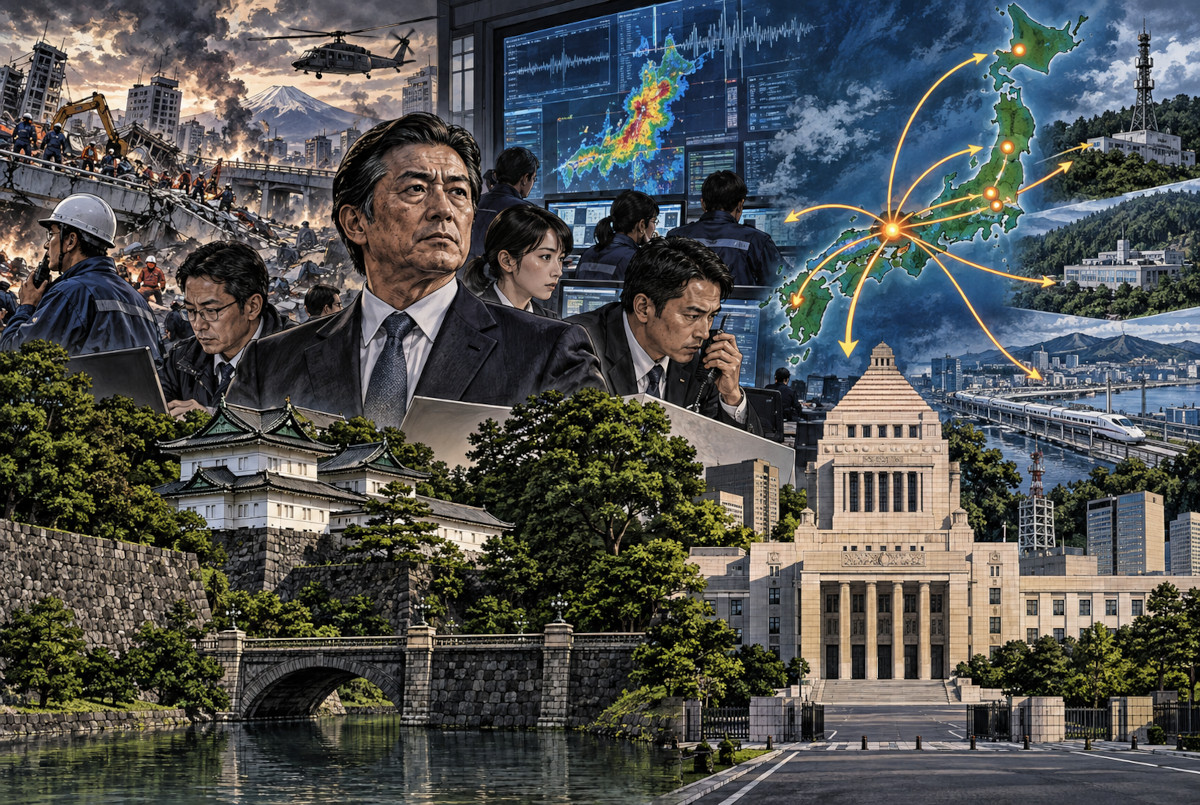 AI-generated conceptual illustration. It does not reproduce actual government facilities, the Imperial Palace, disaster scenes, individuals or security arrangements.
Earthquakes are the awkward part: even a powerful information network cannot provide an exact date
The entire theory depends on one major assumption: that the Japanese government possesses a way to know, in secret, that a large earthquake will occur at a particular time and place.
That is where the evidence becomes much weaker. The Japan Meteorological Agency defines meaningful earthquake prediction as being able to specify the time, location and magnitude of an earthquake with useful accuracy. Under current scientific knowledge, predictions of that kind are extremely difficult.
This is also why Japan’s well-known Earthquake Early Warning system should not be confused with advance earthquake prediction. Early warnings are generated when an earthquake has already begun and can provide seconds of warning before stronger shaking reaches some areas. They are not a notice issued days beforehand.
The same distinction matters with the Nankai Trough Earthquake Extra Information system. Authorities may determine that the probability of another major event has become relatively higher than normal after certain seismic or crustal events, but that still does not produce an appointment on the calendar saying, “Tuesday at 3:20 p.m., magnitude 8.”
There is no publicly demonstrated basis for the idea that officials possess a hidden timetable for future major earthquakes. Intelligence can make a major difference with terrorism, military conflict, political instability or diplomatic crises because those involve human actions and information. Earthquakes are a different problem.
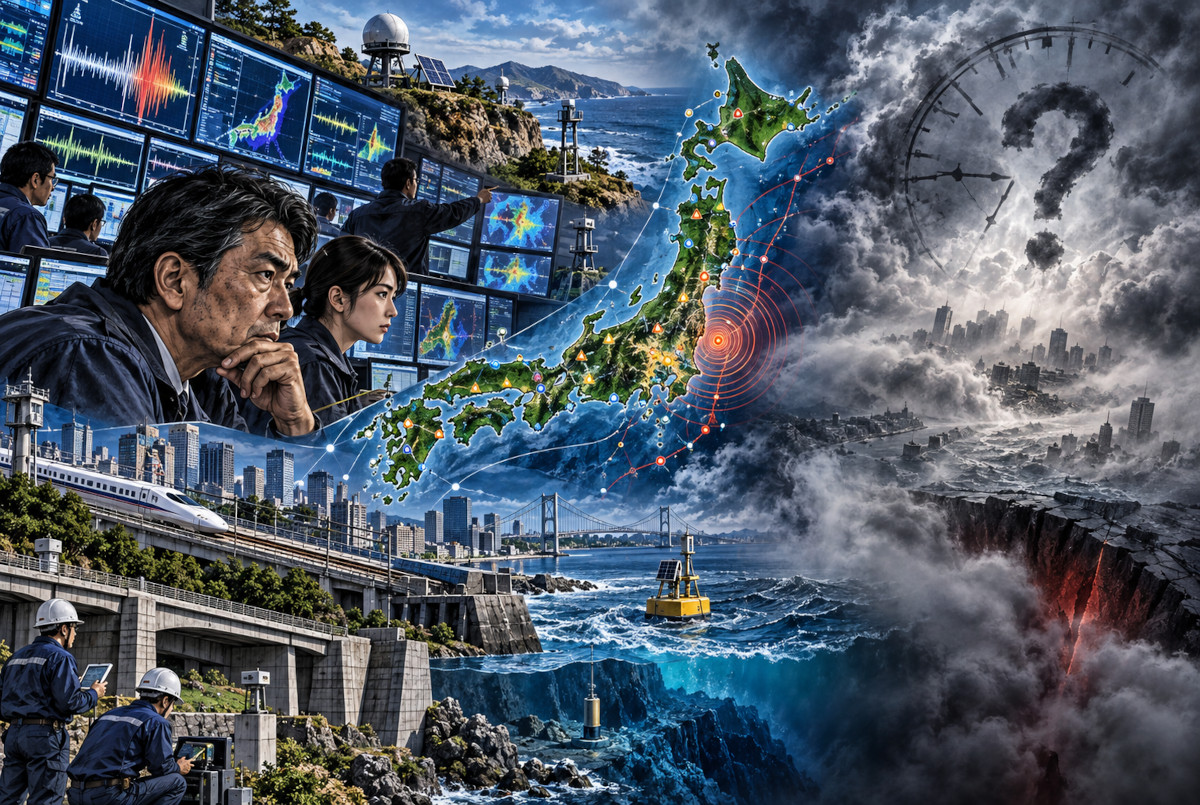 AI-generated conceptual illustration. It does not represent an actual monitoring screen, earthquake forecast or future disaster scenario.
Put major earthquakes beside Imperial Family travel dates, and the pattern starts to weaken
The rumor becomes more interesting when actual dates are checked, because there really have been occasions when members of the Imperial Family were abroad around the time of an earthquake. But there are also some very inconvenient counterexamples.
The Great Hanshin-Awaji Earthquake struck on January 17, 1995. The then Crown Prince and Crown Princess began an official visit to Kuwait, the United Arab Emirates and Jordan on January 20. In other words, the overseas trip began three days after the earthquake, not immediately before it.
During the 2016 Kumamoto earthquakes, the Emperor and Empress at the time were in Japan. A planned visit to Shizuoka Prefecture on April 15 was canceled because of the damage in Kumamoto and the continuing emergency.
The 2018 Hokkaido Eastern Iburi Earthquake struck on September 6. The current Emperor, who was Crown Prince at the time, had official duties in Japan that day. His scheduled visit to France began on September 7—the following day.
And on January 1, 2024, when the Noto Peninsula Earthquake struck, the Emperor and Empress had been taking part in the traditional New Year ceremonies at the Imperial Palace that day.
None of those cases proves that no confidential emergency procedure could ever exist. But taken together, they do not show a recurring pattern in which the Imperial Family leaves Japan immediately before major earthquakes.
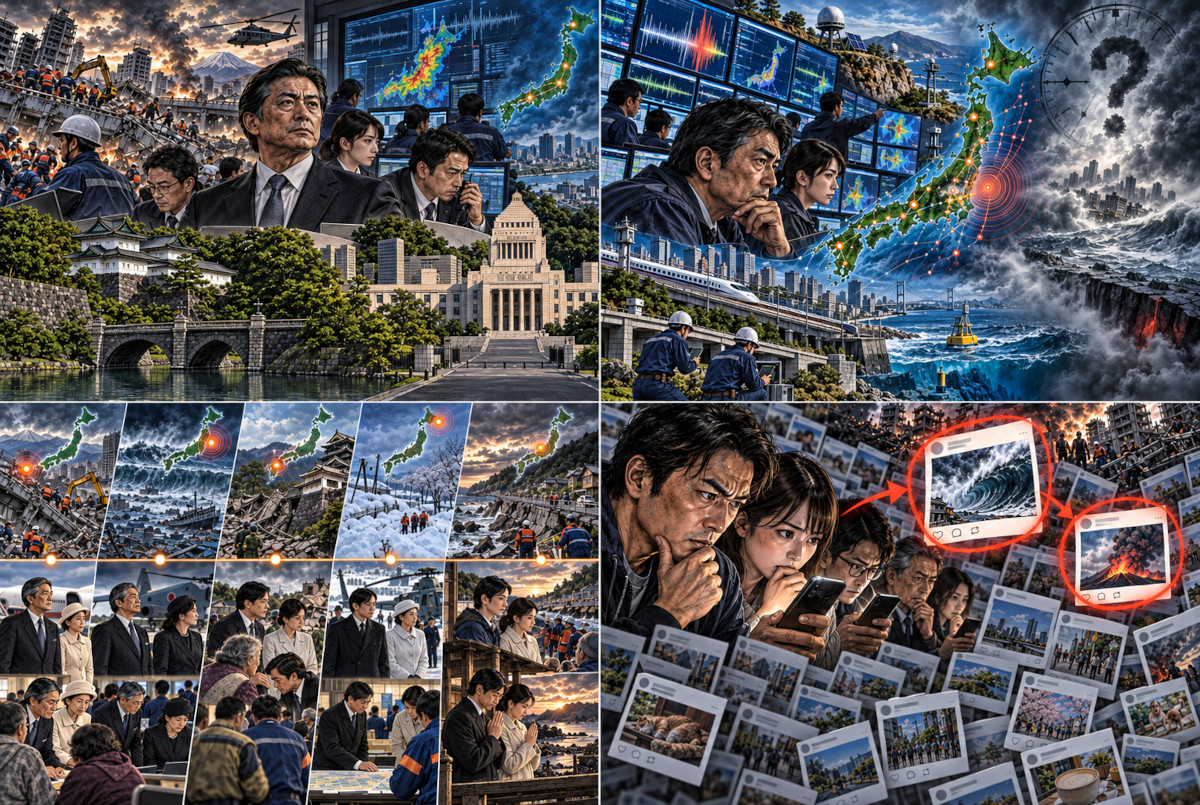
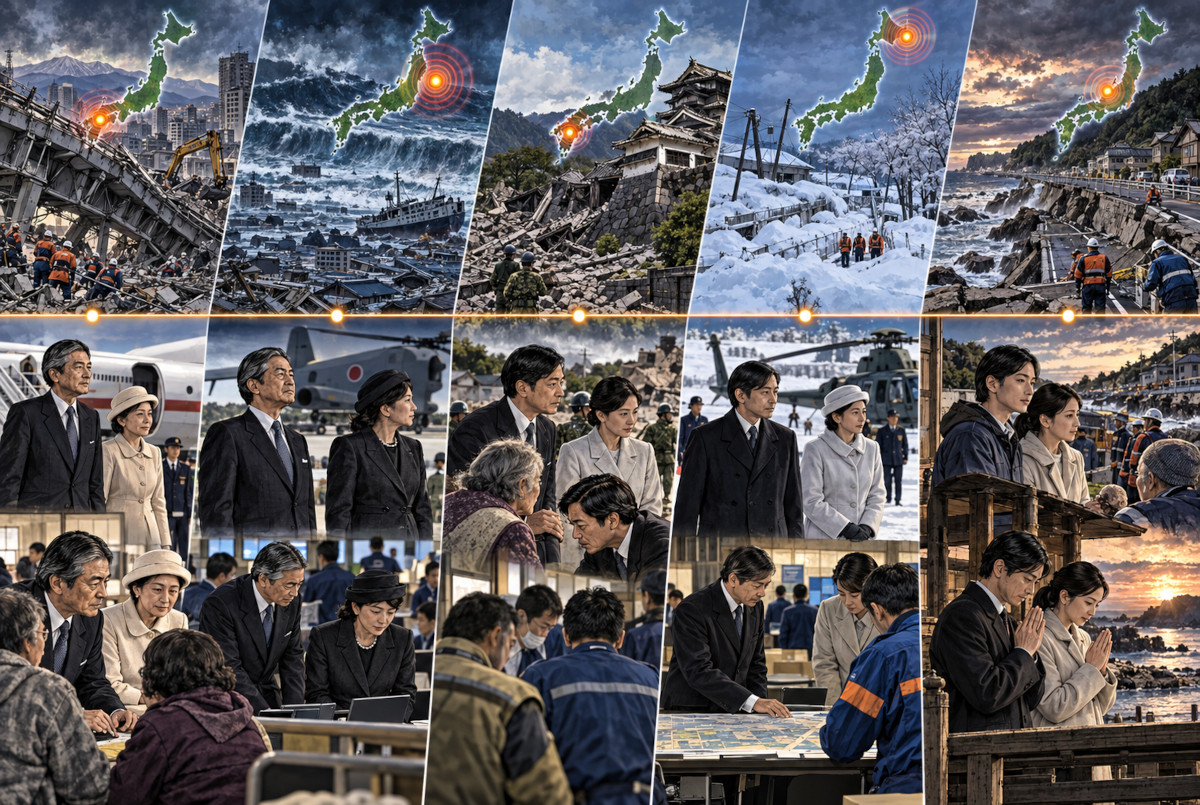 AI-generated comparison illustration. It does not reproduce actual members of the Imperial Family, clothing, aircraft, official visits or disaster scenes.
March 11, 2011 is the example that makes the rumor look suspicious
If someone wanted to build the strongest possible version of this theory, the Great East Japan Earthquake would be the obvious place to start.
Prince Akishino was in Thailand from March 8 to March 11, 2011, attending ceremonies for honorary doctorates from Kasetsart University and Chiang Mai University. Princess Akiko was also abroad, on an academic trip to the United Kingdom that ran from January 28 to March 30.
Seen in isolation, that looks perfect for the rumor: members of the Imperial Family were overseas when the disaster struck.
But once the rest of the record is added, the interpretation becomes less dramatic. Prince Akishino’s trip had a documented academic purpose. The Imperial Household Agency’s schedule for March 11 also records the Emperor and Empress receiving Prince Akishino after his return from Thailand, while the Emperor continued official duties in Japan.
There is no evidence in the published record that the Thailand trip was suddenly inserted as an emergency evacuation immediately before the earthquake.
And there is an obvious structural problem with the theory. If the purpose of a secret operation were to move the Imperial Family out of danger before a known catastrophic earthquake, leaving the Emperor and Empress in Japan would be a remarkably strange way to carry it out.
“Some members of the Imperial Family happened to be overseas when an earthquake occurred” and “the Imperial Family was evacuated because officials knew the earthquake was coming” may sound similar in a short social-media post. They are not the same claim.
How a coincidence turns into a convincing conspiracy pattern
There is another reason the story survives. Members of the Imperial Family make overseas visits for diplomacy, ceremonies, academic work and international events. Japan, meanwhile, experiences earthquakes on a regular basis. Over a long enough timeline, some overseas visits and significant earthquakes will inevitably overlap.
The psychological trap appears when only the overlaps are collected.
An Imperial Family member leaves Japan. Three days later, something happens. That case gets screenshotted, reposted and added to a list. But an Imperial Family member travels abroad and nothing happens? Nobody makes a viral video about that. A large earthquake occurs while the Emperor is at the Imperial Palace? That is far less useful to the theory, so it tends to disappear from the story.
This is close to a classic selection problem: count the apparent “hits,” forget the misses, and the surviving examples begin to look far more extraordinary than the complete dataset would suggest.
Once coincidence and evidence of prior knowledge are treated as the same thing, almost any historical timeline can be made to look suspicious.

The less cinematic reality may be more interesting than the escape story
After going through the official documents, the most interesting part of this rumor is that it contains a small piece of truth.
The government and Imperial Household really do have emergency systems that ordinary citizens do not. The safety of the Imperial Family, continuity of state functions, emergency communications, transportation and backup government operations really are planned in advance.
But the evidence points toward a different purpose from the one suggested by the rumor. Continuity of Japan’s central institutions is treated as a priority during a national emergency. That is not especially mysterious. A state that loses its command structure, communications and ability to perform essential constitutional functions in the middle of a disaster has created a second disaster for itself.
So the more interesting question may not be, “Do they secretly know when the earthquake is coming?” It may be this:
When Japan prepares for the worst, what does the country consider too important to be allowed to stop?
Editor’s Note
I have never been particularly fond of the lazy version of debunking that simply says, “That is a conspiracy theory, end of story.” Sometimes the reason a strange rumor survives is that there is a real mechanism hiding underneath it.
In this case, the emergency plans are real. Backup arrangements are real. The Imperial Household and central government really are prepared differently from an ordinary family living in Tokyo. Pretending otherwise would actually make the rumor look more convincing.
But once I went looking for the dramatic part—the secret advance warning and the last-minute overseas escape—the official record became much less cinematic. What exists is something quieter: systems designed to keep the state functioning while everything around it may be going wrong.
Conspiracy stories usually prefer helicopters, hidden bunkers and a plane taking off at midnight. Real disaster management seems to prefer generators, communications, backup offices and paperwork. Frankly, I find the boring version more interesting. It tells us much more about how power and institutions actually prepare for a crisis.
References
- Imperial Household Agency, Business Continuity Plan, revised February 2024 (Japanese)
- Japan Meteorological Agency, “Can Earthquakes Be Predicted?” FAQ (Japanese)
- Japan Meteorological Agency, Nankai Trough Earthquake Information FAQ (Japanese)
- Cabinet Office, Government Business Continuity Planning (Japanese)
- Imperial Household Agency, Overseas Visits by the Emperor and Imperial Family, 1989–1998 (Japanese)
- Imperial Household Agency, Overseas Visits by the Emperor and Imperial Family, 2009–2018 (Japanese)
- Imperial Household Agency, Schedule of the Akishino Family, January–March 2011 (Japanese)
- Imperial Household Agency, Schedule of Their Majesties, April–June 2016 (Japanese)
- Imperial Household Agency, Crown Prince’s Official Visit to France, 2018 (Japanese)
- Imperial Household Agency, Imperial Palace Events on January 1, 2024 (Japanese)