

Old Japanese youth magazines were once packed with features promising things like “how to talk to women” or “the perfect first-date strategy.” If you were bad at dating, you bought the magazine, asked a friend, tried your luck—and quite possibly crashed and burned anyway.
Now there is another option. You can show an AI your dating profile and ask what is wrong with it. You can paste in a message before sending it and get told that it is too long, too intense, too self-important, or simply boring. For men who never really understood where their conversations went wrong, there is now a dating adviser available 24 hours a day. It just happens to be generative AI.
Yes, There Really Are Men Who Used AI and Ended Up in Relationships
One of the more extreme examples is Aleksandr Zhadan, a Russian man profiled by Forbes in 2024. Zhadan built a system that filtered through thousands of Tinder profiles and used ChatGPT to handle parts of his conversations with matches.
One of those matches was Karina Vyalshakaeva. They eventually met in person, started dating, moved in together, and were engaged by the time Forbes reported the story. According to the report, she did not learn until more than six months into the relationship that AI had been involved in some of their early conversations.
It would be easy to turn that into a headline saying, “AI saved a hopelessly undateable man.” But that would be sloppy. Zhadan had previously been in a relationship for about two years. What AI seems to have done was not transform a man with zero romantic experience into Casanova. It dramatically streamlined the searching, filtering, and messaging process.

AI May Be More Useful in Much Less Dramatic Ways
The less spectacular cases may actually tell us more. In 2025, Reuters interviewed a 35-year-old man who said he struggled with starting conversations with women. He used the AI dating assistant Rizz to look at profiles and help him come up with opening messages. According to him, it helped move interactions beyond chat and toward actual face-to-face dates.
His face did not change. His income did not suddenly increase. He did not wake up one morning with movie-star charisma.
AI simply removed one bottleneck: “I have no idea what to say first.” For shy, geeky, or socially awkward men, that may be far more important than any supposedly magical pickup line.
In Japan, Asking AI for Dating Advice Is Already Quite Normal
In April 2026, Japanese matchmaking company O-net published a survey of 436 unmarried adults aged 25 to 34. Some 28.2% said they had used AI for romantic messaging or similar dating-related communication. Roughly speaking, that is more than one in four.
Another survey, conducted in November 2025 by Eureka, the company behind the major Japanese dating app Pairs, questioned 1,022 people in their 20s and 30s who had experience using dating apps. Overall, 53.1% said they had consulted generative AI about romance or dating. Among men in their 20s, the figure was 66.3%—almost two out of three.
The two surveys used different samples, so their figures should not be compared directly. Still, one thing is fairly clear: asking AI for dating help is no longer some bizarre hobby practiced by a handful of tech obsessives.
But People Suddenly Feel Differently When They Learn the Message Was Written by AI
This is where human beings become wonderfully inconvenient.
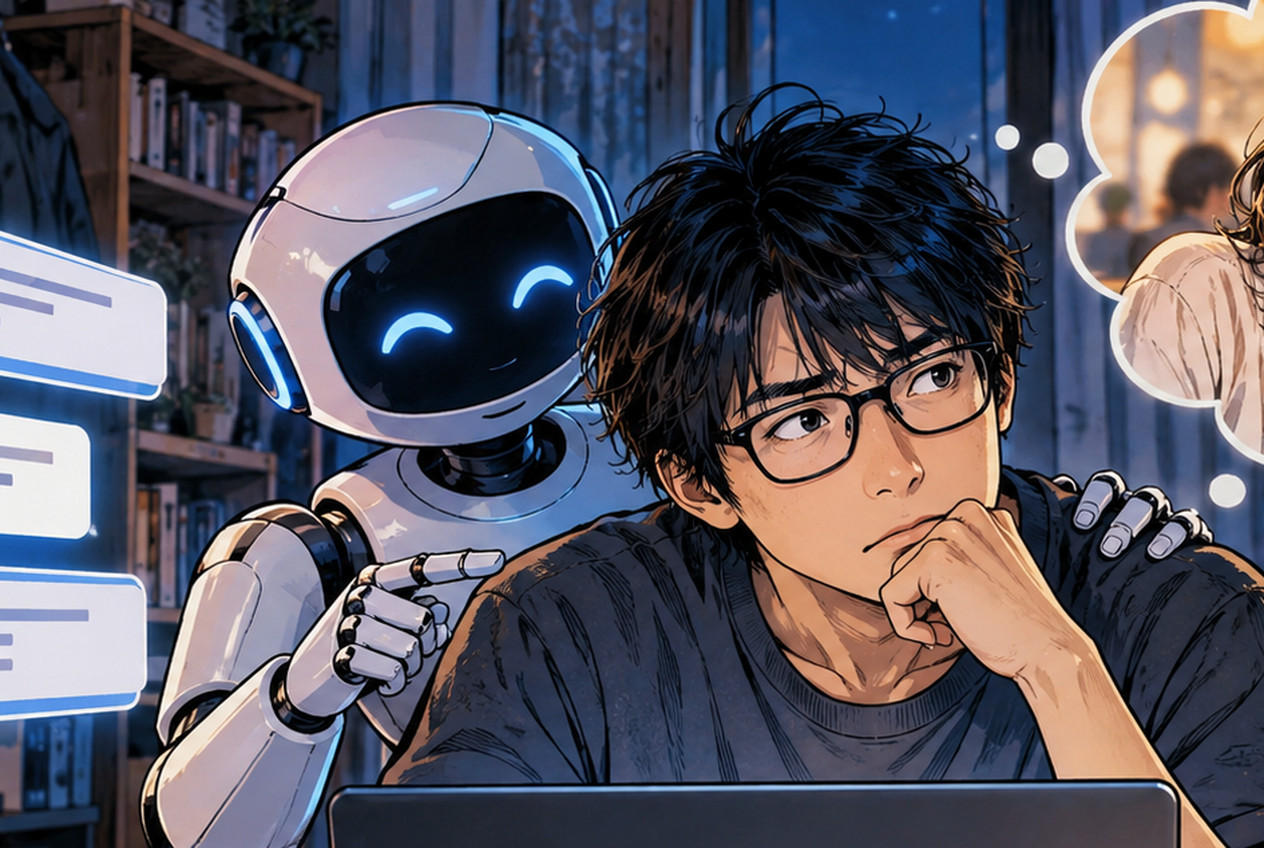
In the same O-net survey, 56.2% said they would feel either considerably or somewhat less interested if they discovered that a romantic message they had been happy to receive was actually created with AI. That compares with 28.2% who reported having used AI for romantic communication themselves. The questions measure different things and cannot be treated as a direct apples-to-apples comparison, but numerically, 56.2% is almost exactly twice 28.2%.
From the sender’s point of view, the logic may be simple: “I knew what I wanted to say. AI just helped me say it better.” From the recipient’s side, however, the question becomes: “Was that really you talking to me?”
A 2026 study titled “The Cyrano Effect” explored exactly this tension through interviews with 45 people who either used LLMs to help manage impressions in online dating or received AI-assisted messages. The researchers highlighted issues including loss of trust after AI use was revealed and the gap between an AI-polished online persona and the actual person someone meets offline.
There Is a Big Difference Between Letting AI Flirt for You and Letting It Train You
After looking at these cases, the phrase “AI can make you better at dating” starts to look rather misleading.
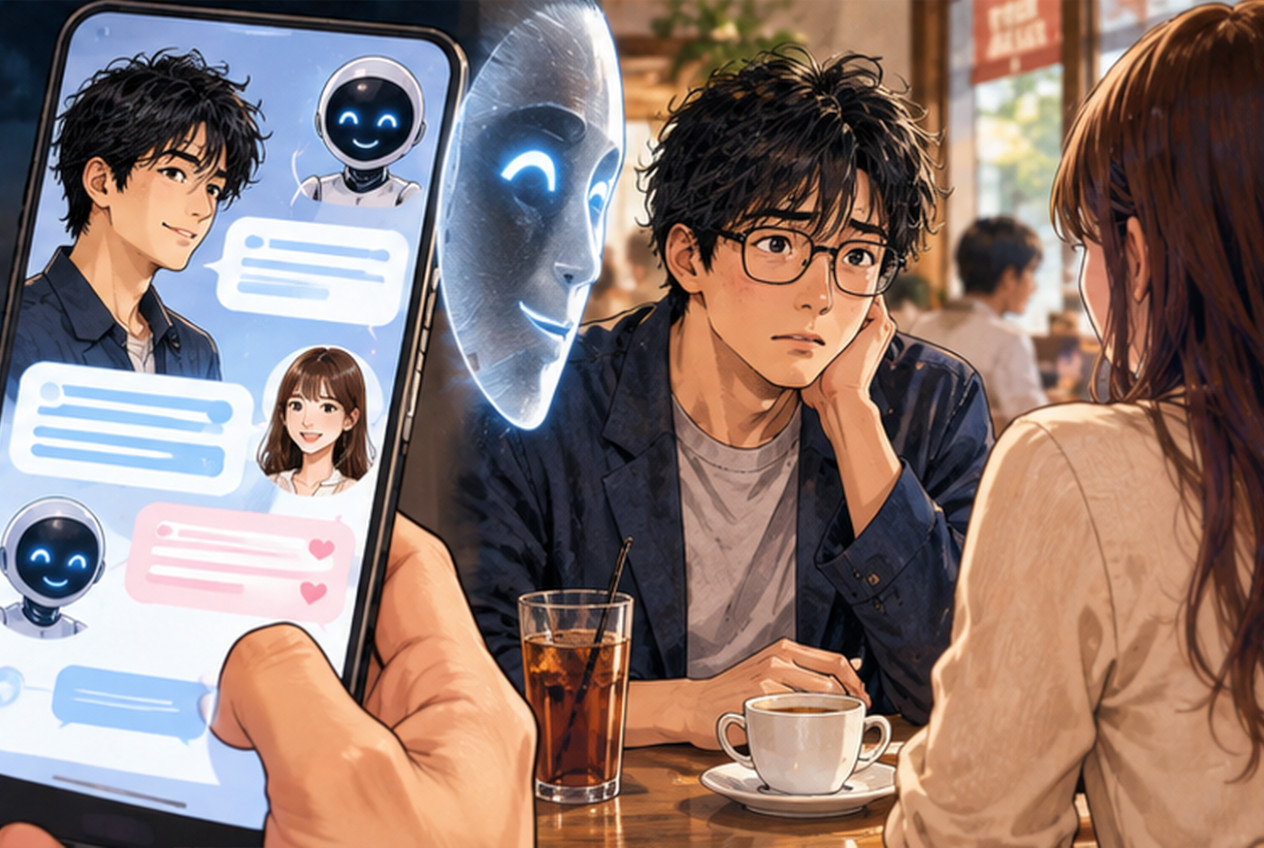
If AI writes your profile, handles your messages, and practically performs your personality for you, then the version of you living inside the dating app may simply be more articulate and charming than the person who eventually turns up for coffee. At some point, however, the AI stays home and you have to go on the date yourself.
That is why using AI as an editor may be more useful than using it as a ghostwriter. You can ask: “Is this too intense?” “Does this sound like bragging?” “Did I completely ignore her question?” If you do that repeatedly, you may start recognizing the same patterns yourself. At that point, AI is no longer doing the flirting for you. It is helping you practice.
Research on online dating profiles also points in a useful direction. One study found that profiles perceived as more original also tended to make their writers seem more intelligent and humorous, which was in turn associated with greater perceived attractiveness and willingness to go on a date. The participants skewed older, so the results should not simply be treated as a rule for men in their 20s. Even so, the implication is interesting: rather than letting AI produce generic, polished sludge, it may make more sense to keep the person’s actual material and use AI only to improve how that material is expressed.
So Can AI Actually Help Men Who Struggle With Dating?
There is still no solid evidence that “use ChatGPT and you will get a girlfriend.” But there are now real cases, survey data, and commercial tools showing that AI can help with some of the awkward entry points of modern dating: writing a profile, sending the first message, replying without overthinking it, or figuring out how to suggest meeting in person.
Dating apps themselves are moving in the same direction. Hinge offers AI-assisted Prompt Feedback for profile answers, while Bumble has introduced AI-based profile guidance and other tools designed to help users present themselves more effectively.
AI is not a machine that manufactures attractive men. But it may be a useful set of training wheels for someone who genuinely does not understand why the same conversations keep going wrong.
That may be the biggest difference between old dating-advice books and AI. A magazine gave the same advice to a million readers. AI can look at your actual message and tell you, personally, “That paragraph right there? Delete it.”
Editor’s Note
If I were using AI for dating, I would rather make it my last-minute editor than let it flirt on my behalf. Geeky people have a particular talent for turning a perfectly normal message into a three-paragraph lecture the moment the conversation touches something they know too much about. Having something say, “No. Cut that part,” may already be useful enough. In the end, ChatGPT is not the one showing up for the date. You are.
References
- Forbes, “Is Your Tinder Date Actually An AI Chat Bot? Maybe.” (February 14, 2024)
- Reuters, “‘Perfection without the connection’: How AI is becoming a digital wingman” (October 4, 2025)
- O-net, survey on AI use in romantic communication among unmarried Japanese adults (April 8, 2026, Japanese)
- Eureka / Pairs, survey on returning to dating apps and using generative AI for dating advice (December 19, 2025, Japanese)
- Lennart Ante, “The Cyrano effect: LLM-assisted impression management and authenticity in online dating,” Telematics and Informatics (2026)
- van der Zanden et al., “Originality in online dating profile texts: How does perceived originality affect impression formation and what makes a text original?” PLOS ONE (2022)
- Hinge, “How Prompt Feedback Works”
- Bumble, “Bumble Announces Two New Features For Confidence and Clarity in Dating” (February 26, 2026)