
Outside Kawaguchiko Station sits a rather odd-looking old electric railcar: a brown, riveted body with a simple white “1” on the front. It is Mo 1, built in 1929 for Fujisanroku Electric Railway, the predecessor of today’s Fujikyu railway operation.
So far, this sounds like a straightforward story about a preserved historic train. But follow its history a little further and things become much stranger. The Mo 1 displayed at Kawaguchiko Station once stopped being “Mo 1” altogether and spent decades in Nagano as a different railway vehicle. Which raises a slightly awkward question: how much of the railcar standing here today is actually the original Mo 1?
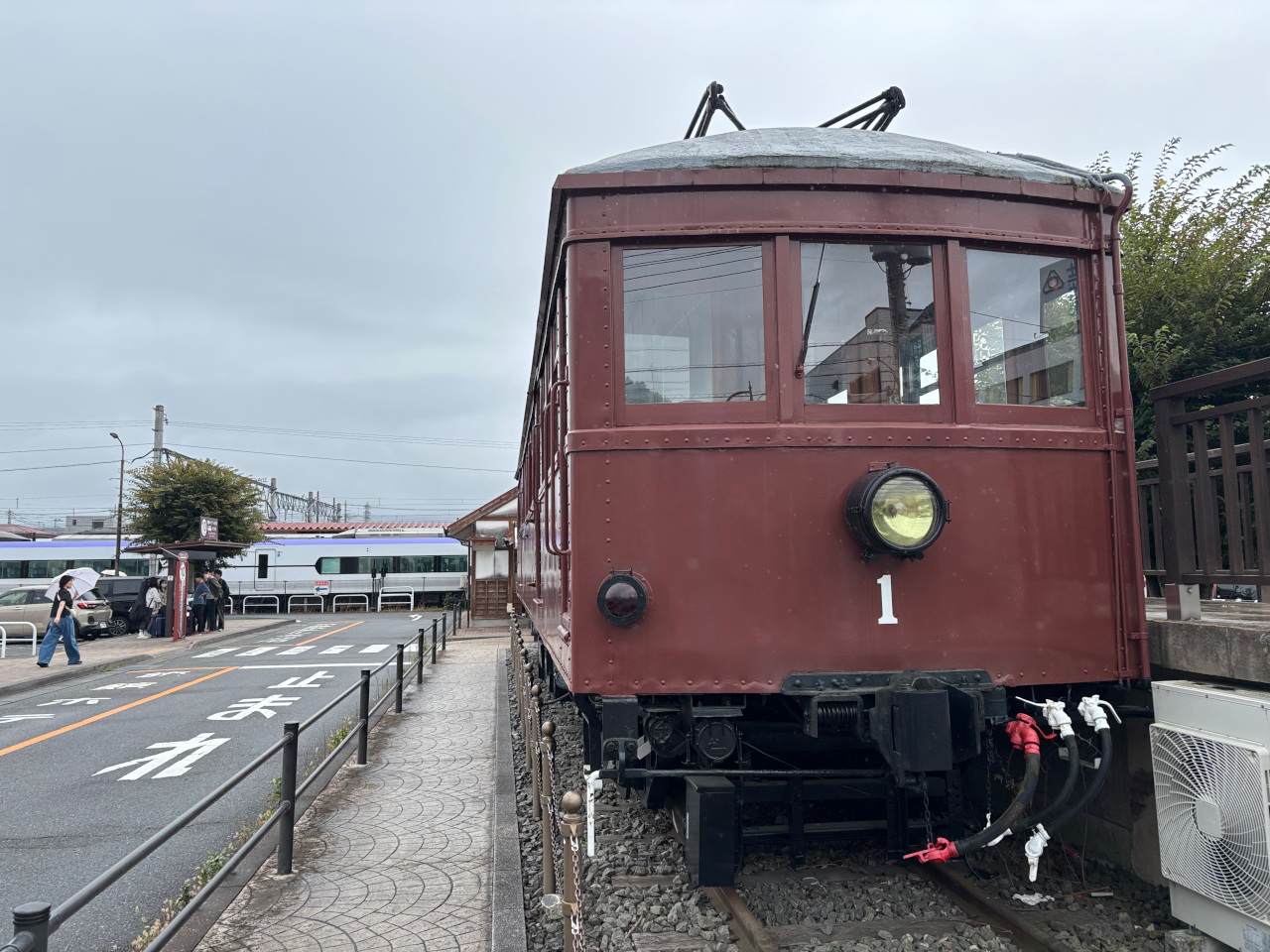
Mo 1 preserved outside Kawaguchiko Station. Photographed by the editor in September 2026.
Mo 1 Is 21 Years Older Than Kawaguchiko Station
Fujisanroku Electric Railway opened the 23.6 km line between Otsuki and Fuji-Yoshida on June 19, 1929. Five new electric cars, Mo 1 through Mo 5, were built by Nippon Sharyo for the opening, with Mo 1 as the first vehicle in the series.
The railway did not reach Kawaguchiko until August 24, 1950. In other words, Mo 1 is 21 years older than Kawaguchiko Station itself. The odd part is that a train now displayed outside Kawaguchiko Station had already been running for more than two decades before the station even existed.
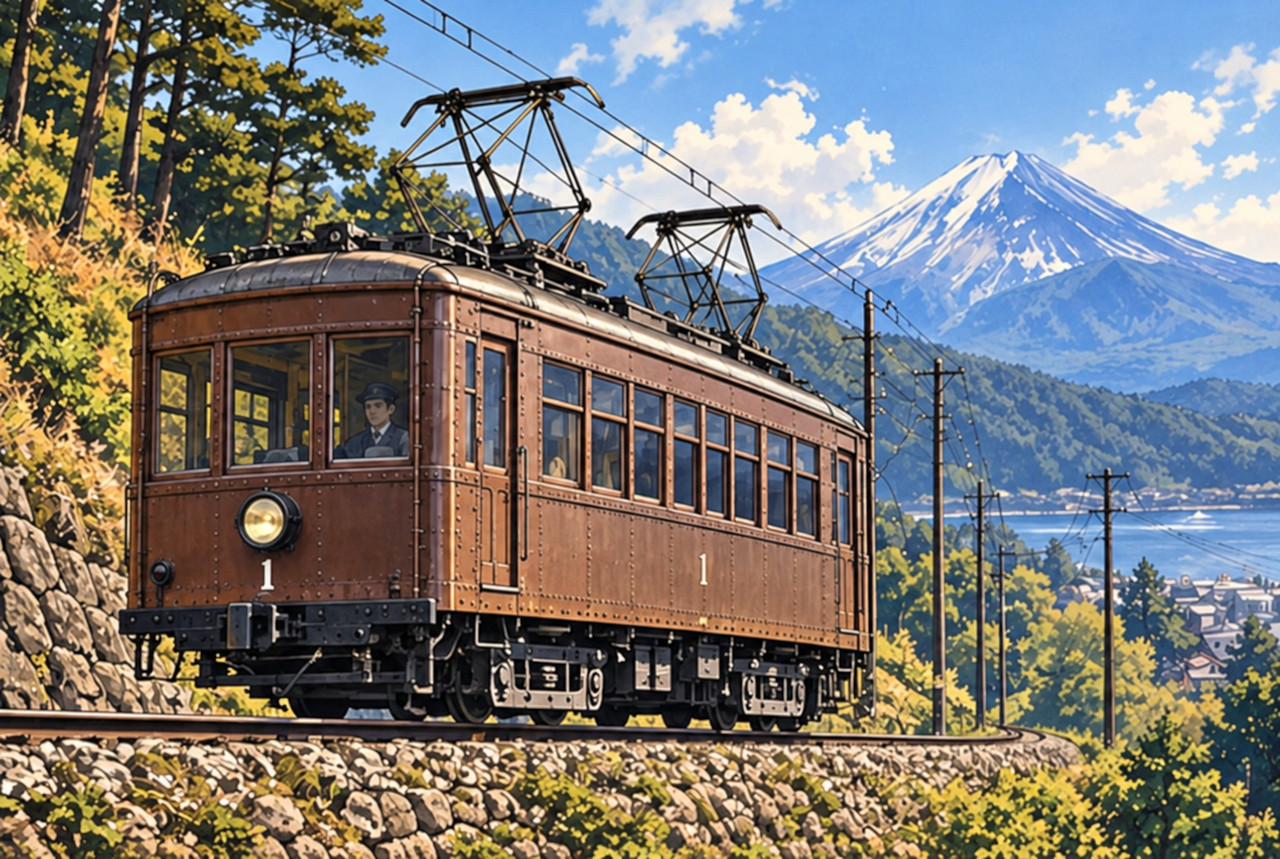
AI-generated period illustration. The scenery and exact running location are not intended as a reconstruction of an actual historical scene.
Small Car, Serious Mountain-Railway Hardware
According to the information board at the site, Mo 1 measured 15,240 mm in length, weighed 34 metric tons and could carry 102 passengers. Its four traction motors were rated at 93.25 kW each, giving a simple combined rating of 373 kW.
The more interesting details, however, are the ones designed for steep grades. The National Museum of Nature and Science’s database notes that the cars were equipped with two pantographs, sanders and multiple-unit control, while the local information board also lists electric braking. Even today, the Fujikyu line includes gradients of up to 40‰—a rise of 40 meters for every horizontal kilometer.
In other words, this was not some sleepy little countryside tram simply because it was small and built in 1929. It was machinery designed to climb.
In the 1950s, Mo 1’s Body and Running Gear Went Separate Ways
This is where the story becomes properly strange. During the 1950s, the Mo 1 series underwent body renewal. The original body of Mo 1 was removed, but instead of being scrapped, it was transferred to Ueda Maruko Electric Railway in Nagano Prefecture.
There, the former Mo 1 body entered service in 1955 as KuHa 251. It was later motorized and became MoHa 4257. So the vehicle body that had once been “Fujisanroku Electric Railway Mo 1” lost both its original identity and role, then continued working under another railway company as another class of train.
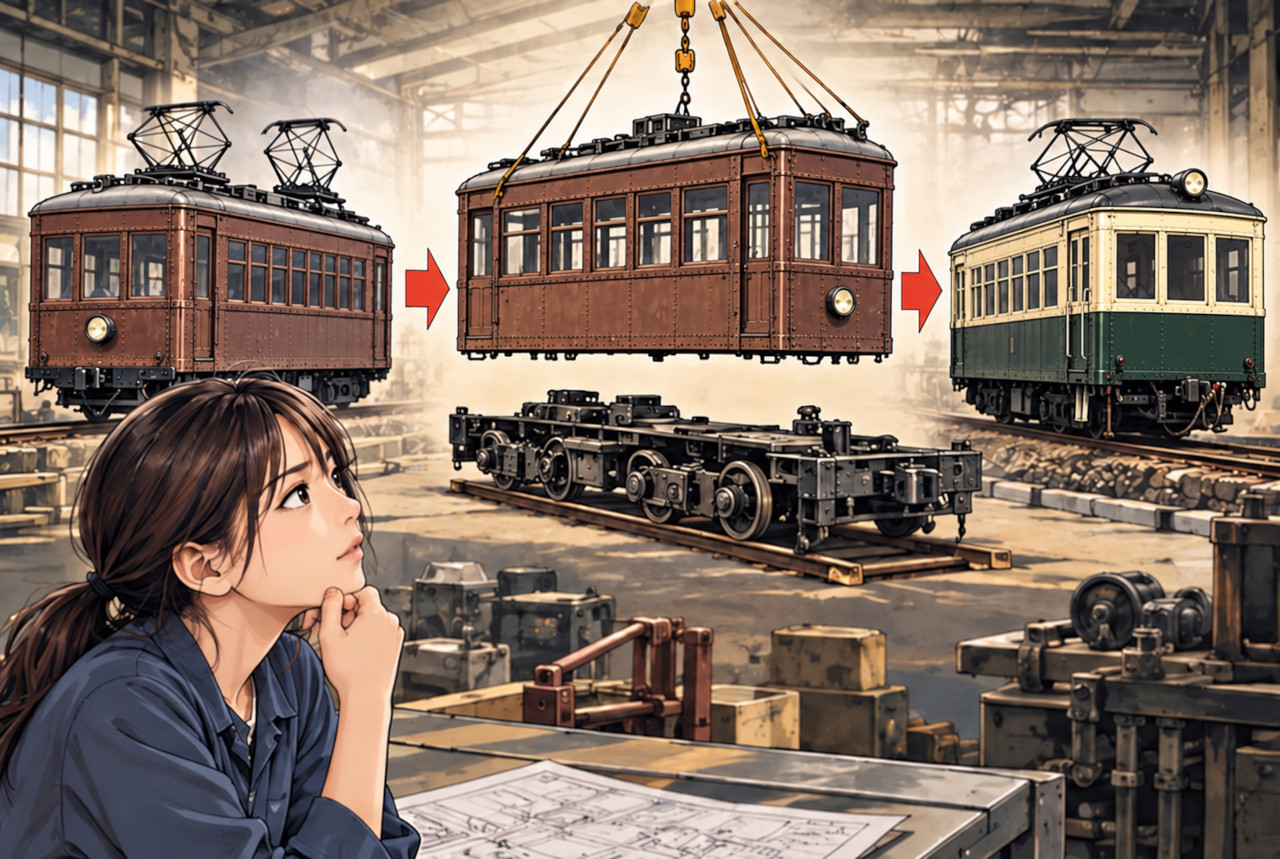
AI-generated schematic illustration. It explains the sequence of body renewal and reuse, rather than reproducing the actual workshop process or every historical vehicle detail precisely.
MoHa 4257 was retired in 1983. Counting from the debut of KuHa 251 in 1955, the former Mo 1 body spent 28 years in use on the Ueda side. That is hardly a brief retirement posting. Its second railway career lasted about as long as its first life in Yamanashi.
So Is the Mo 1 at Kawaguchiko Station “Real”?
At this point, it would be easy to assume that the display car is basically a replica. That would also be wrong.
The National Museum of Nature and Science describes the preserved vehicle as the original pre-renewal body that had been transferred to Ueda Maruko Electric Railway, later bought back and restored as Mo 1. The information board at Kawaguchiko also explains that the body was recovered, restored and preserved as part of Fujikyu’s 60th-anniversary project.
So the body really is the body of the 1929 Mo 1. But the preserved vehicle is not a time capsule containing every component exactly as it was in 1929.
The roof gives away one obvious difference. The original car used two pantographs, while the preserved vehicle today carries one. Rather than thinking of it as a perfect factory-fresh recreation, it makes more sense to see it as a surviving 1929 body that has accumulated several different railway lives.
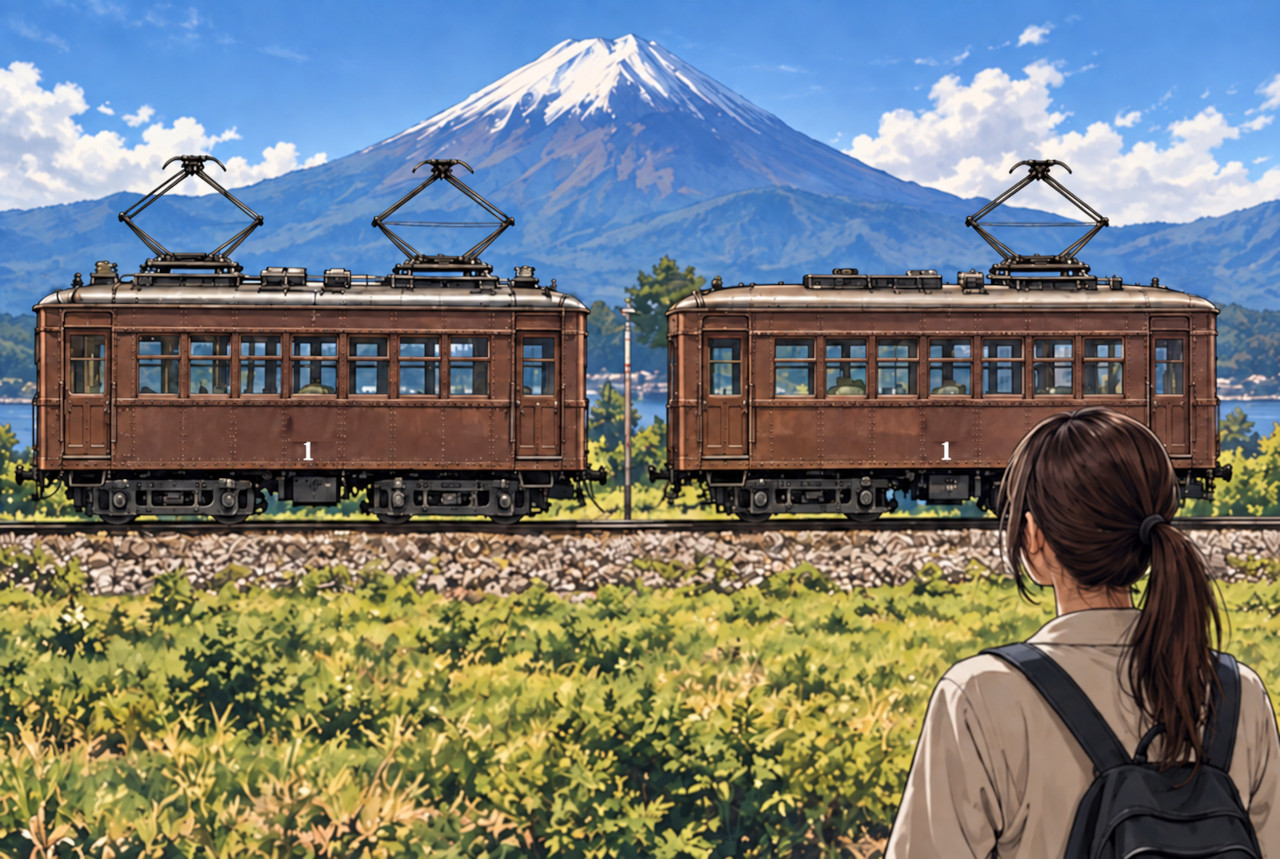
AI-generated comparison image focusing on the number of pantographs. Details such as lamps, bogies and other fittings are not intended as an exact engineering reconstruction.
The Rails Under It Are Even Older
There is one more wonderfully unnecessary detail. The display information notes that the rail beneath Mo 1 carries a “CARNEGIE 1897” marking.
If that date is taken at face value, the rail is 32 years older than the 1929 electric car sitting on top of it.
You arrive expecting to look at an early-Showa electric train, only to discover that the track underneath it reaches back to 1897. That is exactly the sort of detail that turns an ordinary preserved-railway exhibit into something much more interesting.
Even the Company Name Came Back
There is one final twist. In April 2022, Fujikyu’s railway business was separated into a new operating company, and the historic name Fujisanroku Electric Railway returned—the same name used when Mo 1 was born.
The body went from Yamanashi to Nagano, became a different railway vehicle, was retired, then came home. The railway business itself also passed through the Fujikyu era before once again carrying the Fujisanroku Electric Railway name. Mo 1 is therefore more than a 1929 railcar on display. It is a surviving body whose history somehow managed to loop back to where it started.
Editor’s Note
At first, I only thought, “There’s an old train sitting outside the station.” The year it was built was interesting, but the body’s strange second life turned out to be much more interesting than the age itself. Its name changed, its company changed, its role changed, and it spent 28 years in Nagano before eventually returning with the number “1” on the front again. Preservation is not always about freezing a machine exactly as it left the factory. In this case, the messy history carried by the surviving body is the best part of the story.
References
- National Museum of Nature and Science, Industrial Technology History Database — “Fujisanroku Electric Railway Mo 1 Electric Car”
- Fujikyu Corporation — Corporate History, Founding Period
- Fujisanroku Electric Railway — Kawaguchiko Station Information
- Fujisanroku Electric Railway — Fujisan View Express Viewing Spots, including the 40‰ gradient section
- Fujisanroku Electric Railway — “Returning to Its Original Name”
- Local Line — Ueda Railway vehicle history, including KuHa 251 and MoHa 4257
- On-site information board for Fujisanroku Electric Railway Mo 1, Kawaguchiko Station