


You wear the clothes everyone seems to be wearing, carry the bag that is currently popular, wait in line at a highly rated restaurant, and order the dish marked “most popular.”
You work a fairly ordinary office or sales job, and on weekends you visit a shopping mall or whichever place is getting attention online.
From the outside, it can raise an uncomfortable question: is that kind of life actually interesting?
But dismissing it as “boring” or “too ordinary” misses the more interesting point.
The real question is not whether a life looks conventional.
It is why people feel so comfortable choosing what everyone else has already approved.
Once we look at that, a very old part of human nature starts to show itself.

Illustration: Trendy clothes, fashionable bags, restaurant queues, and smartphone reviews represent the everyday influence of popularity and social approval.
Why Popular Clothes and Restaurants Feel Like the “Right” Choice
Human beings have always relied partly on other people when deciding what is safe, useful, desirable, or socially acceptable.
Evaluating every option from scratch takes time, and making the wrong choice can carry a cost.
That makes labels such as “popular,” “recommended,” “best-selling,” or “top-rated” surprisingly powerful.
They do more than advertise a product.
They allow us to borrow the judgment of other people before making our own decision.
Psychologists have long studied related phenomena under concepts such as conformity and social influence.
If many people appear to approve of something, that approval itself becomes information.
So someone who chooses a popular restaurant is not necessarily shallow or unoriginal.
They may simply be following a very practical human tendency:
reduce uncertainty and lower the chance of disappointment.
The same logic applies to choosing the best-selling dish instead of the strange item at the bottom of the menu.
We like to think of ourselves as independent decision-makers, but avoiding regret is also a powerful force.
Ordinary Work and a Life Built Around Predictable Choices
It would also be unfair to assume that office work or sales work is inherently dull.
Plenty of people find satisfaction, competition, skill, or purpose in jobs that look completely ordinary from the outside.
A conventional job does not automatically produce a conventional personality.
Still, a predictable working structure can fit comfortably with a lifestyle that favors low-risk choices.
Work steadily during the week, go somewhere well reviewed on the weekend, wear something that does not attract the wrong kind of attention, and choose places that friends and coworkers already recognize.
This is not necessarily a failure of imagination.
It can be understood as a lifestyle designed to reduce social friction.
There are obvious advantages.
There are fewer spectacular mistakes.
Conversation with coworkers is easier.
Friends and partners are more likely to share the same references.
You are less likely to be regarded as the strange person in the room.
Playing it safe may look boring, but as a social survival strategy, it is remarkably effective.

Illustration: An ordinary office environment represents stability, routine, and the social advantages of predictable choices.
What Makes Life Feel Dull Is Not Being Ordinary — It Is Outsourcing Every Choice
The problem begins when the reason for almost every decision comes from somewhere outside the person making it.
Buy it because it is trending.
Go there because everyone recommends it.
Order it because it is ranked No. 1.
Watch it because everyone is talking about it.
When personal curiosity, strange preferences, and individual obsessions disappear from the process, life can become a sequence of consumption decisions with very little personal editing.
Imagine two people entering the same ramen restaurant.
One orders the top-selling bowl because the machine says it is No. 1.
The other notices an obscure item near the bottom and thinks, “Why does nobody seem to order that?”
At many ramen shops in Japan, customers buy a meal ticket from a vending machine before sitting down, so the rankings and menu photographs can influence the decision before anyone even speaks to the staff.
It is a small example, but it captures the difference rather well.
The first person is using the crowd as a filter.
The second is using curiosity as a filter.
Neither is automatically right or wrong.
But psychologically, they are not making the same kind of choice.
Research on curiosity treats it as a motivation to seek novelty, knowledge, challenge, and unfamiliar experiences.
That suggests the interesting divide is not between glamorous lives and ordinary ones.
It may be between people who repeatedly follow established answers and those who still allow themselves to investigate what catches their attention.
In other words, what often makes a life feel personal is
not how unusual the choice is, but whether curiosity had any role in making it.
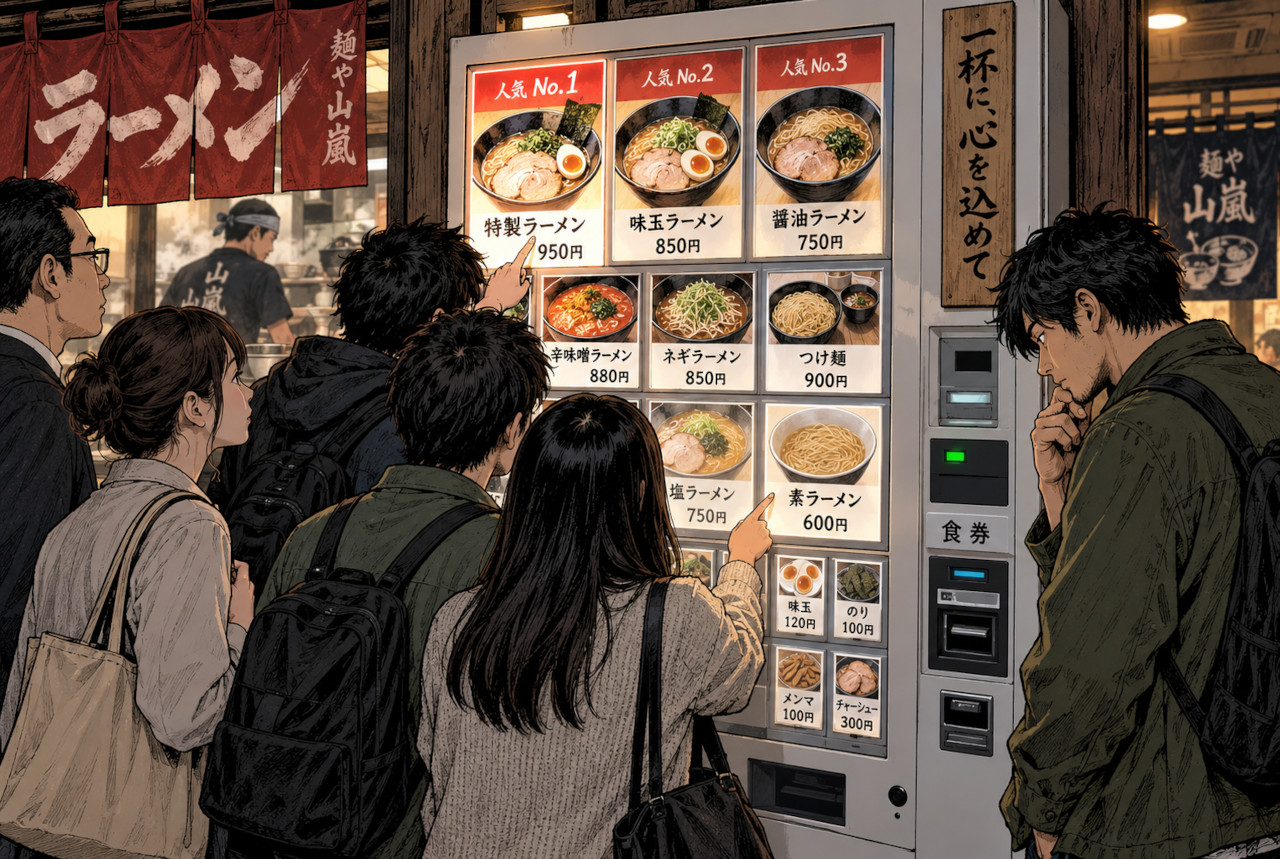
Illustration: Most customers choose the highest-ranked ramen, while one person becomes curious about a less obvious option.
But Are People Who Follow Popular Choices Actually Unhappy?
This is where the easy argument falls apart.
A life filled with popular clothes, famous restaurants, and recommended experiences is not automatically empty or unhappy.
In fact, research associated with psychologist Thomas Gilovich and colleagues has repeatedly suggested that spending on experiences tends to produce more lasting satisfaction than spending on material possessions alone.
Experiences can become memories, stories, and shared moments with other people.
That means someone who regularly visits restaurants, takes trips, spends weekends with friends, and shares enjoyable experiences may be doing quite well psychologically — even if every destination came from a “Top 10” list.
This creates an awkward but important distinction:
an interesting life and a happy life are not necessarily the same thing.
A person whose life looks completely ordinary from the outside may genuinely enjoy it.
That is not a weakness.
In some ways, being able to find satisfaction in ordinary life is an extremely useful ability.
The reverse is also true.
Someone may travel to obscure places, buy unusual things, reject every trend, and constantly advertise how different they are.
But if the real motivation is simply to be seen as unusual, that person is still allowing other people to determine the meaning of the choice.
Following the crowd because the crowd approves and rejecting the crowd because the crowd approves may look like opposites.
But both can still revolve around the crowd.
What Remains After a Lifetime of Safe Choices?
Popular clothes, popular restaurants, and best-selling dishes are not evidence of human weakness by themselves.
They are often the product of something more complicated:
rational decision-making mixed with anxiety about making the wrong choice.
There is nothing wrong with that.
Most of us use recommendations constantly because they save time and prevent unnecessary mistakes.
But if personal preference, curiosity, obsession, and even the occasional bad decision disappear completely, something else may disappear with them.
A person’s character is often revealed less by what they chose than by why they chose it.
An ordinary life is not automatically boring.
A life in which almost every important choice has effectively been made by someone else, however, may eventually feel strangely empty.
Enjoying popular things is not the problem.
The uncomfortable part begins when popularity becomes the answer to almost every question.
At that point, a person may accumulate a long record of choices that were rarely wrong — but surprisingly few discoveries that felt entirely their own.

Illustration: The crowded road represents safe, socially validated choices; the smaller path represents curiosity and personal exploration. Neither path automatically guarantees happiness.
Editor’s Note
I’ll admit it: when I see someone chasing one popular thing after another, part of me thinks, “Are you really going to let review sites run your entire life?”
But the more I look at it, the less comfortable that easy criticism becomes.
People who live that way may actually be perfectly happy.
They avoid a lot of unnecessary trouble, they share experiences with the people around them, and they may be much better at enjoying ordinary life than people like me who keep wandering off to look at strange things nobody else seems interested in.
People who dig into obscure cars, forgotten places, odd technology, or whatever else catches their attention probably do collect better stories.
We also collect more wasted time, dead ends, bad purchases, and unnecessary complications.
That comes with the territory.
So for me, the dividing line is no longer “ordinary versus unusual.”
It is whether I can honestly say, “I chose this because I wanted it.”
Once that disappears, even fashionable clothes and excellent restaurants can start to feel like pieces borrowed from somebody else’s life.
References
- Self-Determination Theory — Official Theory Overview
- Cornell Chronicle — Glee from buying objects wanes, while joy of buying experiences keeps growing
- Cornell Chronicle — To feel happier, talk about experiences, not things
- Kashdan, Rose & Fincham (2004) — Curiosity and exploration: facilitating positive subjective experiences and personal growth opportunities
- Asch (1956) — Studies of independence and conformity: A minority of one against a unanimous majority