
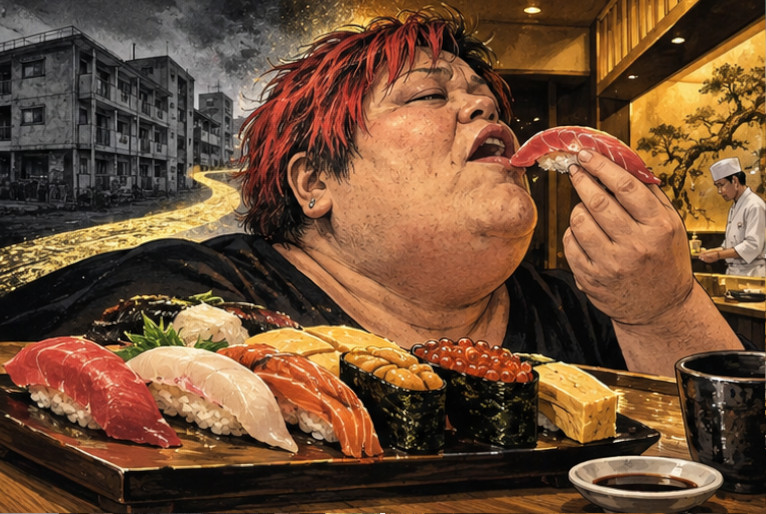
Suppose someone receiving welfare in Japan sits down at a sushi counter and spends ¥10,000 on dinner. Would that be allowed?
For a salaried worker watching taxes and social-insurance contributions disappear from every paycheck—while cutting back on lunch—it is easy to feel that something is off. So where does Japan’s welfare system actually draw the line? Expensive meals, video games, pachinko, savings, overseas travel, cars and investments: I went through the rules to see how much “luxury” is really permitted.
First, one important point. As of September 2026, the national laws and administrative guidelines I checked do not contain a simple nationwide rule such as “a meal over ¥X is prohibited.” But that does not mean recipients are free to do absolutely anything with money. The deeper you look, the stranger—and more logical—the boundary becomes.
A ¥10,000 sushi dinner is not automatically welfare fraud
Japan’s last-resort welfare program is officially known as the Public Assistance system, or seikatsu hogo in Japanese. Article 60 of the Public Assistance Act requires recipients to make efforts to reduce expenditure and to maintain or improve their standard of living.
What it does not do is provide a shopping list saying “no restaurants,” “no video games,” or “sushi must cost less than ¥3,000.”
So if a recipient economizes on ordinary food, clothes or other expenses and occasionally spends the money saved on an expensive meal, the fact that the meal itself was expensive does not automatically make the person a fraudulent recipient. Of course, the situation changes if the money used came from income that should have been reported but was not.
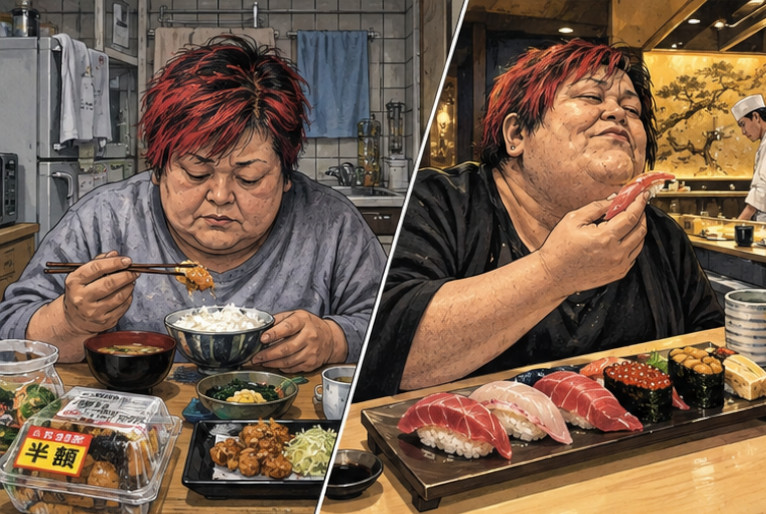
Here is a deliberately simple calculation. Spend an extra ¥333 every day and, over 30 days, that comes to ¥9,990. Save roughly ¥333 a day and spend about ¥10,000 on sushi once a month, and the monthly difference is almost the same.
Yet only one of those lifestyles produces a photograph that can go viral with the caption: “Welfare recipient eats ¥10,000 sushi!” The system, however, is not supposed to determine eligibility from a sushi photograph.
AI-generated illustration for explaining the system. It is not based on an actual public assistance recipient.
Even video games and pachinko are not simply banned
The same problem appears with ordinary possessions. Japan’s Ministry of Health, Labour and Welfare does not treat every television, camera or entertainment device as automatically disqualifying. Administrative guidance considers factors such as resale value, necessity and whether ownership is significantly out of balance with ordinary households.
That means there is no nationwide rule saying, for example, “own a game console and your benefits are terminated.”
Pachinko makes the issue even more interesting. Pachinko is a common Japanese gaming pastime in which prizes can be exchanged through a separate system. Government discussions have addressed cases where recipients spend excessive amounts on such entertainment and, as a result, damage their health or their ability to maintain an independent life.
The distinction matters. The system is not built around the idea that spending even one yen on entertainment is forbidden.
The problem is less the existence of recreation itself than spending that undermines the minimum standard of living or the recipient’s ability to live independently.
Surprisingly, welfare recipients are not simply forbidden to save money
This was one point I had misunderstood before checking the actual guidance.
Japan’s administrative rules specifically address savings accumulated by economizing on public assistance payments that have already been received. If the money was not accumulated through concealed or improper income, and if its intended use is not contrary to the purpose of the Public Assistance system, those savings may be allowed to remain.
In other words, Japan does not operate on a rule that says: “Spend every last yen of your welfare payment before the end of the month.”
That does not mean there is a universal rule saying that any amount of savings is acceptable. Where the money came from and what it is intended to be used for both matter. Using accumulated cash to obtain assets that recipients are generally expected to dispose of can raise an entirely different issue.
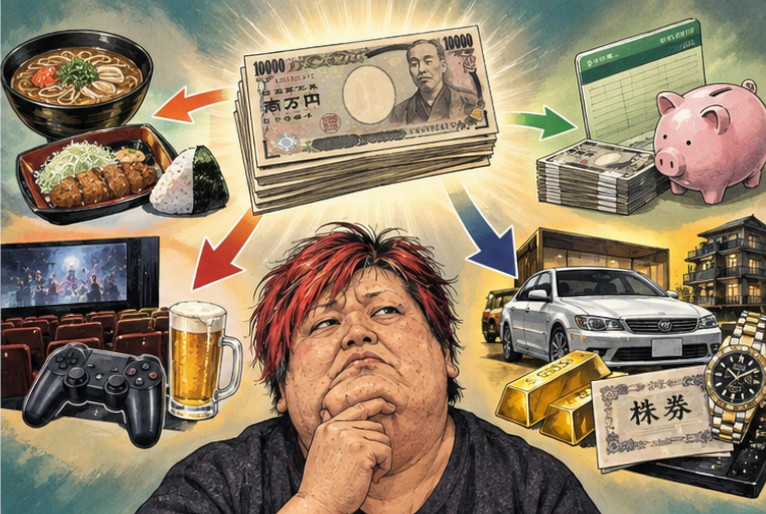
AI-generated conceptual illustration. It is not an official chart and does not by itself show whether any particular asset may legally be retained.
Cars, precious metals and investments change the picture
This is where the meaning of “luxury” starts to change.
As a general rule, vehicles are treated as assets that should be disposed of before relying on public assistance. There are exceptions, however, including certain situations involving employment, medical needs or areas where public transportation is extremely limited.
The rules become much less forgiving when an item functions primarily as an asset. Administrative guidance states that precious metals and bonds are not to be retained. It also restricts asset-building securities such as shares, government securities and investment-trust beneficiary certificates.
Why is this different from sushi?
Sushi disappears after dinner. Gold bullion or shares remain property that can be converted back into money.
One of the biggest dividing lines in Japan’s Public Assistance system is therefore not simply “Was it expensive?” but “Does it remain as an asset?”
Overseas travel is more complicated than it sounds
Another common assumption is that a welfare recipient who leaves Japan automatically loses public assistance. The actual rule is more complicated.
Under Ministry of Health, Labour and Welfare guidance, a recipient who temporarily travels abroad while maintaining a place of residence in Japan cannot have assistance suspended or terminated solely because of that short-term trip.
But purely recreational overseas travel receives different treatment. Money used for transportation and accommodation can become subject to what Japanese welfare administration calls income recognition—meaning that the money may be counted as available income when calculating public assistance. This is an administrative welfare calculation, not an income-tax rule.
There are separate provisions for certain purposes, including family funerals, visiting a critically ill relative, visiting family graves, school trips, and participation in official international cultural or sporting events, generally subject to conditions including the duration of travel.
So saying simply that “overseas travel is allowed” misses half the story.
The bigger question is not the sushi—it is where the ¥10,000 came from
This was the part I found most revealing.
Imagine two ¥10,000 notes.
One represents money left over after carefully managing assistance payments already received. The other came from an outside source. Those two amounts are not necessarily treated the same way under the system.
Income from employment, pensions and support from relatives can be taken into account when calculating assistance, and recipients have a legal obligation to report changes in their income and other livelihood circumstances. There are detailed exceptions and deductions, but simply hiding outside income is a very different issue from deciding to spend legitimately available money on an expensive meal.
That means staring at the sushi can distract from the more important question.
From the system’s point of view, the price of the sushi may matter less than the answer to: “Where did that ¥10,000 come from?”
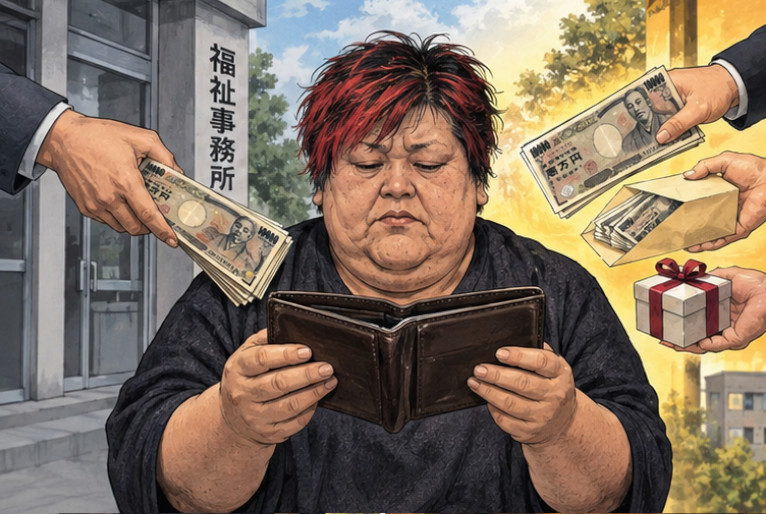
AI-generated illustration for explaining the system. It does not depict an actual person, welfare office or payment procedure. Receiving outside support or a gift does not automatically constitute fraud; the applicable reporting and income-recognition rules depend on the circumstances.
Editor’s Note
I can understand why the phrase “¥10,000 sushi on welfare” irritates people. If you work for a salary, watch taxes and insurance contributions come out of your paycheck, and then cut your own lunch budget, the image is not exactly designed to make you smile.
That was what bothered me at first, too.
But after going through the rules, I do not think policing sushi is where the system makes the most sense. Someone who wastes a little money every day may look perfectly modest from the outside, while someone who lives cheaply for weeks and has one expensive dinner produces a photograph that looks outrageous.
What deserves much closer scrutiny, in my view, is concealed income, unreported financial support, or assets that recipients are not entitled to retain. If taxpayers want the system enforced properly, checking those things makes more sense than demanding that recipients perform poverty convincingly enough for everyone watching.
References
- Japanese Law Translation — Public Assistance Act (English translation)
- Ministry of Health, Labour and Welfare — Operational Guidelines for Public Assistance under the Public Assistance Act (Japanese)
- Ministry of Health, Labour and Welfare — Detailed Handling of the Operational Guidelines for Public Assistance (Japanese)
- Ministry of Health, Labour and Welfare — Public Assistance System (Japanese)
- Ministry of Health, Labour and Welfare — Social Security Council, Committee on Support for the Needy and Public Assistance, Meeting No. 5 (Japanese)