

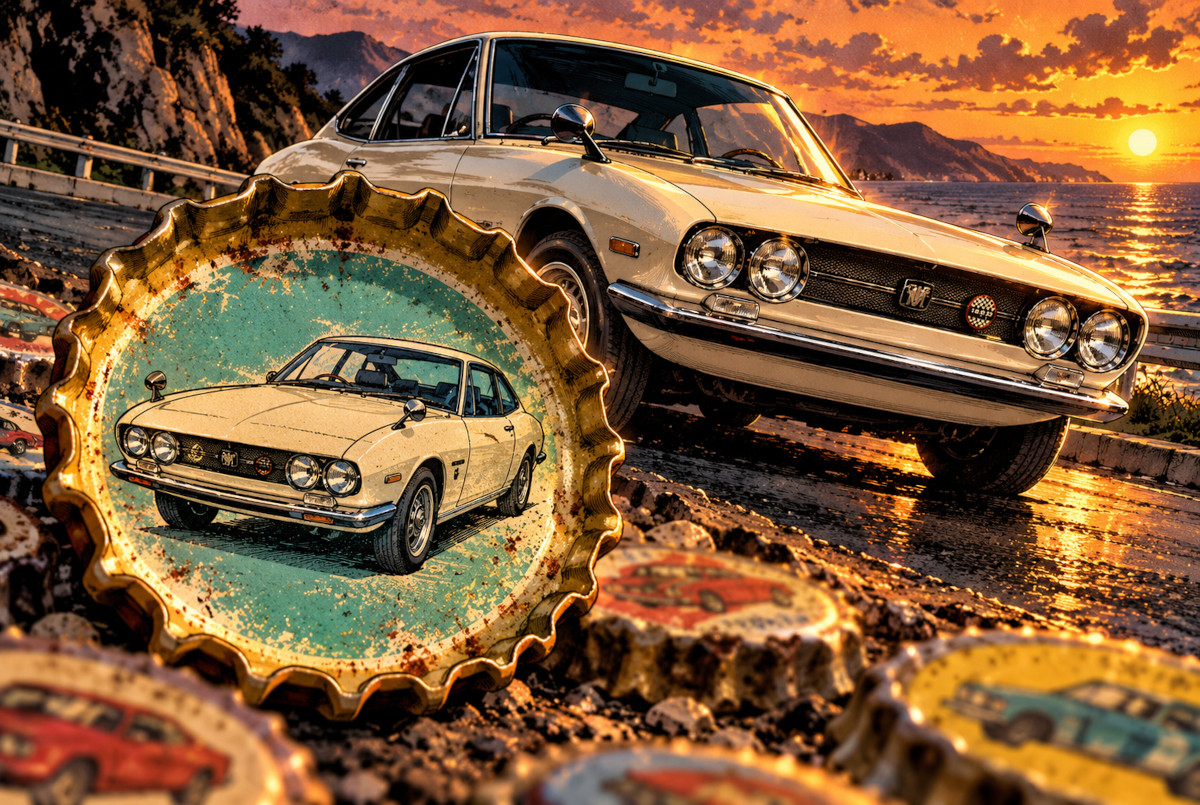
If you grew up in Japan during the 1970s supercar boom, there is a good chance you remember turning over the metal cap from a bottle of cola to see which car was printed underneath. A Lamborghini Countach? A Miura? A Ferrari? For a kid who could not possibly own one, that little bottle cap was part miniature car magazine, part lottery ticket.
One odd memory stuck with me for decades: “Wasn’t the Isuzu 117 Coupé in that supercar bottle-cap series too?”
That sounds slightly wrong today. The 117 Coupé is unquestionably a beautiful and important Japanese car, but it was not a V12 mid-engine exotic, nor was it a 300 km/h machine. So why did it somehow end up in the same childhood universe as Lamborghini and Ferrari?
Yes, the 117 Coupé Really Was There
My memory was not inventing things. During Japan’s 1970s supercar craze, bottle caps from Coca-Cola and Fanta featured cars from around the world. Surviving collections and specialist publications describe a series of 100 different designs.
More importantly for this particular mystery, a surviving collector’s list specifically includes the “Isuzu 117 Coupé X-CJ.”
So there really was an Isuzu 117 Coupé sitting among the Ferraris, Lamborghinis and other dream cars printed inside those tiny metal caps.
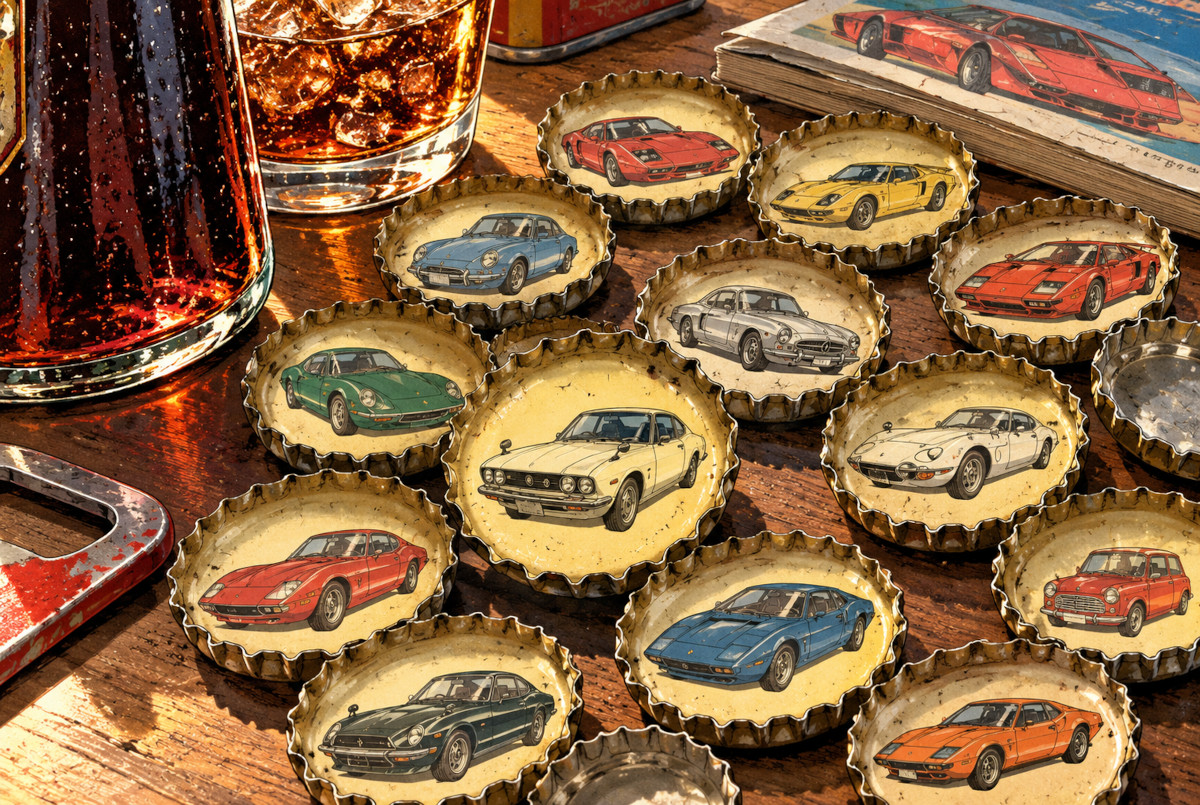
AI-generated illustration. It does not reproduce the actual artwork or exact arrangement of the original supercar bottle caps.
But These Were Not 100 Supercars in the Modern Sense
This is where the story gets more interesting. Look through surviving records of the series and you do not find nothing but Miuras, Ferraris and wedge-shaped exotics. There were also cars such as the Nissan Fairlady Z, Peugeot 504 Coupé, MG Midget, Honda Accord and even the Daihatsu Charmant.
In other words, “supercar” was not being used as the sort of strict technical category enthusiasts might argue about today.
Japanese automotive magazine LE VOLANT describes the promotion as featuring “famous cars from around the world, centered on supercars.” That wording matters. This was less a carefully policed list of 100 qualifying supercars than a miniature encyclopedia of cars that looked exotic, unusual, glamorous or simply interesting to Japanese children at the time.
That means the 117 was not the only apparent gate-crasher. Still, there are good reasons why it could fit into that strange little universe better than its specifications alone might suggest.
The 117 Coupé Was Never an Ordinary Japanese Coupe
The shape originated with Giorgetto Giugiaro while he was working at Carrozzeria Ghia. A prototype was shown at the 1966 Geneva Motor Show, and Isuzu eventually put the design into production in 1968.
The early 117 Coupé used a 1.6-liter inline-four DOHC engine producing 120 PS. Isuzu’s own museum material lists a top speed of 200 km/h, while some period-oriented specialist sources give 190 km/h. Either way, it was a serious high-speed grand tourer by Japanese standards of the late 1960s.
Then there is the price. The original 117 Coupé cost ¥1.72 million. The Toyota 2000GT, launched in 1967, is widely documented at ¥2.38 million. Divide one by the other and the Isuzu works out at roughly 72 percent of the Toyota’s price.
That is the useful comparison. The 117 was not the same kind of car as the two-seat, high-performance 2000GT, but it was certainly not priced like an ordinary family coupe either.
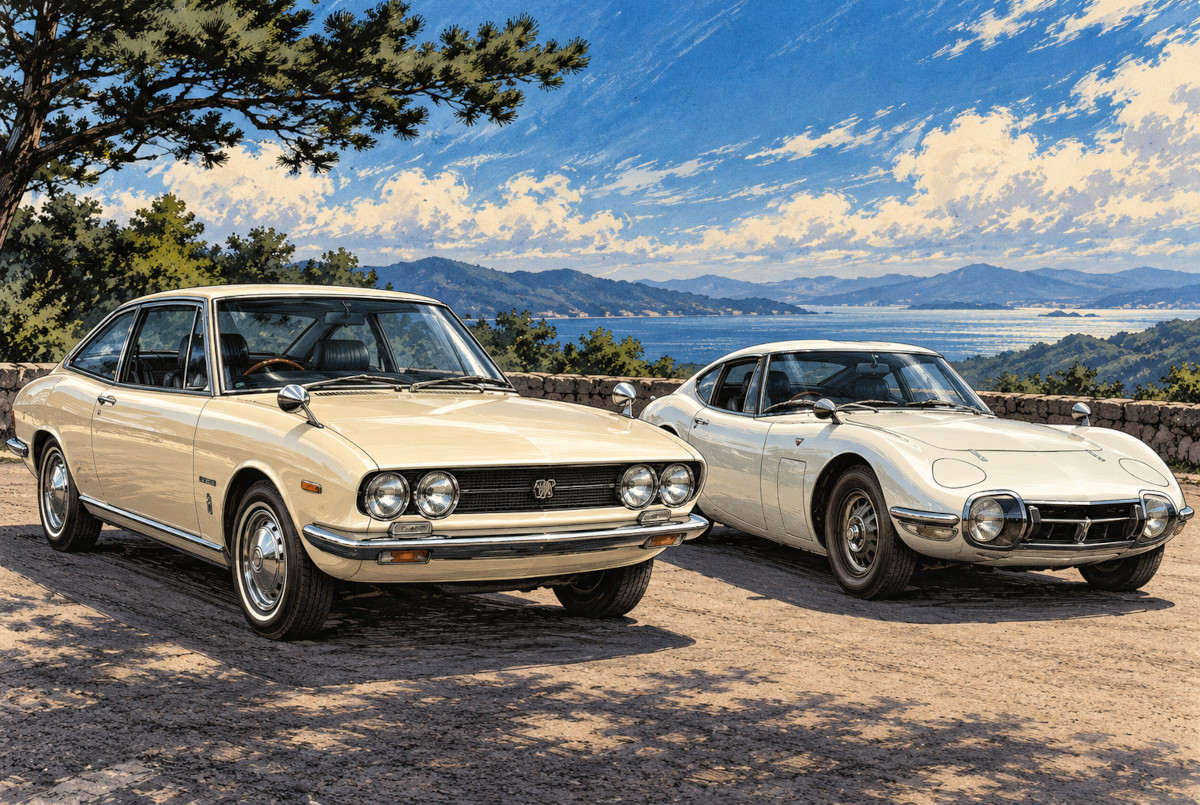
AI-generated comparison illustration. It is not an original period photograph or factory advertisement.
The Early Cars Really Did Involve Hand Work
Giugiaro’s styling also created a manufacturing problem. The 117 had large glass areas, thin pillars and subtle body surfaces that were difficult to reproduce cleanly with the mass-production pressing technology available to Isuzu at the time.
Isuzu itself states that the early cars were produced with hand work in order to preserve the design. Specialist accounts describe body panels being finished by hand after the initial pressing.
That may be the most convincing kind of “super” the 117 possessed: not outrageous horsepower, but the fact that a Japanese manufacturer went to such trouble to put an Italian show-car shape on the road.
There is another nice twist. The bottle cap is identified as a “117 Coupé X-CJ,” not one of the legendary 1968 handmade cars. In other words, the promotion was not simply celebrating the original hand-built model as an old masterpiece. The 117 name itself still carried enough special-car appeal later in the 1970s to belong in the collection.
For a Kid in 1970s Japan, “Super” Was About More Than Numbers
Today, enthusiasts can turn almost any argument into a spreadsheet: horsepower, 0–100 km/h, top speed, power-to-weight ratio. Those numbers are useful. They also make it very tempting to define “supercar” as if it were an engineering standard.
But that may not be how a Japanese schoolboy experienced a special car in the 1970s.
It looked unlike the sedans parked outside ordinary houses. It sat low. It seemed vaguely European. It was expensive. You rarely saw one. And somebody with the wonderfully exotic-sounding name Giorgetto Giugiaro had designed it.
That sense of distance from everyday life may have mattered almost as much as outright performance.
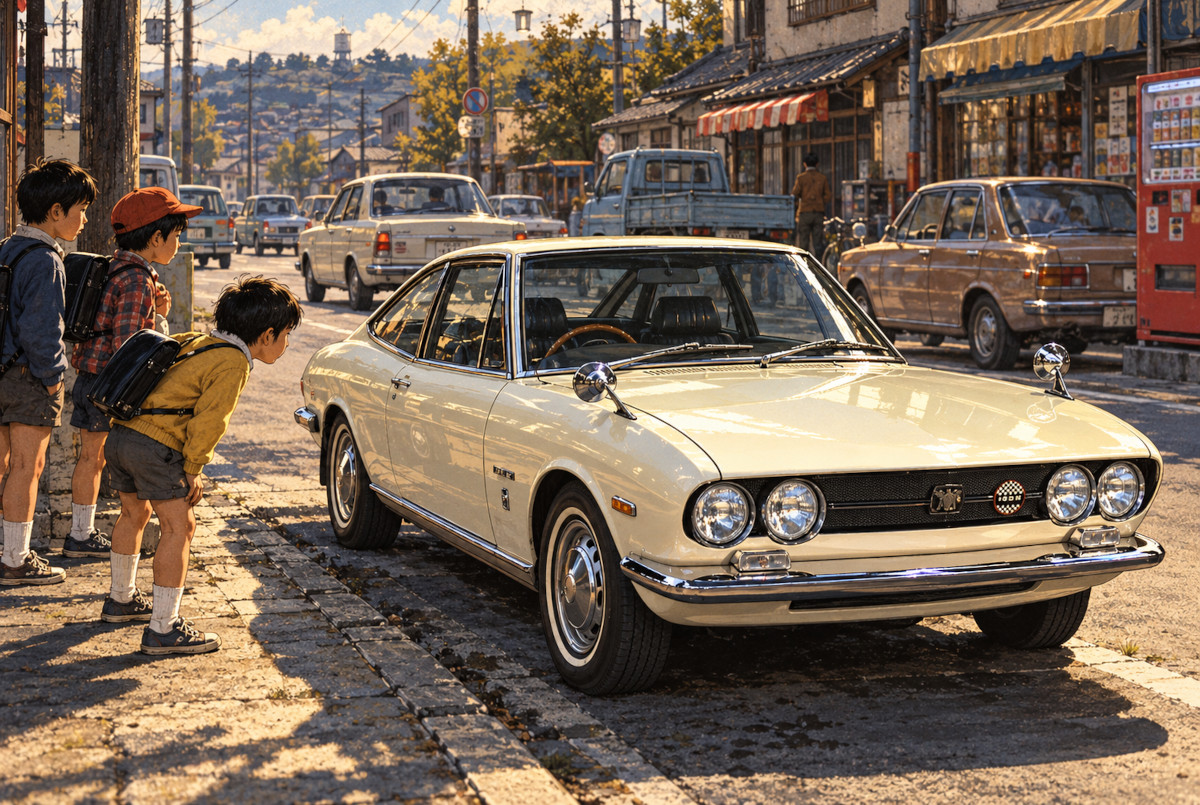
AI-generated depiction of 1970s Japan. It does not recreate a specific historical street or photograph.
So there is no need to retroactively declare that the Isuzu 117 Coupé was a “true supercar” in the same mechanical sense as a Lamborghini Countach. It was a four-seat grand touring coupe with a completely different purpose.
But within the culture of Japan’s Showa-era supercar boom, the 117 Coupé clearly had a place. A tiny bottle cap managed to preserve that slightly looser, more imaginative definition of “supercar” for nearly half a century.
Editor’s Note
What bothered me from the start was that little mismatch in my memory: “Wait, was the 117 really a supercar?” After digging into it, I suspect kids back then simply did not police automotive categories as aggressively as enthusiasts do now. Fast was good, of course, but rare, low, expensive and vaguely foreign-looking could be enough to make a car feel “super.” Maybe we gained precision when we started comparing everything by specifications. I am not completely convinced we gained more fun.
References
- Isuzu Plaza – “117 Coupe” Welcome Exhibition
- Giorgetto & Fabrizio Giugiaro Designers – “117 Coupé”
- LE VOLANT WEB – Feature on the 100 Japanese “Supercar Bottle Caps” (Japanese)
- Web Motor Magazine – Isuzu 117 Coupé, 1968 model and ¥1.72 million launch price (Japanese)
- Japan Automotive Hall of Fame – Toyota 2000GT historical vehicle profile, including ¥2.38 million price (Japanese PDF)
- Surviving “Supercar Bottle Cap” collection listing the Isuzu 117 Coupé X-CJ (Japanese)