

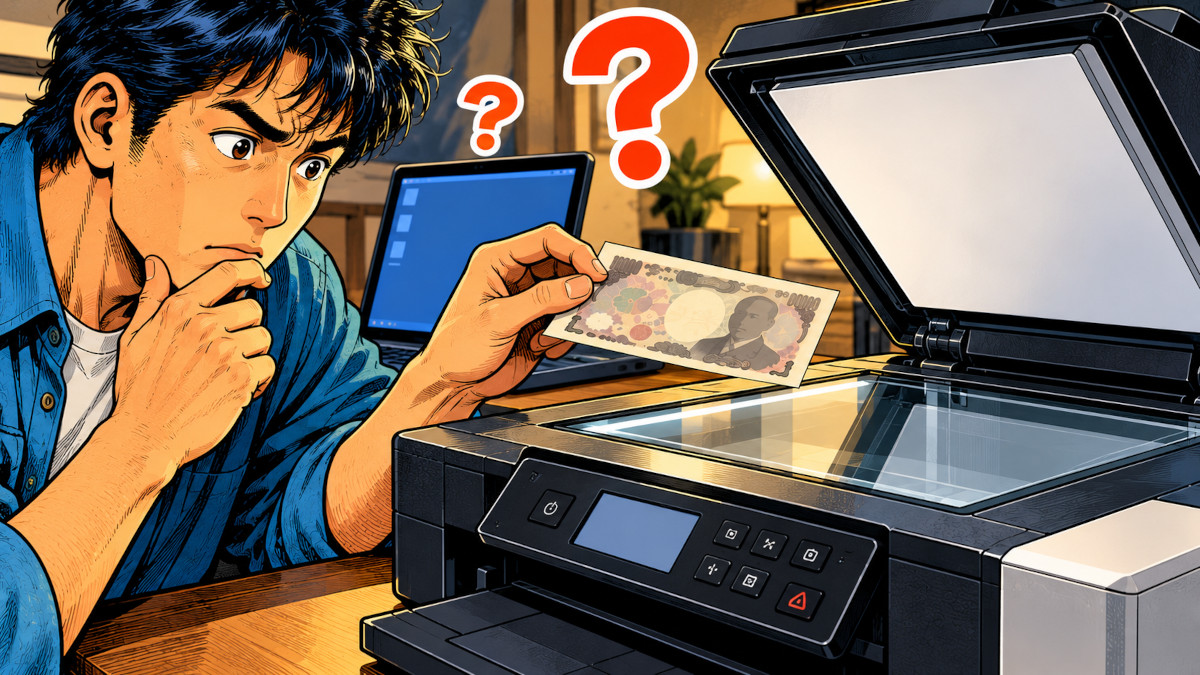
What happens if you place a Japanese ¥10,000 banknote on the glass of a home multifunction printer and press “Scan”?
Will the machine recognize it as money and refuse? Does the image remain somewhere inside the printer? Does anything get reported? And the question that started this whole investigation: have you already crossed a legal line just by scanning the note?
This is specifically a question about Japanese banknotes and Japanese law. Everyone knows that knowingly passing counterfeit money is a crime. What is less obvious is what happens before that point. Once you start digging, “digital image,” “imitation,” “counterfeit,” and “use as money” turn out to be related—but legally very different—stages.
Does turning a ¥10,000 note into an image make it “counterfeit money”?
The first surprise is that a digital image of a banknote and a banknote-like object printed on paper are not necessarily treated as the same thing under Japanese law.
Japan’s Ministry of Finance states that posting image data of banknotes or coins photographed with a digital camera on a website or blog is, in itself, not subject to enforcement under the Act on Control of Imitation of Currency and Securities.
The Ministry’s guidance does not specifically say, “scanning a banknote is always legal,” so it would be careless to turn that statement into a blanket rule. But it does show something important: creating a digital image of a banknote is not automatically the same thing as manufacturing a counterfeit banknote.
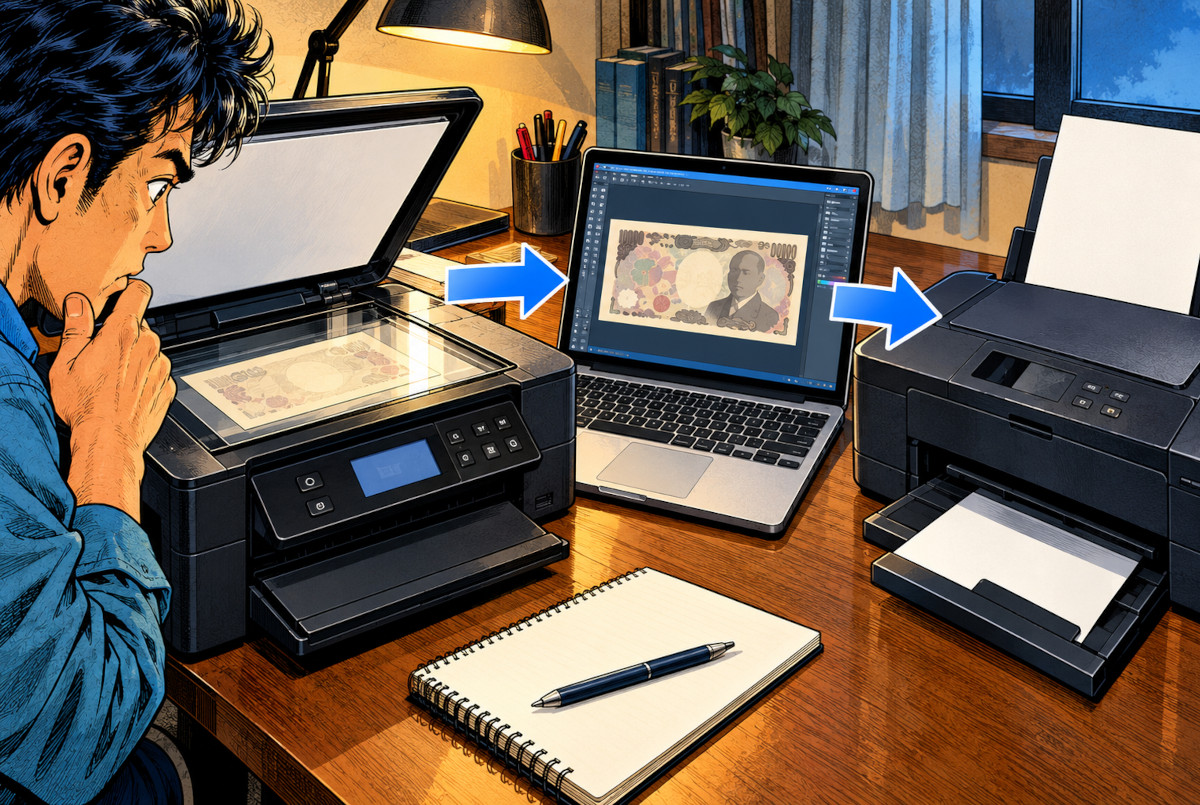
AI-generated schematic. The banknote design is fictional. Actual handling of protected banknote images varies depending on the device and software used.
Put that image on paper, and a different law enters the room
This is where the story gets stranger.
Japan has a law separate from the Penal Code’s currency-counterfeiting provisions: the Act on Control of Imitation of Currency and Securities. It dates all the way back to 1895—Meiji 28—and it is still in force.
The Act prohibits the manufacture or sale of objects that closely resemble current coins, banknotes and certain securities. The current penalty is imprisonment for up to three years.
So “I never intended to spend it” does not automatically end the discussion. The Ministry of Finance specifically warns that once a banknote image is printed, the resulting object may fall within the scope of the Act.
There is no simple published escape hatch such as “write SPECIMEN on it and it is always safe” or “change the size by a certain percentage and it is automatically legal.” The Ministry says factors such as the degree of visual resemblance, size, material, markings and the way the object is used must be considered together.
With banknotes, Japanese law can become relevant before anyone actually tries to spend the thing.
If the intention is to pass it as real money, the Penal Code takes over
The next step is much more serious.
Article 148 of Japan’s Penal Code covers counterfeiting or altering current currency for the purpose of uttering it—in plainer English, with the intention of passing it as genuine money. The punishment is imprisonment for life or for a definite term of at least three years. Uttering counterfeit currency, or delivering or importing it for the purpose of uttering, is also covered.
So there is not one single legal switch marked “fake money.” There are several distinct stages: creating an image, producing something that resembles a banknote, counterfeiting with the intention of passing it as money, and actually putting counterfeit currency into circulation.
To someone looking for one neat yes-or-no answer, that may sound annoyingly technical. But that is precisely the point: the law separates the stages rather than treating everything as one identical act.
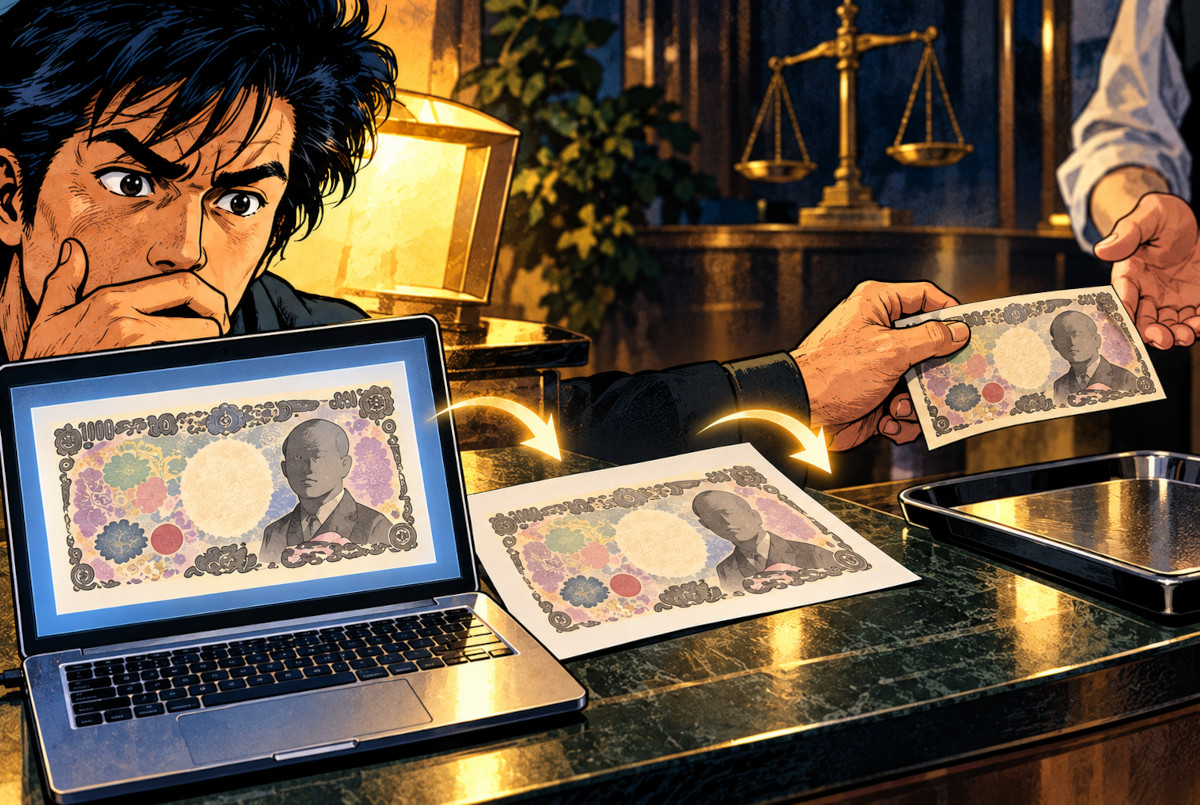
AI-generated schematic using a fictional banknote. A digital image, a banknote-like printed object, and an attempt to use or transfer something as genuine currency involve different legal questions. Whether a printed object violates Japanese law depends on its appearance, purpose and circumstances.
An avant-garde artwork was enough to trigger Japan’s “1,000-Yen Note Trial”
The odd power of this old law becomes much clearer when you look at one of Japan’s most famous avant-garde art cases: Genpei Akasegawa’s “Model 1,000-Yen Note” incident.
In 1963, Akasegawa produced printed works using the design of a ¥1,000 note. This was not the familiar story of somebody making fake cash and trying to spend it at a shop. His reproductions appeared in art-related works and exhibition material.
Nevertheless, Akasegawa was prosecuted in 1965 over a violation of the law controlling imitations of currency and securities. The case became known as the “1,000-Yen Note Trial,” drawing the worlds of avant-garde art and law into the same courtroom. In 1970, his appeal was rejected by the Supreme Court, leaving a guilty verdict in place: three months’ imprisonment, suspended for one year.
That is the wonderfully strange detour in this story. A question about a modern home scanner eventually runs straight into a legal controversy created by Japanese avant-garde art more than half a century ago.
Can a printer actually recognize a banknote?
This part is not merely an internet urban legend.
A group of central banks developed the Counterfeit Deterrence System (CDS), technology intended to prevent personal computers and digital imaging tools from capturing or reproducing images of protected banknotes.
In a 2004 press release published by the Bank of Japan, the Governors of the Group of Ten central banks said that several leading computer hardware and software manufacturers had voluntarily adopted the system.
That means some devices or software may prevent a protected banknote image from being captured or reproduced normally. It does not mean that every scanner and printer behaves identically.
And here is where one of the better urban legends falls apart. The same Bank of Japan release explicitly states that the technology does not have the capacity to track the use of a personal computer or digital imaging tool.
So the popular movie-plot version—scan a ¥10,000 note, a secret signal is transmitted somewhere, and the police are automatically notified—is not what CDS is described as doing.
Does the printer remember the scanned image?
There is no honest one-word answer to this either.
A multifunction device may need to use internal memory or storage while processing an image. Ricoh, for example, explains that on its multifunction printers, scan, print and copy image data may be stored temporarily on a hard disk or memory device. Its security systems can overwrite that temporary data afterward.
Consumer devices vary widely. Depending on the model and workflow, the destination may instead be a PC, smartphone, USB storage device or network location.
So it is inaccurate to say that a printer permanently keeps a secret copy of every banknote you scan—but it is equally inaccurate to say that no image data can ever exist inside the device during processing.
And if you deliberately save the scan to your computer, then of course the file exists on your computer. Before worrying about a mysterious hidden banknote database, it may be worth remembering the JPEG you saved yourself.
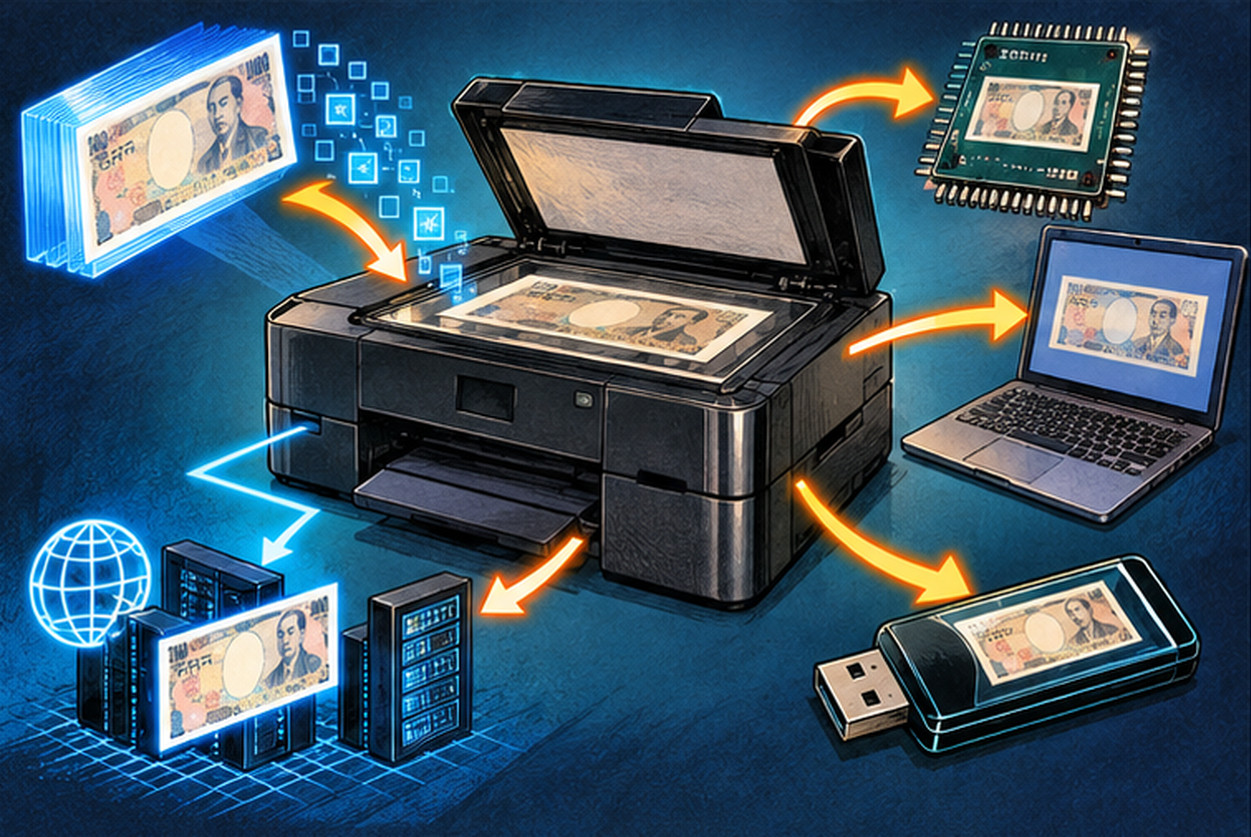
AI-generated schematic. It does not mean that a multifunction printer automatically sends every scan to all of these destinations. Temporary processing and storage depend on the device, connection method and user settings.
The copier-versus-counterfeiter arms race was already underway in the early 1990s
There is a historical reason these restrictions exist.
According to Japan’s National Police Agency in its 2002 Police White Paper, around 1992 almost all counterfeit banknotes it was seeing had been made using color copiers.
As color copiers equipped with anti-counterfeiting measures became more widespread, the number of detected counterfeit notes temporarily declined. Then personal computers and printers became cheaper, more common and more capable, and counterfeiters increasingly moved toward those tools instead.
In other words, anti-copy features in printers are not simply manufacturers being needlessly difficult. They are part of a long technological response to the fact that better copying equipment has repeatedly been turned toward currency counterfeiting.
Editor’s Note
I started with what seemed like a hardware question: surely scanning a banknote is not automatically a crime, but does the printer remember it? Does something get reported?
The more interesting part turned out not to be the printer at all. It was the law. “I’m not going to spend it, so it isn’t counterfeit money” sounds simple enough—until an 1895 imitation law appears before you even get that far. Then, somehow, a Japanese avant-garde artist and his Model 1,000-Yen Notes enter the story.
At the same time, I found no futuristic surveillance system in CDS that secretly reports every banknote scan to the police. The machine turns out to be fairly ordinary. The law is the part with the surprisingly long memory. That, more than anything, is what makes this story feel appropriately strange.
References
- Ministry of Finance, Japan — Guidance on using photographs and illustrations of banknotes and coins [Japanese]
- Bank of Japan — Laws concerning Banknote Reproduction
- e-Gov Laws and Regulations Search — Act on Control of Imitation of Currency and Securities [Japanese]
- Bank of Japan — G10 Press Release: Central banks and technology industry join to combat banknote counterfeiting
- National Police Agency — 2002 Police White Paper, currency counterfeiting section [Japanese]
- Tokyo National Research Institute for Cultural Properties — Research on Genpei Akasegawa’s “Model 1,000-Yen Note”
- Ricoh — Security Functions for Multifunction Printers