

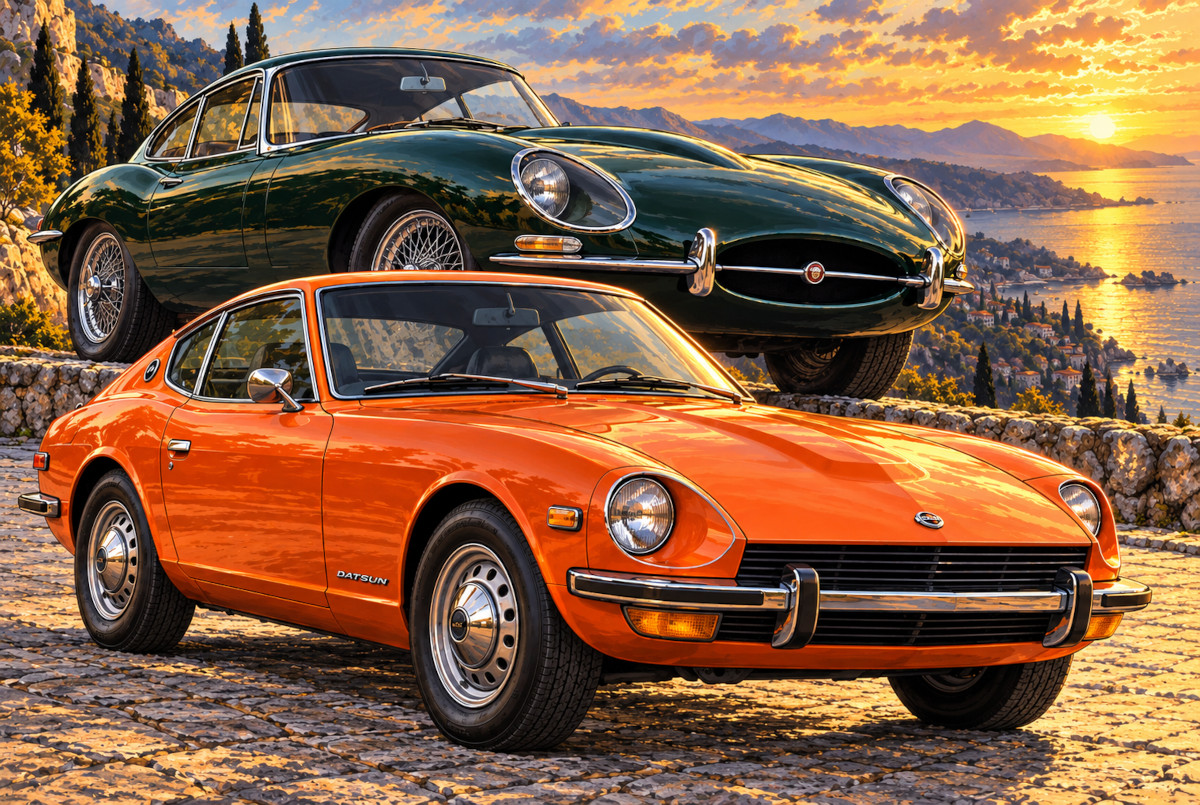
Look at an early Datsun 240Z and it is hard not to think of the European sports cars of the 1960s: the long hood, the cabin pushed rearward, and the fastback roofline flowing down toward the tail. The Jaguar E-Type, in particular, has been part of the comparison for decades.
So was the original Z simply Nissan’s cheaper Japanese answer to the E-Type? The deeper you dig, the less convincing that explanation becomes. What Nissan seems to have borrowed was not just a shape, but the world European sports cars had created—and then it tried to make that world far more accessible.
Nissan Z — 3-Part Series
From the birth of the original S30 and its American-market mission, through the Z31 and Z32 era, to the Z33 revival and today’s Z, this three-part series traces how the Fairlady Z changed while preserving the idea behind Nissan’s long-running sports GT.
- Part 1: Was the Datsun 240Z a Jaguar E-Type Copy? Why Nissan Built It
- Part 2: English edition Coming soon
- Final Part: English edition Coming soon
The car before the Z was already fast
Before the Z, Nissan already had the Fairlady 2000, the SR311, known in export markets as the Datsun 2000 Sports or Roadster. Introduced in 1967, its 1,982cc U20 inline-four produced 145 PS in Japanese specification. With a curb weight of just 910kg, Nissan listed a top speed of 205km/h. The company describes it as the first Japanese production car to break the 200km/h barrier, and the model swept first through third in the GT class at the 1967 Japan Grand Prix.
In other words, Nissan did not need to create the Z because the old Fairlady was too slow. The SR311 was already seriously quick for its time. The limitation was somewhere else. It was a small open two-seater with a leaf-sprung rear axle—great ingredients for a traditional sports car, but less ideal if the goal was to cover huge American distances quickly, comfortably and with luggage in the back.
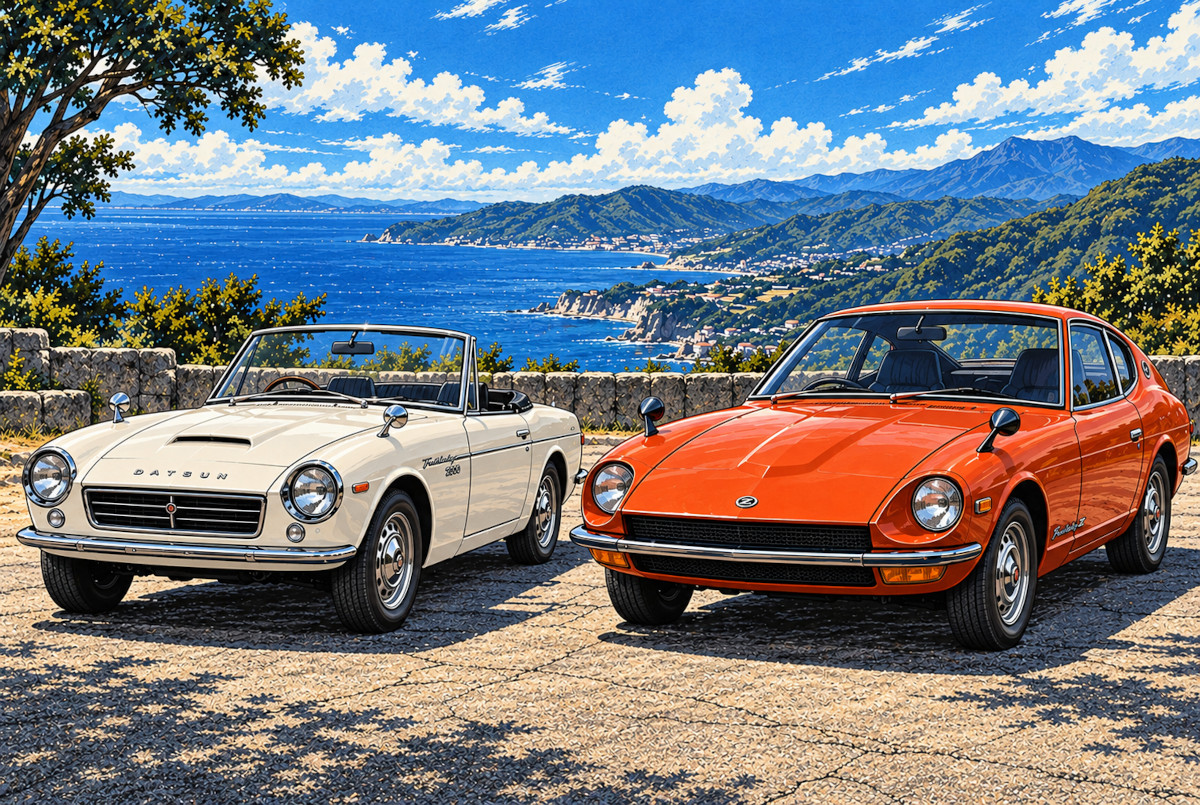
AI-generated comparison image. It illustrates the shift in character from the SR311 to the S30 and does not reproduce one specific year or trim level in exact factory specification.
Yoshihiko Matsuo was not dreaming of a tiny production run
Yoshihiko Matsuo, who led the design development of the original Z, later wrote in the Journal of the Society of Automotive Engineers of Japan that his ambition went back to his student days: he wanted to create a genuine high-performance sports car that could succeed in the United States not in tiny numbers, but in volume.
He began developing the concept in the mid-1960s. His encounter with Yutaka Katayama, the influential head of Nissan’s U.S. operation, helped turn the idea into a real production program.
That distinction matters. The objective was not simply, “Japan should build an exotic sports car too.” At least in Matsuo’s vision, selling the car in meaningful numbers in America was part of the idea from the beginning.
Nissan’s own retrospective on the first Z points to the same basic formula: strong performance, reliability and a price ordinary enthusiasts could realistically consider. The 2.4-liter export version was sold in North America as the Datsun 240Z, where it debuted in 1970.
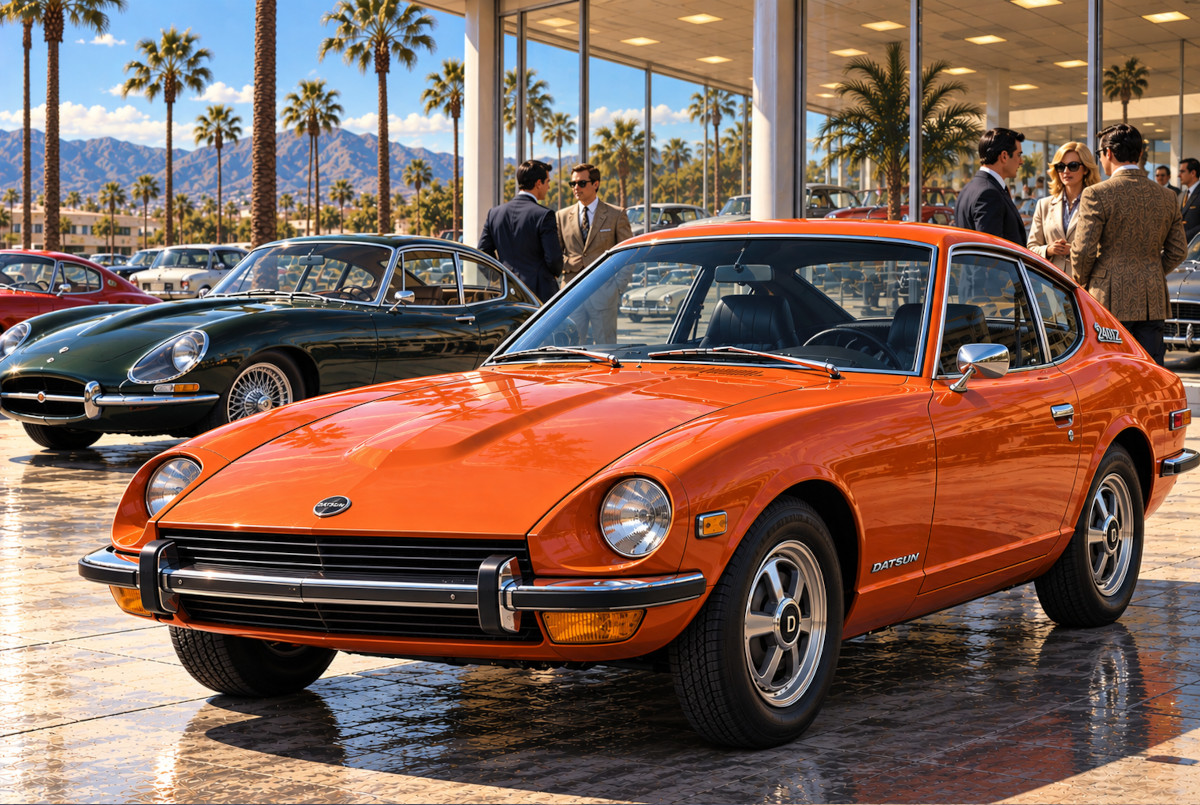
AI-generated image inspired by the North American sports-car market around 1970. It does not depict an actual dealership or a documented historical scene.
An E-Type copy? The resemblance is real, but that is not the whole story
The Jaguar E-Type was one of the defining sports cars of the 1960s: low, dramatic, long-nosed and unmistakably expensive-looking. Porsche’s 911 and other European GTs were also establishing what buyers expected an aspirational sports car to look and feel like. It would be strange to imagine Nissan developing a global sports car in that period without paying attention to them.
But the available development history does not support the simple claim that Nissan copied the E-Type and called the result a Z. Nissan itself describes the S30 as delivering the appeal of a European-style sports car with reliability and an affordable price, while the actual styling work was carried out by Nissan’s own design staff.
That brings us to another old argument: Albrecht von Goertz, the German designer associated with the BMW 507, has often been described as the man who designed the 240Z. Nissan’s later statement on the subject was more nuanced. It said the 240Z was the work of Nissan’s design staff, while also acknowledging that the designers had benefited from and been influenced by Goertz’s work during his time with Nissan.
So the most defensible answer is not “pure copy” and not “created in a vacuum.” Nissan was studying the same European GT vocabulary as everyone else, then trying to reshape it into something that could actually be sold in volume in America.
The Toyota 2000GT comparison exposes how unusual the Z really was
Japan already had another world-class GT in the same era: the Toyota 2000GT. Toyota launched it in 1967 and produced 337 cars before production ended in 1970. The first-generation Z, by contrast, recorded more than 520,000 worldwide sales by the time the S30 era ended in 1978.
This is not an apples-to-apples comparison. The cars were built for different purposes, sold at very different prices, and the figures themselves are different measures—worldwide sales for the Z versus total production for the 2000GT. Even so, divide the two raw numbers and the gap is roughly 1,540 to one.
The 2000GT demonstrated that Japan could build a sophisticated GT capable of standing beside prestigious European machinery. The Z attacked the problem from another direction. Nissan created something that looked and performed like a serious international sports GT, then industrialized the idea and sold it by the hundreds of thousands.
That may be the most radical thing about the original Z. Its achievement was not merely that it looked exotic. It made exotic-looking sports-car ownership far less exotic.
Success pushed the Z even further toward the GT side
Seen from today, it is tempting to think of the S30 as the pure, lightweight sports car and the later S130 as the moment Nissan softened the formula. Nissan’s own description of the original S30 complicates that story. It says the Fairlady changed dramatically from an open sports car into a more comfortable GT that could be enjoyed on long cruises.
And the idea worked. Worldwide sales exceeded 520,000 units. When the second-generation S130 arrived in 1978, Nissan enlarged the body, increased cabin space and fitted four-wheel disc brakes. The traditional long-nose, short-deck theme remained, but comfort and refinement moved further up the priority list.
For enthusiasts looking backward, it is easy to say, “The S130 turned the Z from a sports car into a luxury GT.” The history suggests something slightly different. The Z already had a strong GT element from the beginning. The S130 simply pushed further in the direction that had already made the original car successful.
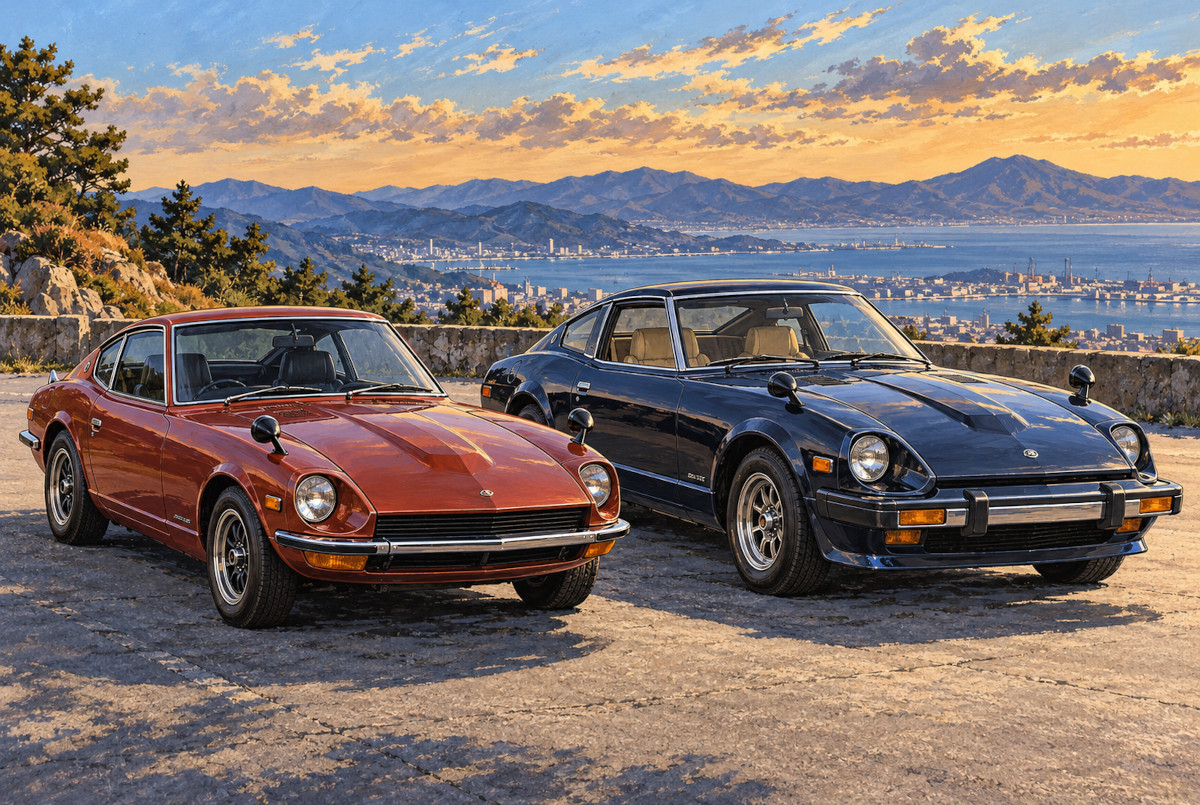
AI-generated generational comparison. It illustrates the Z’s move toward a larger, more luxurious GT and does not reproduce one specific year or factory trim in exact detail.
Editor’s Note
I started with the obvious question: put an early Z next to an E-Type and, yes, you can see why people talk about influence. But after digging into the history, the part I found more interesting was not the styling. It was the business model.
Nissan already had a fast sports car in the SR311. Japan already had an exotic prestige GT in the Toyota 2000GT. What Nissan did differently with the Z was build a car an American enthusiast could realistically buy, drive a long distance, carry luggage in—and then sell hundreds of thousands of them.
We tend to romanticize “great cars” as tiny-run machines built by craftsmen who supposedly ignored cost and common sense. The Z went in almost the opposite direction. It was meant to be manufactured efficiently, sold in volume and used in the real world—and somehow it still looked special. The more I look at the numbers, the more I think that may be the cleverest part of the whole car.
References
- Nissan Heritage Collection — Datsun 2000 Sports (1967: SR311)
- Nissan Heritage Collection — Fairlady Z-L (1970: S30)
- Nissan Motor Corporation — Nissan Z: 50 Years of Excitement
- Nissan Heritage Collection — Fairlady 280Z-L (1978: HS130)
- Society of Automotive Engineers of Japan — Yoshihiko Matsuo, “The Design-oriented Development of the First FAIRLADY Z (240Z)”
- Miki Press — Fairlady Z Story: The Sports Car That Opened the U.S. Market (Japanese-language reference)
- Nissan Motor Co. — “Design Evolution of the 240-Z” statement concerning Albrecht von Goertz
- Toyota Motor Corporation — Toyota Reproduces and Sells Spare Parts for 2000GT