

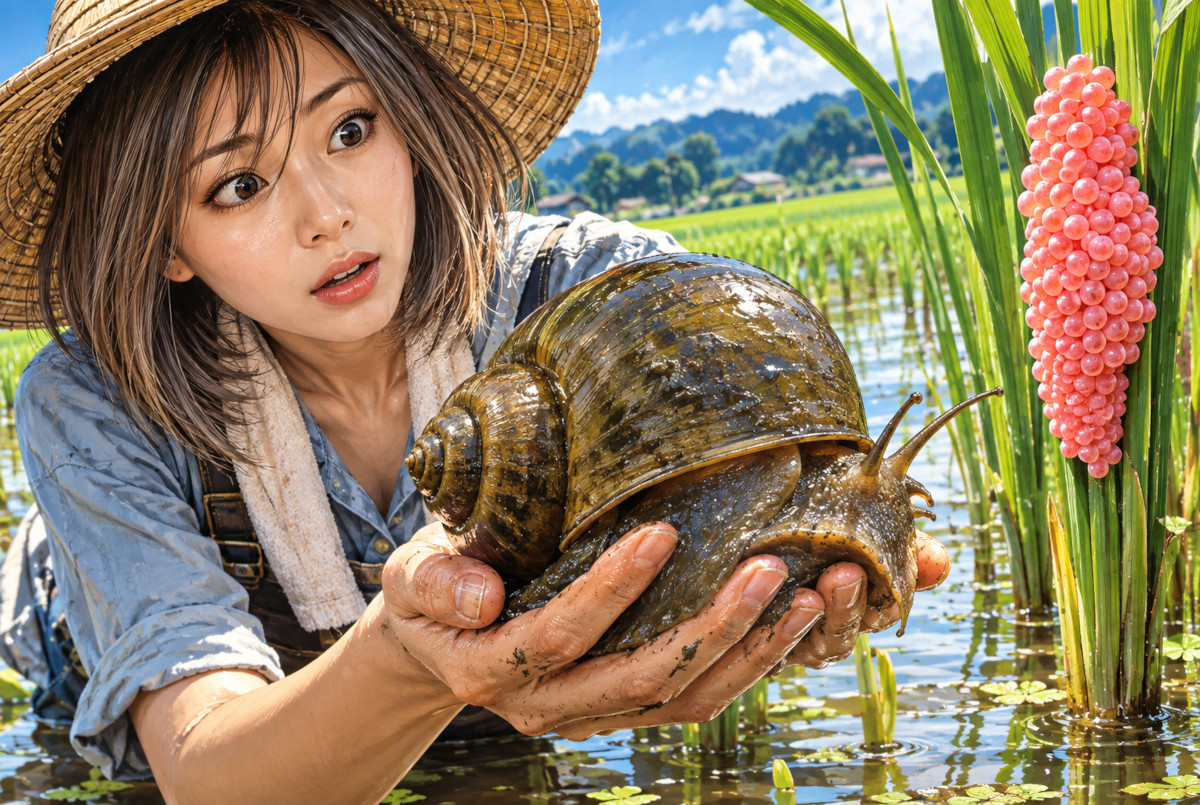
Along rice paddies and irrigation canals in Japan, you sometimes see something that looks almost unnaturally bright: clusters of shockingly pink beads stuck to rice stems, concrete walls or posts above the waterline.
They are the eggs of Pomacea canaliculata, the channeled apple snail—better known in Japan by the nickname jumbo tanishi. The adult snail is edible. In fact, it was brought to Japan for food. But the eggs are a different story: they contain defensive proteins that help deter predators.
Edible parent, chemically defended eggs. If this were a 1970s Japanese monster-and-nature encyclopedia, that contrast alone would deserve a full-page spread.
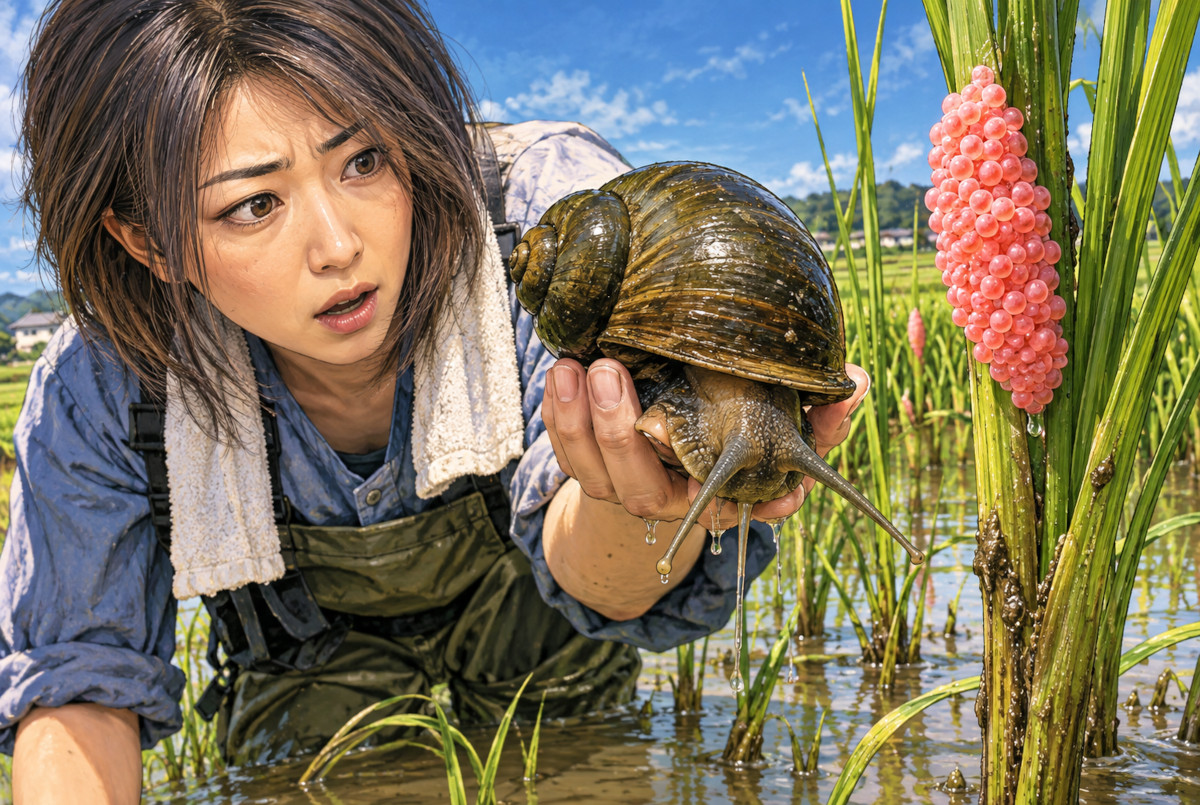
AI-generated explanatory illustration. The size of the apple snail is exaggerated for visual effect; adults found in Japanese rice fields are generally much smaller than shown here.
An Edible Adult, but Eggs You Should Not Eat
Pomacea canaliculata is a large freshwater apple snail native to South America. Despite its Japanese nickname, “jumbo tanishi,” it is not simply a giant version of Japan’s native pond snails. It belongs to a different family of freshwater gastropods.
What makes it especially easy to notice is the way it reproduces. The female climbs out of the water and deposits conspicuous pink egg masses on rice stems, canal walls and other surfaces above the waterline.
According to Japan’s Ministry of Agriculture, Forestry and Fisheries, a single clutch commonly contains around 200 to 300 eggs, while one female can lay more than 3,000 eggs in a year.
At first glance, that strategy looks absurd. Why put hundreds of bright pink eggs in plain sight where birds can see them?
That turns out to be part of the point.
The Pink Color Is Basically a “Do Not Eat” Sign
The eggs contain carotenoid-associated proteins that contribute to their intense coloration. Research on apple snails has shown that the orange-pink color works together with toxicity as a form of warning coloration, or aposematism: the eggs advertise that eating them may be a bad idea.
One of the best-studied defensive proteins is PcPV2. Laboratory research has shown neurotoxic effects in rodents, while other egg proteins are unusually resistant to digestion and have antinutritive properties.
In other words, the eggs are not merely hidden packets of nutrition waiting for a predator. The snail has evolved chemical defenses that make the package much less attractive than its bright color suggests.
That does not mean scientists have established a human dose at which one egg, ten eggs or any specific number will cause poisoning. Animal toxicology should not be casually converted into a human lethal-dose claim. What can be said is that these eggs contain biologically active defensive toxins and are not something to experiment with as food.
Japan Deliberately Imported This Snail as Food
This is where the story gets stranger.
According to Japan’s National Agriculture and Food Research Organization (NARO), Pomacea canaliculata was introduced from Taiwan to Nagasaki and Wakayama prefectures in 1981 for food production. At the time, there was commercial interest in raising the snails and producing juvenile stock.
By 1983, only two years later, Japan had apple-snail aquaculture operations at roughly 500 locations across 35 prefectures.
Then the market failed to develop as hoped.
Snails escaped or were abandoned when farming operations closed, and populations became established in irrigation systems and rice paddies. In 1984, after crop damage had become a serious issue, Japan’s Ministry of Agriculture, Forestry and Fisheries formally designated the species as a harmful animal.
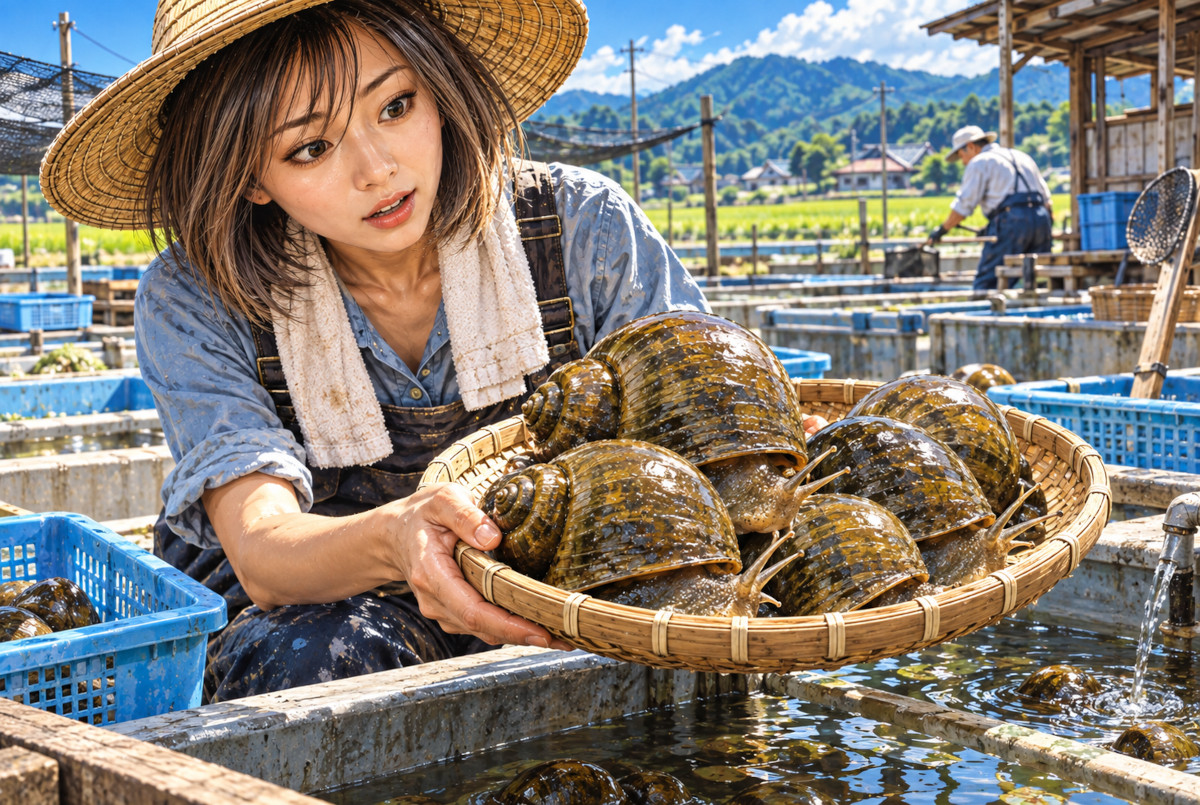
AI-generated historical explanatory image. It does not recreate a specific Japanese aquaculture facility from the 1980s, and the snails are shown larger than life for visual clarity.
So this was not simply a foreign species that somehow invaded Japan on its own. People brought it in because they thought it might become a profitable food product. When that business model collapsed, the ecological bill remained.
That distinction matters whenever invasive species are discussed. Sometimes the first step of an “invasion” was a perfectly deliberate human decision.
It Is a Rice Pest—but Rice Is Not Necessarily Its Favorite Food
The apple snail prefers soft aquatic vegetation. According to NARO, the main problem is not that mature rice is an irresistible delicacy. The danger comes just after transplanting, when tender rice seedlings may be among the easiest edible plants available.
That is why the most serious damage generally occurs during roughly the first three weeks after rice transplanting.
The appetite is not trivial. In one feeding experiment cited by NARO, a snail with a shell height of about 3 cm ate approximately 2 grams of potato per day at 28°C.
Do the deliberately crude arithmetic and the scale becomes easier to picture:
100 snails × 2 g per day = 200 g per day.
Over 30 days = about 6 kg, or 13 lb, of potato-equivalent food.
Of course, potatoes in a laboratory are not rice seedlings in a field, so this is not a crop-loss estimate. It is simply a way to visualize what happens when a modest appetite is multiplied by a large population.
There is another twist: apple snails also eat weeds. In paddies where the species is already established, farmers have sometimes exploited that appetite for weed control.
Eat the rice and it is a pest. Eat the weeds and it becomes an unpaid weeding crew.
The snail itself has no interest in our agricultural job descriptions.
When They Are Small, Even Diving Beetles Eat Them
For all their success, apple snails are not invincible.
In experiments reported by NARO, researchers tested 46 types of aquatic animals and found that 27 would eat newly hatched apple snails. Predators included various fish, crustaceans and aquatic insects. Diving beetles were capable of attacking small juveniles.
There is an especially odd Japanese connection here. Research has also shown that larvae of the Heike firefly, a firefly associated with wetlands and rice-field environments in Japan, can prey on small Pomacea canaliculata and develop while feeding on them.
As the snail grows larger, however, the number of predators capable of eating it decreases. So the life strategy starts to look surprisingly coherent: chemically defended eggs, huge numbers of hatchlings, heavy predation while young, and fewer enemies for the individuals that survive long enough to grow.
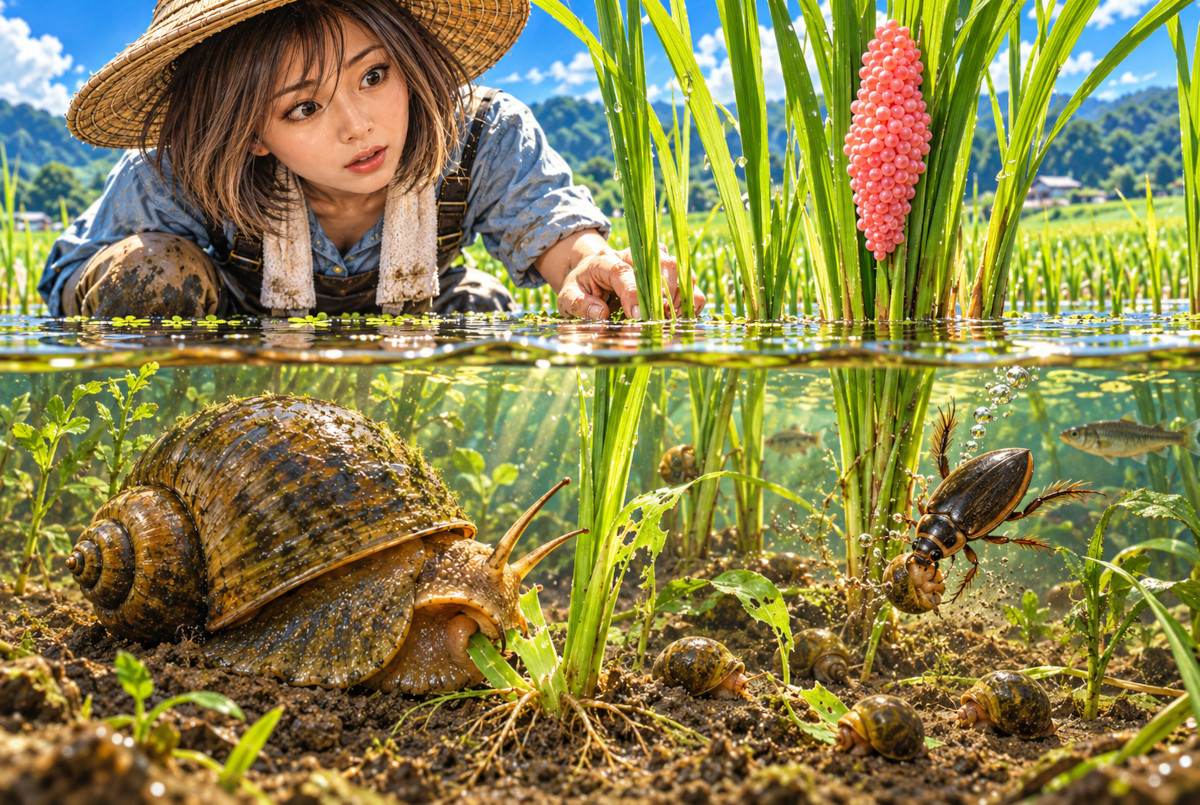
AI-generated ecological illustration. It is a schematic representation of predator-prey relationships and does not depict one actual location or a single observed moment in nature.
If You Want to Eat One, the Parasite Is the More Practical Concern
The adult snail itself is edible. Apple snails are still eaten and farmed as food in parts of Asia, including Thailand. I have eaten them there myself.
But a wild-caught snail introduces another issue entirely: Angiostrongylus cantonensis, commonly known as rat lungworm.
In Taiwan in 2012, eight Thai factory workers developed eosinophilic meningoencephalitis after eating inadequately cooked Pomacea canaliculata collected from a pond at their workplace. Investigators also detected larvae of A. cantonensis in snails from the same pond.
Natural infection of apple snails with the parasite has also been documented in Japan.
So “this species is edible” and “you can safely pick one out of a ditch and eat it” are two very different statements. Even for people who enjoy unusual foods, that distinction is not a joke.
Nothing in this article should be read as a recommendation to collect and eat wild apple snails.
Editor’s Note
I had eaten these snails in Thailand, so in my head they were simply “that edible snail.” I knew they had become a nuisance in rice fields, but I had never paid much attention to the pink eggs.
Finding out that the eggs are not merely bright but are backed by a real chemical-defense system made the whole creature feel much stranger in retrospect. I had eaten the parent without ever knowing what the next generation was carrying around as protection.
But the part that still bothers me more is the Japanese history. This animal did not arrive wearing a little sign that said “future agricultural pest.” People imported it because it looked like a business opportunity. When the business failed, people were left trying to control the animal they had deliberately encouraged.
The apple snail is certainly an invasive pest in Japanese rice farming. But in this particular story, humans wrote the opening chapter.
References
- Ministry of Agriculture, Forestry and Fisheries (Japan): Countermeasures against the channeled apple snail (Pomacea canaliculata) [Japanese]
- National Agriculture and Food Research Organization (NARO): Distribution and crop damage caused by Pomacea canaliculata [Japanese]
- NARO: Ecology and feeding behavior of Pomacea canaliculata [Japanese]
- NARO: Predation on Pomacea canaliculata by aquatic animals [Japanese]
- NARO: Use of apple snails for weed control in rice paddies [Japanese]
- Kondo & Tanaka: Predation on the apple snail by larvae of the Heike firefly [Japanese Journal of Applied Entomology and Zoology]
- Dreon et al.: “Novel animal defenses against predation: a snail egg neurotoxin combining lectin and pore-forming chains…”
- Brola et al.: “Evolution of aquatic snails’ defences resulted in clade-specific differences in egg toxicity, pigments and warning coloration”
- Japan Institute for Health Security (JIHS): Angiostrongyliasis [Japanese]
- Taiwan Centers for Disease Control: “An Outbreak of Meningoencephalitis Caused by Angiostrongylus cantonensis among Thai Workers in Changhua County, Taiwan, 2012”