

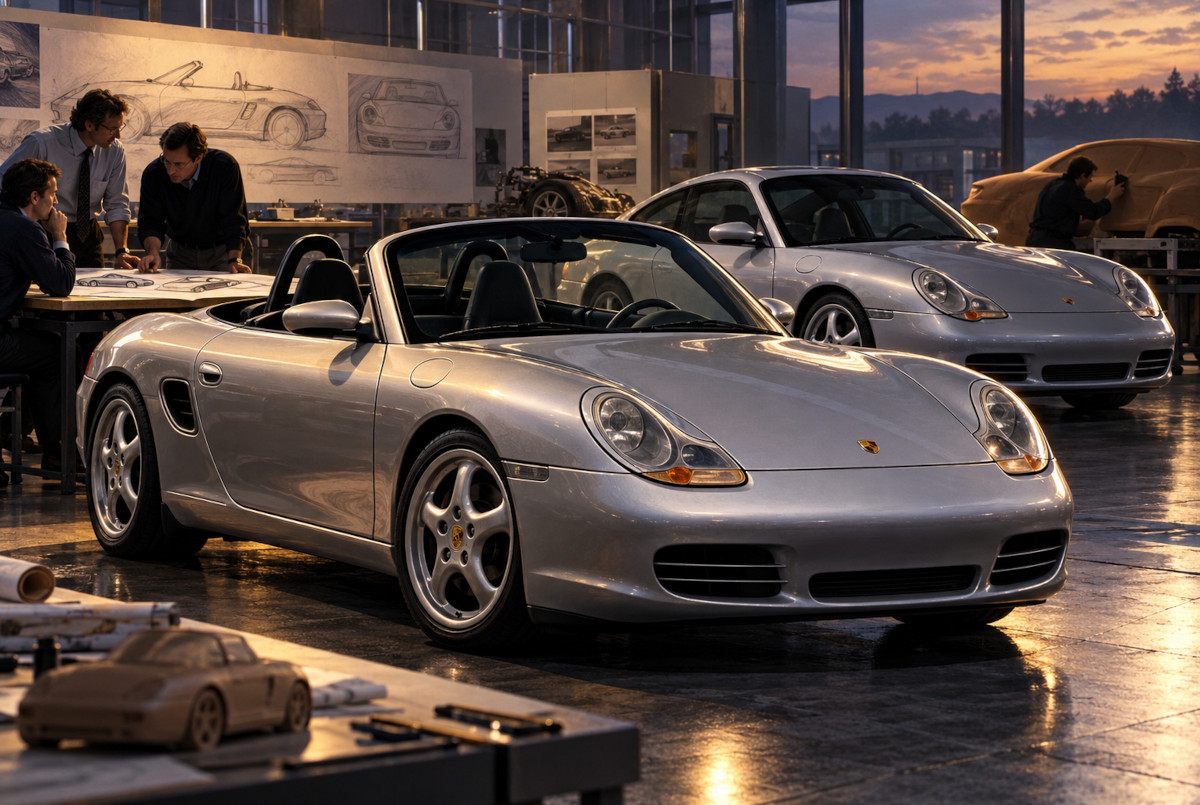
With the 968, Porsche kept refining the 944 formula. With the Boxster, it did almost the opposite. Instead of creating more bespoke parts, Porsche developed the new roadster alongside the next-generation 911 and shared a remarkable amount of hardware between them. Instead of another expensive GT, it built a two-seat sports car aimed at younger buyers. Yet it still gave the car a mid-engine layout and a water-cooled flat-six.
The result was dramatic. Porsche built 164,874 examples of the first-generation Boxster 986. The 968, covered in the previous chapter of this series, reached 11,248 units. That makes the Boxster total roughly 14.7 times larger. The production periods were different, so calling the Boxster “14.7 times more popular” would be nonsense. But one thing is hard to ignore: the Porsche that shared heavily with the 911 was produced on a completely different scale from the highly refined, increasingly expensive 968.
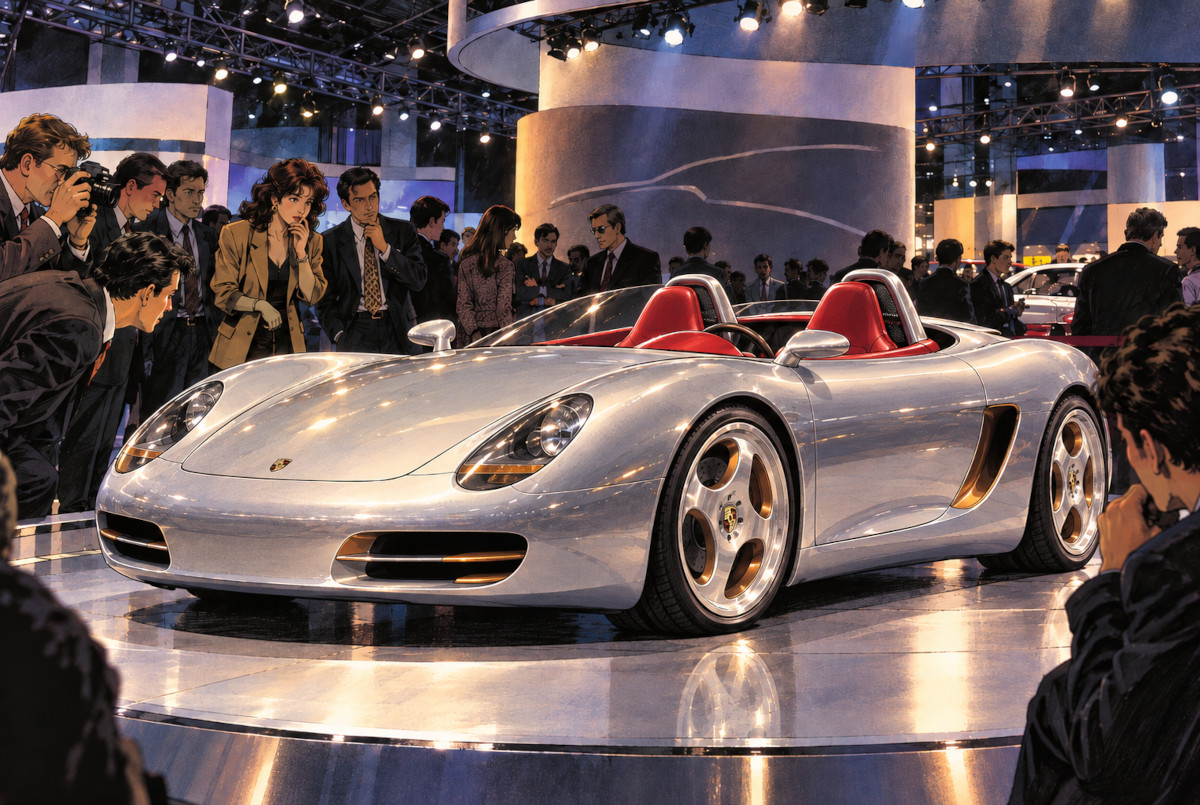 AI-generated historical illustration inspired by the 1993 Boxster Concept. It does not reproduce the actual Detroit Motor Show display or a specific vehicle.
Porsche did not need another more expensive car
At the beginning of the 1990s, Porsche was in serious trouble. Sales had fallen to around 23,000 cars in 1991, less than half the level five years earlier. By the end of 1992, losses had reached 240 million Deutsche Marks. A weak US dollar, high manufacturing costs and a model strategy with too few shared components were all weighing on the company.
Porsche was also developing the four-seat Type 989 at the time. But Horst Marchart, then responsible for research and development, later recalled that its expected sales volume was too small and that an independent model with little commonality with the 911 would not solve Porsche’s financial problem. A different idea emerged: a two-seat, mid-engine roadster using components from the next-generation 911, with a target price of around DM70,000.
It was not a 911 hand-me-down — it was developed with the 911
The first Boxster 986 reached production in 1996. The 996-generation 911 followed in 1997. That order matters. The Boxster was not simply a cheaper car assembled later from whatever parts the finished 911 happened to leave behind. The two models were developed in parallel, and Porsche says that more than half of their parts were shared.
The commonality was anything but theoretical. The bonnet, front headlamp assemblies, front wings and doors were identical between the early 986 Boxster and 996 Carrera. Porsche later stated that the parts-sharing strategy reduced development costs by around 40 percent. At the same time, the company had set itself a broader goal of cutting manufacturing costs for new cars by 30 percent.
Porsche did not make the cheaper car affordable simply by putting less effort into it. It made the Boxster affordable by engineering it together with the new 911. That was a very different philosophy from the increasingly expensive path that had led from the 944 to the 968.
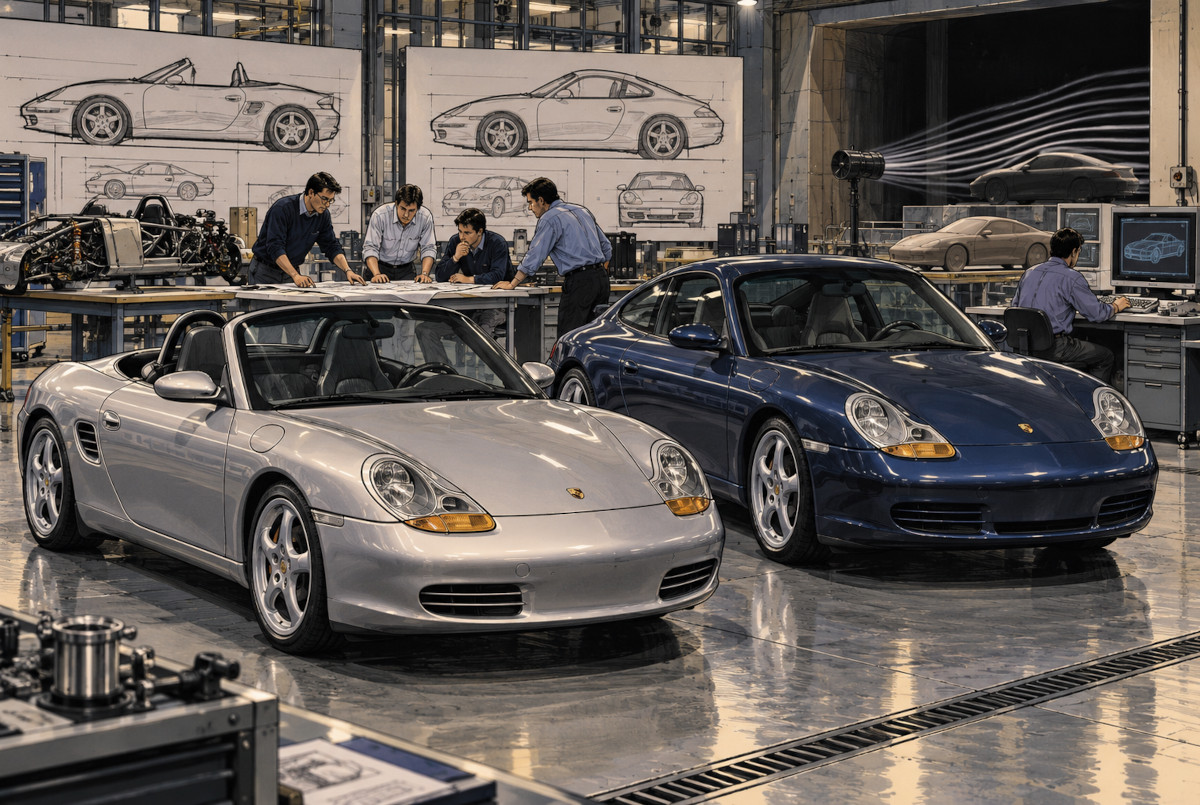 AI-generated comparison image illustrating the parts-sharing strategy between the 986 Boxster and 996-generation 911. It does not depict an actual Porsche development facility.
The cheaper Porsche actually introduced the new engine first
The original Boxster arrived with a 2.5-liter, water-cooled flat-six producing 204 PS in European specification. Porsche describes this engine generation as its first water-cooled flat-six in series production. One year later, the 996-generation 911 made its own historic break with air cooling and adopted a water-cooled flat-six.
So the cheaper Porsche was not receiving yesterday’s technology. In terms of market launch, the Boxster put Porsche’s new water-cooled flat-six generation on the road before the new 911 did. The 1993 Boxster Concept also looked backward as well as forward: its design deliberately evoked classic mid-engine Porsches such as the 550 Spyder and 718 RS 60 Spyder.
It had 36 PS less than the 968 — yet Porsche built nearly 15 times as many
| Porsche 968 | Early Boxster 986 | |
|---|---|---|
| Engine | 3.0L inline-four NA | 2.5L flat-six NA |
| Power | 240 PS | 204 PS |
| Layout | Front engine + rear transaxle | Mid-engine |
| Total production | 11,248 | 164,874 |
The Boxster had 36 PS less than the 968. Yet commercially, the difference was enormous. That does not mean “less power sells better.” What changed was much more fundamental. Porsche had changed how the car was developed, how it was manufactured and where it was positioned in the market.
Porsche’s own historical account says that it sold around 32,000 vehicles in 1996, roughly half of them Boxsters, and returned to positive figures. Still, saying “the Boxster alone saved Porsche” makes the story too neat. The Boxster, the forthcoming 996, their shared development programme, manufacturing reforms and aggressive cost control were all parts of the same turnaround.
Cost-cutting did not make it drive like a cut-price sports car
In 1997, Car and Driver compared the new Boxster with the BMW Z3 2.8 and Mercedes-Benz SLK. The US-spec Boxster produced 201 hp and reached 60 mph in 6.2 seconds, the quickest result of the three. More importantly, the magazine praised its steering, cornering behaviour and progressive responses near the limit, ultimately placing the Boxster first overall.
That may be the cleverest part of the entire project. Porsche shared components and development work aggressively with the 911, but preserved the thing the driver actually paid to experience: a dedicated mid-engine sports-car layout. Cost reduction and cheapening the product were not treated as the same thing.
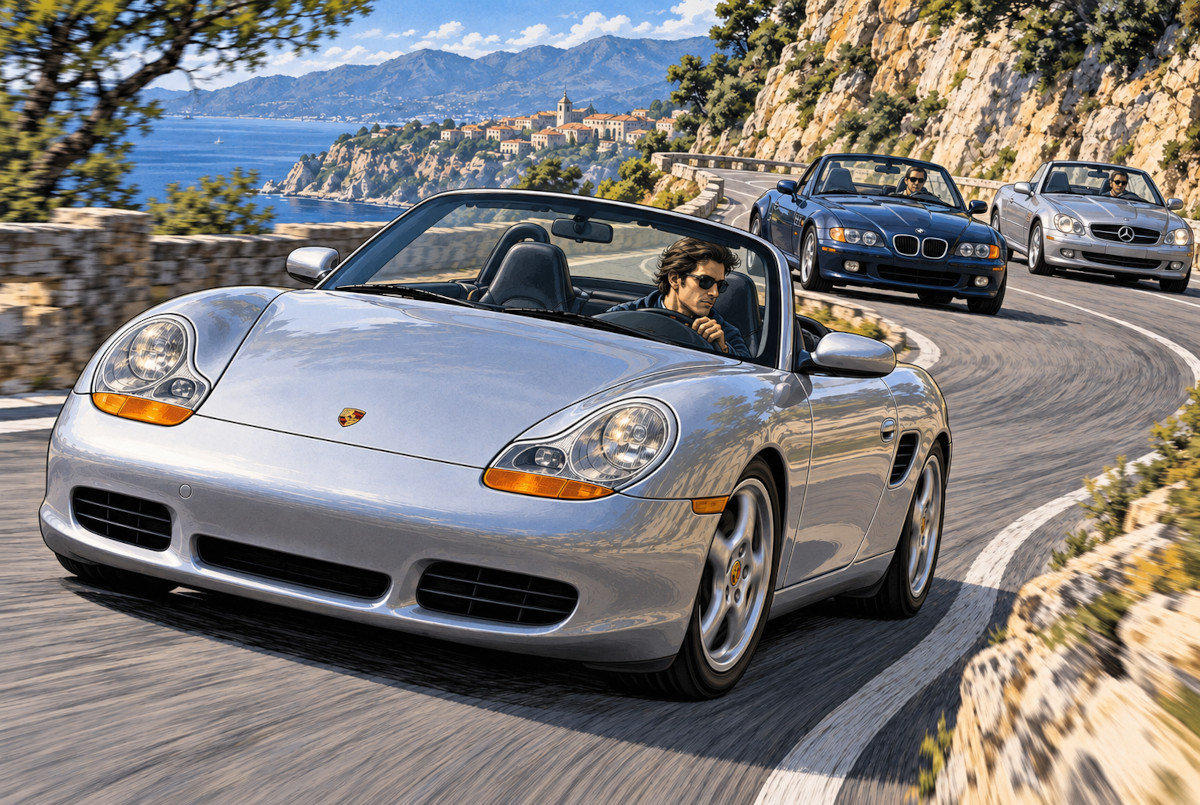 AI-generated comparison illustration. It is inspired by the type of 1990s roadster comparison discussed in the article and does not recreate the actual 1997 Car and Driver test, its cars or its location.
Even looking too much like the 911 had a purpose
The resemblance between the 986 Boxster and the 996-generation 911 later became a criticism in its own right. Their shared headlamp design in particular made the two cars look unusually similar. To a buyer paying substantially more for a 911, sharing a face with the cheaper Boxster was not necessarily an attractive idea.
But Porsche was fighting for survival. If every visual difference required another set of expensive bespoke components, the company would have been drifting back toward the very cost structure it was trying to escape. The similarity between the Boxster and 911 was therefore both a design weakness and visible evidence of the strategy that helped Porsche recover.
The 968 had shown what happened when Porsche kept polishing an existing formula until the product became expensive and difficult to position. The Boxster took a different route. Share what could be shared, but do not remove the things that gave customers a reason to want the car in the first place: a mid-engine layout, two seats and a flat-six.
Porsche’s answer was not simply to build a cheaper car. It was to decide where money mattered — and where it did not.
In the final chapter of this series, the Boxster gains a fixed-roof sibling called the Cayman. Eventually both cars adopt the historic “718” name. And with that change, the story circles all the way back to something that once made the 912 and 914 controversial: the four-cylinder Porsche.
The Other Porsche — 6-Part Series
Not every Porsche followed the 911 formula. From the four-cylinder 912 and VW-linked 914 to the 924, 944, 968 and the later mid-engine generation, this six-part series traces the strange history of Porsche's more accessible sports cars.
- Part 1: Four-Cylinder Porsches and a VW-Powered 914 — Were the 912 and 914 Really “Fake” Porsches?
- Part 2: Porsche 924: The VW Project That Became a Porsche
- Part 3: Was the Porsche 944 Turbo Really Faster Than the 911 Carrera?
- Part 4: Why Did the Porsche 968 Sell So Poorly? The Final Transaxle Porsche
- Part 5: Did the Porsche Boxster Help Save Porsche? How the 986 Shared Parts with the 911
- Final Part: Why Did the Porsche Cayman Become the 718? From Four Cylinders to a 911 GT3 Engine Coming soon
Editor’s Note
My old car-magazine reflex says a cheaper model should be the one that gets the expensive car’s leftovers. The Boxster turns that logic inside out. Porsche was developing it alongside a 911 that had not even reached showrooms yet, and the shared-parts strategy itself was one of the weapons. Even the new water-cooled flat-six reached customers in the Boxster first. The supposedly junior Porsche was leading the new generation through the door.
The contrast with the 968 is hard to ignore. More than 80 percent of the 968’s components were new or significantly revised, yet only about 11,000 were built. The Boxster shared more than half its parts with the 911 and passed 160,000 units. Different eras and production runs mean that is not a clean popularity contest, of course. But it still makes one thing obvious: “better” does not automatically mean “more bespoke parts.” Porsche cut costs ruthlessly where it could — and kept the mid-engine layout where it counted. In the end, maybe the clever part was not saving money. It was knowing where not to.
References
- Porsche Newsroom: 1993 — The moment of change
- Porsche Newsroom: The people — and thinking — behind the Porsche Boxster
- Porsche Newsroom: A quarter century of driving pleasure — the Boxster family turns 25
- Porsche Christophorus: Opening Gambit — 25 Years of the Boxster
- Porsche Christophorus: Evolution of the species
- Porsche Classic: Porsche Boxster Type 986
- Porsche Newsroom: Time lapse — Porsche’s transaxle models
- Car and Driver: 1997 BMW Z3 vs. Mercedes-Benz SLK vs. Porsche Boxster