

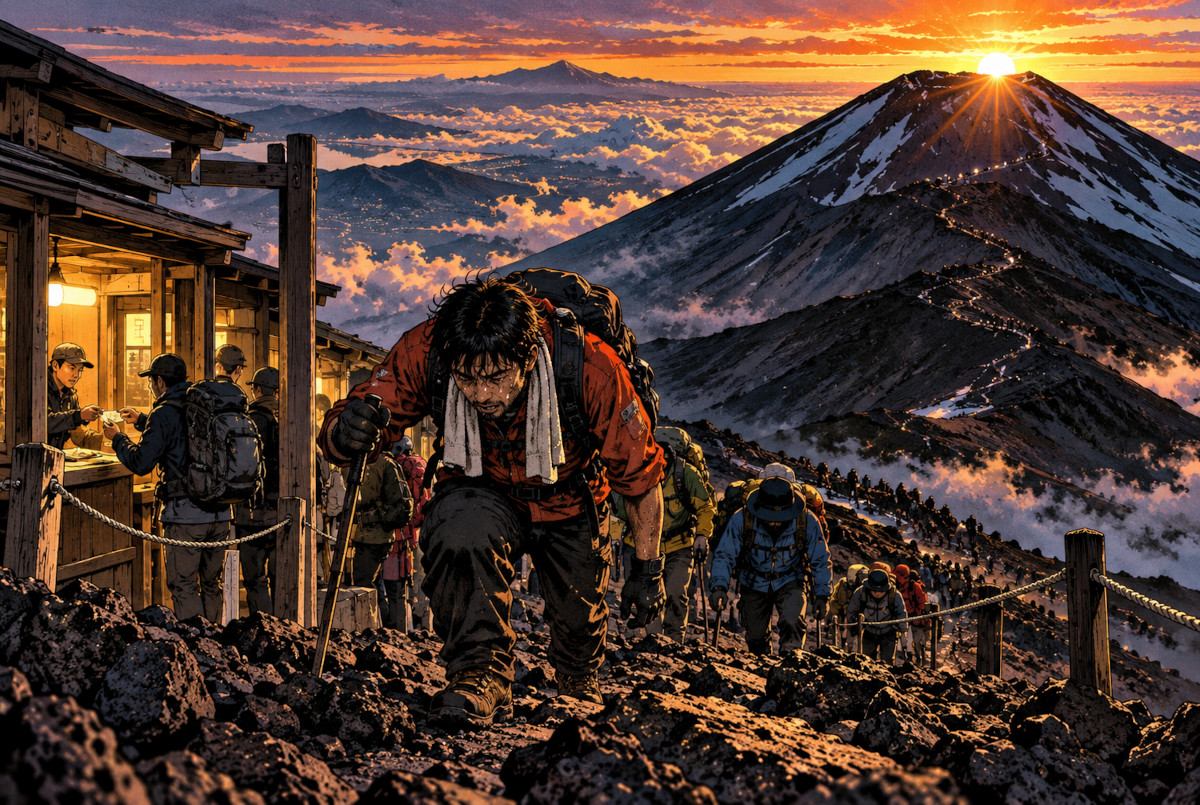
Serious hikers may call this a stupid question, but I am going to ask it anyway: what, exactly, is fun about climbing Mount Fuji? You pay money, walk for hours, deal with the cold, end up with aching legs, and when you finally reach the summit there is no cable car waiting to take you home. You still have to walk all the way back down.
A hot spring charges you to feel good. An amusement park charges you to be entertained. A mountain charges you, and then makes you do the work yourself. As leisure products go, that is a slightly odd arrangement. So rather than dismiss climbing, I wanted to use Mount Fuji to examine a stranger question: why do people place value on recreation that deliberately makes them work and suffer?
Put the Numbers on It, and This Is Not an Easy Day Out
Take the Yoshida Trail, the most popular route up Mount Fuji. Its trailhead at the Fuji-Subaru Line 5th Station sits at 2,305 meters, while the summit reaches 3,776 meters. That is a raw difference of 1,471 meters; the official climbing guide describes the elevation difference along the route as roughly 1,450 meters.
The official estimates put the ascent at 6.8 km and about six hours, with the descent at 7.0 km and about four hours. In other words, a round trip of 13.8 km and roughly 10 hours of standard walking time.
Then there is the money. In the 2026 climbing season, all four official Mount Fuji routes required a ¥4,000 hiking fee per person per climb. Divide ¥4,000 by those roughly 10 hours and you get ¥400 per hour. Obviously, nobody is literally “buying mountain climbing by the hour,” but it does highlight the oddity: you pay for the privilege of spending around 10 hours doing the physical work yourself.
If you want to experience goraikō—the sunrise viewed from the mountain—an overnight stay in a mountain hut is also common. At Fujisan Hotel at Hon-Hachigome, the Original 8th Station on the Yoshida Trail, a 2026 stay with dinner and breakfast cost between ¥12,000 and ¥14,500 depending on the day. Add transportation, food and equipment, and a first-time climber starting from scratch is not choosing Mount Fuji simply because it is a cheap day out.
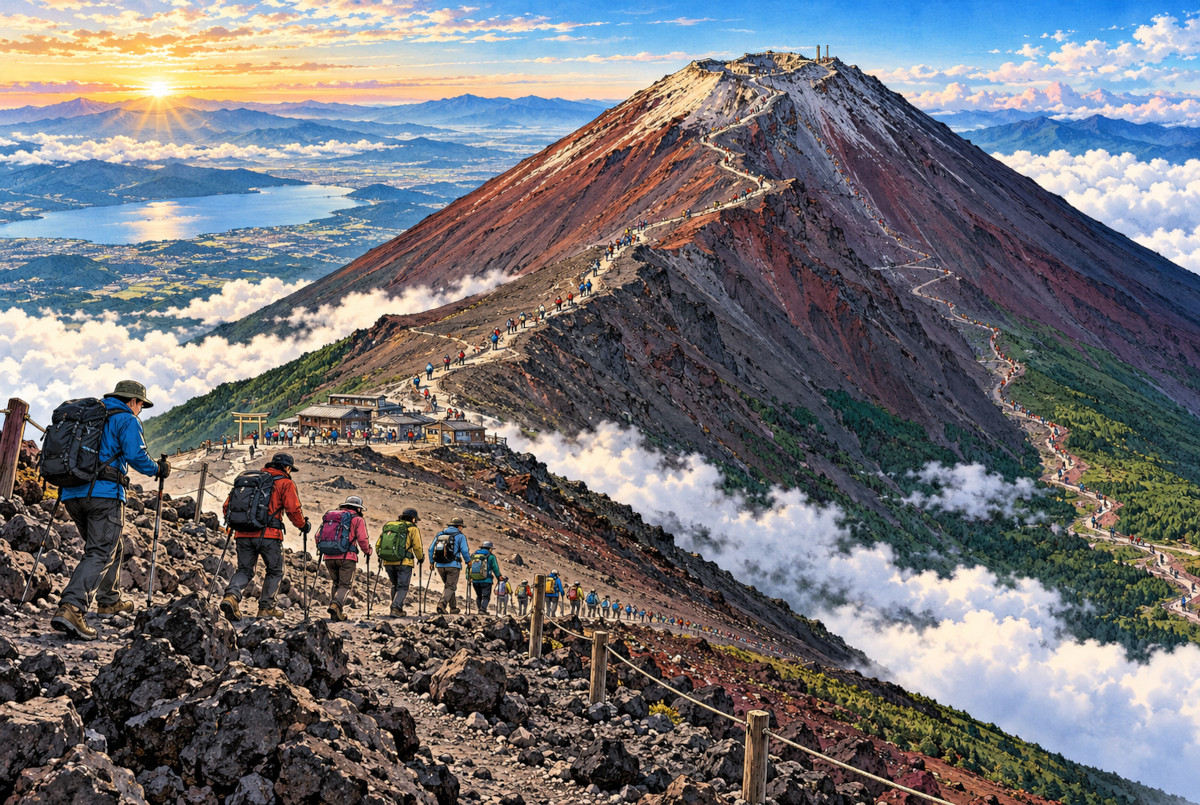 AI-generated explanatory illustration. It is not a precise topographic reconstruction of the actual Yoshida Trail.
Climbers Are Not Just Paying to Walk
So what are people actually looking for up there? A FY2015 survey of Mount Fuji climbers gives us an interesting clue. With multiple answers allowed, the most frequently selected motivation across all routes was “I want to climb Japan’s highest mountain,” at 55.2%. That was followed by “I want to see the sunrise” at 38.7%, and “I want to see beautiful nature and scenery” at 28.5%.
The survey was not designed to measure every possible pleasure people get from the act of hiking itself, so it would be wrong to conclude that nobody enjoys the walking. What is interesting is that the top answer was essentially “because it is the highest mountain in Japan.” Mount Fuji is not merely a scenic walk. For many climbers, reaching 3,776 meters is a clearly defined achievement.
And people keep coming. During the 2026 season, 166,178 climbers were counted on the Yoshida Trail between July 1 and September 10. They paid the hiking fee and accepted hours of climbing anyway. Apparently, “people only choose leisure when it is easy” is not much of a theory.
Psychology Has a Name for This: the Effort Paradox
This is where psychology becomes useful. Researchers have described something called the “effort paradox.” Humans generally treat effort as a cost and tend to avoid unnecessary work. Yet we can also value outcomes more highly because we worked for them—and sometimes we actively choose activities precisely because they require effort.
A 2018 review by Michael Inzlicht, Amitai Shenhav and Christopher Olivola even uses mountain climbing and ultra-marathons as examples. Effort, in other words, is not simply something that reduces the value of an experience. Under some conditions, it can become part of the value itself.
This is not the old moral lesson that “the more you suffer, the better a person you become.” Imagine, purely as a thought experiment, being dropped at exactly the same 3,776-meter point by helicopter instead of reaching it after hours on foot. The geographical location would be identical, but the experience would clearly mean something different. The hardship may not merely obstruct the experience; it may help create the value of the experience.
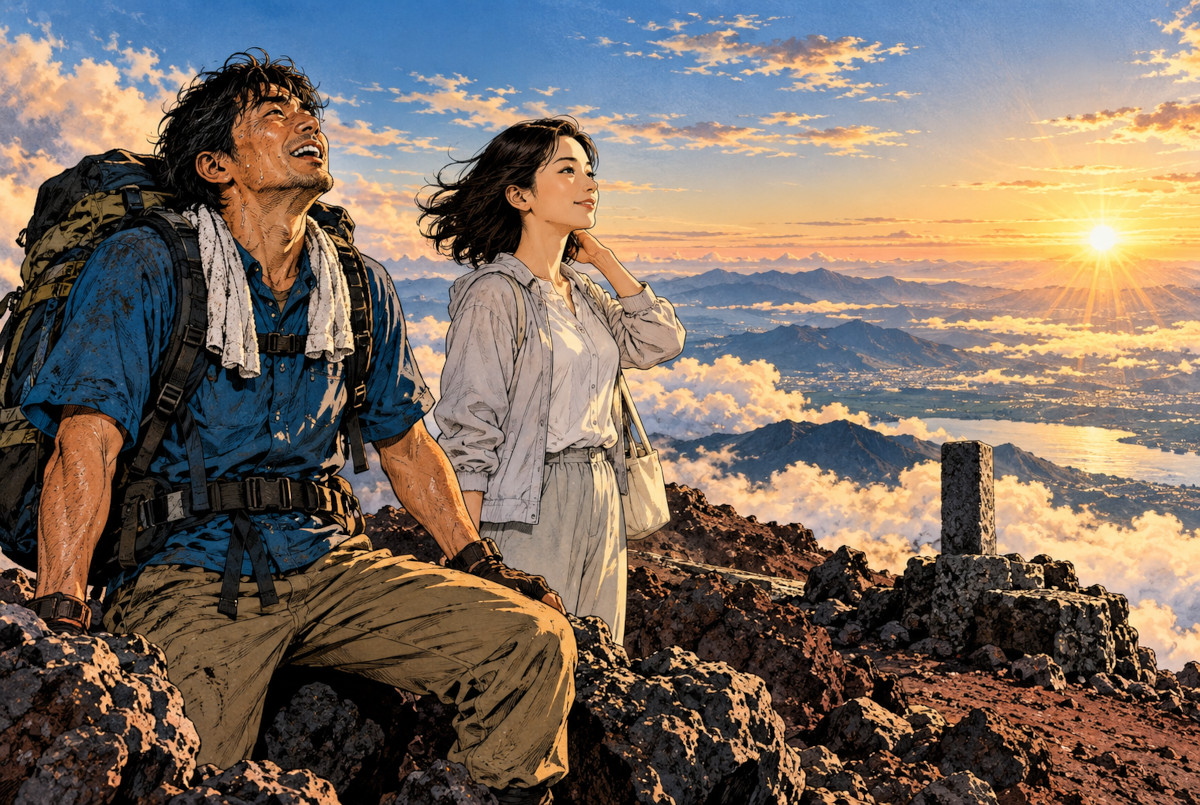 AI-generated conceptual illustration. It does not represent an actual method of reaching the summit or recommended clothing and equipment for climbing Mount Fuji.
You Do Not Actually Need the Summit to See the Sunrise
Then there is goraikō. The Official Website for Mt. Fuji Climbing explicitly points out that you do not have to be at the summit to see a beautiful sunrise. On the Yoshida Trail, the sunrise can be viewed from above the 5th Station, while the area above the 8th Station becomes especially crowded between roughly 3 a.m. and 5 a.m. because so many climbers are trying to reach the top in time.
Yet the thought “if I have come this far, I want to see it from the summit” remains powerful. Depending on conditions, watching the sunrise near a mountain hut and heading upward after daylight can be easier and less congested. But many people still want that specific combination: “I climbed to the top of Mount Fuji and watched the sunrise from there.”
At that point, perhaps the product is not merely the view. It is the story attached to the view.
Research on the “peak-end rule” adds another interesting angle. When people look back on an experience, they do not necessarily weight every minute equally; especially intense moments and the way an experience ends can have an outsized effect on the overall memory. A 2022 meta-analysis found strong support for this effect across a broad body of research.
That does not prove the peak-end rule explains why people enjoy climbing Mount Fuji. The research did not study Mount Fuji specifically, and sunrise is not necessarily the end of the climb. Still, the pattern is suggestive: a cold pre-dawn trail, finally reaching the summit, clouds spread beneath you, sunrise, and eventually the relief of finishing the descent. A handful of powerful moments may matter far more in memory than the average discomfort of every minute in between.
Climbing Mount Fuji Was Never Just Recreation
There is another piece of this story that should not be ignored. Mount Fuji is a UNESCO World Heritage property inscribed under the title “Fujisan, sacred place and source of artistic inspiration.” For centuries, reaching the mountain was connected with pilgrimage and religious practice rather than simply outdoor recreation.
From the 17th century onward, Fuji-kō pilgrimage associations flourished during Japan’s Edo period, and groups made worship ascents toward the summit. Modern hikers are obviously not all performing religious training. But the basic structure is curiously familiar: make an effort to climb, reach a special place above ordinary life, witness sunrise, stand at the summit, and then return to the world below.
So there may be a sense in which modern Mount Fuji climbing still carries the shape of a pilgrimage, even after becoming a leisure activity. That is not an official historical classification of modern hikers; it is my interpretation after putting the older pilgrimage tradition next to the behavior we see today.
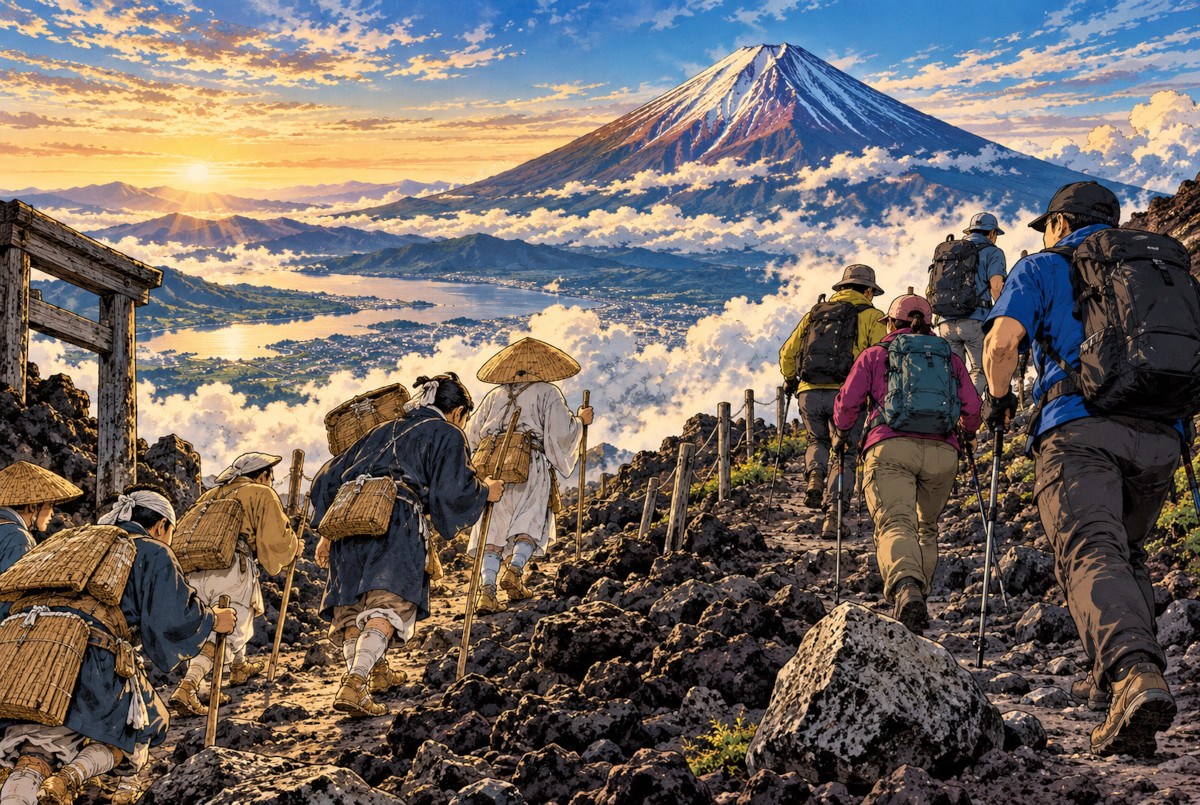 AI-generated historical comparison. It does not reconstruct a specific Fuji-kō group or an actual Edo-period pilgrimage scene.
If “Fun” Means “Comfortable,” Mount Fuji Makes No Sense
Which brings us back to the original question. “You spend money just to suffer” is not entirely wrong. Mount Fuji requires hours of walking. It can be cold. Your legs can hurt. It costs money. If comfort is the only measure of a good day off, there are obviously easier ways to spend one.
But comfort may not be what climbers are buying. They set a target, reach it under their own power, endure the point where they start wondering why they came, and come home able to say, “I climbed that mountain.” On Mount Fuji, the hardship may not be a defect in the product. It may be one of the ingredients that makes the product work.
That does not mean someone who says, “No thanks, I am not paying money for that,” has misunderstood anything. For that person, Mount Fuji really may be an expensive and exhausting trip. But for someone who loves climbing, remove every inconvenience and every difficult step and something essential disappears with them. At some point, it stops feeling like climbing Mount Fuji at all.
Editor’s Note
I still have trouble getting my head around the idea of paying ¥4,000, walking for around 10 hours and then saying, “That was fun.” But imagine an air-conditioned elevator that takes you to 3,776 meters in five minutes. Nobody would seriously call that “climbing Mount Fuji.” Put it that way and the answer suddenly becomes annoyingly clear. The hassle and the pain are part of what makes the word “climb” mean something. Whether that makes me want to do it myself is, of course, an entirely separate matter.
References
- Official Website for Mt. Fuji Climbing — Comparison of Climbing Trails
- Official Website for Mt. Fuji Climbing — Restrictions on Climbing Mt. Fuji (2026)
- Official Website for Mt. Fuji Climbing — Tips to Avoid Crowds
- Fujisan Hotel — 2026 Accommodation Rates [Japanese]
- Mt. Fuji World Cultural Heritage Council — FY2015 Survey and Research on Visitor Management [Japanese PDF]
- Fujiyoshida City — Yoshida Trail Climber Count and 8th Station First-Aid Station Results, 2026 [Japanese]
- Inzlicht, Shenhav & Olivola, “The Effort Paradox: Effort Is Both Costly and Valued,” Trends in Cognitive Sciences, 2018
- Alaybek et al., “All’s Well That Ends (and Peaks) Well? A Meta-Analysis of the Peak-End Rule and Duration Neglect,” 2022
- UNESCO World Heritage Centre — “Fujisan, sacred place and source of artistic inspiration”