

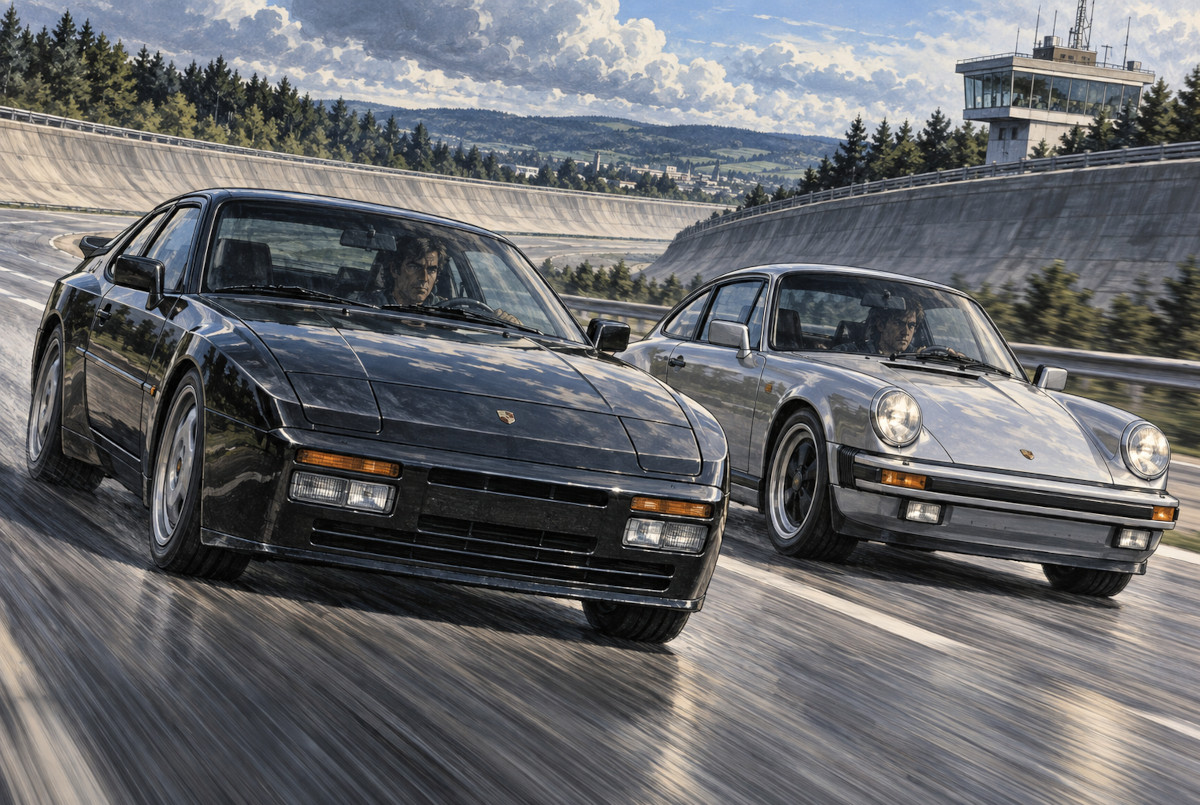
At first glance, the Porsche 944 looks like a 924 that was simply made wider, faster, and more expensive. But the deeper you dig, the stranger the story becomes. Introduced in 1981, when Porsche was still a West German company, the 944 kept the 924’s front-engine, rear-transaxle layout while gaining a 2.5-liter inline-four developed by Porsche itself.
And the 944 did more than sell well. Contemporary testing put its handling in the same conversation as the 911, while the later 944 Turbo eventually surpassed the naturally aspirated 911 Carrera in several factory performance figures. So did Porsche’s supposedly lower-tier model actually become faster than the 911? The answer is yes—but only if we are careful about which 911 we mean.
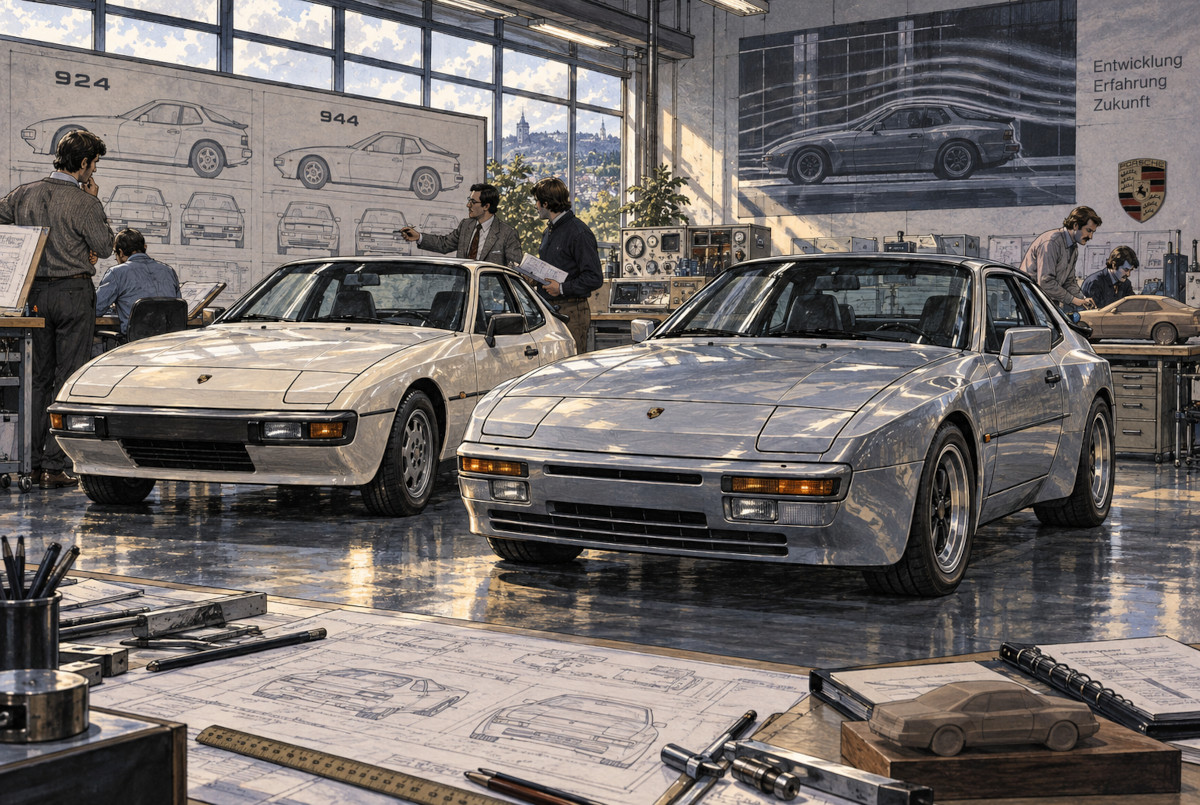 AI-generated comparison illustration. It does not reproduce an actual Porsche development facility or the exact details of one specific model year.
Give the 924 a Porsche Engine, and You Get the 944
The 944 made its debut at the 1981 Frankfurt Motor Show. With a 163 PS, 2.5-liter inline-four, it was positioned between the 924 and the 911 in both price and performance. What makes Porsche’s own retrospective especially revealing is the contrast with the 924: while the earlier car had sometimes been dismissed because of its Volkswagen and Audi connections, Porsche says the 944’s Porsche-developed engine helped it gain acceptance from the beginning as a “real Porsche.”
The engine itself has produced one of the more persistent bits of Porsche folklore. It is often described as “half of the 928’s V8.” That is a little too literal, but not entirely wrong in spirit. More accurately, the 2.5-liter four-cylinder was developed using the right-hand cylinder bank of the 928 V8 as its design basis. With four cylinders displacing roughly 625 cc each, it was a large four-cylinder engine, and Porsche used two balance shafts to control the vibration that comes with that layout.
Then the 944 Became Half of Porsche
The visual change was just as obvious. The 944 adopted the broad, muscular fenders associated with the 924 Carrera line, giving it a much more substantial presence than the narrow-bodied 924. But the sales figures were even more dramatic. Porsche recorded roughly 30,000 orders in the first production year, and after just one year on sale, the 944 accounted for about 51 percent of Porsche’s total production.
Think about that for a moment. Porsche was still producing the 911, 928 and 924, yet roughly one out of every two Porsches being built was a 944. By the end of production in 1991, Porsche had built 163,302 examples, making it the company’s best-selling sports car up to that point. Porsche has even described the 944 as helping save the company during the economically difficult 1980s.
Calling it merely “the model below the 911” therefore misses something important. For a time, in sheer production volume, the 944 was effectively Porsche’s main product.
It Did Not Show Much Respect for the 911 in the Corners Either
The 944’s appeal was not just price and practicality. In 1984, Car and Driver assembled eight performance cars for a handling comparison, including the Ferrari 308, Lotus Esprit Turbo, Audi Quattro, Toyota Celica Supra, Porsche 928S, Porsche 911 Carrera and Porsche 944. The 911 Carrera in that test was not completely standard in appearance and chassis specification: it used Turbo-style bodywork, brakes, suspension and wider wheels, while retaining the naturally aspirated Carrera engine.
The car ultimately selected as the magazine’s best-handling imported car was the 944. Car and Driver also praised the 911’s ultimate capabilities, but the 944 scored particularly well for steering, balance and controllability near the limit. Of course, one magazine comparison does not prove that every 944 handles better than every 911. What it does show is that by the mid-1980s, the supposedly junior Porsche was already being judged against the 911 on equal terms—and could come out on top in a serious comparative test.
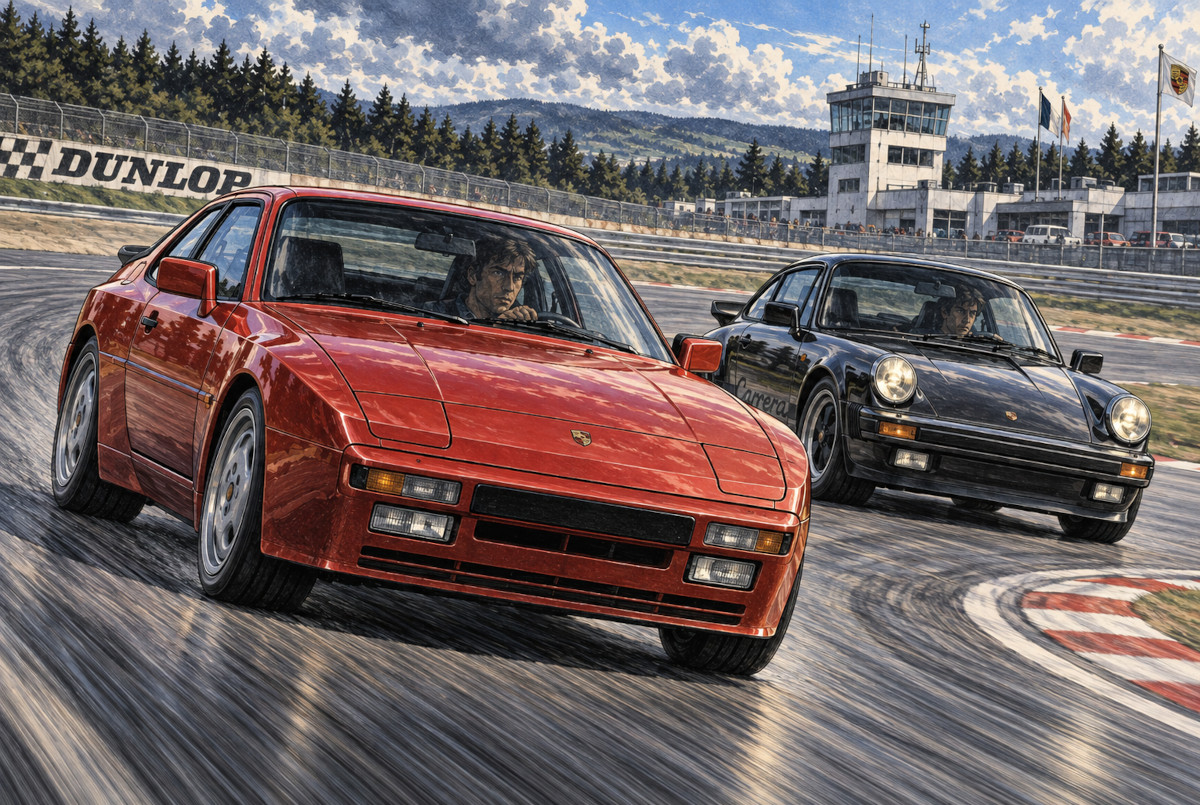 AI-generated comparison illustration. It does not reproduce the actual cars or location used in the 1984 Car and Driver test.
By 1989, the 944 Turbo Really Was Faster Than a 911 Carrera
The 944 Turbo arrived in 1985. In 1988, Porsche introduced the 250 PS 944 Turbo S, and from the following year that 250 PS specification became standard for the regular 944 Turbo.
So let us compare like with like: 1989 European-market cars, using the 944 Turbo and the naturally aspirated, non-catalyst 231 PS version of the 911 Carrera 3.2.
| 944 Turbo | 911 Carrera 3.2 | |
|---|---|---|
| Engine | 2.5L turbo inline-four | 3.2L naturally aspirated flat-six |
| Power | 250 PS | 231 PS |
| 0–100 km/h | 5.9 sec | 6.1 sec |
| Top speed | 260 km/h | 245 km/h |
That gives the 944 Turbo a 19 PS advantage, a 0.2-second advantage to 100 km/h, and a 15 km/h advantage in top speed. None of those numbers represents a crushing defeat. But on the manufacturers’ published figures, the 944 Turbo genuinely outperformed the naturally aspirated 911 Carrera 3.2.
There is one important catch. Saying “the 944 was faster than the 911” without qualification is misleading. Porsche was also selling the 911 Turbo, or 930, with roughly 300 PS. The 944 Turbo had overtaken the naturally aspirated Carrera 3.2—not every version of the 911.
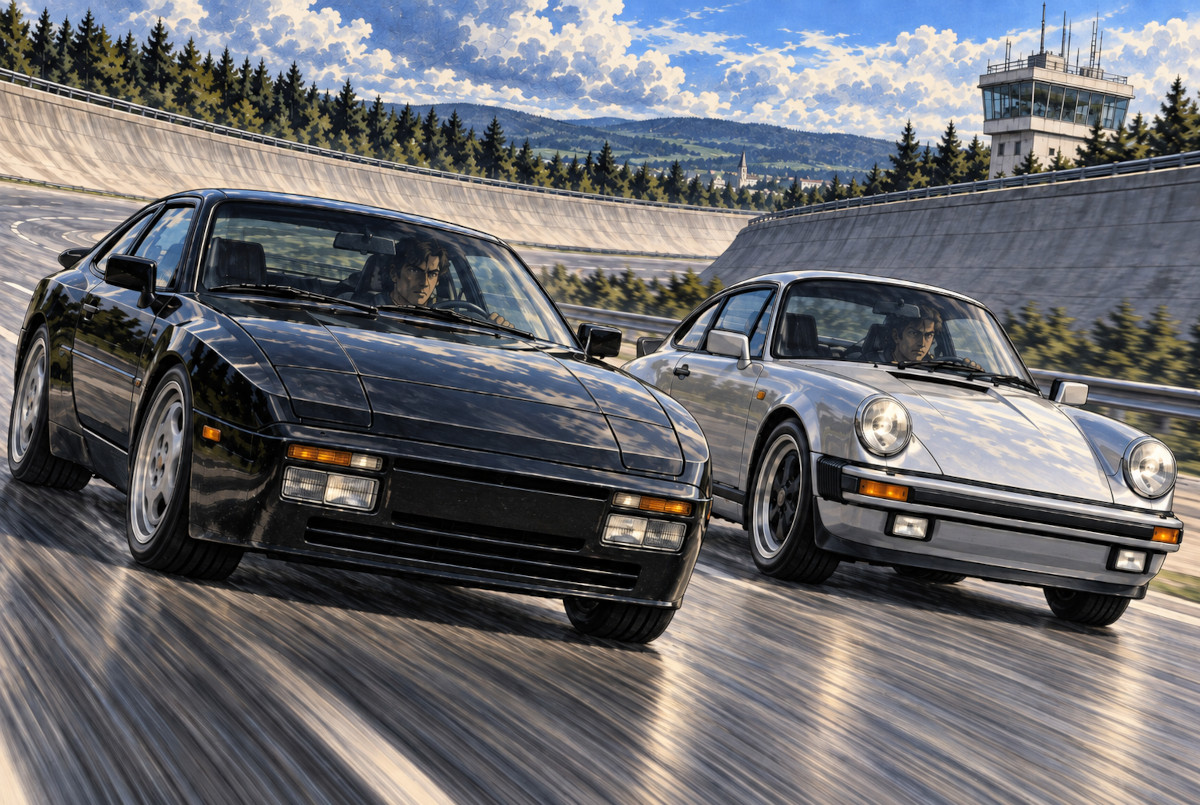 AI-generated comparison illustration. It does not depict an actual head-to-head test conducted at this location.
The Four-Cylinder Eventually Grew to 3.0 Liters
The Turbo was not the only strange endpoint of the 944 story. The 944 S2, introduced in 1988, used a naturally aspirated 2,990 cc inline-four producing 211 PS. At the time, it was the largest-displacement inline-four fitted to a series-production car.
Divide 2,990 cc by four and each cylinder displaces about 747.5 cc. For a Japanese comparison, the current engine-capacity limit for Japan’s tiny kei cars is 660 cc—meaning one cylinder of the 944 S2 was about 13 percent larger than an entire kei-car engine. That is a slightly absurd comparison, but it makes the point: by this stage, calling the 944 “just a four-cylinder Porsche” no longer told you very much about the scale of the engineering.
The 944 Could Beat a 911 and Still Fail to Replace It
This may be the most interesting part of the whole story. The transaxle line that began with the 924 represented a very different idea of what a modern Porsche could be. The 944 sold in huge numbers, earned praise for its handling, and in Turbo form surpassed the naturally aspirated 911 Carrera in published performance figures.
The 911 did not survive because the 944 failed. The 911 survived even though the 944 succeeded. Porsche eventually found room for both ideas instead of declaring one of them the single correct answer.
The next car in this line, the 968, would take the front-engine transaxle four-cylinder concept even further. By then, however, Porsche was already moving toward another kind of sports car—one that would eventually lead to the Boxster.
The Other Porsche — 6-Part Series
Not every Porsche followed the 911 formula. From the four-cylinder 912 and VW-linked 914 to the 924, 944, 968 and the later mid-engine generation, this six-part series traces the strange history of Porsche's more accessible sports cars.
- Part 1: Four-Cylinder Porsches and a VW-Powered 914 — Were the 912 and 914 Really “Fake” Porsches?
- Part 2: Porsche 924: The VW Project That Became a Porsche
- Part 3: Was the Porsche 944 Turbo Really Faster Than the 911 Carrera?
- Part 4: In preparation Coming soon
- Part 5: In preparation Coming soon
- Final Part: In preparation Coming soon
Editor’s Note
Back in the old magazine days, it would have been easy to dismiss a four-cylinder Porsche as the junior model—the one you bought because you could not stretch to a 911. Then you look at the numbers. The 944 became Porsche’s biggest-volume car, beat a 911 in a major handling comparison, and eventually became faster than a 911 Carrera in Turbo form. That is not exactly junior-model behavior.
And yet the 911 still refused to die. That is the bit I like. If cars were nothing more than specification sheets, Porsche could simply have replaced the older concept with the newer one and moved on. But apparently there was something about the 911 that the numbers could not erase. At the same time, the 944 did far too much to be dismissed as Porsche’s bargain model. Cars from the West German era were good at this sort of contradiction: engineering logic on one side, stubborn identity on the other.
References
- Porsche Newsroom — Porsche and the four-cylinder engine
- Porsche Newsroom — Porsche Museum pays tribute to “40 years of the transaxle”
- Porsche Newsroom — Time lapse: Porsche’s transaxle models
- Porsche — 944 Turbo Coupé Technical Data (1989)
- Porsche Newsroom — 50 Years of the Porsche 911 G-Series
- Porsche Newsroom — Why is the transaxle concept still so fascinating today?
- Car and Driver — Best-Handling Imported Cars of 1984