
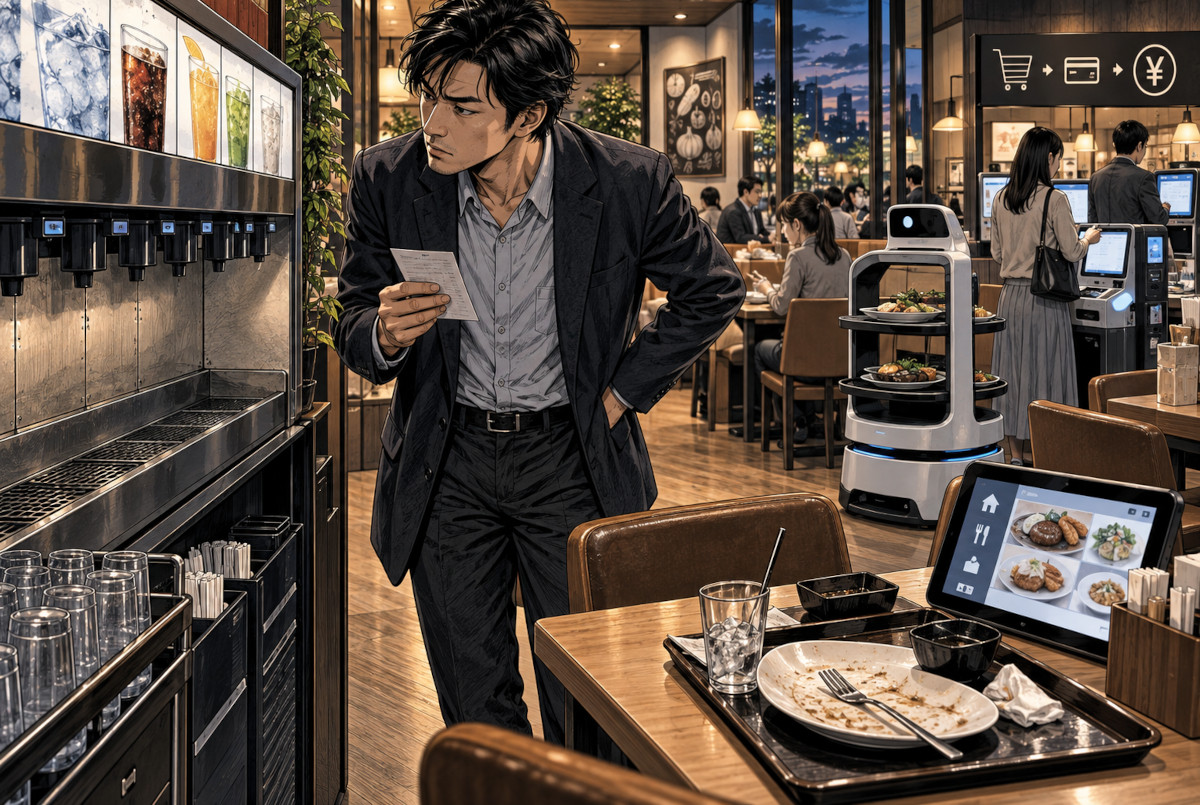
At a Japanese family restaurant, you walk over to the self-service drink station, press the cola button, and get little more than carbonated water. The orange juice looks suspiciously pale. The coffee machine has run out of beans. What happens next? In many cases, the customer finds a staff member and says, “I think this has run out.”
For readers outside Japan, a “family restaurant,” or famiresu, does not mean a family-owned restaurant. It usually refers to a large, casual restaurant chain aimed at a broad range of customers. Many of these restaurants also have a “drink bar”: a self-service station where customers can refill soft drinks, coffee, tea, and other beverages.
None of this seems particularly irritating. It is self-service, after all. A staff member replaces the syrup, beans, cups, or ice, and the problem is solved. But viewed as a restaurant-management system, something more interesting is happening. Customers are not only serving their own drinks. They are also becoming the people who notice when the system stops working.
The drink bar has moved beyond simple self-service
A drink bar is naturally designed around customer participation. Customers choose a cup, walk to the machine, and make their own drinks. But checking syrup levels, ice supplies, coffee beans, cups, and equipment condition is still fundamentally a restaurant-management task.
A restaurant could send an employee to inspect the drink station every 10 or 15 minutes. That would reduce the chance of a customer discovering an empty dispenser first. But it would also consume staff time. From an efficiency standpoint, it can be much cheaper to respond only when a problem is actually noticed.
There is no evidence that major restaurant chains officially instruct employees to “leave it until a customer complains.” That would be an unfair claim. But in a labor-saving restaurant environment, the result can look very similar: a customer discovers the problem, reports it, and staff respond.
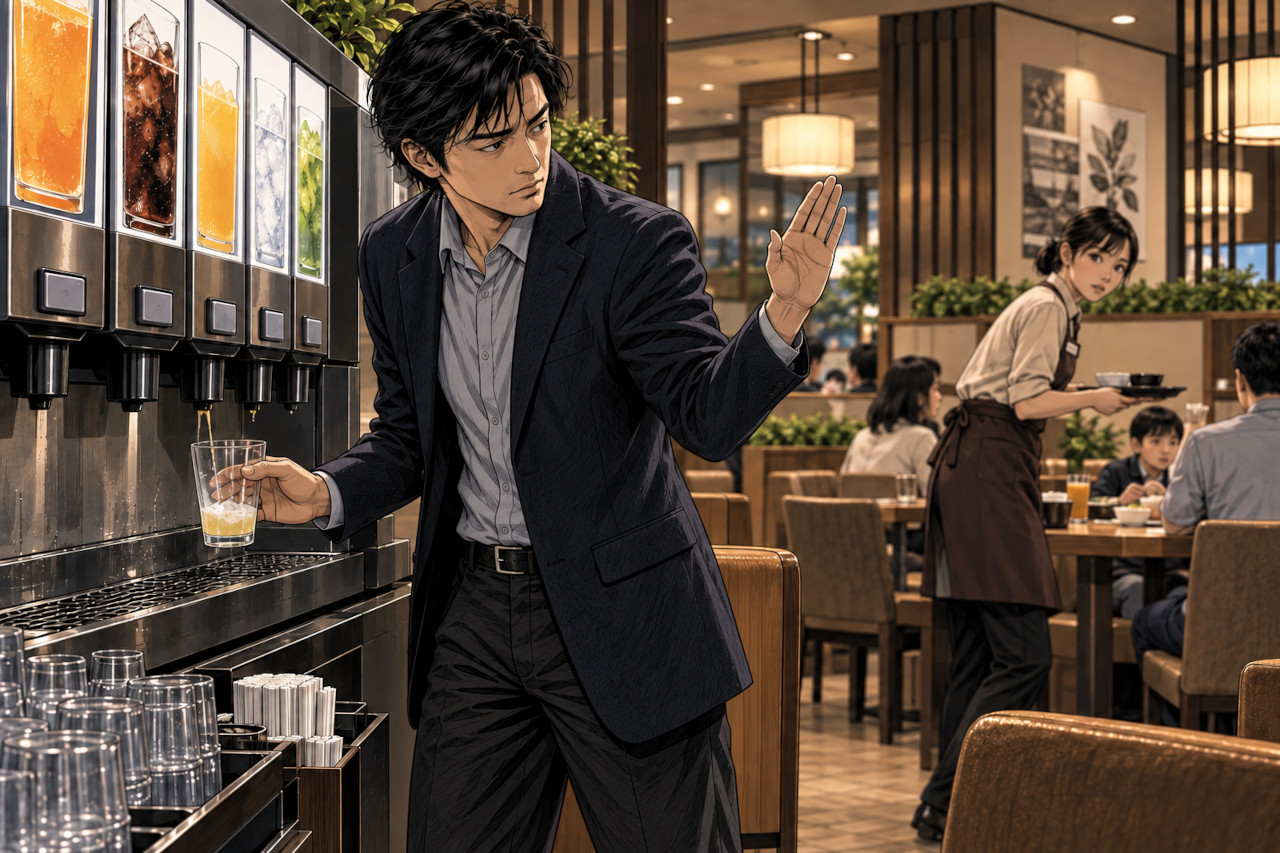
Conceptual illustration of a self-service drink station. It does not depict any specific restaurant chain.
Customers have quietly become part of the monitoring system
From an operations perspective, this is actually quite efficient. If 100 customers use the drink bar during the day, each person automatically checks at least one part of the system simply by using it. Someone wanting cola discovers that the cola syrup is empty. Someone wanting ice discovers that the ice bin needs attention.
In other words, customers function as an informal network of free “fault-detection sensors.” They have no obligation to do so, of course. Yet many people will naturally tell a staff member when something is wrong. That allows the restaurant to discover problems without constantly assigning an employee to inspect the equipment.
This is not limited to drink bars. Japanese family restaurants have increasingly adopted touchscreen ordering, serving robots, self-checkout systems, and payment at the table. Skylark Holdings, one of Japan’s major restaurant groups, has publicly described digital ordering and serving robots as tools for reducing floor-service workload and improving productivity.
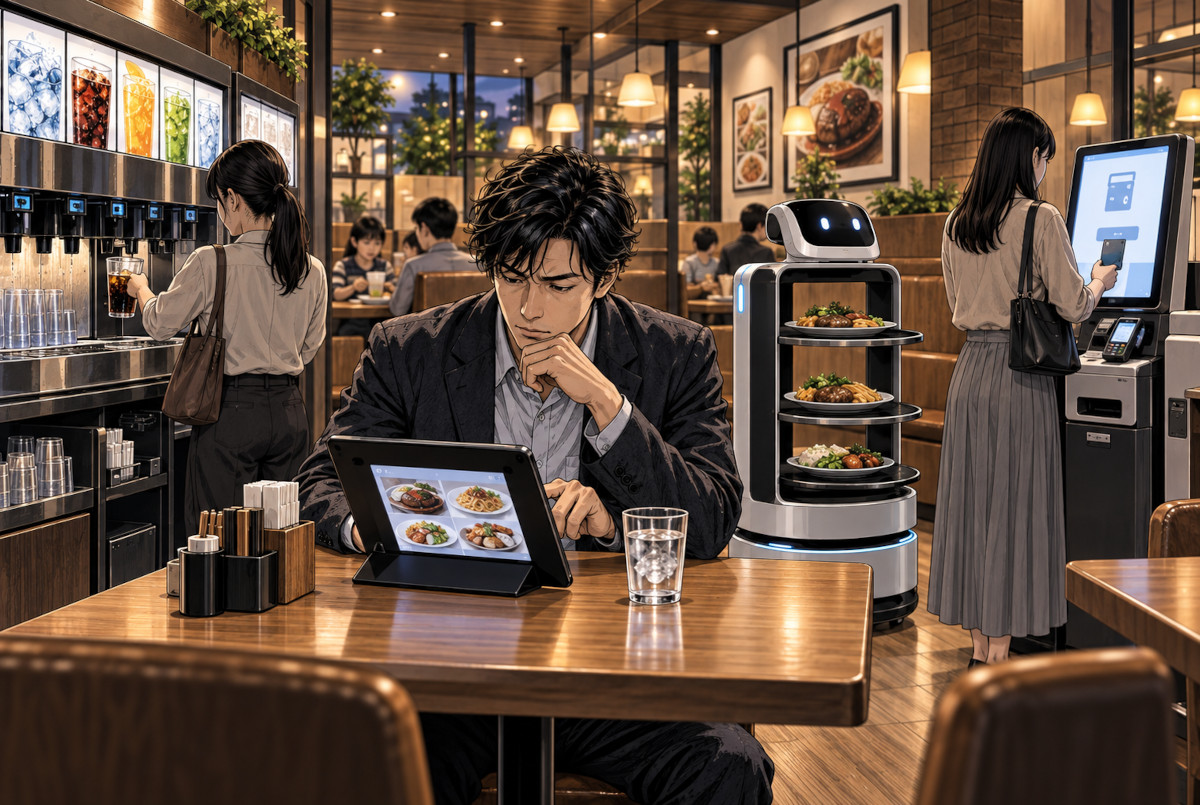
Conceptual illustration showing how restaurant tasks are increasingly divided between customers and machines.
Why this feels acceptable in a family restaurant but not in a luxury restaurant
The same arrangement would feel very different in an expensive restaurant. If customers repeatedly had to tell staff that wine glasses were missing, drinks needed replacing, or basic service equipment had run out, most people would consider that a failure of service.
A higher-priced restaurant is selling more than food. Attention, timing, anticipation, and staff presence are part of the product. Customers expect problems to be noticed before they need to mention them.
A family restaurant operates under a different agreement. Customers already understand that some tasks are self-service. They may collect their own water, refill their drinks, use a touchscreen to order, or pay without interacting with a cashier.
That arrangement can be perfectly reasonable. The implicit bargain is that simpler service helps keep the restaurant affordable, convenient, and easy to use. As long as customers feel that the trade-off is fair, reporting an empty drink dispenser is unlikely to cause much resentment.
The problem begins when “at least it is cheap” stops feeling true
This is where the situation becomes more complicated. Customers are doing more of the work themselves, but restaurant prices have not stayed frozen at their old levels. Food costs, electricity, gas, wages, distribution expenses, and other operating costs have risen substantially.
According to Teikoku Databank, 900 restaurant businesses in Japan entered legal bankruptcy proceedings in 2025, the highest annual total in its dataset. The figure covers legal insolvencies with liabilities of at least ¥10 million. Higher food, utility, and labor costs were among the pressures affecting the industry.
Labor shortages also remain important. In Teikoku Databank’s January 2026 survey, 58.6% of restaurant businesses reported a shortage of non-regular workers. The situation had improved compared with the previous year, but the percentage was still high enough to explain why restaurant operators continue investing in automation and labor-saving systems.
So the argument cannot simply be, “If customers are doing the work, the food should be cheaper.” A restaurant may save money through automation and still face even larger increases in ingredients, energy, wages, rent, maintenance, and logistics.
But accounting logic and customer psychology are not the same thing. From the customer’s point of view, the experience can easily become: “I place the order myself, get my own drink, a robot brings the food, I pay at a machine—and the bill is still higher than it used to be.”
That feeling is not economically precise, but it is understandable.
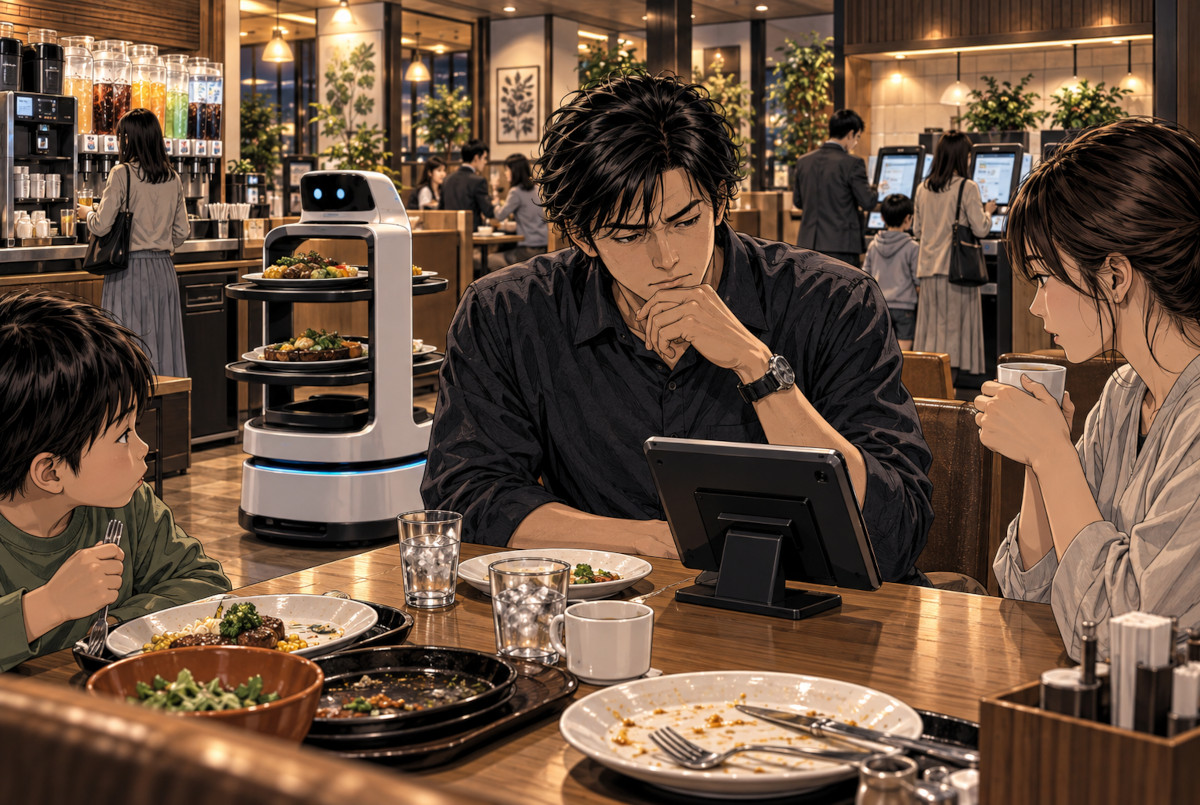
Conceptual illustration of the gap customers may feel between increased self-service and rising restaurant prices.
There is still a line between efficient self-service and poor management
This is not an argument for returning to restaurants packed with employees performing every small task. Serving robots can reduce repetitive walking. Touchscreen ordering can reduce mistakes and eliminate the need to wait for a server. Self-checkout can shorten payment lines.
For restaurants facing persistent staffing problems, those technologies may be necessary rather than optional.
But self-service has limits. If broken equipment is left unattended for long periods, the drink station becomes dirty, cups remain unavailable, or customers repeatedly cannot find anyone to help, the problem is no longer “self-service.” It is simply weak management.
The real challenge is deciding which tasks customers can reasonably handle and which responsibilities must remain with the restaurant. A customer casually reporting an empty syrup cartridge may be perfectly acceptable. A restaurant that depends entirely on customer complaints to discover every problem is something else.
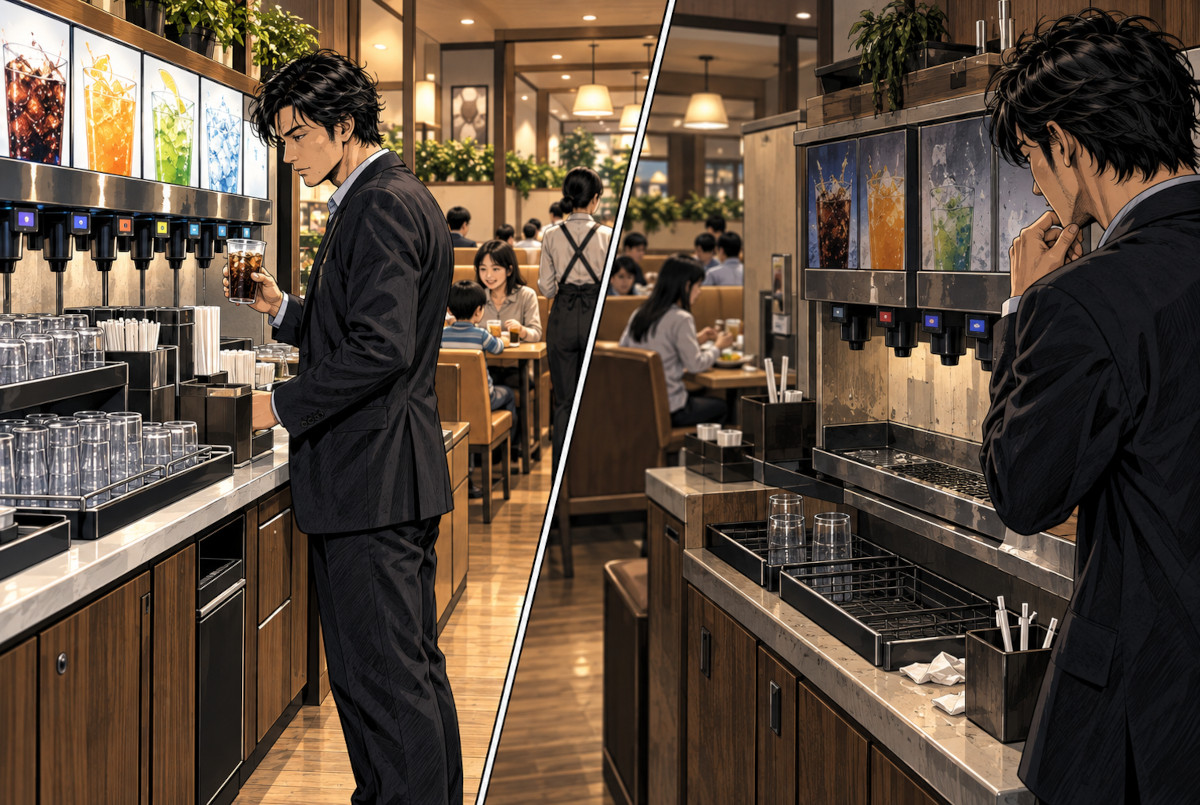
Conceptual comparison illustrating the difference between efficient labor-saving operations and simple neglect.
The modern family restaurant is no longer just a restaurant with fewer employees
If we compare today’s family restaurants with those of the past, it is easy to say that there are simply fewer staff members on the floor. But that description misses what has really changed.
The missing labor has been divided among several replacements: ordering tablets, serving robots, self-checkout systems—and customers themselves.
That is not automatically a bad thing. Customers may prefer ordering without waiting for a server. Robots can deliver dishes quickly. Automated payment can remove another queue. Self-service can sometimes make a restaurant more convenient, not less.
But when prices rise at the same time, customers naturally begin asking what they are receiving in exchange for taking on more of the work.
The success of restaurant automation will not ultimately be decided by how few employees a restaurant can operate with. It will be decided by whether the balance between customer effort, price, convenience, and service still feels fair.
A customer telling a staff member that the cola syrup has run out may seem like an insignificant moment. But that tiny interaction reveals something larger about how modern restaurants are being redesigned: the customer is no longer only the person being served. Increasingly, the customer has become part of the operating system.
【Editor’s Take】
I actually think this model is fine for a casual family restaurant. If I were managing one, I would not want an employee checking every drink nozzle every few minutes either. If a customer says something has run out, replace it immediately and move on. That is efficient.
But there is still a point where I start thinking, “Hang on a second.” I place the order myself. I get my own drink. A robot brings the food. I may even pay without a cashier. And somehow the meal is more expensive than it used to be.
I understand why prices are rising, and I am not against automation. But if restaurants transfer more work to customers, they should preserve something obvious in return—lower prices, faster service, greater convenience, or preferably more than one of those. Otherwise, customers may eventually notice that the word “self-service” has expanded much further than they expected.
References
- Skylark Holdings — Digital Transformation (DX) — Information on digital menu systems, serving robots, reduced restaurant-floor workload, and productivity improvements.
- Skylark Holdings — Shareholder Newsletter 2023 — Information on serving robots, self-checkout systems, table payment at approximately 2,400 locations, and responses to labor shortages.
- Teikoku Databank — Survey on Corporate Labor Shortages, January 2026 — Data on labor shortages in Japan’s restaurant industry, including the 58.6% shortage rate for non-regular employees.
- Teikoku Databank — Restaurant Bankruptcy Trends, 2025 — Data on 900 restaurant bankruptcies in 2025 and cost pressures including food, utilities, and labor.