
In August 2000, production of the Z32 ended and Nissan’s Z-car disappeared from showrooms. Normally, that would sound like the end of the story: an aging sports car was dropped and the company moved on. Except Nissan had already shown a new Z concept at the Detroit auto show in 1999.
That timing is the strange part. Nissan was entering its alliance with Renault and preparing the Nissan Revival Plan, a restructuring program aimed at rebuilding the company itself. Yet in 2002, it brought back a two-seat sports car as the Z33—known outside Japan as the 350Z. Twenty years later, its successor’s successor arrived as a new-generation Z, but not as a “Z35.” Its chassis code was RZ34. So how has the Nissan Z survived without starting from scratch every time?
Nissan Z — 3-Part Series
From the birth of the original S30 and its American-market mission, through the Z31 and Z32 era, to the Z33 revival and today’s Z, this three-part series traces how the Fairlady Z changed while preserving the idea behind Nissan’s long-running sports GT.
- Part 1: Was the Datsun 240Z a Jaguar E-Type Copy? Why Nissan Built It
- Part 2: Why Did Nissan Bring the Inline-Six Back to the Z31? From Z31 to Z32
- Final Part: How Did the Nissan Z Come Back? From the 350Z to the RZ34
Why revive a sports car while rebuilding the company?
Nissan announced the Nissan Revival Plan in October 1999. It was not a cosmetic reorganization: plants, product lines, purchasing and the company’s broader structure were all being reconsidered. Yet Nissan continued to treat the Z as a globally recognized piece of its identity. A new Z Concept, much closer to the eventual production car, appeared at the 2001 North American International Auto Show. In July 2002, after roughly two years without a production Z, the Z33 went on sale in Japan and the United States.
That is what makes the decision interesting. If a company is fighting to rebuild itself, a dedicated two-seat sports car sounds like an easy thing to cut. But Nissan regarded the Z as more than a volume product. Its own heritage material describes the car as part of Nissan’s corporate DNA.
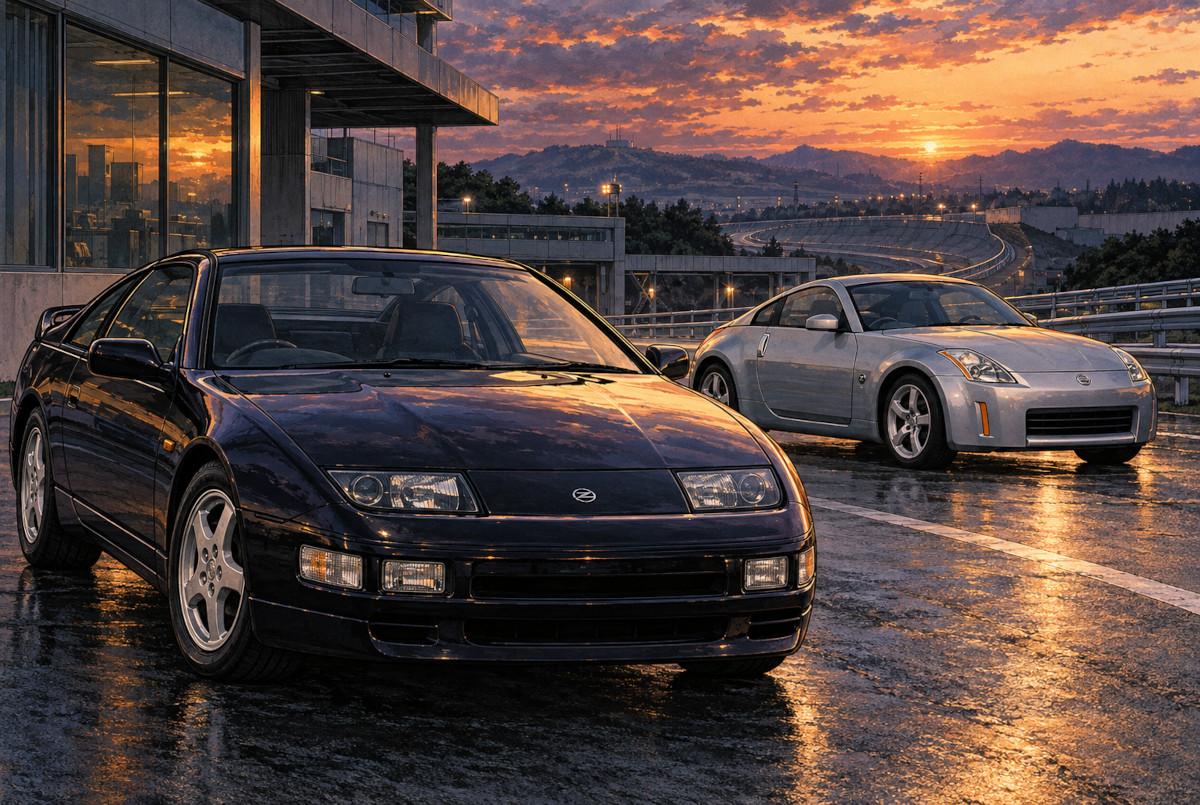
AI-generated illustration representing the transition from the Z32 to the revived Z33. It does not reproduce one exact model year or factory trim in every detail.
The 350Z came back with less, not more
The reborn Z33 was not simply a more lavish version of the Z32. At launch, Nissan kept the formula unusually simple: one 3.5-liter naturally aspirated VQ35DE V6 and a two-seat coupe body. No twin turbo. No 2+2. Nissan itself later noted that this deliberately focused product concept was well received.
Nor was every mechanical element created exclusively for the Z. The Z33 used Nissan’s FR-L architecture, while the same broader front-midship/FM packaging philosophy was deployed in cars such as the V35 Skyline and Infiniti G35. The VQ engine family was hardly a Z-only creation either.
That does not make the 350Z a cheap collection of borrowed parts. If anything, the interesting part was Nissan’s ability to take proven volume-production technology and turn it into a serious two-seat sports car. In that sense, the strategy has a faint echo of the original Z.
The numbers are revealing too. A Z32 Twin Turbo two-seater with a five-speed manual produced 280 PS and weighed 1,510kg. The 2002 Z33 Version ST also made 280 PS, but from a 3.5-liter naturally aspirated V6, at 1,450kg. The simple weight-to-power calculation improves from roughly 5.39kg/PS to 5.18kg/PS.
That does not mean the Z33 was automatically faster in every situation—the engines, gearing, tires and chassis were completely different. What matters here is that Nissan arrived at the same headline 280 PS through an almost opposite mechanical recipe.
And the revival worked commercially. Nissan says more than 250,000 Z33s were sold during its six-year run. The 350Z was not merely nostalgia wearing a new body.
The 370Z got shorter instead of simply getting bigger
The Z34, known internationally as the 370Z, arrived at the end of 2008. At first glance it looks like a straightforward evolution of the 350Z, but its proportions changed more than the styling suggests.
Using the Japanese-market specifications compared here, the wheelbase fell from 2,650mm to 2,550mm—a full 100mm reduction. Overall length went from 4,310mm to 4,250mm, while width increased from 1,815mm to 1,845mm.
Its 3.7-liter naturally aspirated VQ37VHR produced 336 PS. So Nissan did not simply enlarge the Z33. It shortened it, widened it and made the package more concentrated.
There is another old-car-spec-sheet trap here. Nissan used aluminum for panels including the hood and doors and pursued weight reduction in individual components and structures, but that does not mean every Z34 was lighter than every Z33. Curb weight still varied by grade and equipment. “Smaller” and “lighter” are not automatically the same thing.
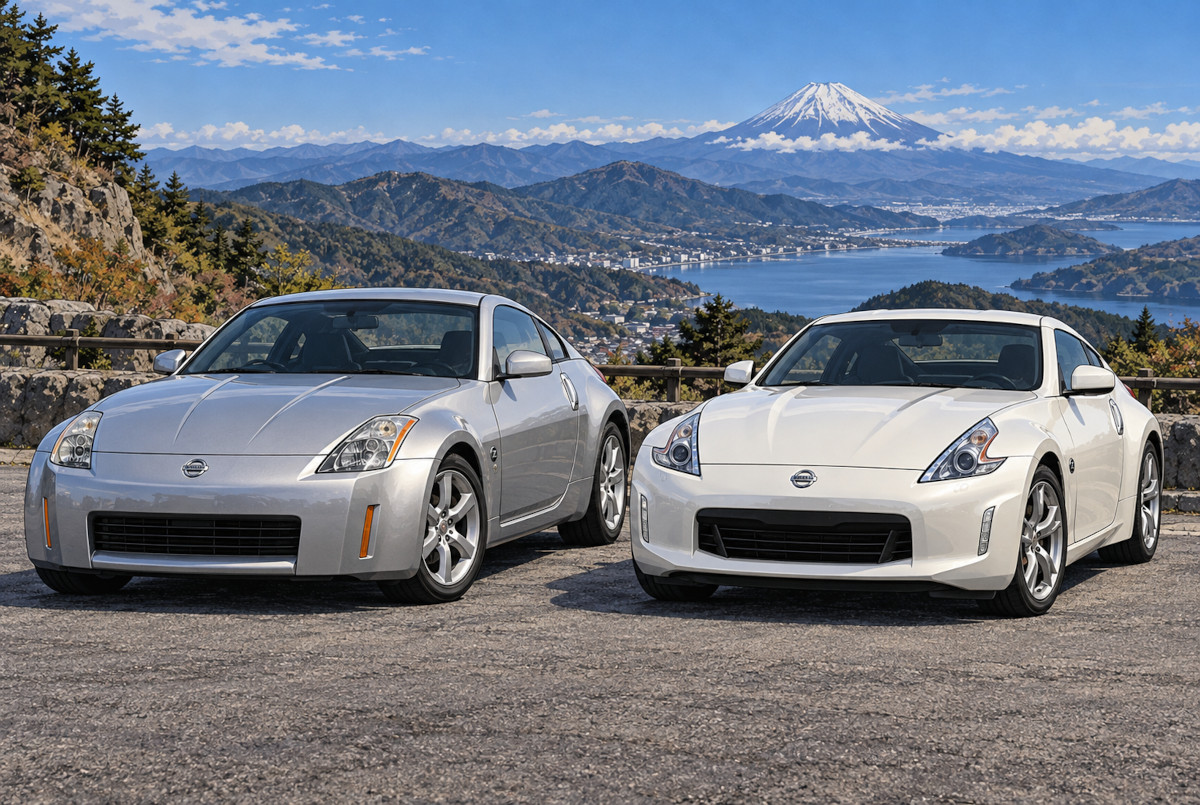
AI-generated comparison illustrating the proportional differences between the Z33 and Z34. The Z34 shown includes styling details from a later model year and does not exactly reproduce the original 2008 launch specification.
Then the new Z arrived—and it still was not called Z35
In Japan, Nissan launched the current RZ34-generation Fairlady Z in August 2022. In most export markets it is simply called the Nissan Z. Its VR30DDTT 3.0-liter twin-turbo V6 produces 405 PS and 475N·m in Japanese specification, with both a six-speed manual and a nine-speed automatic available.
Line up the engines and the Z starts looking almost allergic to straight-line evolution. The Z32 used a 3.0-liter twin-turbo V6 at 280 PS. The Z33 switched to a 3.5-liter naturally aspirated V6, still at 280 PS. The Z34 moved to a 3.7-liter naturally aspirated V6 at 336 PS. Then the RZ34 returned to a 3.0-liter twin-turbo layout at 405 PS.
It is the same sort of odd back-and-forth we saw in the previous chapter, when the Z31 abandoned the inline-six and then brought one back. The Z’s engineering history is rarely a neat one-way march.
Its chassis code makes the current car even more curious. It is treated by Nissan as a new generation, yet its code is RZ34, not Z35. Its 2,550mm wheelbase is identical to that of the preceding Z34, and Nissan engineers have openly discussed carrying over parts of the previous chassis while substantially reworking areas such as tires, dampers and electric power steering.
But there is an important line not to cross: Nissan has not officially said that the car is called RZ34 specifically because it carries over the previous platform. That explanation is often repeated as if it were confirmed, but it remains an inference. What we can say with confidence is that Nissan did not start with a completely blank sheet of paper. It kept useful foundations and changed the parts it believed mattered.
Fifty years later, the Z began borrowing from itself
The current Z’s styling makes the point even more clearly. Nissan says its overall silhouette deliberately recalls the original S30. Its headlamp treatment references the Japan-market 240ZG, while the rear lighting draws from the Z32.
In the first article of this series, we looked at how the original Z studied the world of European GTs and turned that appeal into a sports car Nissan could build and sell in serious numbers. Half a century later, the Z itself had become the reference material for the next Z.
The story continued in Japan with the August 2026 update. Nissan brought the front “Z” emblem back after roughly a quarter century, reviving a badge used from the S30 through the Z32 era. The Z NISMO also gained a six-speed manual transmission. The modern Z is not simply copying old styling for decoration; Nissan is selectively pulling pieces of its own history back into the current product. :chatgpt-content-reference{index=”0″}
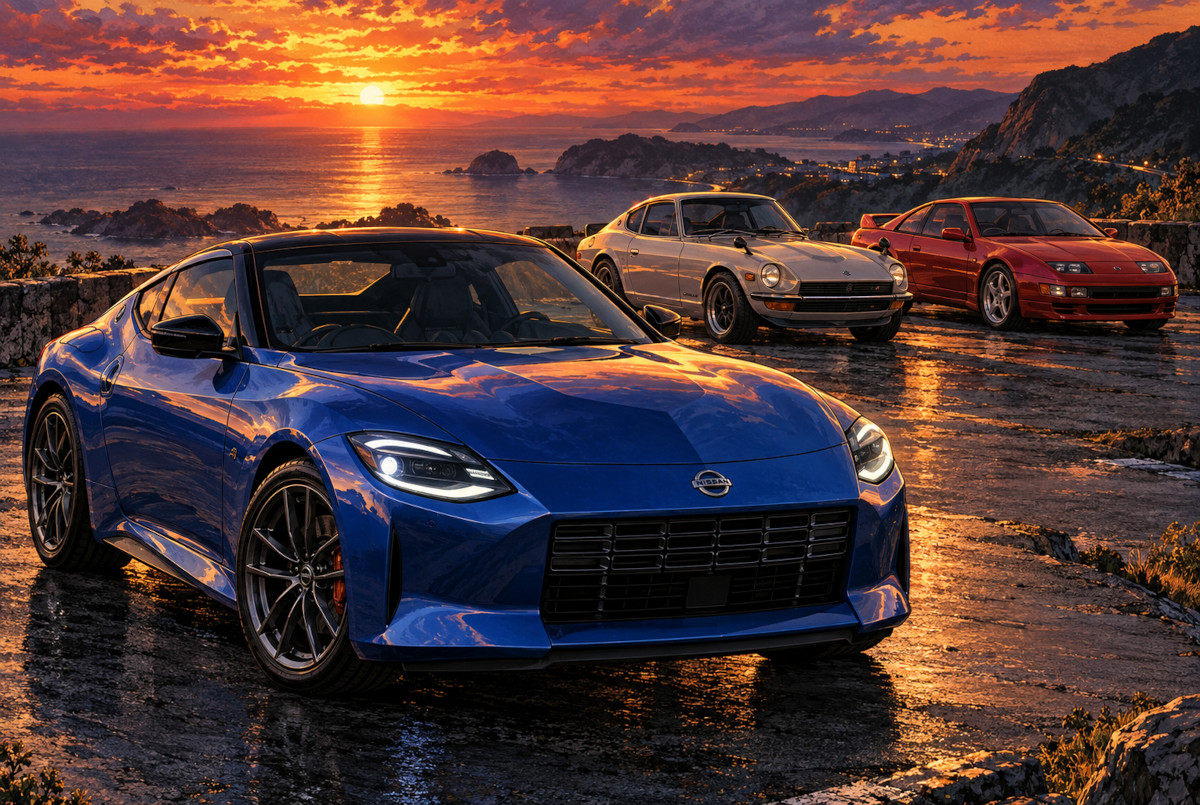
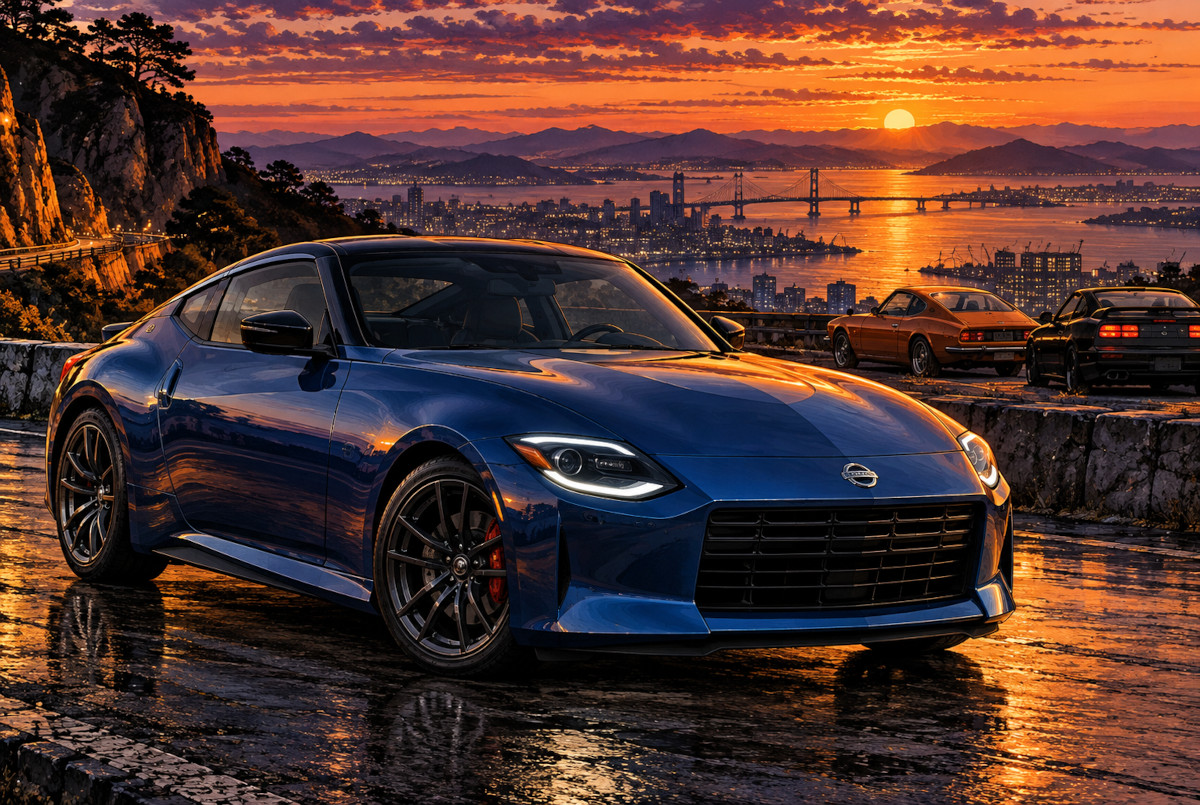
AI-generated illustration representing the connection between the 2022-era RZ34 and earlier Z generations. It is not a precise comparison of the August 2026 facelift or of individual historical design details.
Maybe the Z survived because it never insisted on reinventing everything
After following all three generations of this story, one thing becomes obvious: the Z is surprisingly inconsistent.
It abandoned the inline-six for a V6, brought the inline-six back, then standardized on V6 power again. It dropped twin turbos for naturally aspirated engines, stayed that way for two generations, then returned to twin turbos two decades later.
Yet somehow, it has remained recognizably a Z.
That suggests “Z-ness” may not come from one engine layout, one horsepower figure or an obsession with exclusive hardware. If there is a thread running all the way back to the first car, it may be something more practical: build a good-looking, rear-drive sports GT that can realistically be manufactured and realistically be bought.
Instead of rebuilding everything for the sake of saying it is new, Nissan has repeatedly reused what works and spent engineering effort where it believed the Z needed to change. That rather unromantic practicality may be one reason the car has survived for more than half a century.
Editor’s Note
I used to have the slightly purist idea that a genuinely new sports car ought to have a new chassis, a new engine and as much dedicated hardware as possible. If you were reusing things, somehow that felt like cheating.
Following the Z from the beginning makes that idea much harder to defend. Nissan has always used engines and technology that made sense at the time. The current car is a new-generation Z and still carries the RZ34 code.
But then the original 240Z was never an exotic, money-no-object supercar either. It was an industrial product designed to sell in huge numbers in America. Once you remember that, the Z’s willingness to share technology and avoid unnecessary reinvention starts to look less like compromise and more like part of its personality.
More than fifty years ago, Nissan looked outward at European GTs while creating the first Z. Today the Z can look backward at itself. After going through the whole three-part history, that is the part I find most satisfying.
References
- Nissan Motor Co., Ltd. — Annual Report 1999
- Nissan Motor Co., Ltd. — Nissan Vision & Business Plan History
- Nissan Heritage Collection — Fairlady Z Version ST (Z33)
- Nissan Motor Co., Ltd. — Annual Report 2002
- Nissan — Fairlady Z Z34 Specifications (Japanese official archive)
- Nissan — Fairlady Z RZ34 Performance (Japanese official archive)
- Nissan Motor Corporation — “Finely tuned for enthusiasts: the all-new Nissan Z”
- Nissan Motor Corporation — Behind the Design of the Nissan Z Proto (Japanese)
- Nissan — Fairlady Z Exterior and Design (Japanese)
- Nissan — Fairlady Z NISMO Performance (Japanese)