

Imagine leaving a major corporation after years as a department manager, only to join a Japanese company with 30 employees. Suddenly, the rules seem improvised, everyday tasks take twice as many steps as necessary, and even the president’s decisions leave you scratching your head.
“How on earth is this place still in business?”
Is that just corporate arrogance talking? Or has the newcomer spotted something genuinely wrong? Japan’s official statistics reveal a substantial productivity gap between large and smaller firms, while surveys point to very different levels of digitalization. But that doesn’t automatically make the small-company president incompetent. The real story is a little more complicated.
Why a Move to a Smaller Company Can Feel Like Entering Another World
According to an analysis published by the Recruit Works Institute in August 2025, among Japanese employees who changed from one full-time, permanent position to another between 2022 and 2024, a surprisingly large proportion moved from big companies to smaller ones.
Among workers leaving companies with at least 300 employees, 33.8% of those in their 30s joined organizations with fewer than 300 employees. For workers in their 40s, the figure reached 58.3%.
That’s a difference of 24.5 percentage points. More than half of the large-company job changers in their 40s moved to a smaller employer.
These percentages describe people who actually changed jobs, not all employees in those age groups. Still, they show that moving to a smaller company is a significant career transition, particularly in mid-career.
What awaits them isn’t simply a miniature version of their old workplace. At a major corporation, accounting, human resources, legal affairs and IT may each have dedicated departments. At a small company, the same handful of employees may handle several of those responsibilities. Sometimes the president gets dragged into all of them.
Corporate Department Head vs. Small-Company President: Who Actually Has the Bigger Job?
Comparing their job titles misses the point. Their responsibilities operate on different levels.
| Area | Manager at a Large Corporation | President of a Small Company |
|---|---|---|
| Primary responsibility | Performance and management of an assigned division | Overall management of the company |
| Basis for decisions | Internal policies, budgets and delegated authority | Cash flow, customers and business continuity |
| Organizational support | Specialist departments for HR, finance and legal matters | Responsibilities may be shared among a small staff |
| Authority and accountability | Authority delegated within the corporate hierarchy | Responsibility for business policy and company-wide decisions |
Note: This table compares typical organizational arrangements, not every company. Under Japan’s Companies Act, a representative director has legal authority to represent a corporation. The title “president” alone does not necessarily establish that authority, and the division of powers depends on the company’s governance structure.

In a small firm, the president may personally handle responsibilities that large corporations assign to specialist departments. Fictional illustration; no real company or individuals are depicted.
A corporate department head might recommend replacing outdated equipment. The small-company president may first have to work out how to cover next month’s payments. Suppliers need paying, employees expect their salaries, and the bank may want answers.
That’s a legitimate difference in perspective. But having greater responsibility doesn’t make every management decision correct. If a president refuses to listen to experienced employees and leaves obvious inefficiencies untouched, questioning that leadership isn’t necessarily arrogance.
Are Small-Company Employees Less Capable? The Productivity Numbers Say Something Else
Japan’s 2026 White Paper on Small and Medium Enterprises provides an unusually revealing comparison.
For fiscal 2024, the reported annual labor productivity, measured as value added per employee, was approximately ¥19.351 million at large companies versus ¥6.656 million at smaller companies.
Divide the first figure by the second:
¥19.351 million ÷ ¥6.656 million = approximately 2.91 times.
That is a substantial difference, but it is not an intelligence test. Productivity reflects equipment, capital investment, industry mix and business conditions, not simply the talent of individual employees.
The comparison also uses specific company-size definitions based on capital: at least ¥1 billion for large firms and ¥10 million to less than ¥100 million for the smaller-company group. It does not represent every business covered by Japan’s broader SME definitions.
There’s another detail worth remembering. The same white paper reports that hourly productivity among smaller firms increased by 25.5% between fiscal 2015 and fiscal 2024. Progress has been made, even if a sizable gap remains.
Now consider digitalization. A 2025 survey of 12,215 smaller businesses, published in the 2026 white paper, classified companies into four stages:
- Stage 1 — 15.4%: Work still relies mainly on paper and verbal communication.
- Stage 2 — 57.3%: The business is transitioning toward digital tools.
- Stage 3 — 24.5%: Digital tools are being used for operational efficiency and data analysis.
- Stage 4 — 2.8%: Digitalization is being used to transform business models or strengthen competitiveness.
Our calculation is straightforward: 15.4% + 57.3% = 72.7%.
In other words, nearly three-quarters of the surveyed firms were still in the first two stages, rather than the more advanced stages focused on efficiency, data analysis or business transformation.
That does not mean 72.7% were doing nothing to improve. Stage 2 firms were already moving toward digital tools. Nor does this survey directly measure how efficiently every employee works.
But it helps explain why someone accustomed to integrated corporate systems might find the new workplace frustrating.
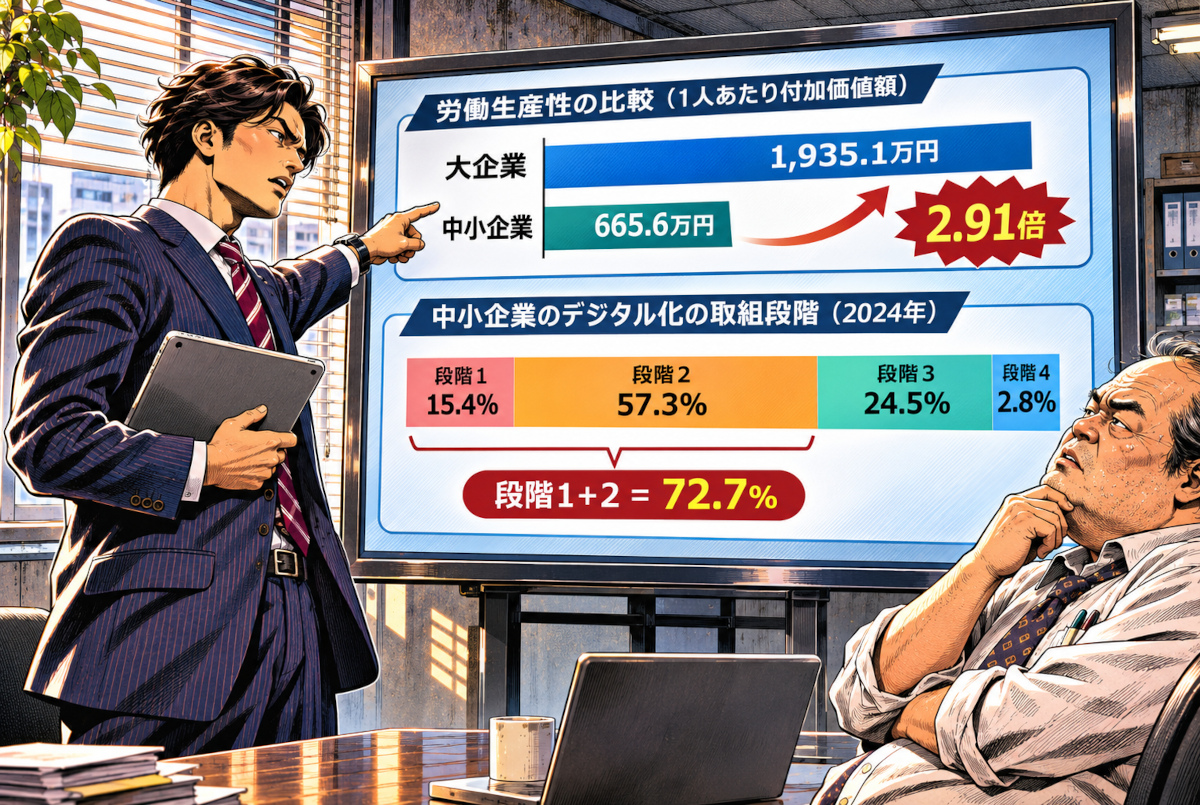
Correction: The Japanese label “2024年” in the digitalization panel is incorrect. The productivity figures refer to fiscal 2024, while the digitalization percentages come from a 2025 survey published in the 2026 SME White Paper. These are separate datasets with different definitions. Bar widths are illustrative rather than precisely proportional; refer to the printed percentages. Source: Japan’s Small and Medium Enterprise Agency, 2026 SME White Paper.
A Company That Doesn’t Even Have a Computer Ready on Day One
It sounds like the setup for an office comedy. Unfortunately, it is also something that has happened in real workplaces.
In research published in March 2026, the Recruit Works Institute examined interviews with 15 people who had moved from large Japanese companies to smaller employers.
One participant arrived at his new workplace to discover that a computer had not been prepared for him. The lack of basic onboarding arrangements left him wondering whether the organization was ready to accept him at all.
Another participant received a computer and an introductory explanation of company policies, but found that his actual duties were poorly defined. There was no clear training arrangement, and his supervisor was too busy to provide much guidance.
These are individual experiences, not evidence that most small businesses operate this way. The study involved only 15 interviewees and was intended to explore career transitions rather than establish national failure rates.
Even so, the distinction matters. A company may genuinely lack money for sophisticated IT systems. But failing to prepare basic equipment or assign responsibility for welcoming a new employee is not necessarily a financial problem.
Sometimes, it is simply poor management.
Twenty Wasted Minutes a Day: What Does That Cost a 30-Person Company?
Here’s a question that bothered me more than the fancy corporate productivity statistics: what if a small company simply wastes 20 minutes of every employee’s day?
Imagine a fictional Japanese company employing 30 people. Each employee spends an unnecessary 20 minutes daily on duplicated data entry, handwritten paperwork or avoidable administrative checks.
Assume 240 working days per year and an illustrative total labor cost of ¥2,500 per hour.
The calculation is:
30 employees × 20 minutes ÷ 60 × 240 days = 2,400 hours per year
2,400 hours × ¥2,500 = ¥6,000,000 in annual labor-time costs.
That’s six million yen worth of working time consumed by just 20 unnecessary minutes per person per day.
This is our own hypothetical calculation, not a measured loss at a real company. The hourly amount is an assumption, and eliminating the work would not automatically produce ¥6 million in cash savings. The released time might instead be used for other tasks.
Still, imagine a president refusing a relatively inexpensive process improvement while allowing thousands of working hours to disappear into repetitive administration. Isn’t that an odd way to save money?
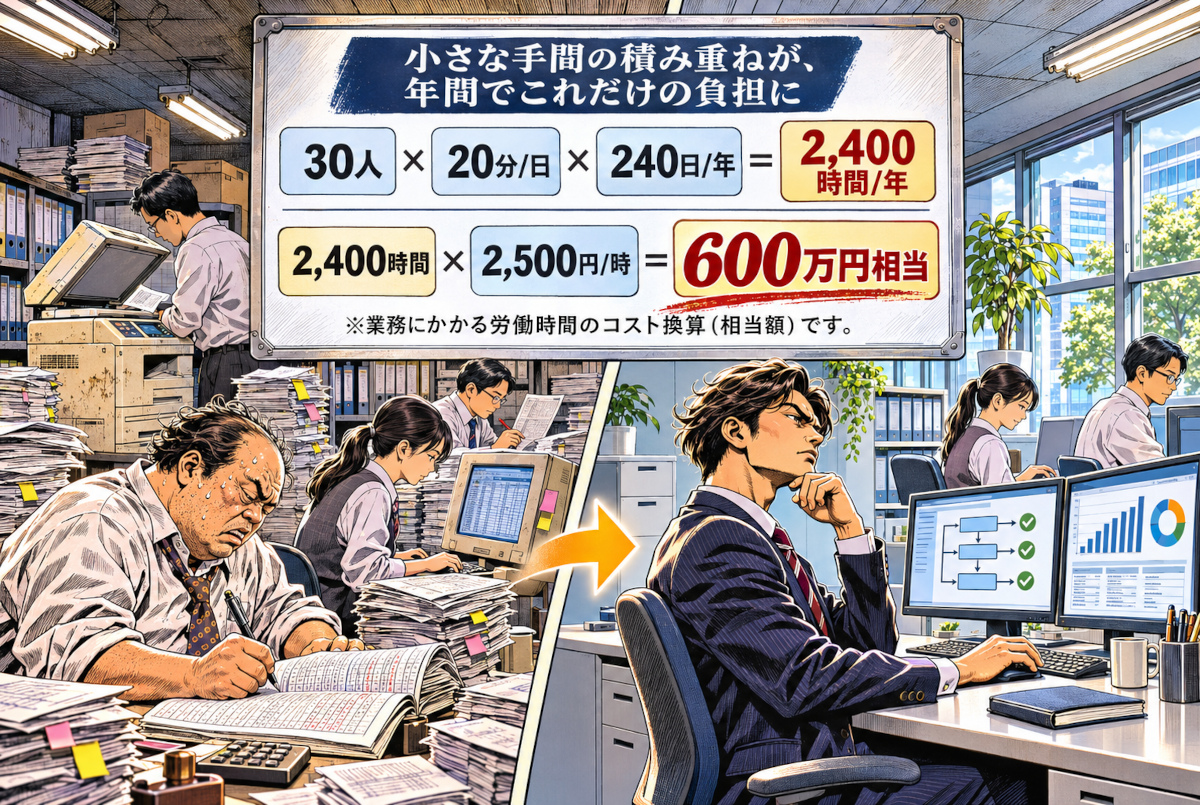
Hypothetical example: 30 employees × 20 minutes per day × 240 working days ÷ 60 = 2,400 hours annually. At an assumed labor cost of ¥2,500 per hour, that equals ¥6 million in labor-time costs. The illustration omits the division by 60 in its first formula. The result is not a verified cash loss or a guaranteed saving from digitalization.
The Small Company to Avoid: Where the President’s Preferences Become the Rules
Small companies have a genuine advantage: decisions can be made quickly without passing through layers of corporate bureaucracy.
But there’s a difference between decisive leadership and a workplace where every rule changes according to the president’s mood.
In Japan, small employers are not exempt from labor law merely because of their size. The Labor Standards Act applies to workplaces with employees. A workplace regularly employing 10 or more workers must prepare and submit formal work rules to the relevant Labor Standards Inspection Office.
That requirement applies per establishment, not simply according to a company’s total headcount. And regardless of company size, internal preferences cannot override applicable labor law.
Before accepting a job at a smaller Japanese company, a candidate should investigate three things:
- Authority to make improvements: Who can approve changes to workflows, equipment or operating procedures?
- Employee evaluation: Can the company explain how performance, pay and promotion decisions are made?
- The president’s willingness to change: What has the company actually improved in response to employee suggestions?
The problem is not that a company is small. The real warning sign is a business that recognizes its problems but refuses to fix them, assigns responsibility without authority, and expects newcomers to accept everything without question.
Of course, experienced managers from major corporations also need to adapt. Practices that worked with extensive resources and specialist departments may be unrealistic in a 30-person firm.
The difference between a successful move and a disastrous one may come down to whether both sides are willing to rethink their assumptions.
Editor’s Note
When I hear about a former corporate manager looking down on the president of a small business, my first reaction is predictable: take away that famous company name on the business card and let’s see how impressive the manager really is.
Fair enough.
But then I come across a company that couldn’t even get a computer ready for a new employee on their first day. And I’m supposed to believe the newcomer is the problem for expecting basic organization?
Come on.
Running a small company is hard. Cash flow is real, budgets are tight, and the president can’t simply summon a specialist department whenever something goes wrong.
But here’s the thing: having no money and having no plan are two different problems.
Maybe the most troublesome person isn’t the ex-corporate manager or the small-company president. It’s whoever stops thinking the moment they decide, “My way is the right way.”
And there’s one last uncomfortable question: when you change companies, whose true abilities are being exposed — the people around you, or your own?
Terms That May Need a Quick Explanation
- Labor productivity
- The value added generated per employee or per hour worked. It can be influenced by equipment, capital, industry structure and working conditions. It is not a direct measure of an individual employee’s intelligence, skill or effort.
References
- Small and Medium Enterprise Agency (Japan), 2026 White Paper on Small and Medium Enterprises and Small Enterprises, Summary (April 2026, pp. 11 and 43; in Japanese). Official productivity statistics and digitalization survey results.
- Recruit Works Institute, “Why Do Employees Leave Large Companies for Smaller Ones?” (August 21, 2025; Japanese-language research article). Analysis of job transitions by company size and age group.
- Recruit Works Institute, “Why Do They Start Looking for Another Job?” (March 17, 2026; Japanese-language research article). Interviews with 15 employees who moved from large to smaller companies.
- Japan’s Companies Act, Articles 348, 349 and 362 (official Japanese legislation, e-Gov Law Search). Corporate management authority and legal representation.
- Ministry of Health, Labour and Welfare (Japan), “Work Rules” (official Japanese guidance). Requirements under the Labor Standards Act, including Article 89.