
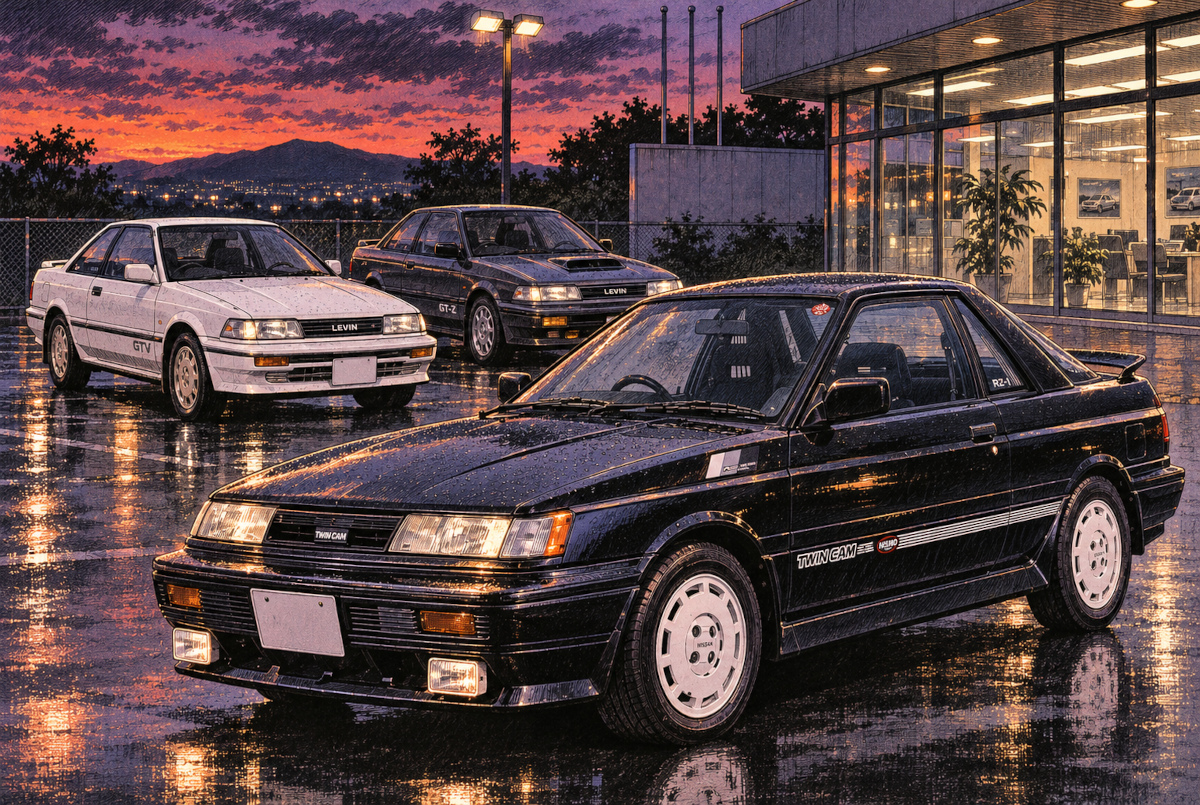
In 1987, the Nissan Sunny RZ-1 Twin Cam NISMO cost ¥1.73 million in Japan. The Toyota AE92 Corolla Levin GTV was ¥1.49 million.
Both were front-wheel-drive, 1.6-liter DOHC coupes producing 120 PS. Yet the Nissan cost an extra ¥240,000.
And here’s the awkward part: another ¥103,000 would have bought a Levin GT-Z, complete with a supercharged engine producing 145 PS.
So what, exactly, were RZ-1 NISMO buyers paying for? The evidence suggests Nissan was selling suspension tuning, special equipment and a distinct driving experience rather than additional horsepower. Whether that made the RZ-1 faster than its Toyota rivals is another question entirely.
Same 120 PS, ¥240,000 More. What Was Nissan Selling?
The RZ-1 Twin Cam NISMO arrived in August 1986 alongside the newly introduced CA16DE-powered RZ-1 models. Toyota followed in May 1987 with the AE92 Levin and Sprinter Trueno, moving the sporty Corolla coupes to front-wheel drive.
To understand the difference in price, we compared four Japanese-market models using their published specifications and original base prices.
| Model | Price | Power | Weight |
|---|---|---|---|
| RZ-1 Twin Cam Type A | ¥1,530,000 | 120 PS | 1,040 kg |
| RZ-1 Twin Cam NISMO | ¥1,730,000 | 120 PS | 1,050 kg |
| AE92 Levin GTV | ¥1,490,000 | 120 PS | 1,000 kg |
| AE92 Levin GT-Z | ¥1,833,000 | 145 PS | 1,070 kg |
Comparison of five-speed manual models introduced in 1986–1987. Prices are period vehicle base prices from the referenced Japanese catalog listings, expressed before tax. Equipment and launch dates differ. Both RZ-1 models use the naturally aspirated CA16DE, the GTV uses Toyota’s naturally aspirated 4A-GE, and the GT-Z uses the supercharged 4A-GZE. All power figures are net ratings, expressed in metric horsepower (PS).
Now for the arithmetic.
The NISMO cost ¥240,000 more than the Levin GTV, a premium of approximately 16.1% relative to the Toyota’s price.
The GT-Z, meanwhile, cost only ¥103,000 more than the NISMO, or roughly 6.0% extra.
For that additional amount, a buyer could move from the Nissan’s 120 PS naturally aspirated engine to Toyota’s 145 PS supercharged unit.
Looking only at purchase price and peak output, Toyota had a compelling argument. But a comparison based entirely on horsepower would miss much of what Nissan had built into the NISMO.
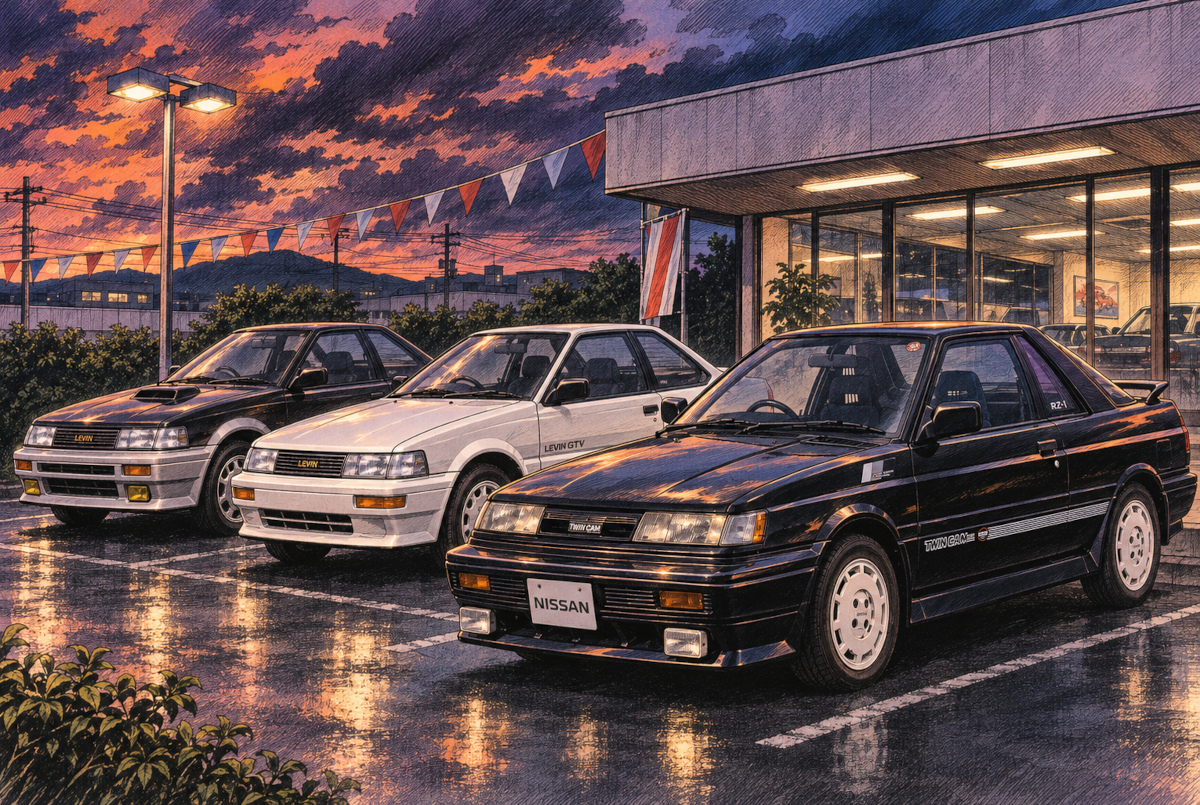
An original illustration imagining the AE92 Levin GT-Z (left), Levin GTV (center) and Sunny RZ-1 Twin Cam NISMO (right) in 1987. Their listed base prices were ¥1,833,000, ¥1,490,000 and ¥1,730,000 respectively. Some exterior details are stylized, and the setting does not reproduce an actual dealership.
Where Did the NISMO’s Extra ¥200,000 Go?
There is another price comparison worth examining: the RZ-1 Twin Cam Type A versus the NISMO.
The Type A cost ¥1.53 million. The NISMO was ¥1.73 million, an increase of ¥200,000, or approximately 13.1%.
Yet both cars used the same CA16DE engine, rated at 120 PS. Nissan had not increased its peak output for the NISMO.
According to the Nissan Heritage Collection, the NISMO received special suspension tuning, dedicated aerodynamic parts, special seats, a leather-wrapped steering wheel and white-faced instruments.
However, equipment such as 185/60R14 tires, ventilated front disc brakes and rear disc brakes was also available on the regular Twin Cam Type A.
That extra ¥200,000 was not buying a completely upgraded engine or braking system. Much of the difference lay in the NISMO-specific chassis setup, body styling and interior equipment.
The suspension deserves particular attention. Nissan equipped the car with a dedicated setup intended to alter its handling characteristics.
But that does not establish how much faster it was. We could not verify directly comparable lap times or controlled handling-test results for the NISMO and the standard Type A.
It would therefore be misleading to claim a measurable cornering advantage without further evidence.
What Nissan could offer was a more distinctive package: the same engine in a car with different suspension tuning, appearance and driver-focused equipment.
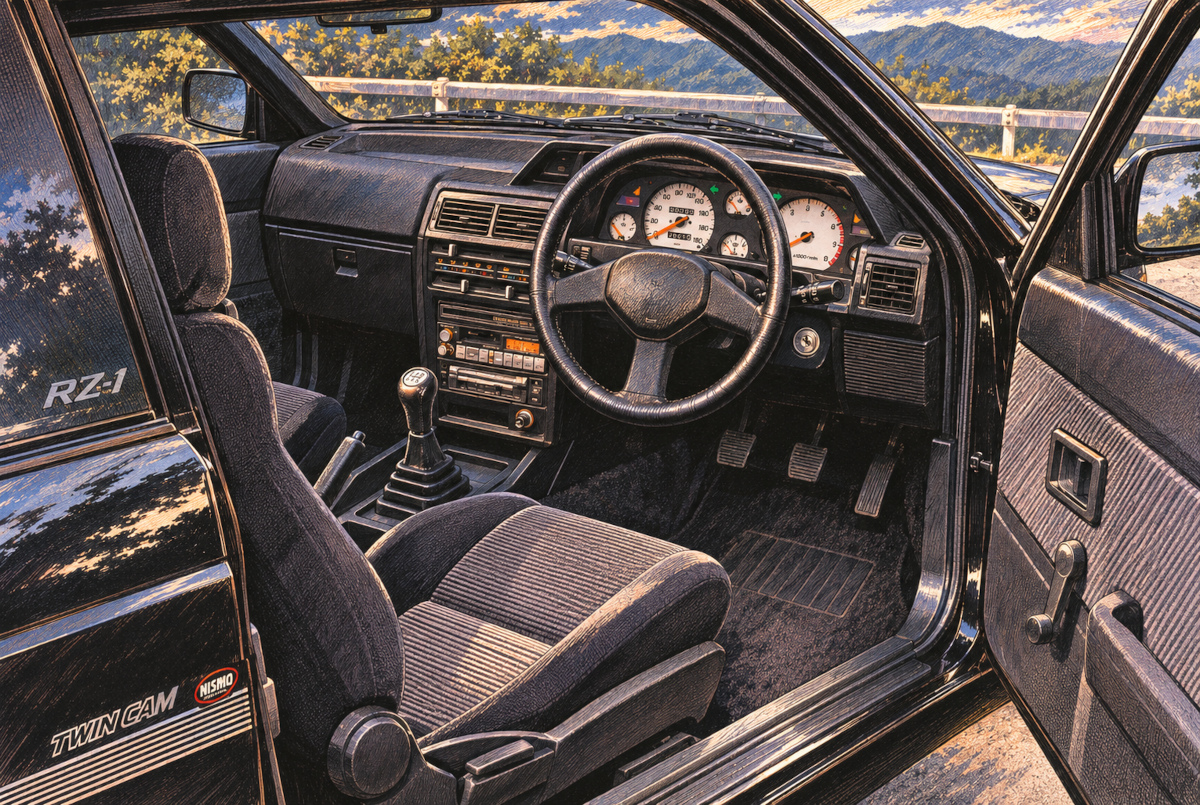
An original illustration inspired by the RZ-1 Twin Cam NISMO interior. The production model featured white-faced instruments, a dedicated leather-wrapped steering wheel and special seats. The shapes and details of some components are stylized rather than exact factory reproductions.
Did the NISMO Actually Have a Worse Power-to-Weight Ratio?
Let’s be a little unfair to the NISMO for a moment and calculate something that special seats and aerodynamic trim cannot improve on paper: power-to-weight ratio.
We divided each model’s published peak output by its curb weight in metric tons.
| Model | Calculation | Power-to-weight ratio |
|---|---|---|
| RZ-1 Type A | 120 ÷ 1.040 | 115.4 PS/t |
| RZ-1 NISMO | 120 ÷ 1.050 | 114.3 PS/t |
| AE92 GTV | 120 ÷ 1.000 | 120.0 PS/t |
| AE92 GT-Z | 145 ÷ 1.070 | 135.5 PS/t |
Independent calculations based on published peak output and curb weight. PS/t means metric horsepower per metric ton. These figures are not measured acceleration results.
And there it is.
The NISMO weighed 10 kg more than the regular Type A despite having exactly the same rated power. That left its power-to-weight ratio approximately 1% lower.
Compared with the NISMO, the AE92 GTV had a power-to-weight advantage of about 5.0%, using the Nissan’s figure as the baseline.
The supercharged GT-Z extended that advantage to approximately 18.6%.
The more expensive RZ-1 NISMO had a slightly worse power-to-weight ratio than Nissan’s own standard Twin Cam Type A.
That is not a flattering result if horsepower per ton is your only measure of value.
But it is not proof that the NISMO was a poor car. Suspension tuning, seat support and steering feel do not appear in a power-to-weight calculation. Neither does cornering performance.
This is precisely why the price difference is so interesting. Nissan was asking buyers to value something other than the largest number in the engine specifications.
From the 305Re to the 306 and RZ-1: NISMO Had More Than One Sunny
Digging into the RZ-1 NISMO reveals two other unusually named Sunny models: the 305Re NISMO and the 306 Twin Cam NISMO.
The 305Re NISMO arrived in 1985. Based on the B12-generation Sunny three-door hatchback, it used a 1.5-liter E15E engine producing 82 PS.
Rather than transforming the engine output, Nissan concentrated on the suspension, exterior styling and other special equipment.
In 1986, the 306 Twin Cam NISMO joined the range with the 1.6-liter CA16DE producing 120 PS.
It, too, was based on the Sunny three-door hatchback. But it was not the same body as the RZ-1, which used its own angular, coupe-like three-door hatchback design.
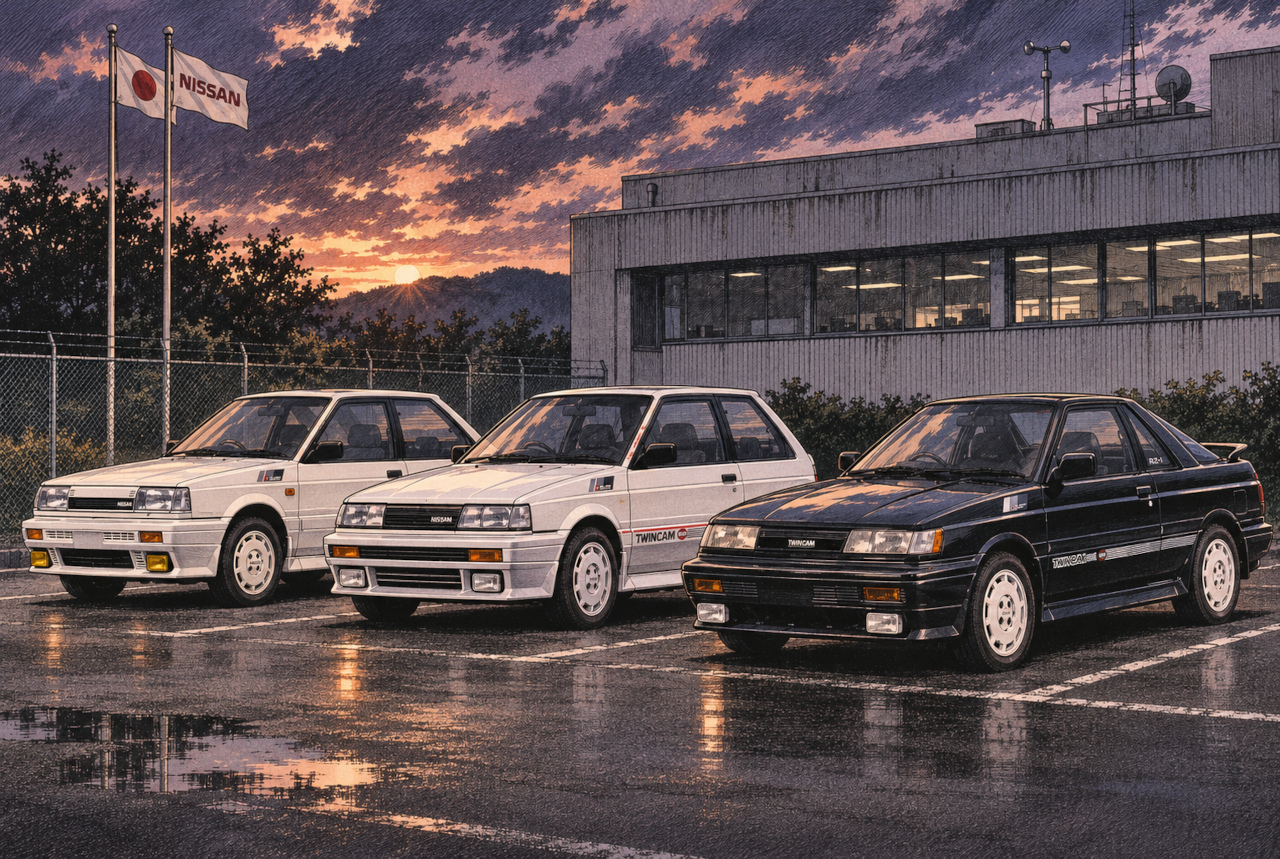
An original illustration comparing three B12-generation Sunny performance models: the 1985 305Re NISMO (left), the 306 Twin Cam NISMO introduced in 1986 (center), and the RZ-1 Twin Cam NISMO (right). The 305Re and 306 use the conventional three-door hatchback body, while the RZ-1 has a distinct coupe-style three-door design. Some vehicle details are stylized. This is not an actual Nissan development-facility photograph or a historical gathering of the three cars.
There were effectively two related ideas within the B12 Sunny family: making the conventional three-door hatchback more sporting, and offering a NISMO version of the separately styled RZ-1 coupe.
The 305Re and 306 demonstrate how Nissan developed its sporting hatchback range. The RZ-1 added another body style to that approach.
That does not establish that Nissan developed the RZ-1 NISMO as a direct successor to the 305Re. We could not verify a primary-source statement supporting that precise relationship.
What connects the cars is the broader strategy of making the Sunny more distinctive through suspension, styling and equipment—not simply by chasing engine output.
1989: Toyota Reached 140 PS. The RZ-1 NISMO Stayed at 120
The horsepower contest became more difficult for Nissan in May 1989.
Toyota revised the AE92 Levin and Trueno’s naturally aspirated 4A-GE. With changes to the compression ratio and intake and exhaust systems, the updated engine produced 140 PS and required premium gasoline. The earlier T-VIS variable-induction system was also discontinued.
The supercharged GT-Z advanced from 145 PS to 165 PS, gaining another 20 PS.
By contrast, the 1989 RZ-1 Twin Cam NISMO preserved in Nissan’s Heritage Collection still carries the CA16DE engine, rated at 120 PS.
By 1989, Toyota’s naturally aspirated 1.6-liter DOHC Levin had a 20 PS advantage in published peak output.
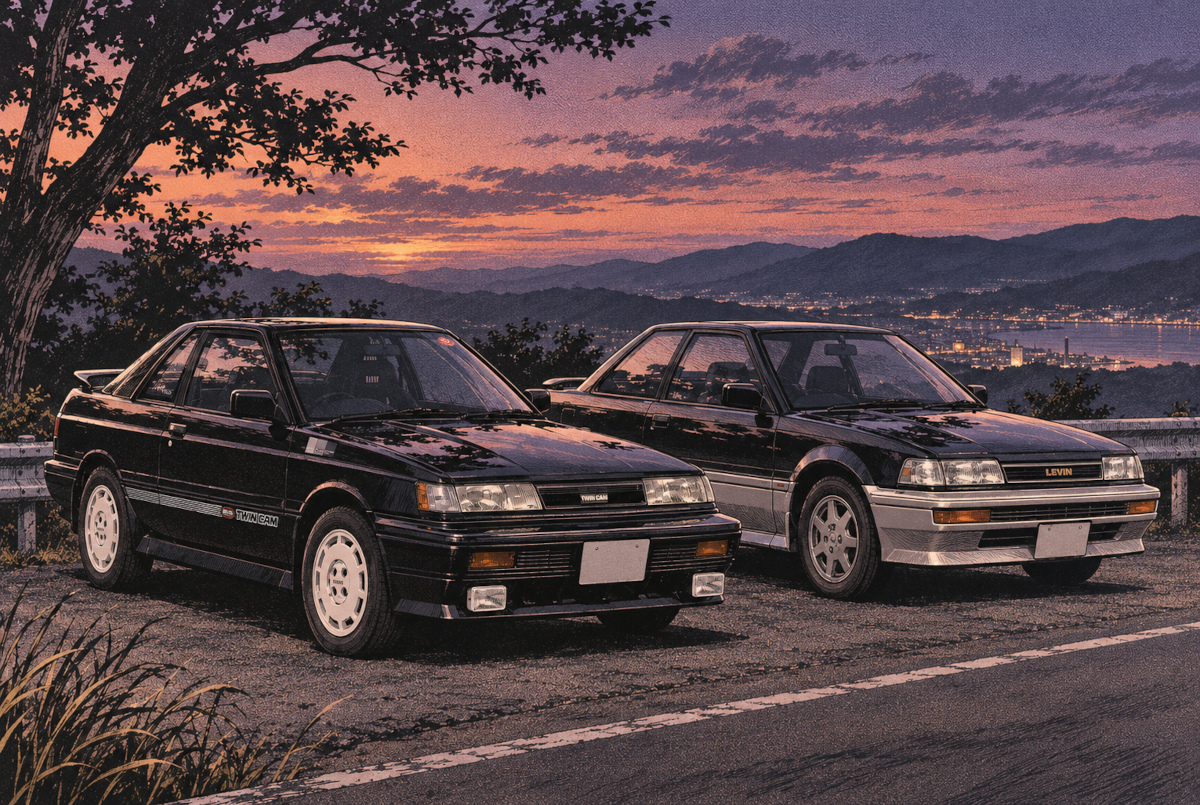
An original illustration imagining the 1989 Sunny RZ-1 Twin Cam NISMO (120 PS) beside an updated naturally aspirated AE92 Corolla Levin (140 PS). Some exterior details differ from the production cars. The figures are published peak-power ratings, not results from a real-world acceleration or driving comparison.
Those figures alone still cannot settle which car was quicker on the road. But they show how the two manufacturers’ products diverged.
Toyota continued increasing engine output. The RZ-1 NISMO, meanwhile, retained its distinctive combination of a 120 PS engine, special suspension and NISMO-specific equipment.
In 1990, the B12 Sunny generation gave way to its successor. The sharp-edged RZ-1 did not receive a direct second generation.
That leaves one final question for this series: why did Nissan abandon the RZ-1 formula, and what did it choose instead in the changing Japanese coupe market?
Terms That May Need a Quick Explanation
- Power-to-weight ratio
- Peak engine output divided by vehicle weight. Here, it is expressed as metric horsepower per metric ton (PS/t). A higher figure means more rated engine power relative to vehicle mass, but it does not directly establish acceleration, handling or lap-time performance.
Editor’s Note
The ¥240,000 difference is what sent me down this particular rabbit hole.
Same 120 PS, yet the Nissan was that much more expensive. And for a little over ¥100,000 more than the NISMO, you could have a supercharged 145 PS Levin GT-Z.
I keep wondering how a Nissan salesman in 1987 would have handled that conversation. A customer walks in, compares the catalog figures and asks why the RZ-1 costs so much. That’s not an easy question to answer with a horsepower chart.
Still, calling the NISMO nothing more than a Sunny with some extra bodywork would be unfair. Nissan went to the trouble of fitting dedicated suspension and interior equipment. Clearly, it was trying to build a particular kind of driver’s car.
And the more I look into the B12 Sunny, the stranger the whole range becomes. The 305Re, the 306 Twin Cam, the RZ-1 NISMO—Nissan really did seem determined to give this ordinary family-car platform a sporting personality.
Which makes me wonder one more thing: if Nissan was prepared to go that far, couldn’t it have squeezed a little more power out of the CA16DE as well?
Nissan Sunny RZ-1: Four-Part Series
From its unusual 1986 debut as a personal coupe to the CA16DE twin-cam engine, NISMO models, and rivalry with the Toyota Levin and Trueno. Across four articles, we examine the RZ-1, its engineering, and why it disappeared.
- Part 1: A Date Car With a Scowl: The Nissan Sunny RZ-1’s Curious 1986 Debut
- Part 2: The 10-PS Trap: Was Nissan’s Sunny RZ-1 Really Outgunned by the AE86?
- Part 3: Same 120 PS, ¥240,000 More: What Was Nissan Selling with the Sunny RZ-1 NISMO?
- Final Part: English edition Coming soon
References
- Nissan Heritage Collection — Sunny RZ-1 Twin Cam NISMO. Official Nissan documentation of the special equipment and specifications of the preserved 1989 model. (Japanese)
- CarSensor Japan — Nissan Sunny RZ-1 Twin Cam NISMO, five-speed manual. Grade-specific price, equipment and curb-weight data. (Japanese)
- CarSensor Japan — Nissan Sunny RZ-1 Twin Cam Type A, five-speed manual. Specifications for comparison with the NISMO edition. (Japanese)
- CarSensor Japan — Toyota AE92 Corolla Levin GTV, five-speed manual. Original 120 PS specifications and 1,000 kg curb weight. (Japanese)
- Toyota Motor Corporation, 75 Years of Toyota — Sixth-Generation Corolla Levin. Official AE92 vehicle history and original GTV and GT-Z specifications. (Japanese)
- Web Motor Magazine — 1980s Boys’ Racers: The AE92 Levin and Its Supercharged Performance. Period model analysis covering the original GT-Z and its 145 PS engine. (Japanese)
- Toyota Motor Corporation — May 1989 Corolla Levin GT Specifications. Official 140 PS naturally aspirated 4A-GE data. (Japanese)
- Toyota Motor Corporation — May 1989 Corolla Levin GT-Z Specifications. Official 165 PS supercharged model data. (Japanese)
- GAZOO — Nissan Sunny Three-Door Hatchback 305Re NISMO. Japanese catalog data for the E15E engine, 82 PS output and vehicle specifications.
- Motor-Fan — The First NISMO Model Was a Sunny Hatchback (2026). Specialist retrospective on the 305Re NISMO, its engine and dedicated equipment. (Japanese)
- Best Car — NISMO Performance-Car History, 1985–2013. Historical overview of the 305Re and 306 Twin Cam NISMO models. (Japanese)