
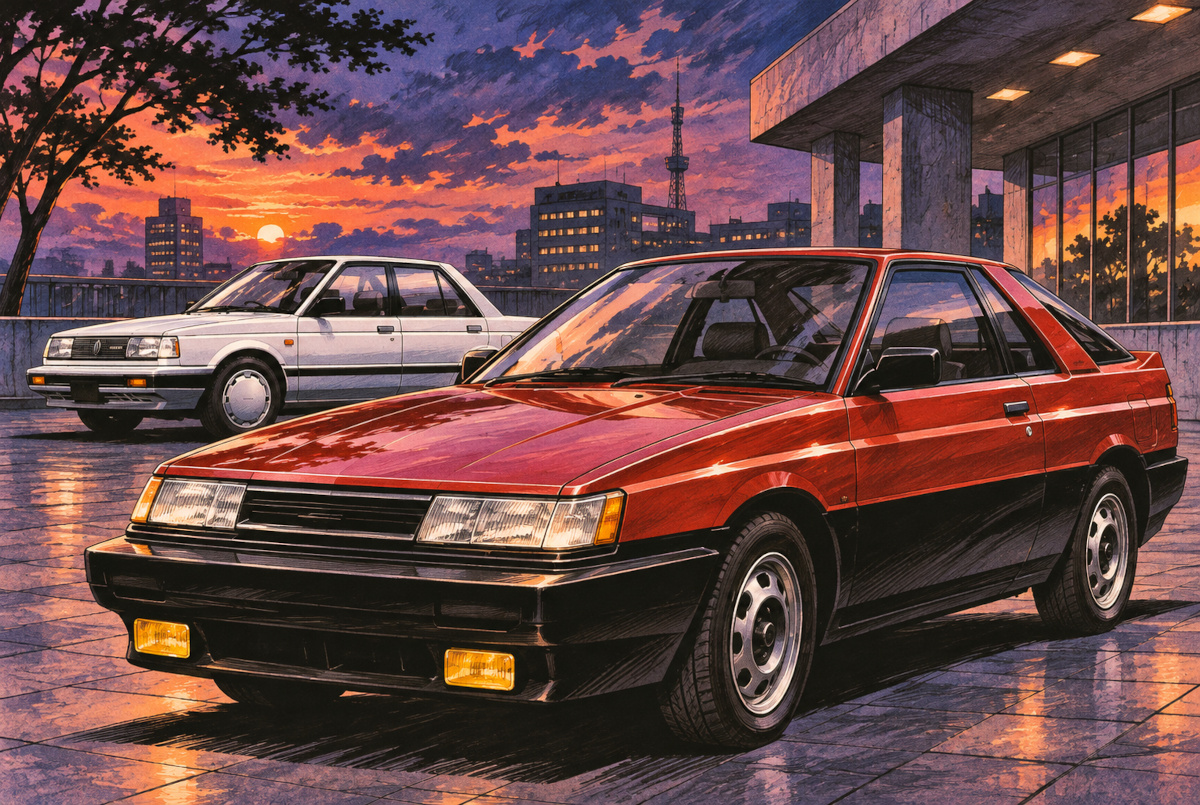
Was the Nissan Sunny RZ-1 built to take on Toyota’s Corolla Levin and Sprinter Trueno, better known to enthusiasts as the AE86 twins?
Looking back at the car’s February 1986 debut, that familiar assumption starts to look a little shaky. The original RZ-1 offered a 1.5-liter naturally aspirated engine rated at 73PS or a turbocharged version rated at 100PS. The 120PS twin-cam engine that later defined its sporting image wasn’t available yet.
Then there was the advertising. Its Japanese slogan was “男1。女1。2’s Coupe”—roughly, “One man. One woman. A coupe for two.”
That’s a curious pitch for a car with such an uncompromisingly angular face. Was Nissan selling a sports coupe, a fashionable date car, or something in between?
Same Sunny Family, but 50mm Lower
In September 1985, Nissan introduced the sixth-generation B12 Sunny. Japanese buyers knew it as the “Trad Sunny,” a nickname reflecting its restrained, traditional styling. The boxy sedan appealed to established Sunny customers while helping the model attract younger buyers.
Five months later, in February 1986, Nissan added the RZ-1, a sharply styled three-door hatchback coupe based on the same B12 family.
The mechanical relationship was close. Visually, however, the two cars seemed to have very different ideas about what a Sunny should look like.
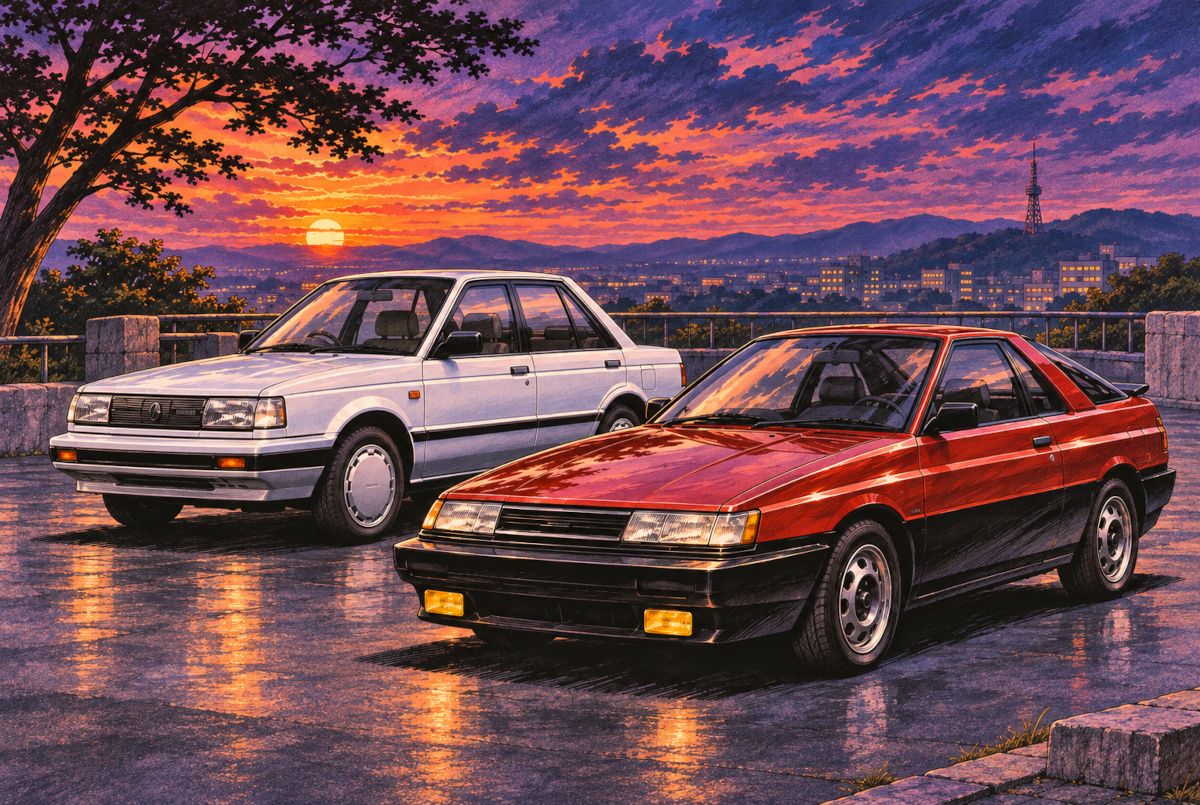
The boxy B12 Sunny sedan and the angular RZ-1 coupe. An original illustration; some exterior details are stylized.
To put that contrast into numbers, we compared two vehicles documented in Nissan’s Heritage Collection.
| Dimensions | Sunny Sedan | Sunny RZ-1 |
|---|---|---|
| Length | 4,175mm | 4,230mm |
| Width | 1,640mm | 1,665mm |
| Height | 1,385mm | 1,335mm |
| Wheelbase | 2,430mm | 2,430mm |
Source: Nissan Heritage Collection specifications for a 1988 Sunny sedan and a 1989 RZ-1 Twin Cam NISMO. This is a comparison of documented examples, not identical launch-year trims.
The wheelbase was exactly the same at 2,430mm, yet the RZ-1 stood 50mm lower and 25mm wider. It was also 55mm longer.
In other words, Nissan used the same basic platform to produce two remarkably different silhouettes.
The sedan had an upright roof and a conventional three-box shape. The RZ-1 featured a lower nose, pronounced fenders and distinctive rear-quarter glazing that helped create its wedge-shaped profile.
Its design certainly looked sporty. But the specific internal reasoning behind those styling decisions remains unverified.
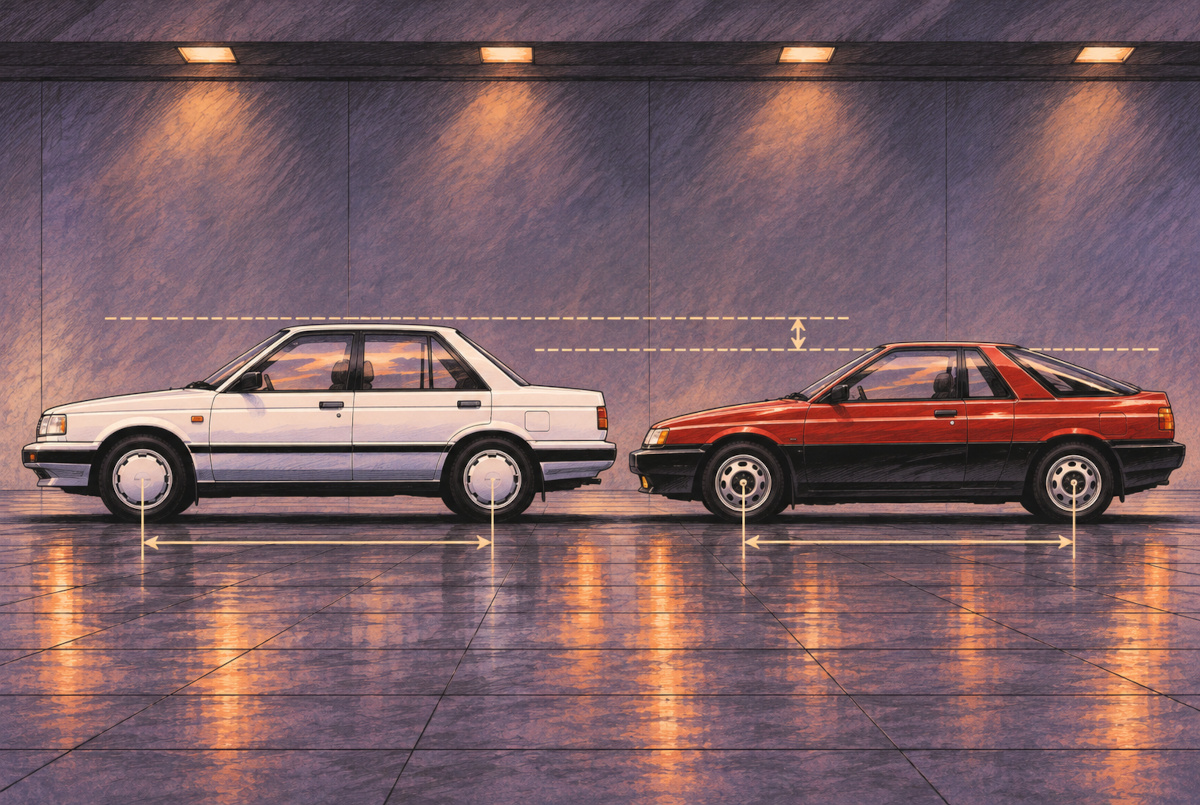
Both cars had a 2,430mm wheelbase, but the RZ-1 was 50mm lower. This is a schematic visual comparison, not an exact-scale engineering drawing.
A “Coupe for Two” That Actually Seated Four
The RZ-1’s Japanese advertising slogan is one of the most revealing details about its original positioning.
“One man. One woman. A coupe for two” sounds like a deliberate invitation to leave ordinary family-car duties behind and head out on a drive together.
There is just one small catch.
The RZ-1 wasn’t a two-seat car. It had two rows of seats and accommodation for four people.
The slogan wasn’t describing its seating capacity. It was selling an experience: a car intended to feel personal, stylish and particularly appealing when shared by two people.
That distinction matters when judging what Nissan originally wanted the RZ-1 to be.
The better-equipped Type B also offered features such as adjustable sports seats, power windows and an electronically tuned AM/FM radio. These were not the priorities of a stripped-out competition car.
The RZ-1 had sporting looks, but comfort and image were part of the package from the beginning.
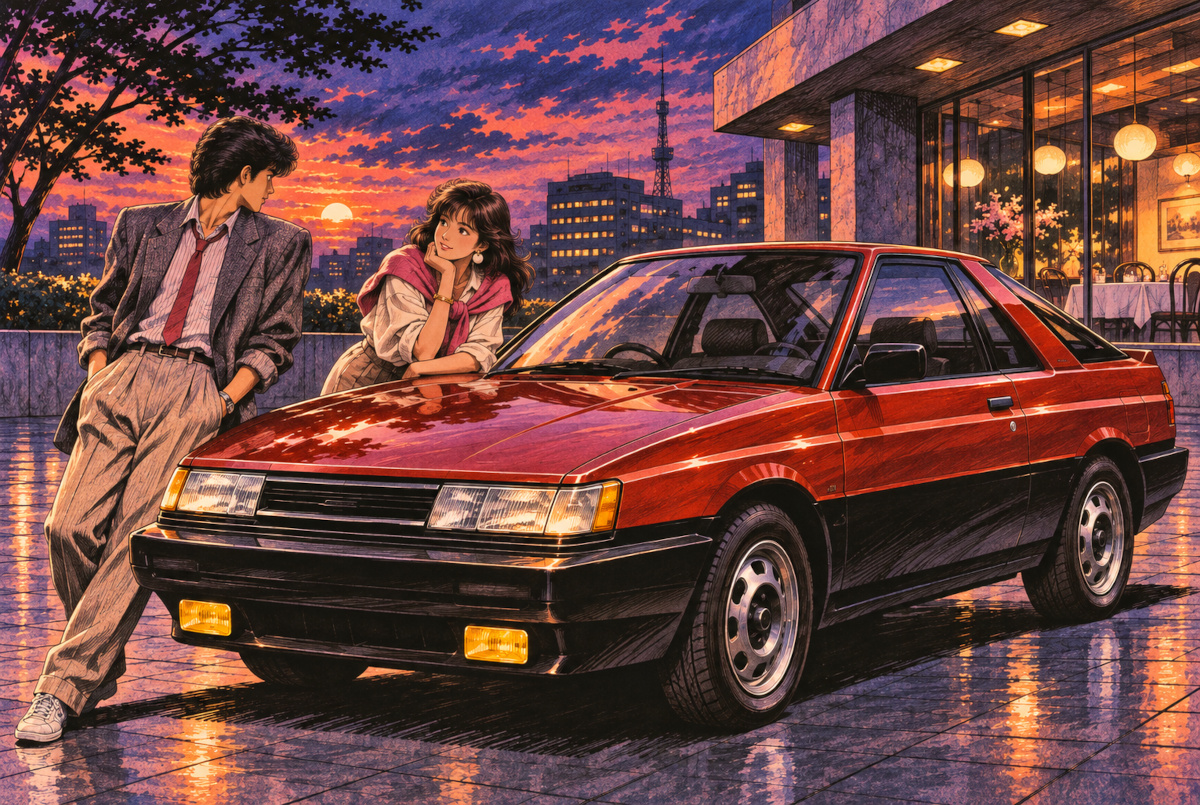
An imagined scene inspired by Japan’s mid-1980s personal-coupe culture. This illustration does not reproduce an actual Nissan advertisement or portray real people.
What Did an Extra ¥220,000 Buy in 1986?
At launch, the Japanese-market RZ-1 offered two 1,487cc four-cylinder engines: the naturally aspirated E15S and the turbocharged E15ET.
To understand how Nissan differentiated them, we compared the original Type A models with five-speed manual transmissions.
| Specification | 1.5 Type A | 1.5 Turbo Type A |
|---|---|---|
| Published output | 73PS | 100PS |
| Published torque | 11.8kgm | 16.0kgm |
| Curb weight | 940kg | 990kg |
| Original price (excl. tax) | ¥1,250,000 | ¥1,470,000 |
| Tires | 155SR13 | 185/60R14 |
| Front brakes | Disc | Ventilated disc |
| Rear brakes | Drum | Disc |
Source: CarSensor’s Japanese domestic-market catalog listings for the early Type A five-speed manual models. Prices are the listed pre-tax new-car prices. PS denotes metric horsepower; kgm is kilogram-force meter.
The turbo model cost ¥220,000 more, an increase of 17.6% over the naturally aspirated Type A. Its weight increased by 50kg, or approximately 5.3%.
Those figures come directly from comparing the published prices and weights: ¥220,000 divided by ¥1,250,000, and 50kg divided by 940kg.
But the extra money didn’t simply buy a turbocharger. The turbo model also received wider, lower-profile tires on 14-inch wheels, ventilated front discs and rear disc brakes instead of drums.
There is one important qualification about the horsepower figures. Period-car specialist Web Motor Magazine describes the turbo engine’s 100PS rating as a gross figure. Gross output is measured under different conditions from net output, which more closely reflects an engine installed with its normal accessories and systems.
We could not establish that the published 73PS and 100PS ratings used identical measurement conditions. Therefore, treating their numerical difference as a precisely measured percentage gain in actual engine performance would be misleading.
The more defensible finding is that the extra ¥220,000 bought a substantially different mechanical package—not just a bigger horsepower number.
The original RZ-1 turbo was more than a styling exercise. Even before the twin-cam arrived, Nissan was offering buyers a version with hardware better suited to enthusiastic driving.
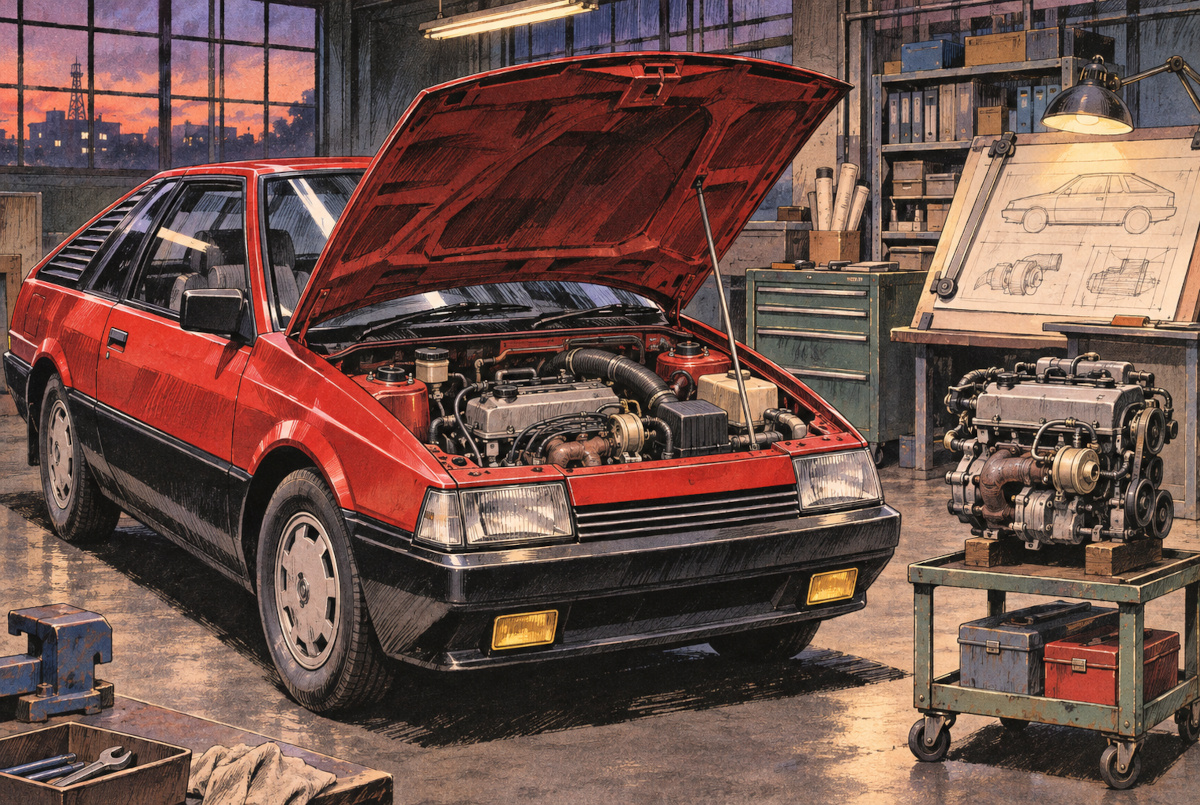
An original illustration inspired by the RZ-1’s 1.5-liter turbo engine. The engine bay, piping and separate engine display are stylized and do not precisely reproduce the actual E15ET installation.
Was the RZ-1 Really Designed to Beat the AE86?
In 1986, Toyota’s AE86 Corolla Levin and Sprinter Trueno were rear-wheel-drive sports models with 1.6-liter DOHC engines.
The RZ-1, by contrast, was front-wheel drive and initially offered a naturally aspirated or turbocharged 1.5-liter SOHC engine.
Both could have appeared on the same young buyer’s shopping list. But sharing potential customers does not prove that Nissan developed the RZ-1 specifically to defeat the AE86.
We have not found a primary source establishing the AE86 as the RZ-1’s direct development target.
The original advertising, equipment and model range instead suggest a broader personal-coupe proposition, one that balanced sporty appearance with comfort and individual style.
Then, in August 1986, Nissan added the CA16DE, a 1.6-liter DOHC engine rated at 120PS, along with a more serious sporting direction that included a NISMO version.
Why did a coupe marketed around two people and a stylish drive gain a much stronger performance identity only months after launch?
That’s the question for Part 2, when we’ll compare Nissan’s CA16DE with Toyota’s 4A-GE and examine whether the familiar horsepower figures really tell the whole story.
Editor’s Note
What keeps bothering me about the RZ-1 is that face.
You’re trying to sell a car around the idea of a man and a woman heading out together, yet you’ve given it one of the sternest-looking front ends in the compact-coupe class. Wouldn’t something a little softer have made more sense?
And then there’s the engine range. A fairly ordinary 73PS 1.5-liter on one side, a 100PS turbo model with bigger tires and stronger brakes on the other. Was Nissan trying to please the date-car crowd and the drivers who wanted a bit more excitement at the same time?
Maybe. But writing the RZ-1 off as a car that “lost to the Levin” still seems unfair. Before declaring a loser, I’d like to know whether Nissan was even trying to win the same contest in the first place.
References
- Nissan Motor Co., “Launch of the New Sunny” (September 1985). Original Japanese press release.
- Nissan Heritage Collection, “Sunny 1500 EX Saloon.” Japanese-language specifications and B12 model history.
- Nissan Heritage Collection, “Sunny RZ-1 Twin Cam NISMO.” Japanese-language specifications and model background.
- Nissan Global, “Heritage Model: SUNNY.” Historical photographs of the 1986 RZ-1 and its E15S and E15ET engines.
- CarSensor Japan, “Nissan Sunny RZ-1 1.5 Type A, 5MT.” Original specifications, equipment and pricing.
- CarSensor Japan, “Nissan Sunny RZ-1 1.5 Turbo Type A, 5MT.” Original specifications, equipment and pricing.
- Web Motor Magazine, “Showa-Era Classics No. 97: Nissan Sunny RZ-1 Twin Cam NISMO” (2019). Japanese-language historical review, including the turbo engine’s gross horsepower rating.
- Best Car, “The Sunny and Its Remarkable Family of Derivative Models” (2021). Japanese-language article discussing the RZ-1’s original advertising and positioning.
- Toyota Motor Corporation, “75 Years of Toyota: Sprinter Trueno (AE86).” Official vehicle history and specifications.