

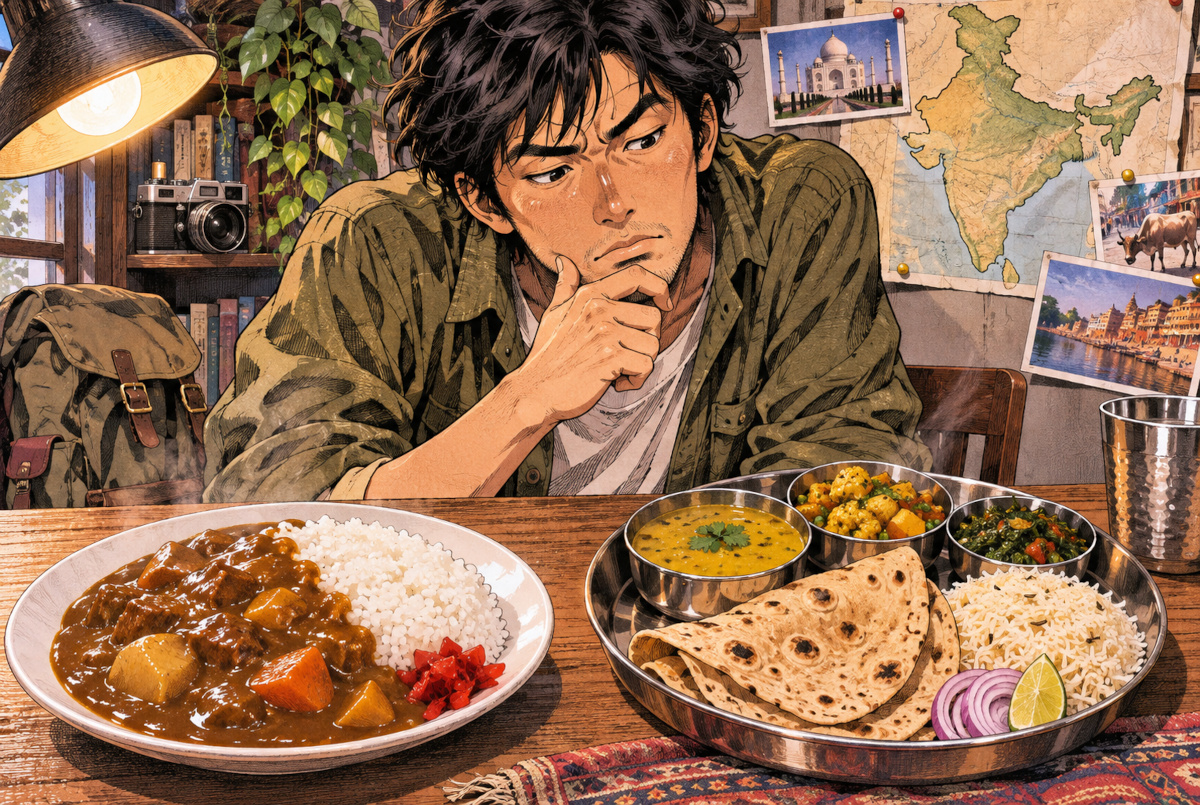
Do people in India really eat curry every day? Three times a day, even?
If you’re familiar with Japanese curry rice, you might picture an entire country eating the same thick, spicy sauce over rice for breakfast, lunch, and dinner. But after digging into Indian food culture, I began to suspect that the question itself was the problem.
What exactly counts as “curry” in the first place?
Spiced dishes are deeply rooted in Indian food culture, but that doesn’t mean everyone in India eats Japanese-style curry rice every day. Nor could I establish a nationwide number of curry-eating days from the official sources examined for this article.
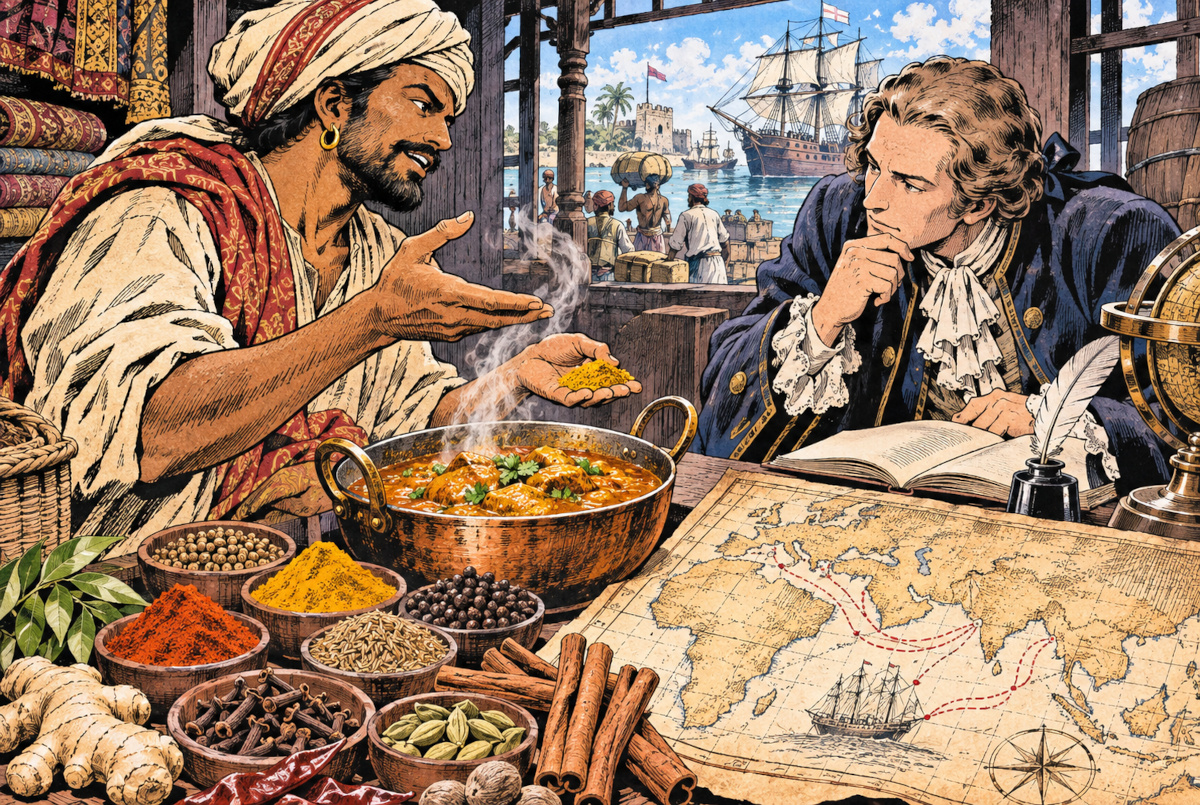
AI-generated historical illustration inspired by the spread of Indian spices and food culture to Europe. The traders, conversation, ships, and nautical chart are fictionalized elements, not a reconstruction of a documented event or actual trade route.
Who Decided to Call All These Dishes “Curry”?
One widely cited explanation traces the English word “curry” to kari, a word from Tamil, a language spoken in southern India. But the precise history of the term remains debated. It would be misleading to claim that its origin has been settled beyond doubt.
What is clear is that European encounters with South Asian cooking helped turn “curry” into a broad label for many different preparations.
By 1747, the British cookbook author Hannah Glasse had included a recipe titled “To make a Currey the India Way” in The Art of Cookery Made Plain and Easy. The spelling was different, and the dish was not the familiar Japanese curry rice served today.
Meanwhile, Indian dishes have names of their own. Dal refers to preparations made from lentils or other pulses. Sambar is a South Indian lentil-and-vegetable dish. Sabzi commonly refers to vegetable preparations.
People in India certainly use the word “curry” today, including in English-language menus. But that does not mean every spiced dish is understood locally as the same food.
Whether someone eats “curry” every day depends partly on what the person asking the question has decided to count as curry.
One Country, Four Very Different Regional Food Traditions
To see how much variety gets hidden behind that single word, I compared food information published by India’s official tourism website. Rather than trying to invent a national daily menu, I selected examples associated with four regions.
| Region and state | Examples of local foods |
|---|---|
| North: Uttar Pradesh | Roti (flatbread), dal, and rice |
| South: Tamil Nadu | Idli (steamed rice-and-lentil cakes), dosa (thin savory crepes), and sambar |
| East: West Bengal | Rice, fish dishes, eggs, and vegetable preparations |
| West: Gujarat | Roti, dal, kadhi (a yogurt-based dish), and vegetables |
Travel farther south-west to Kerala and you’ll find other familiar combinations, including coconut-based fish dishes and rice-based breads.
This is not a ranking of what people eat most often, nor is it a survey of what every household serves. These are regional examples. Meals vary with family traditions, religion, income, season, and individual preferences.
Still, the comparison makes one thing obvious: the image of Indian cuisine as nothing but naan and chicken curry is remarkably incomplete.
Trying to explain Indian food with that single restaurant photograph would be rather like explaining all Japanese food with a picture of sushi.
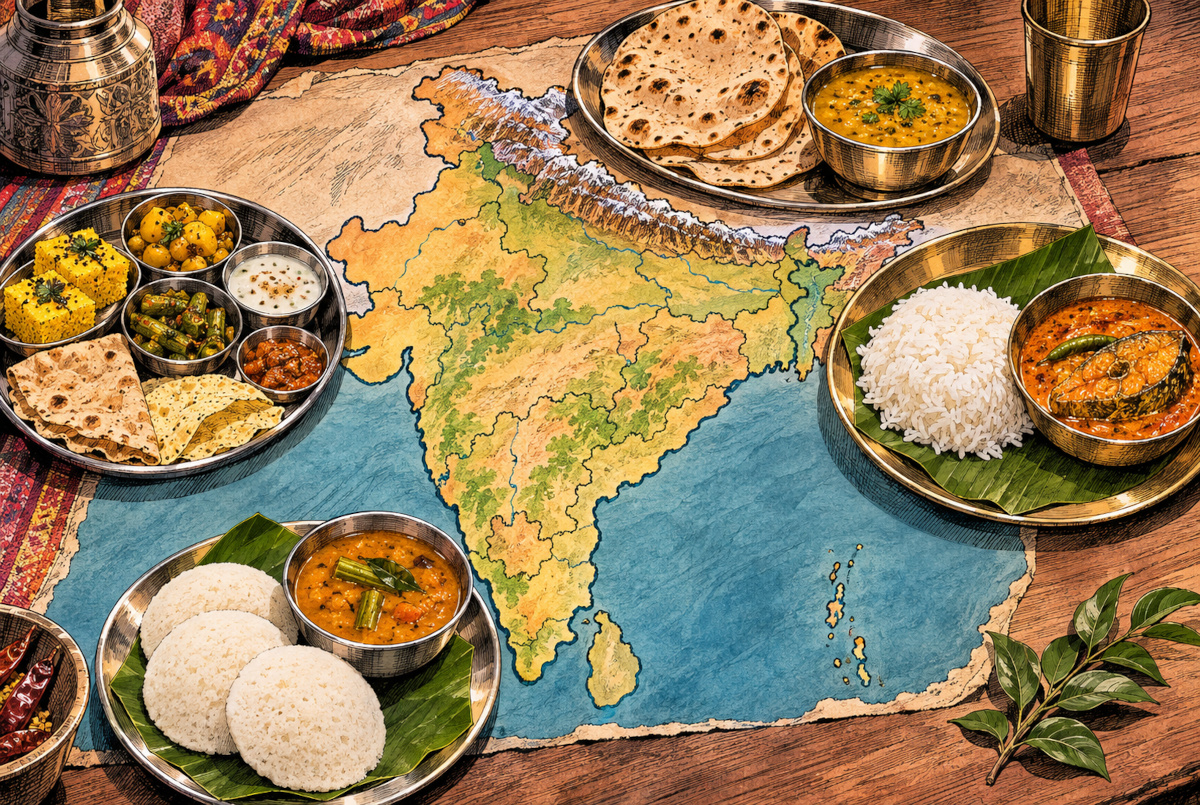
AI-generated illustration of selected Indian regional dishes. The map and food placements are schematic, not geographically precise. The meals represent examples of regional food traditions, not fixed daily menus for everyone living in those areas.
How Japanese Curry Took a Detour Through Britain
Now consider the curry that became a staple of Japanese home cooking.
A typical Japanese curry rice features steamed white rice covered in a thick brown sauce, often containing meat, potatoes, onions, and carrots. It is a recognizable dish with a fairly standardized home-cooking format.
That format did not arrive in Japan unchanged from an Indian household.
According to Japanese spice manufacturer S&B Foods, British cooking helped popularize blended curry powders and flour-thickened curry preparations. Curry subsequently entered Japan as part of Western-style cooking during the Meiji era (1868–1912).
House Foods, another Japanese food manufacturer, identifies two cookbooks published in 1872, Seiyo Ryori Tsu and Seiyo Ryori Shinan, as early Japanese publications containing curry recipes.
Consider the sequence: a curry recipe appeared in a British cookbook in 1747, and recipes were being published in Japan by 1872. That is a 125-year gap between two documented milestones, although it does not represent the full history of curry’s transmission between the countries.
Indian cooking traditions were interpreted through British food culture, and Japan then developed a distinct version of its own.
The solid blocks of prepared Japanese curry roux familiar in Japan make that difference even clearer. They typically combine ingredients such as flour, fats, spices, and seasonings to produce a thick sauce conveniently.
That is one Japanese approach to making curry. It should not be treated as the standard recipe for all the diverse dishes of India.
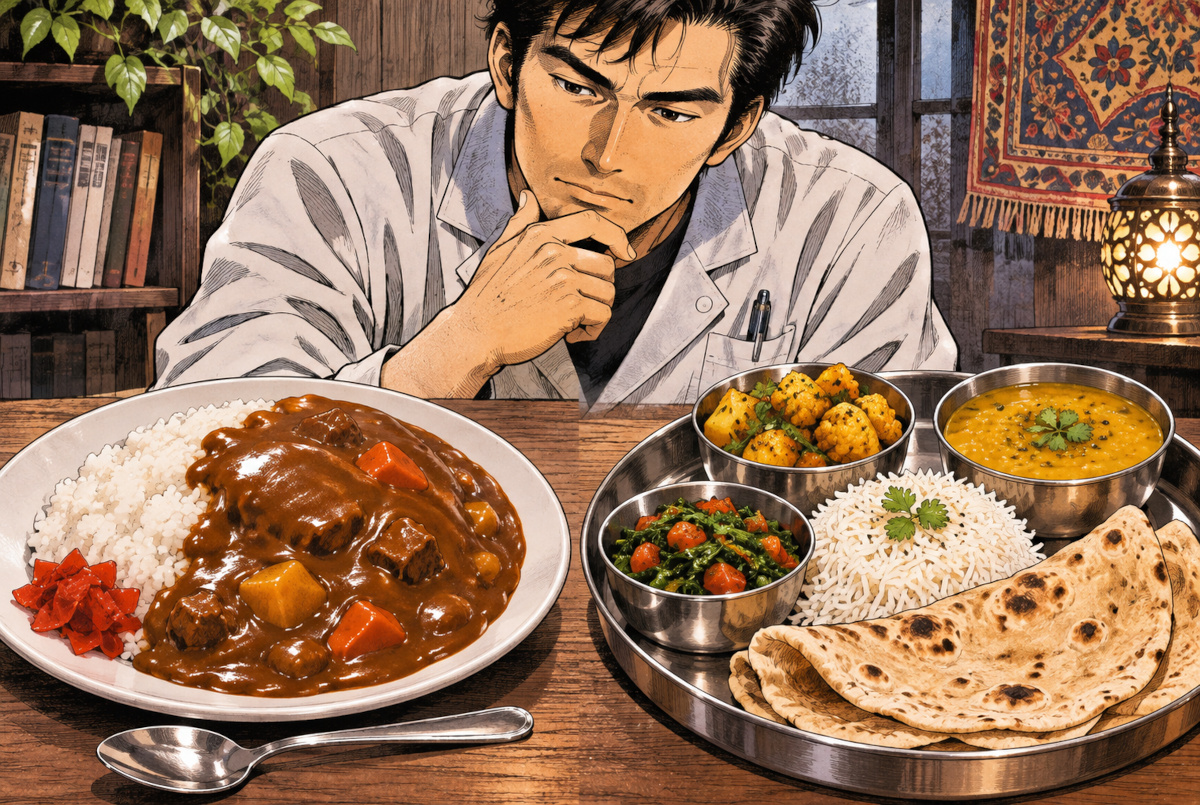
An illustrative comparison of Japanese curry rice and one Indian meal arrangement featuring roti, rice, dal, and vegetables. Indian cooking varies widely by region and household; this thali-style meal does not represent every Indian dish or dining tradition.
If Spices Are So Healthy, What Do India’s Health Statistics Say?
There’s another assumption worth investigating. If spices are so common in Indian cooking, does that mean people in India must be especially healthy?
To examine that idea, I went to public health data rather than claims about miracle ingredients.
The ICMR-INDIAB national study, published in 2023, reported a diabetes prevalence of 11.4% among Indian adults aged 20 and older.
But the national average concealed a substantial urban-rural difference:
- India overall: 11.4%
- Urban areas: 16.4%
- Rural areas: 8.9%
I recalculated that gap using the published figures.
16.4 ÷ 8.9 = approximately 1.84.
In other words, the reported prevalence in urban areas was about 1.84 times that in rural areas. The absolute difference was:
16.4 − 8.9 = 7.5 percentage points.
These are comparisons of population prevalence, not estimates of an individual’s risk from eating particular foods.
A separate survey offers another perspective. India’s National Family Health Survey (NFHS-5), conducted in 2019–2021, reported that 24% of women and 23% of men in its relevant adult survey groups were overweight or obese.
The figures come from different investigations with different populations and methods, so they should not be combined into a single statistical estimate.
What they do show is that obesity and diabetes remain important public health concerns in a country where spiced dishes are part of everyday food culture.
None of these figures proves that eating curry causes diabetes. The studies do not establish how often individual participants ate specific curry dishes, nor do these simple comparisons isolate physical activity, income, age, or the rest of a person’s diet.
They also do not prove the opposite: that eating spices regularly prevents metabolic disease.
The data are useful for challenging an overly simple health claim, not for blaming a national cuisine.
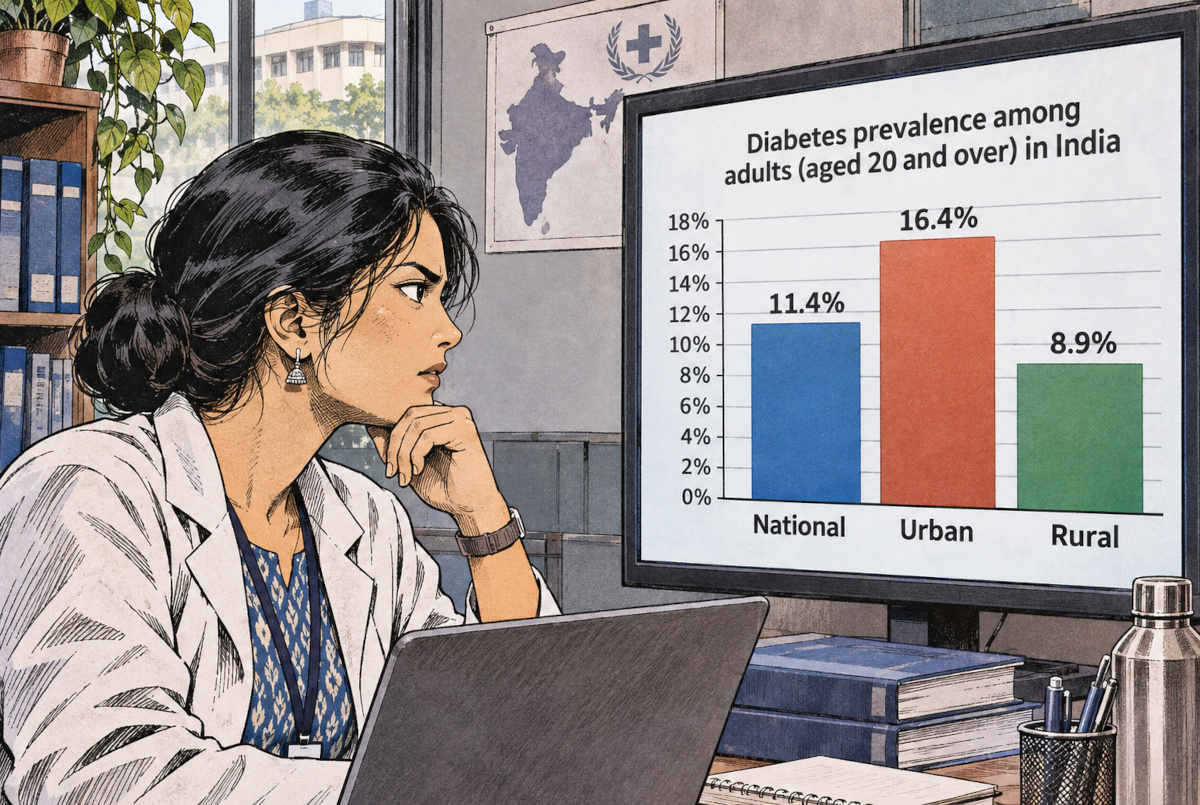
Diabetes prevalence among adults aged 20 and older in the 2023 ICMR-INDIAB study: 11.4% nationally, 16.4% in urban areas, and 8.9% in rural areas. The urban figure is approximately 1.84 times the rural figure. These results do not establish that curry consumption causes diabetes. The researcher and laboratory setting are AI-generated fictional elements.
The Question Isn’t Just How Often People Eat Curry
India’s National Institute of Nutrition published its Dietary Guidelines for Indians in 2024. The recommendations emphasize a varied, balanced diet that includes appropriate combinations of grains, pulses, vegetables, fruits, and other food groups.
That is a much more useful approach to food and health than assigning magical properties to an entire category of spiced dishes.
So, do Indians eat curry every day?
Some people may eat dishes they call curry frequently. Others eat a variety of dishes that an outsider might group under that label. Without a clear definition and appropriate nationwide food-frequency data, there is no sound basis for giving a single number for everyone.
Perhaps the real mistake was using Japanese curry rice as the measuring stick for an entire country’s food culture.
Editor’s Note
There’s a strange habit we have when imagining what people eat abroad. Japanese people live on sushi, Italians survive on pasta, and Indians apparently spend their lives eating curry.
Of course, a single familiar dish makes a convenient label. But once I started looking at actual Indian dish names and regional menus, the label became less convincing.
I began with a question about whether people in India were eating too much curry. By the end, the thing that looked excessive was my own definition of curry. Apparently, Japanese-style curry isn’t the only thing that comes in oversized portions. So do our assumptions.
Curry: A Five-Part Series
Was Ichiro really eating curry every morning? From the science of spices and nutritional comparisons to Indian food culture and the risks of reheating curry, this five-part series examines the facts, figures, and surprising truths behind a familiar dish.
- Part 1: Ichiro’s Morning Curry Legend: 365 Days, or 81 at Most?
- Part 2: 35 Spices and Herbs, but Flour Comes First? Is Japanese Curry Healthy or Fattening?
- Part 3: Do Indians Really Eat Curry Every Day? What Counts as “Curry”?
- Part 4: English edition Coming soon
- Final Part: English edition Coming soon
References
- Food and Foodways (2011), “To Make a Curry the India Way: Tracking the Meaning of Curry Across Eighteenth-Century Communities” — academic research on the term and its use in eighteenth-century Britain (English).
- ABC News, March 29, 2025 — historical reporting on the origins of the term “curry” and its relationship with Indian and British food cultures (English).
- Incredible India, Government of India — Uttar Pradesh: regional food and cultural traditions of northern India (English).
- Incredible India, Government of India — A Foodie’s Guide to Trying Local Cuisine in Chennai and Tamil Nadu (English).
- Incredible India, Government of India — West Bengal: eastern Indian food culture (English).
- Incredible India, Government of India — Gandhinagar: Gujarati thali and regional food traditions (English).
- S&B Foods — Curry Powder: Japanese Food Culture and Spices & Herbs, explaining the development of Japanese curry (Japanese).
- House Foods — World History of Curry: The Eighteenth Century, including Hannah Glasse’s 1747 cookbook (Japanese).
- House Foods — History of Curry in Japan: The Meiji Era, including the two Japanese cookbooks published in 1872 (Japanese).
- Anjana et al. (2023), ICMR-INDIAB National Cross-Sectional Study, The Lancet Diabetes & Endocrinology — national, urban, and rural diabetes prevalence in India (English).
- Press Information Bureau, Government of India (2022) — National Family Health Survey 2019–2021 (NFHS-5), including overweight and obesity statistics (English).
- ICMR–National Institute of Nutrition — Dietary Guidelines for Indians, 2024 (English).