


Thirty-five spices and herbs. That sounds like a pretty convincing selling point for a healthy meal. Turmeric is often praised for its potential health benefits, and even baseball legend Ichiro Suzuki became famous for his morning curry routine. So is Japanese curry something we should be eating more often?
Then I looked at the ingredient list on a popular Japanese curry roux. The first few ingredients were not exotic spices. They were wheat flour, vegetable fats, sugar, and salt.
That’s quite a contrast with the image of a spice-packed health food.
Japanese curry can be part of a balanced diet, but it can also contribute plenty of calories, fat, and salt. What matters is not just the spice blend, but how much roux, rice, and other ingredients end up on your plate.

AI-generated illustration inspired by Ichiro Suzuki’s former morning curry routine. It does not recreate an actual meal, home, or outfit, nor does it suggest that Ichiro ate a particular manufacturer’s curry.
Thirty-Five Spices and Herbs. So Why Does Flour Come First?
For this investigation, I examined S&B Foods’ Golden Curry Medium Hot, a 198 g package of Japanese solid curry roux. This is the type of concentrated block that Japanese home cooks dissolve into a pot of meat, vegetables, and water to make a thick curry sauce.
The manufacturer’s ingredient list, checked in November 2026, begins in this order:
1. Wheat flour
2. Blended palm and rapeseed oils
3. Sugar
4. Salt
5. Curry powder
Under Japan’s food-labeling rules, ingredients are generally listed in descending order by weight. So in this particular product, wheat flour and the blended oils appear before curry powder.
That doesn’t mean flour is somehow suspicious. It helps create the thick, smooth texture associated with Japanese curry. But it does tell us something about what this product actually contains.
There is an important limitation, too. The label lists spices and spice oils separately from curry powder. Therefore, fifth place for curry powder does not mean all the spices combined rank fifth by weight. The exact proportions of the individual spices are not disclosed, so we cannot calculate how many milligrams of curcumin a serving contains.
For an additional comparison, the Hot version of Golden Curry lists blended oils first and wheat flour second. Even within the same brand, the formulas are not identical.
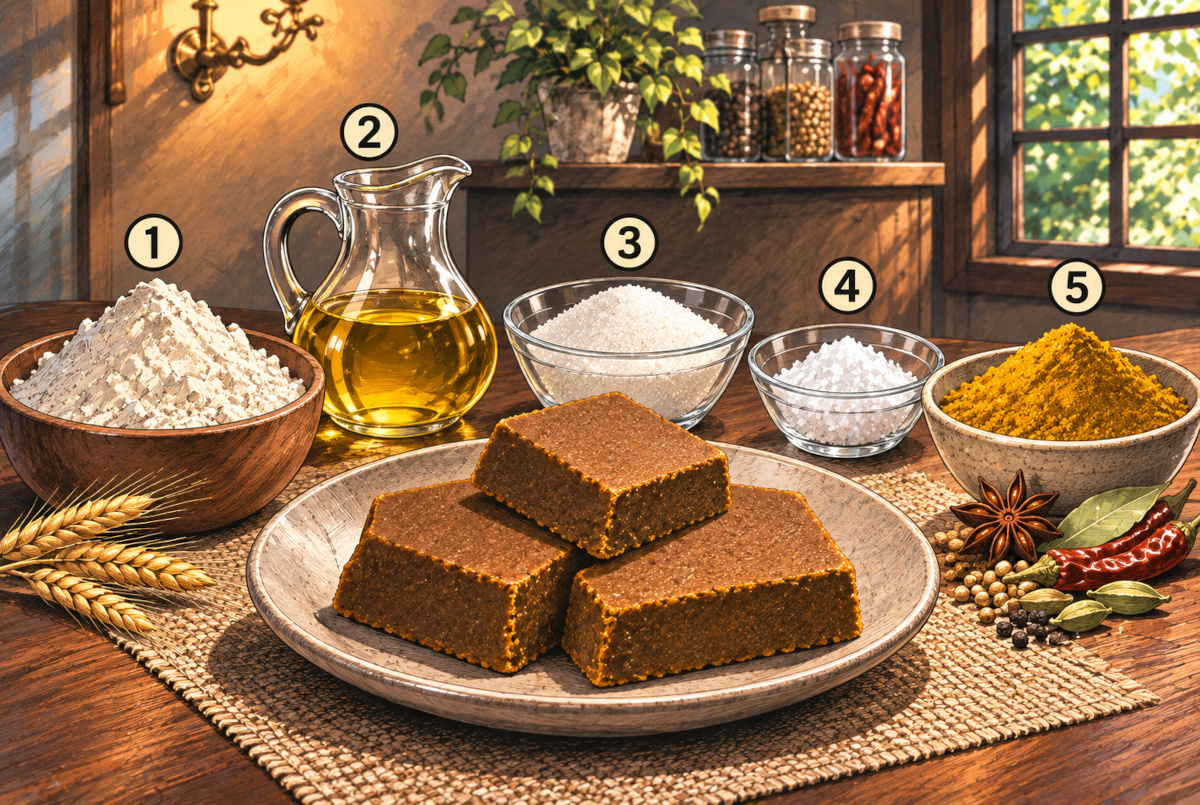
The first five ingredients listed for S&B Golden Curry Medium Hot. The numbers indicate label order, not exact proportions. The amounts and sizes shown are illustrative, and the product also contains other spices and seasonings.
Is an 18 g Portion of Curry Roux Really Almost 30% Fat?
Now for the part that sent me back to the calculator.
According to S&B’s nutrition label, one 18 g portion of Golden Curry Medium Hot contains:
- Energy: 87 kcal
- Fat: 5.3 g
- Carbohydrates: 9.1 g
- Salt equivalent: 2.3 g
First, consider fat as a proportion of the roux’s weight:
5.3 ÷ 18 × 100 = approximately 29.4%.
In other words, nearly three-tenths of this solid roux’s weight is fat.
But what about its calories? Using the standard approximation of 9 kcal per gram of fat:
5.3 × 9 = 47.7 kcal.
Divide that by the product’s stated 87 kcal:
47.7 ÷ 87 × 100 = approximately 54.8%.
Roughly 55% of the energy in this 18 g portion of roux is attributable to fat.
These are two different percentages: 29.4% by weight and approximately 55% of energy. Neither figure describes the nutritional composition of a finished curry meal. The water, rice, vegetables, and other ingredients change the overall picture.
Salt deserves attention as well. In the same Golden Curry range, the Mild and Medium Hot versions each contain 2.3 g of salt equivalent per 18 g of roux, while the Hot version contains 2.2 g. At least for these products, more heat does not automatically mean more salt.
Japan’s 2025 Dietary Reference Intakes set daily salt-equivalent targets below 7.5 g for adult men and below 6.5 g for adult women. The 2.3 g in this single portion of roux amounts to approximately 31% and 35% of those respective Japanese targets.
These are Japan’s dietary targets, not universal limits for every country. And again, the calculation is for the roux alone, before any additional seasoning.
Could the Rice Matter More Than the Curry?
Let’s change one thing at a time: the amount of rice.
Japan’s official food composition database gives 156 kcal per 100 g of cooked white rice. Keeping the curry roux fixed at 18 g, or 87 kcal, produces the following comparison.
| Cooked rice | Rice calories | Rice + 18 g roux |
|---|---|---|
| 150 g | 234 kcal | 321 kcal |
| 200 g | 312 kcal | 399 kcal |
| 300 g | 468 kcal | 555 kcal |
Going from 200 g to 300 g of rice adds 156 kcal, even though the amount of roux stays exactly the same.
If that same extra 100 g of rice were eaten every day for 365 days, the arithmetic difference would be:
156 × 365 = 56,940 kcal per year.
That’s a cumulative difference in food energy, not a prediction of how much body weight someone would gain. Actual weight changes depend on total food intake, physical activity, and physiological adjustments over time.
There’s another distinction worth keeping clear. These figures include only cooked white rice and the 18 g portion of roux. They do not include meat, vegetables, cooking oil, or other additions. They are not measured calorie values for complete plates of curry.
Still, the comparison exposes something easily missed: the rice portion alone can make a substantial difference, even without changing the curry sauce.
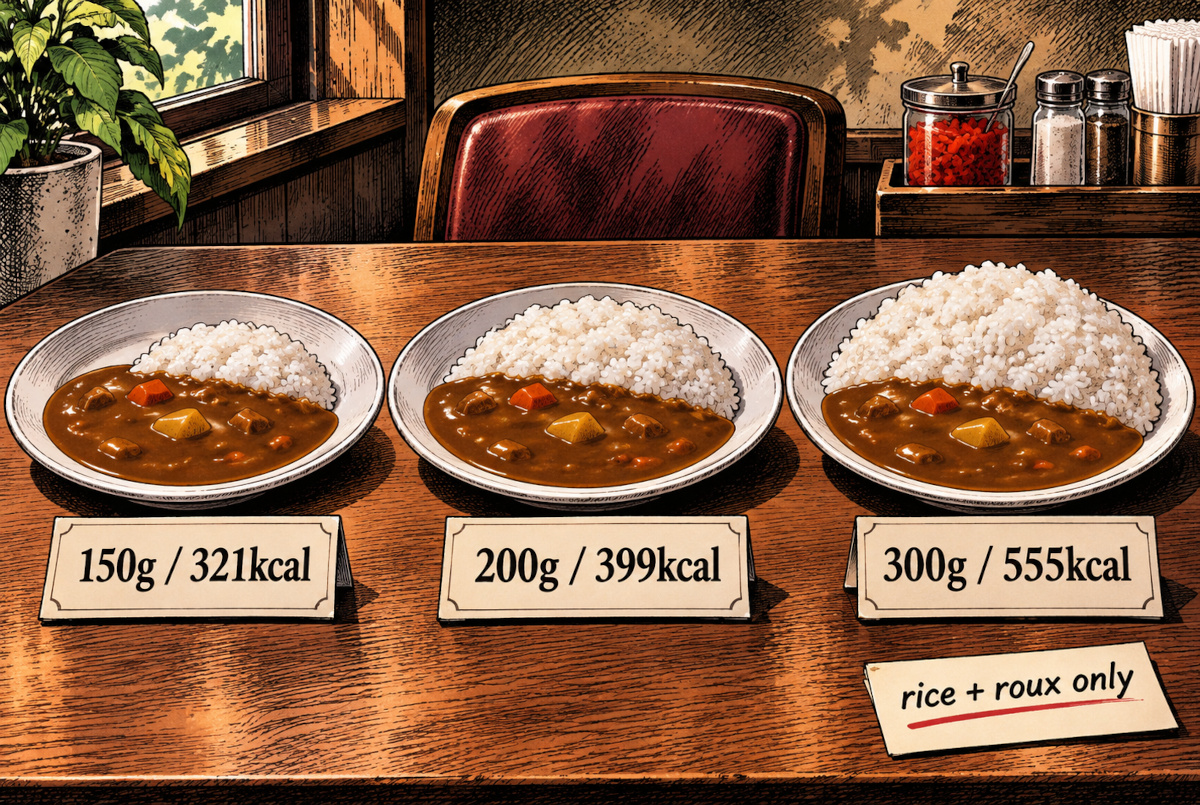
Our calculations combine 150 g, 200 g, or 300 g of cooked white rice with 87 kcal from 18 g of commercial curry roux. The figures exclude the meat, vegetables, and cooking oil depicted in the illustration. They are not measured calorie totals for complete curry meals.
What About Curcumin, the Famous Compound in Turmeric?
If curry has a reputation as a health food, turmeric is one reason why.
Turmeric, the yellow-orange spice also known as ukon in Japan, contains curcumin, a compound studied for its potential biological effects.
According to the U.S. National Institutes of Health’s National Center for Complementary and Integrative Health (NCCIH), turmeric and curcumin have been investigated for conditions including knee osteoarthritis and nonalcoholic fatty liver disease. Some findings are promising, but the evidence remains insufficient to establish definitive health benefits.
Here’s the catch: many of these studies examine concentrated extracts, specially formulated products, or supplements. They are not studies demonstrating that an ordinary plate of Japanese curry produces the same effects.
We also don’t know the curcumin content of the Golden Curry serving examined earlier. The manufacturer does not disclose the amounts of individual spices, so there is no defensible way to calculate a clinical dose from the label alone.
There is a safety issue that tends to disappear from enthusiastic discussions of turmeric. NCCIH notes reports of liver injury associated with some curcumin formulations designed to increase absorption.
That does not mean ordinary culinary use of turmeric is equivalent to taking a high-concentration supplement. It means the distinction between food and a specially formulated supplement matters in both directions: potential benefits cannot simply be transferred, and neither can the risks.
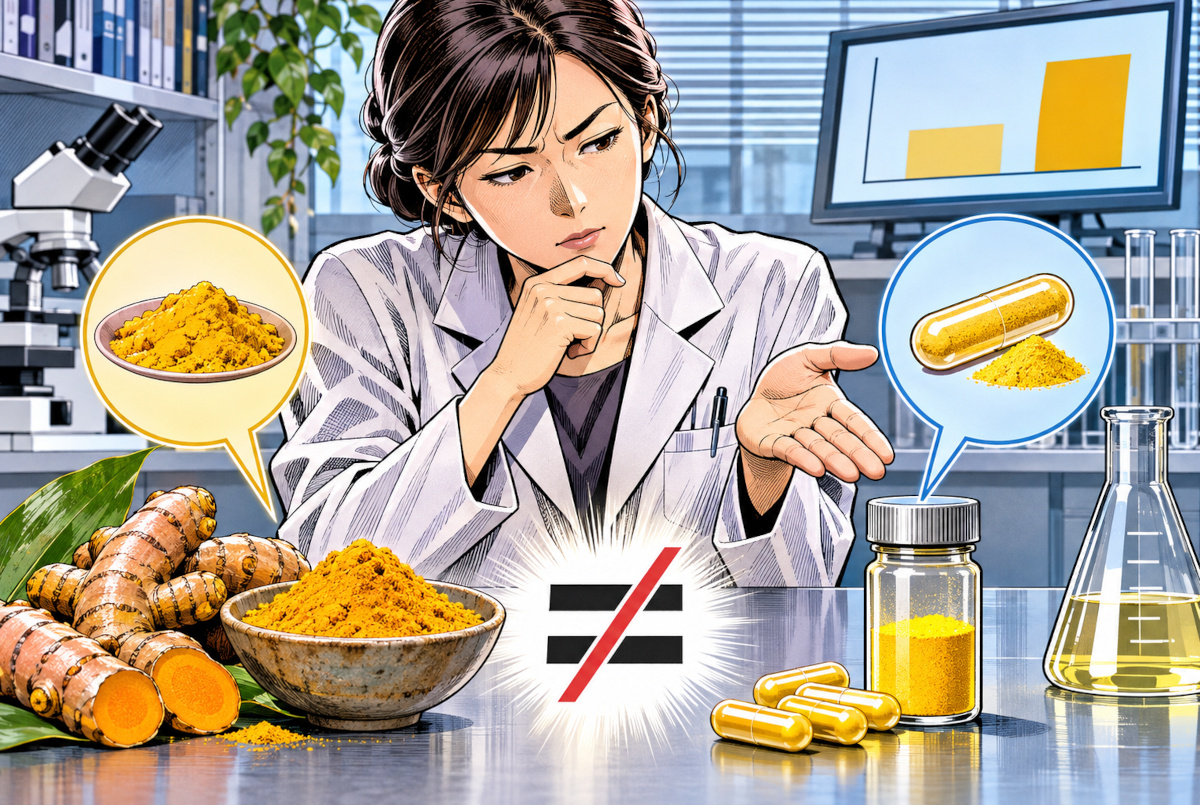
An illustrative comparison of culinary turmeric and concentrated curcumin formulations. Turmeric itself contains curcumin, but doses and research conditions differ. The researcher, laboratory, and background graph are fictional, AI-generated elements, not actual study data or personnel.
Whether Curry Is Healthy Depends on What Goes on the Plate
Curry doesn’t automatically cause weight gain. Nor does the presence of numerous spices automatically make it a health food.
Body-weight changes are influenced by overall energy intake and expenditure over time. As a meal, curry can include rice, vegetables, and sources of protein such as meat or beans. The amounts matter. So do extras like fried cutlets or cheese, which add energy and fat.
There’s no need to turn an everyday dinner into a miracle health product.
Rather than piling on more curry in the hope of getting more benefits from its spices, it makes more sense to balance the ingredients and portions. The ordinary details of the meal matter more than the glamorous spice count.
Editor’s Note
Thirty-five spices and herbs. I have to admit, that sounds impressive. I was expecting the ingredient list to read like a tour of an exotic spice market. Instead, the first thing I found was wheat flour. And 5.3 g of fat in just 18 g of roux? That sent me straight to the calculator.
To be fair, the manufacturer wasn’t hiding a thing. It was all printed on the package. I was simply paying more attention to the exciting spice count than to the less glamorous ingredients underneath it. Maybe the back of a curry box deserves as much attention as the front. It’s certainly where the more interesting numbers are hiding.
Curry: A Five-Part Series
Was Ichiro really eating curry every morning? From the science of spices and nutritional comparisons to Indian food culture and the risks of reheating curry, this five-part series examines the facts, figures, and surprising truths behind a familiar dish.
- Part 1: Ichiro’s Morning Curry Legend: 365 Days, or 81 at Most?
- Part 2: 35 Spices and Herbs, but Flour Comes First? Is Japanese Curry Healthy or Fattening?
- Part 3: English edition Coming soon
- Part 4: English edition Coming soon
- Final Part: English edition Coming soon
References
- S&B Foods, Golden Curry Medium Hot, 198 g — official ingredients and nutrition per 18 g of roux (in Japanese).
- S&B Foods, Golden Curry Mild, 198 g — official product information (in Japanese).
- S&B Foods, Golden Curry Hot, 198 g — official product information (in Japanese).
- Japanese Government e-Gov Legal Database, Food Labeling Standards — ingredient-labeling requirements (in Japanese).
- Ministry of Education, Culture, Sports, Science and Technology (MEXT), Standard Tables of Food Composition in Japan — cooked white rice, 100 g (in Japanese).
- Ministry of Health, Labour and Welfare (MHLW), e-Health Net — Energy-Producing Nutrients and Their Calorie Values (in Japanese).
- Ministry of Health, Labour and Welfare (MHLW), e-Health Net — Sodium and Japan’s 2025 Dietary Reference Intakes (in Japanese).
- National Institutes of Health, National Center for Complementary and Integrative Health (NCCIH), “Turmeric: Usefulness and Safety” (in English).