
I don’t believe in gods or Buddhas. That makes Japanese shrines and Buddhist temples rather curious institutions to me. People pray to powers they cannot see, make offerings, and hope for blessings whose effects cannot be reliably measured. Yet the relationship between religion and money has survived for centuries.
So was religion a business from the beginning? Or did the need to build and maintain sacred places gradually turn faith into a source of income?
Japan’s Great Buddha at Tōdai-ji Temple in Nara offers an intriguing place to start. Historical records give a staggering total of 2,603,638 people across four categories associated with its construction. Emperor Shōmu also explicitly warned officials against forcibly collecting contributions from ordinary people.
Who, then, really paid for this enormous project—and what does that figure of 2.6 million actually tell us?
A Giant Buddha Was Also a Massive State Project
Eighth-century Japan was hardly enjoying a peaceful golden age. Epidemics, political struggles and rebellions had shaken the country. Emperor Shōmu believed Buddhism could help restore stability and protect the state.
In 741, he ordered the establishment of provincial Buddhist temples throughout Japan. On October 15, 743, he issued an imperial edict calling for the construction of an enormous Buddha statue.
The edict reveals something unexpected. Although Shōmu declared that he possessed the wealth and power of the realm, he also called for people to take part willingly—even if they could contribute only something as small as a blade of grass or a handful of earth.
He went further. Provincial and local officials were instructed not to harass ordinary people or force them to provide contributions for the project.
The emperor behind this enormous religious undertaking explicitly prohibited forced collections from the population.
That is a striking detail. The project combined state resources with contributions from the wider population—an enormous undertaking requiring money, materials, skilled workers and ordinary labor.
But an imperial order is not proof that everyone on the ground was treated fairly. Whether all contributions were genuinely voluntary is a separate question, and one the edict alone cannot settle.
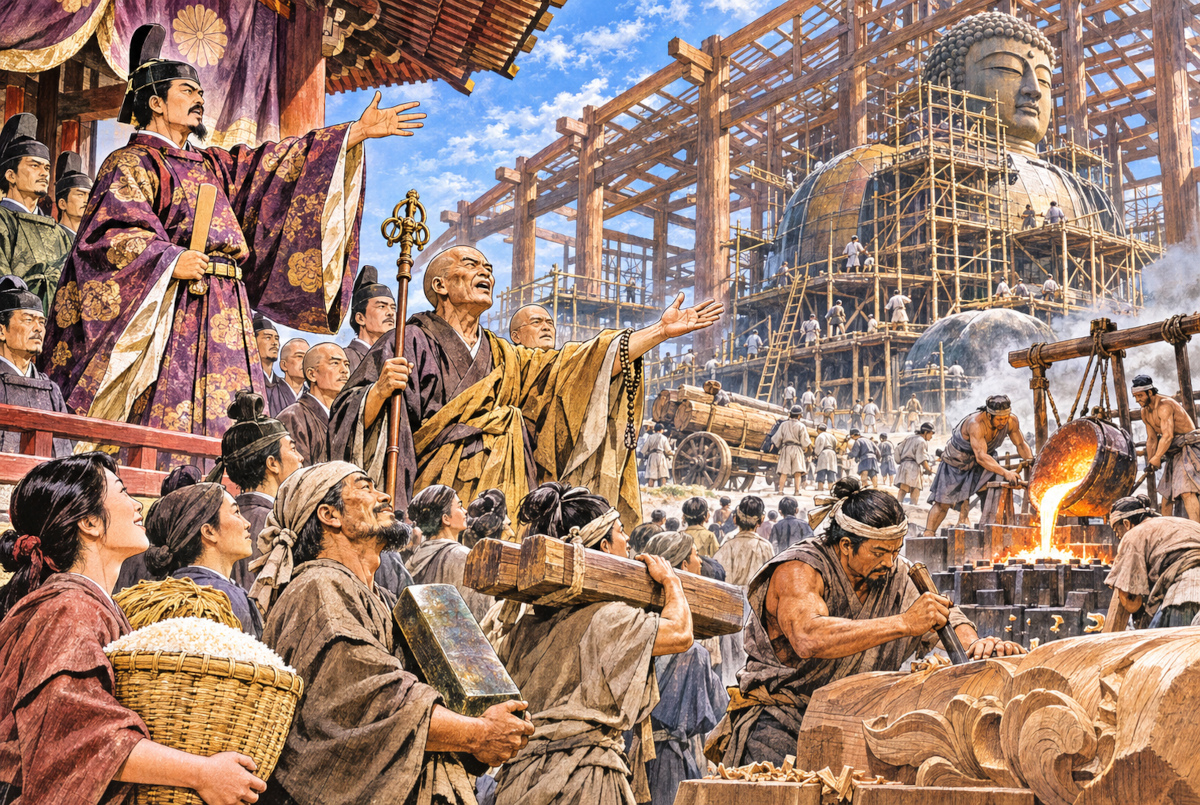
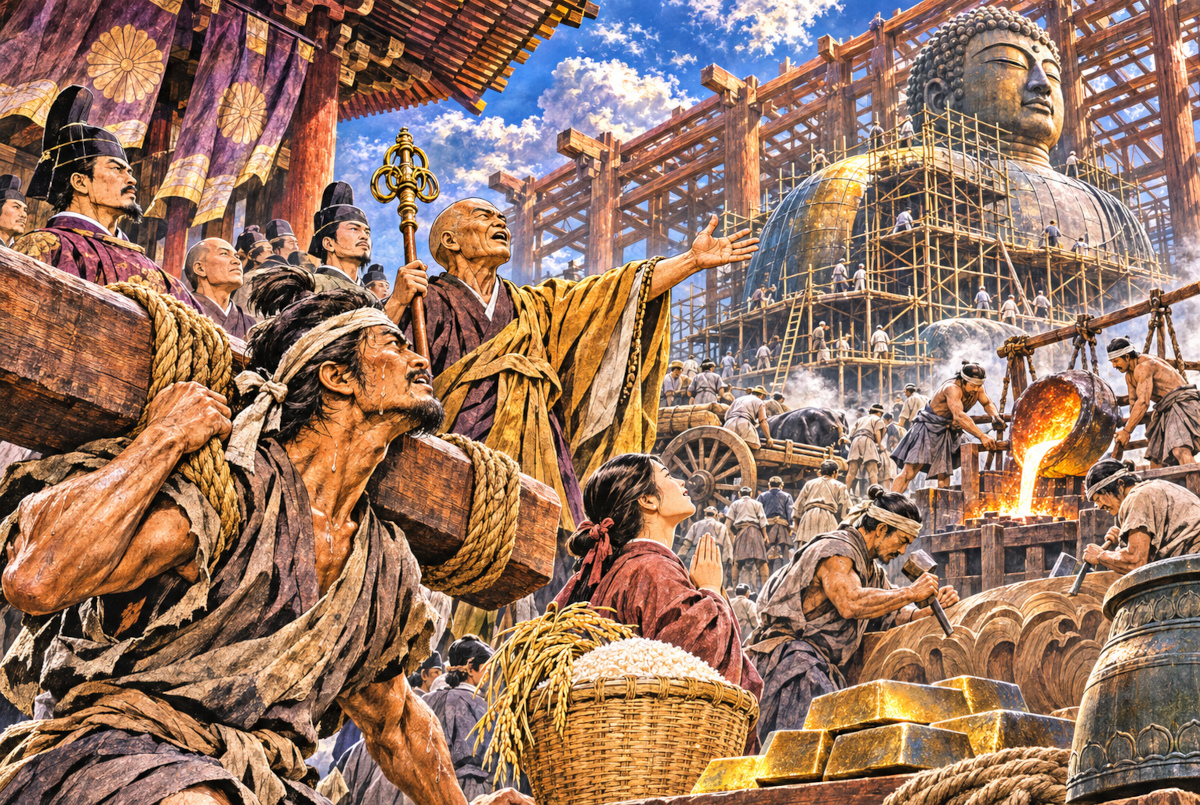
AI-generated interpretive illustration combining Emperor Shōmu’s initiative, the monk Gyōki’s efforts to mobilize support, public contributions and construction work. The figures, costumes, decorative details and construction stages are not intended as an exact historical reconstruction.
2.6 Million People? What Does That Number Actually Count?
The Tōdai-ji Yōroku, a historical compilation concerning Tōdai-ji Temple, preserves figures associated with the construction of the Great Buddha and its hall.
Rather than simply repeating the widely quoted figure of approximately 2.6 million, I compared the four recorded categories using Tōdai-ji’s official information and a historical reference investigation documented through Japan’s National Diet Library.
Here is the breakdown:
| Category in the historical records | Recorded count |
|---|---|
| Wood-related chishiki (材木知識) | 51,590 |
| Wood-related labor (役夫知識) | 1,665,071 |
| Metal-related chishiki (金知識) | 372,075 |
| Metal-related labor (役夫) | 514,902 |
| Total recorded count | 2,603,638 |
The two labor-related categories add up to:
1,665,071 + 514,902 = 2,179,973
Dividing that figure by the overall total gives:
2,179,973 ÷ 2,603,638 × 100 ≈ 83.7%
In other words, approximately 83.7% of the combined recorded count falls into the two labor-related categories.
That changes how we should read the famous 2.6 million figure. It isn’t merely a story about wealthy donors paying for a religious monument. The recorded undertaking was heavily associated with human labor.
There is another important complication. The meaning of chishiki in these particular records is not interpreted identically by every historical source. Some explanations identify the people in those categories as donors, while others emphasize their technical roles. I have therefore retained the historical category names rather than imposing a single interpretation.
And the biggest warning comes last: the total is commonly presented as a cumulative figure. It does not establish that 2,603,638 different individuals participated.
You cannot take that cumulative total, compare it directly with the population of eighth-century Japan, and conclude that half the country helped build the Buddha.
Before comparing historical numbers, we have to ask what was actually being counted.
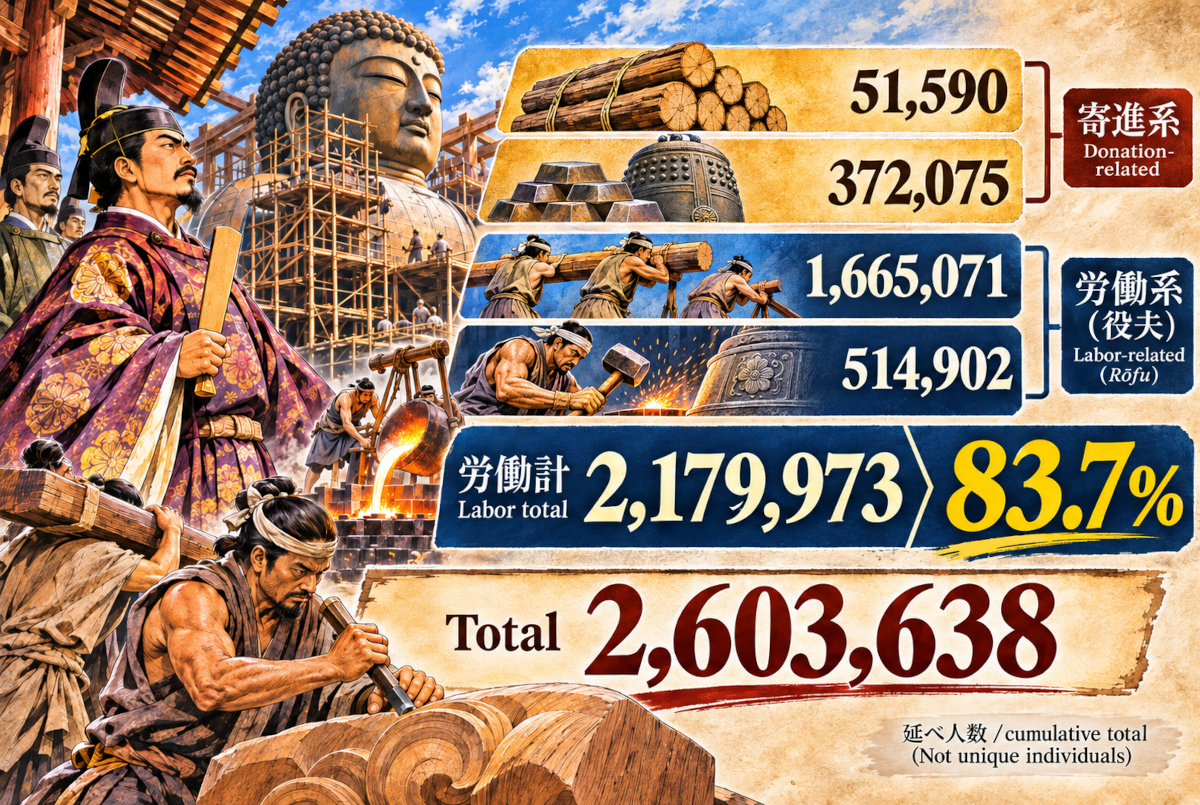
Breakdown based on figures preserved in the Tōdai-ji historical records. The two labor-related categories total 2,179,973, or 83.7% of the combined count. Interpretations of the wood-related and metal-related chishiki categories differ among sources. The total should not be treated as the number of unique participants.
They Held the Grand Ceremony Before the Buddha Was Fully Finished
Construction at the present site began in 745. The Great Buddha’s eye-opening ceremony was held on April 9, 752—a major religious event marking the consecration of the statue.
But Tōdai-ji’s official chronology records the start of gilding on March 14 of that same year, shortly before the ceremony.
According to a presentation at the Geological Society of Japan’s 2022 meeting, finishing work continued until 755, while gilding continued until 757.
So the spectacular ceremony took place while finishing work on the statue was still incomplete.
Think of a grand opening held while the finishing touches are still being applied. The religious milestone and the completion of the physical work were not the same event.
There was no escaping the practical reality. The Buddha needed copper and gold. The building needed timber. Both needed skilled craftspeople, enormous amounts of labor and an organized supply network.
Whatever divine power people believed in, the materials did not deliver themselves.
Were Shrine Offerings Always Made in Cash?
So far, we have been looking at a Buddhist temple. But the financial relationship between religion and ordinary people also developed at Japan’s Shinto shrines.
Today, visitors commonly drop coins into an offering box before praying. This is known as saisen.
It is easy to assume that putting money into a shrine offering box is an ancient, unchanging Japanese tradition. The evidence tells a more complicated story.
According to Professor Naoyuki Ogawa of Kokugakuin University, religious offerings originally centered on newly harvested rice, agricultural produce and other goods offered in gratitude.
Money entered the picture much earlier than many people might expect. Records from the late eighth century describe newly minted coins being presented to a deity.
But the practice of offering coins became more widespread later. Written references to sansen, or scattered coins offered to deities and Buddhas, appear in the first half of the fifteenth century. The term saisen appears in records from the latter half of the sixteenth century.
That timeline becomes more revealing when compared with Japan’s monetary history.
The Bank of Japan’s Currency Museum explains that Chinese coins began entering Japan in large quantities from the middle of the twelfth century. Their use spread through the thirteenth century as commerce expanded and money increasingly replaced rice, silk and cloth in transactions.
The two developments were connected.
The spread of monetary offerings was linked not only to religious custom but also to the growth of a society that used coins more widely.
This was not an overnight switch from rice to cash. Nor does the first appearance of the word saisen mark the beginning of all monetary donations to religious institutions.
People had contributed money and goods to religious projects long before the familiar shrine offering box became part of everyday worship.
So the idea that temples and shrines suddenly became businesses when people started tossing coins into boxes simply does not fit the historical evidence.
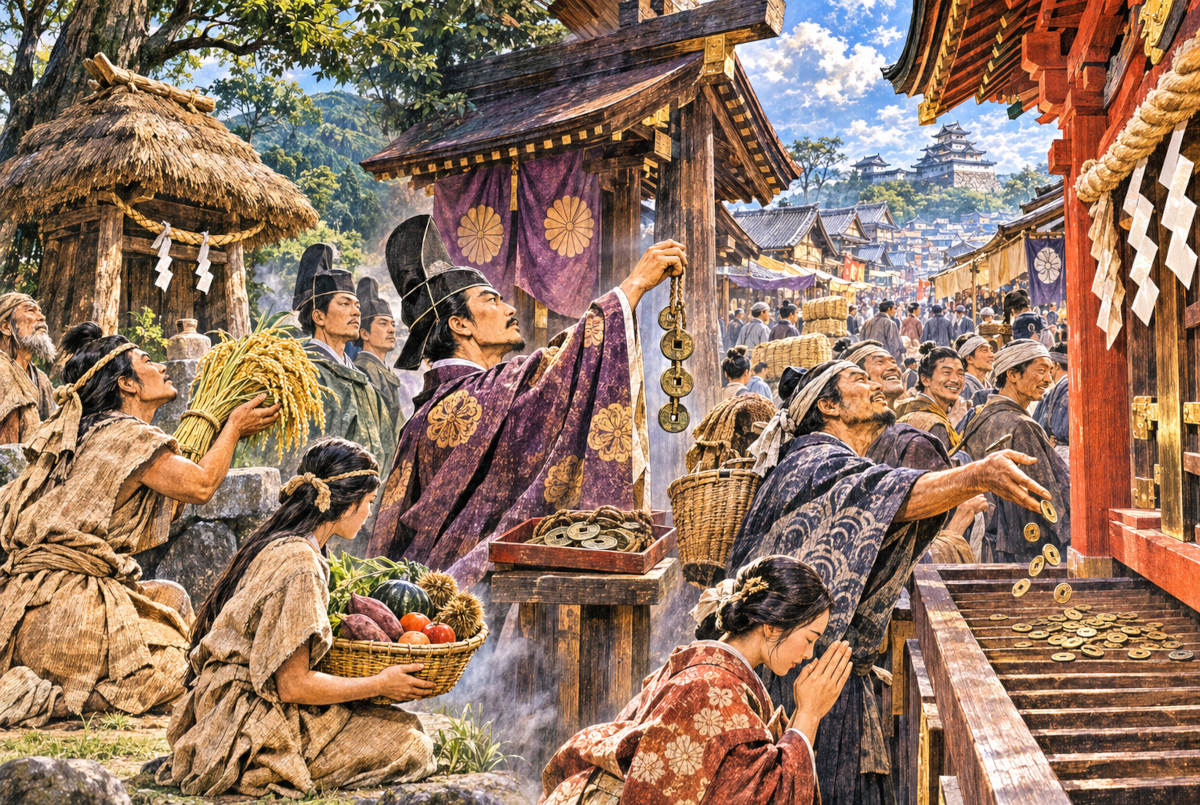
AI-generated conceptual illustration of the shift from agricultural offerings toward monetary offerings. Coin dedications existed in ancient Japan, while written references to sansen appear in the early fifteenth century. Buildings, clothing, decorative elements and some offerings are stylized rather than exact reconstructions of their respective periods.
Editor’s Note
I don’t believe in gods or Buddhas. But I have to admire the people who hauled the timber, melted the copper, assembled the structures and somehow got that enormous statue built. Their work was real, whatever anyone believes about the statue itself.
Maybe the people who created the gods and Buddhas we worship were, in their own way, the most godlike figures of all.
What still bothers me is the emperor’s warning against forced contributions. Here was a ruler promoting one of the largest religious construction projects of his age, yet he was telling officials not to squeeze the public for supplies.
That was the stated ideal, at least. It does not tell us exactly what happened to every worker or every household.
In later centuries, religious institutions would become entangled with systems that tied ordinary families to particular temples. So when did money needed to maintain religion begin to overlap with money earned by exploiting religion?
I’m increasingly convinced that the most suspicious thing about a sacred monument may not be the statue.
It may be the machinery of money and power that grew around it.
Terms That May Need a Quick Explanation
- Chishiki (知識)
- A Buddhist term associated with people who support religious construction through money, materials, labor or other contributions. Its precise meaning in the recorded Tōdai-ji construction categories is interpreted differently by historical sources.
- Saisen (賽銭)
- Money offered to deities or Buddhas, commonly placed in offering boxes at Japanese shrines and temples. Historically, the term was associated with offerings expressing gratitude for fulfilled prayers.
Are Shrines and Temples Businesses? — Seven-Part Series
Faith, donations, land, lending, and religious authority. From the construction of Nara's Great Buddha to modern religious finances, this seven-part investigation examines how money and religion became intertwined in Japan.
- Part 1: Belief Is Free. Building a Giant Buddha Isn’t: Nara’s 2.6 Million Mystery (Part 1)
- Part 2: English edition Coming soon
- Part 3: English edition Coming soon
- Part 4: English edition Coming soon
- Part 5: English edition Coming soon
- Part 6: English edition Coming soon
- Final Part: English edition Coming soon
References
- Tōdai-ji Temple — Official FAQ (Japanese). Historical chronology of the Great Buddha’s construction and recorded categories of people involved in the project.
- Nara National Museum — Shōsō-in Historical Chronology (Japanese). Dates of Emperor Shōmu’s edict, the 752 consecration ceremony and later materials supplied for gilding.
- National Diet Library — Collaborative Reference Database (Japanese; response from Fukuoka Prefectural Library). Reference investigation concerning construction figures preserved in the Tōdai-ji Yōroku.
- Tondabayashi City — History of Tondabayashi, Volume 1 (Japanese). Historical discussion of contributions to temple construction and the interpretation of chishiki.
- Geological Society of Japan (2022) — Mineral Resources Used in the Construction of the Great Buddha of Nara (Japanese conference abstract). Research concerning metal resources, casting and finishing work.
- Kokugakuin University — Naoyuki Ogawa, “Why Do People Offer Money When Praying at Shinto Shrines?” (Japanese). Historical development from first-fruit offerings to sansen and saisen.
- Bank of Japan, Currency Museum — History of Japanese Currency (Japanese). The transition from ancient currency and commodity money to the spread of Chinese coins during medieval Japan.