
Some people are ridiculous—in the best possible way. Making a few minutes of animation almost entirely by yourself is already an absurd amount of work. Then you discover creators who go on to make feature-length films, handling the concept, storyboards, animation, 3D work, editing, sound and sometimes even the music.
It makes you wonder: does this person have an entire animation studio living inside their head? If you admire “genius,” it is tempting to assume that people like this were simply born able to do everything. But once I started looking into how these films were actually made, the picture became much stranger. They are not simply doing the work of a commercial animation studio by themselves. They are redesigning the work so that one person can finish it at all.
Three minutes, three years. That is not what most people call “efficient”
Shingo Tamagawa created the roughly three-minute short film Puparia by himself. The project involved about one year of preparation followed by two years of production—roughly three years in total. Latvian filmmaker Gints Zilbalodis spent around three and a half years making the 75-minute feature Away largely on his own. Kenji Iwaisawa’s ON-GAKU: Our Sound runs about 71 minutes and took roughly seven and a half years to complete, with more than 40,000 hand-drawn frames. In Iwaisawa’s case, a small number of collaborators also contributed, so it would be misleading to call it a literally one-person production.
Now do the crude arithmetic. Spread the finished running time evenly across the total calendar time and Puparia comes out to roughly 0.16 seconds of finished film per day. Away works out to about 3.5 seconds per day, while ON-GAKU comes to roughly 1.6 seconds. These are obviously not measures of actual working speed; nobody worked at exactly the same pace every day for years. But the calculation exposes something important. Solo production does not magically make labor disappear. Instead of spending a large production budget on people, these creators often spend something just as expensive: years of their own lives.
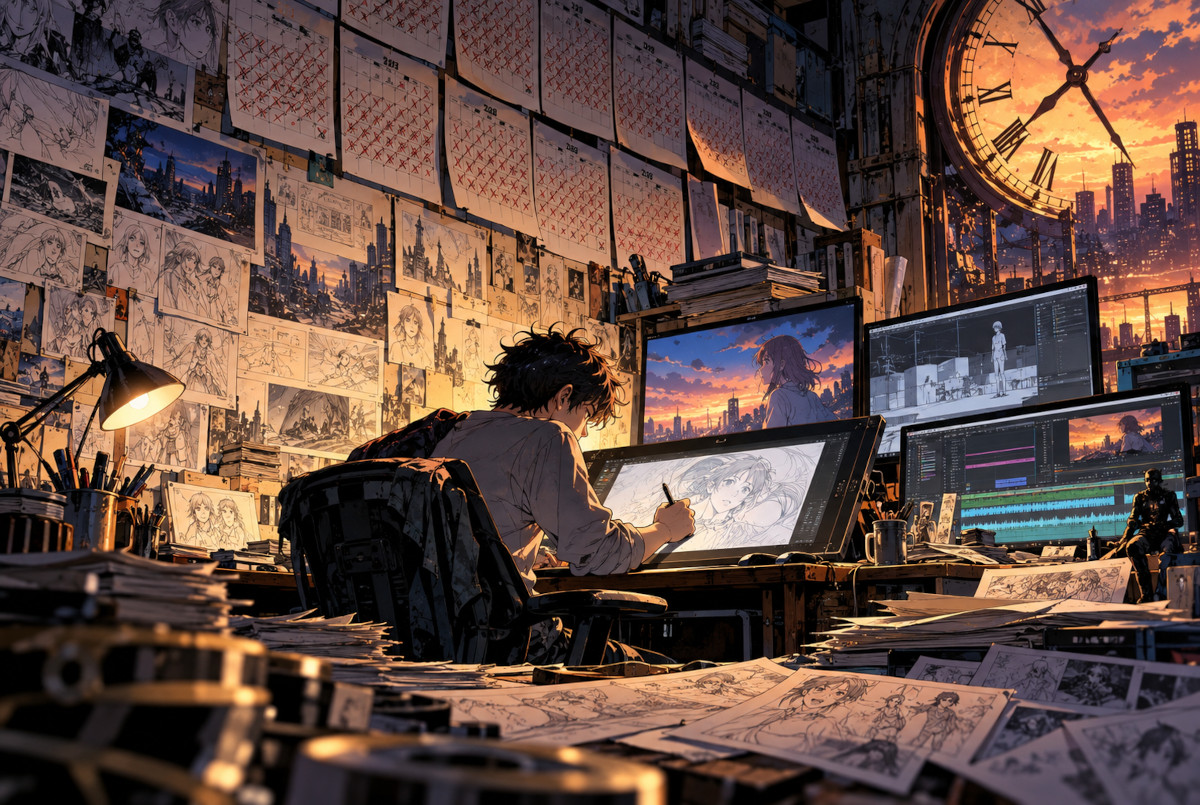
 AI-generated illustration visualizing time as the hidden budget of solo animation production.
The real secret is not being good at everything
Zilbalodis made an especially revealing set of choices on Away. The protagonist rides a motorcycle. There are very few characters. Much of the story takes place on a largely empty island. Those are not random artistic decisions. Zilbalodis has explained that, because he was working alone, he built the story around things that were relatively easy for one person to animate.
That reverses the usual order of thinking. A large studio can imagine a scene first and then assign enough people to make it happen. A solo creator has to ask a different question much earlier: “What kind of movie can I realistically make with the person, tools and time I actually have?”
There is another twist. Zilbalodis has said that he moved away from hand-drawn 2D work partly because he did not consider drawing one of his strongest skills. The normal advice would be to practise until the weakness disappears. He took another route. Instead of waiting until he had conquered every weakness, he moved toward a production method that allowed him to make the film anyway.
Makoto Shinkai’s early work shows a related kind of thinking. During his period of highly personal, small-scale production, animating characters was one of the heaviest workloads. He has described leaning on 3D CG, skies, rain, light and lens-flare effects so the film did not have to depend entirely on elaborate character animation. Some of the imagery that later became associated with Shinkai’s films can therefore also be read as something that grew out of production constraints—not merely as decoration, but as a way of making the movie possible.
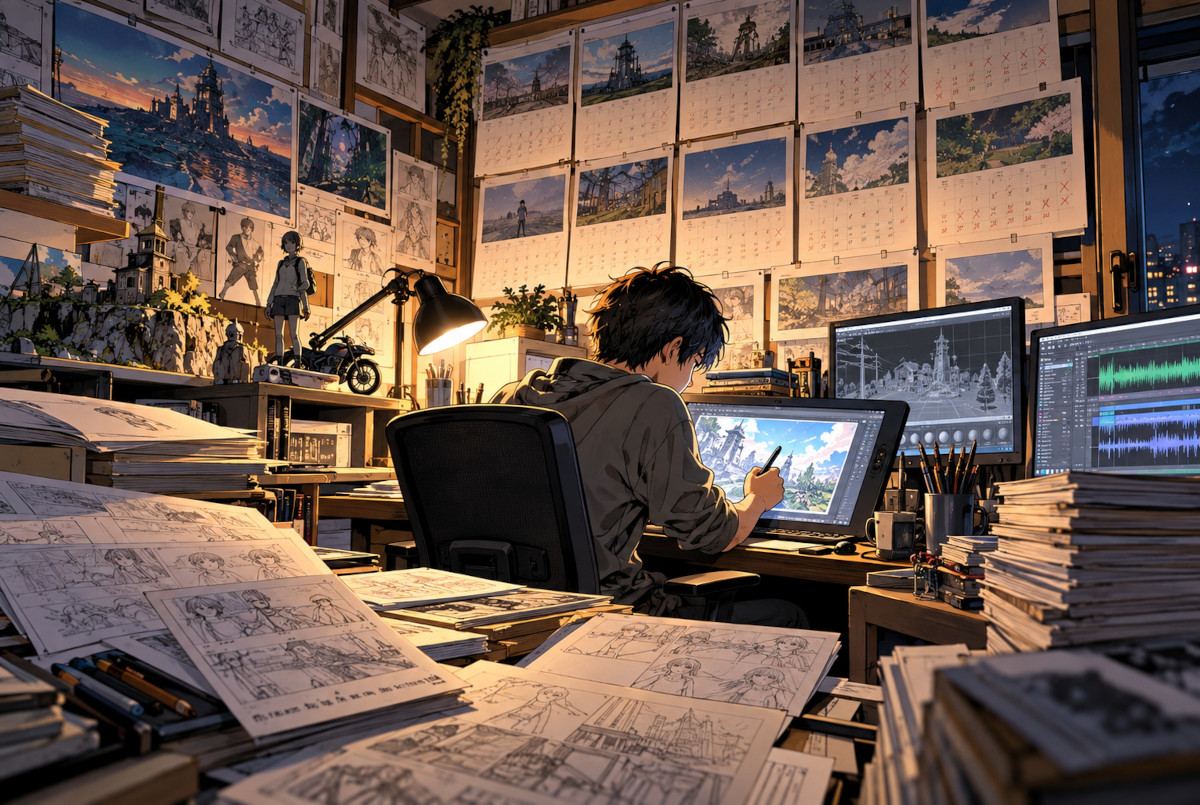
 AI-generated illustration of several production methods being combined by a single independent creator.
Even a “self-taught genius” usually had a life before the masterpiece
There is another myth worth trimming back. Kenji Iwaisawa did teach himself animation, but he had already been involved in live-action filmmaking. Makoto Shinkai worked in game production before becoming known as an animation director. Zilbalodis had experience learning Maya at school. None of them fits the fairy-tale version of a complete beginner waking up one morning and somehow producing a finished animated film.
What is interesting is that they also did not begin with every required skill already installed. They learned what the project demanded, tried different techniques and changed their production method when necessary. In that sense, being “self-taught” is not necessarily about studying an entire discipline from page one of a textbook. It can be a much messier process: “What do I need to learn next if I actually want to finish this thing?” repeated for several years.
Genius is not a row of perfect scores
A solo filmmaker does not need to be a 100-out-of-100 animator, a 100-out-of-100 composer, a 100-out-of-100 editor and a 100-out-of-100 3D artist all at once. More often, the trick is to route around weaknesses, use tools to reduce expensive work and shape the project around whatever the creator can do particularly well.
Commercial animation may divide a production among dozens or even hundreds of specialists. The individual creator compresses, merges or avoids entire parts of that pipeline. That is why the most useful description may not be “a genius who can do everything,” but rather “someone unusually good at designing a project that can actually be finished.”
There is another useful historical point here. Away, ON-GAKU and Puparia were all completed before the recent generative-AI boom. The first major wave of one-person studio filmmaking did not begin with generative AI. Personal computers, digital drawing, 3D software and desktop editing had already allowed an individual creator to absorb jobs that once required separate departments.
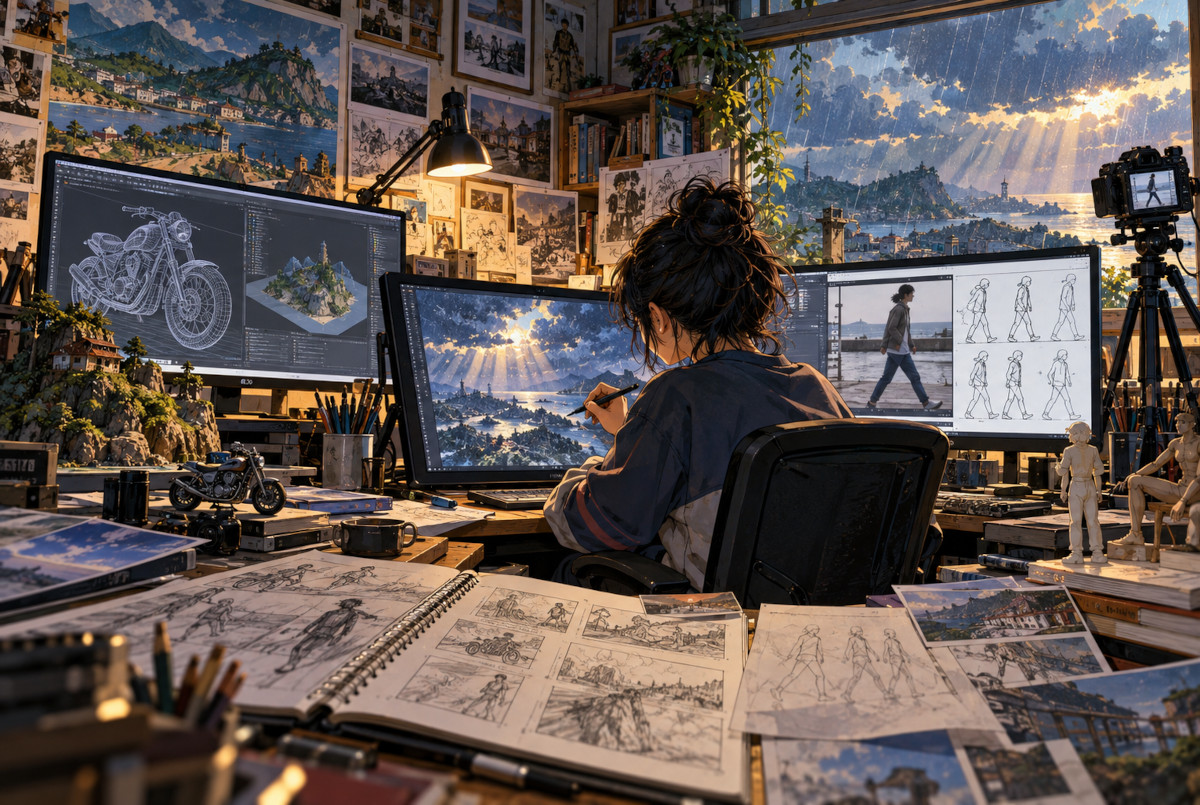
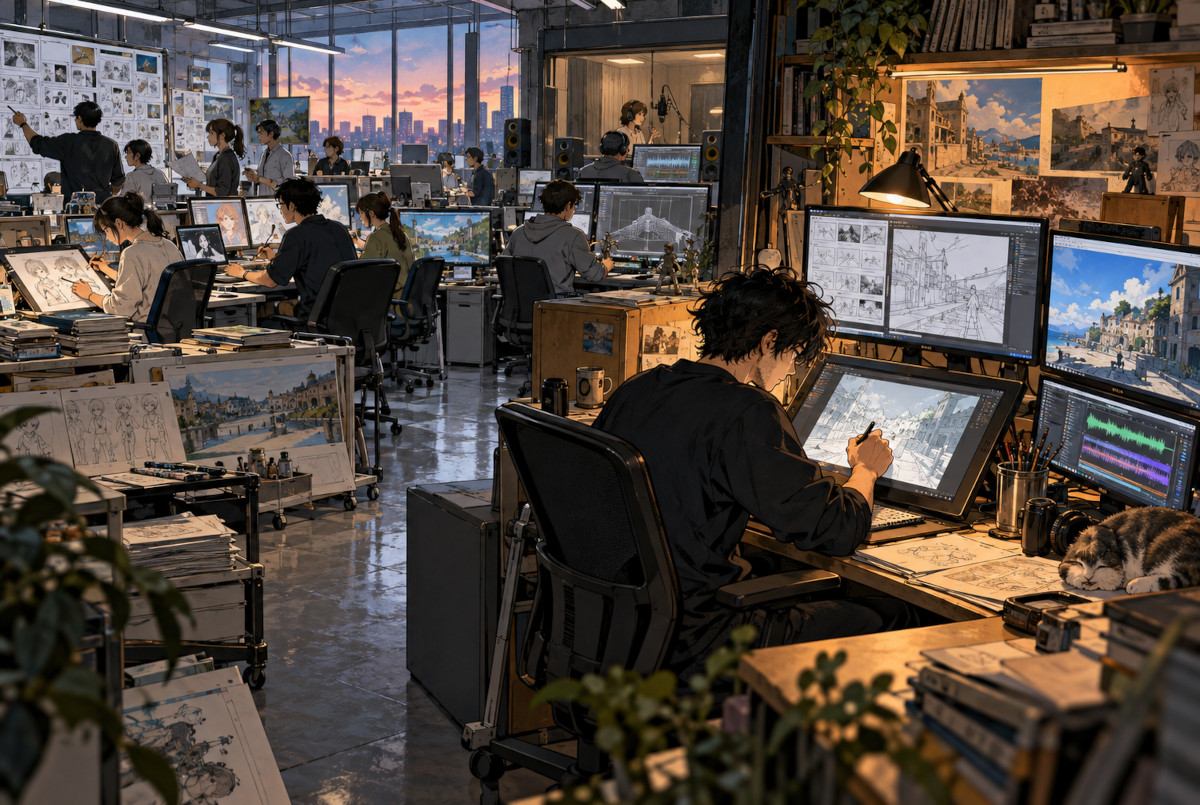 AI-generated illustration contrasting a divided studio workflow with a consolidated solo-production workflow.
If you admire geniuses, you may be looking at the wrong thing
It is easy to look at an extraordinary artist and conclude, “I was not born with that kind of talent.” But these examples suggest that drawing ability is only one piece of the puzzle. Spending three years on three minutes of film is a skill of its own. Learning a missing technique midway through a project is another. Changing the project when the original plan becomes impossible is another. So is continuing for years when nobody can promise that the finished work will ever find an audience.
The most frightening kind of talent may not be the ability to do everything. It may be the ability to start with a pile of things you cannot do—and still drag the project all the way to a finished work.
Editor’s Note
There are days when you look around and wonder how somebody could fail to think through something painfully obvious. Then, on the same planet, somebody else spends three years or seven years making an animated film nobody asked them to make—and actually finishes it. It is slightly annoying that all of these people belong to the same species.
I originally assumed these creators were simply freakishly gifted artists. Then I started reading about how they worked. If drawing is a weakness, move into 3D. If character animation is too expensive, let the sky, rain, light and environment do more of the work. If there is no money, pour in time. It begins to look less like magical talent and more like somebody finding the road blocked, grabbing a machete and cutting a path through the bushes instead.
I have no idea whether anyone can decide to become a genius. But someone who says, “I’ll start once I can do everything,” is likely to be standing in the same place years later. The person who starts now and learns the missing pieces on the way may end up somewhere unexpectedly strange. That, in the end, may be the part worth copying.
References
- Agency for Cultural Affairs, Japan — “Creator’s File 2021: IWAISAWA Kenji”
- GKIDS — “Rotoscoping Behind the Scenes in ON-GAKU: Our Sound”
- Janus Films — “Away”
- Animation Scoop — “Interview: Animator Gints Zilbalodis on Away”
- Cineuropa — “Gints Zilbalodis • Director of Away”
- Blender — “Making Flow: An Interview with Director Gints Zilbalodis”
- VFX Voice — “SUZUME Is Hardly Disastrous for Makoto Shinkai”
- Archipel — “Shingo Tamagawa: Three Minutes, Three Years — Making Puparia”