

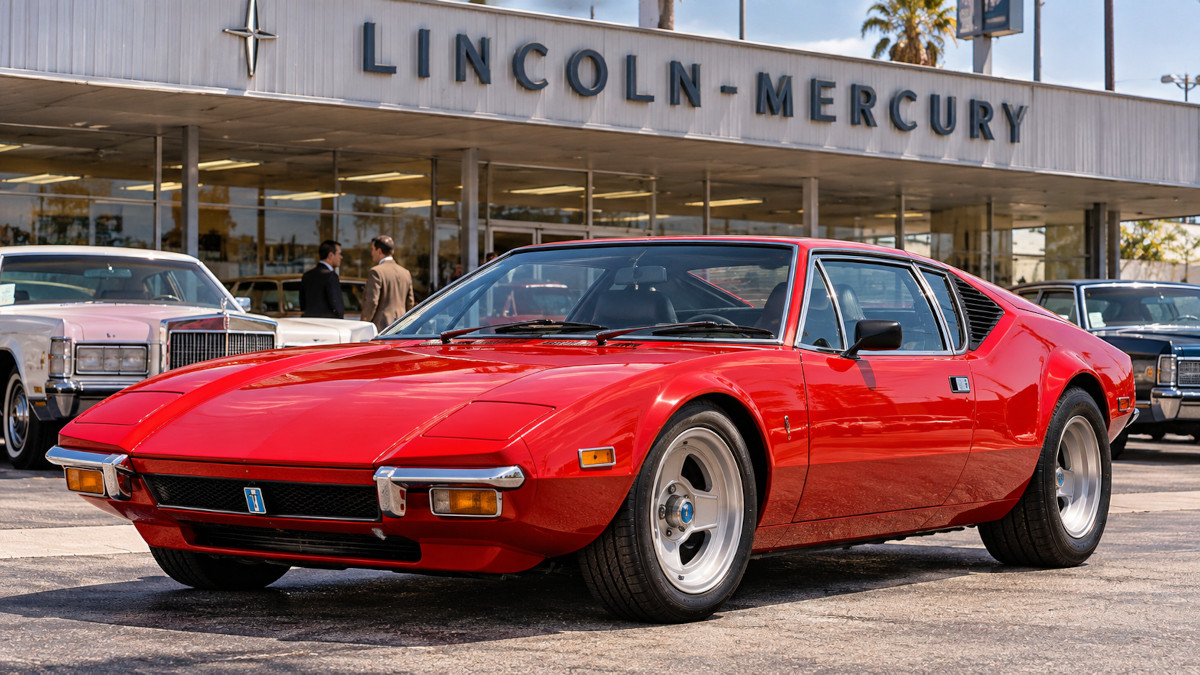
For Japanese readers who remember the late-1970s supercar boom, the De Tomaso Pantera always occupied a slightly odd corner of the poster-car universe. It had the low wedge profile, mid-engine layout and Modena address expected of an Italian exotic. Park one beside a Ferrari or Lamborghini and nothing looked out of place.
Then you opened the engine bay. Sitting behind the seats was not some jewel-like Italian V12, but a Ford 351 Cleveland, a 5.8-liter OHV V8. The five-speed gearbox was German, supplied by ZF, and first gear sat down to the left in a dogleg shift pattern. So was the Pantera simply a cheaper exotic assembled from whatever parts happened to be available? Once you dig into the numbers, the opposite starts to emerge. The Pantera was a serious attempt to use Ford-scale hardware and distribution to turn a genuine mid-engine exotic into a more attainable production car.
The Ford V8 Was Not Just a Cost-Cutting Shortcut
The Pantera appeared in 1970 and went on sale in the United States in 1971. Its shape was created by American designer Tom Tjaarda at Ghia, while Gian Paolo Dallara was involved in the engineering. Compared with the earlier Mangusta, the Pantera abandoned the backbone chassis concept in favor of a steel monocoque body. Behind the cabin sat the Ford 351 Cleveland V8, coupled directly to a ZF five-speed transaxle.
Ford had already begun working more closely with De Tomaso in 1969 and deepened the relationship in 1970, including an investment in Ghia and Vignale. In the United States, the Pantera was then sold through roughly 200 selected Lincoln-Mercury dealerships.
Think about how strange that must have looked. You could walk into a mainstream American dealership surrounded by large luxury cars and find a low, Italian-built mid-engine exotic sitting among them. Even by 1970s standards, that was an unusual sales strategy.
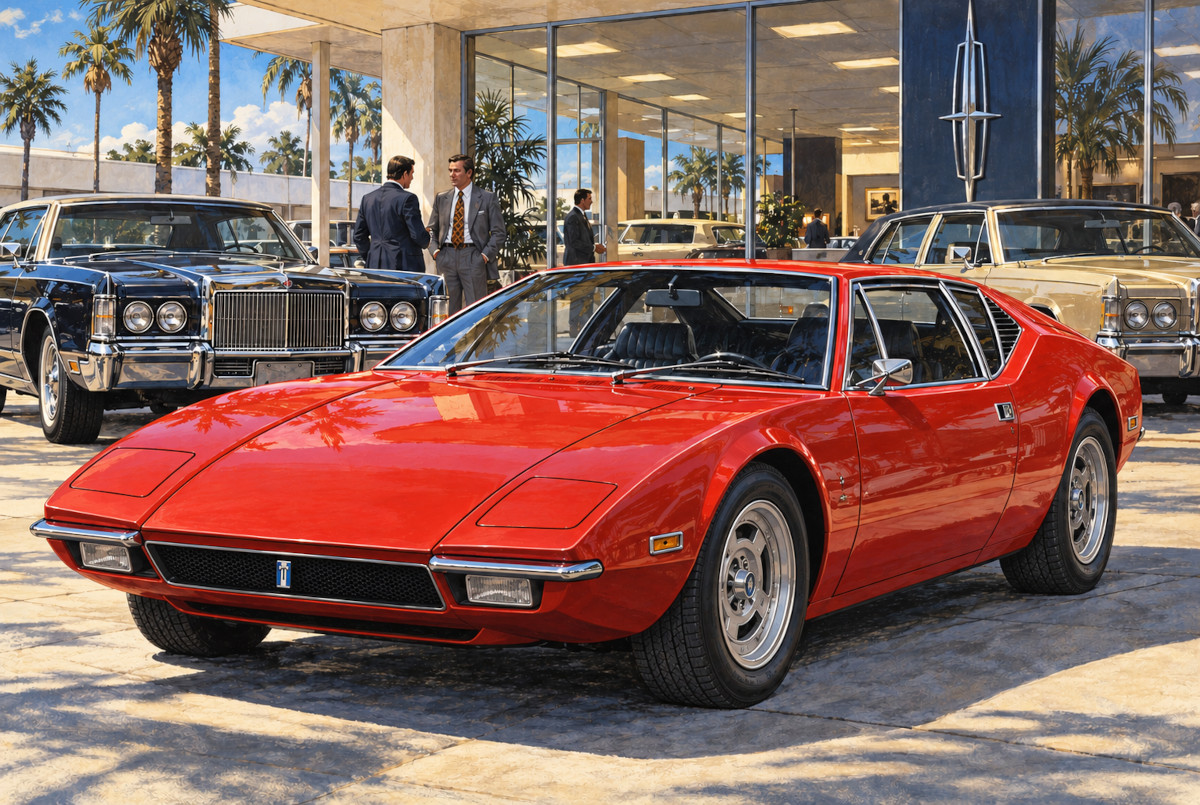
AI-generated illustration visualizing the historical fact that the Pantera was sold through selected Lincoln-Mercury dealerships in the United States. It does not recreate a specific dealership or individual vehicle.
The price was another clue to what Ford and De Tomaso were trying to do. In 1971, the Pantera sold for roughly $10,000. Car and Driver noted that it delivered the kind of performance and excitement buyers had previously expected from exotics costing around $25,000.
That changes the way the Ford engine should be viewed. Using a mass-produced American V8 was not simply a matter of building a bargain-bin supercar. It offered power, parts availability, serviceability and production capacity that would have been much harder to achieve with a tiny-volume bespoke engine. The Ford V8 was part of the business model as much as it was part of the drivetrain.
A Mass-Produced Engine, but Genuine Supercar Performance
Horsepower figures for early Panteras vary depending on model year, market specification and the measurement standard being quoted. You will see figures around 310 hp as well as roughly 330 PS in period and later sources, so treating every early Pantera as if it had one universal output figure is risky.
For a specific reference point, the Pantera tested by Car and Driver in 1971 was rated at 310 hp at 5,400 rpm. The test car weighed 3,123 lb, or about 1,417 kg, and recorded 0–60 mph in 5.5 seconds and the quarter-mile in 14.0 seconds.
In other words, dismissing the Pantera because its engine belonged to the same basic Ford family used in Mustangs and Torinos misses the point. Once the stopwatch started, the argument became much harder to make.
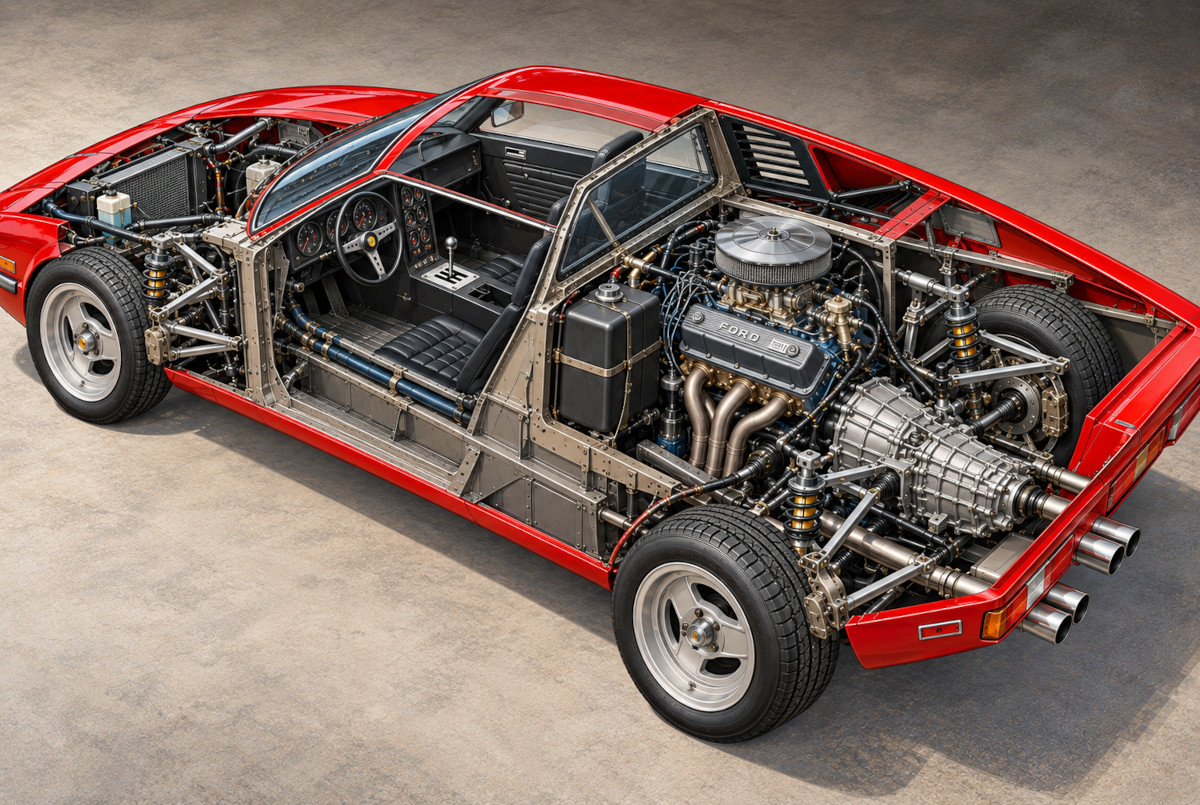
AI-generated visualization of the Pantera’s basic powertrain layout. It shows the 351 Cleveland V8 and ZF five-speed transaxle for explanatory purposes; plumbing, ancillary components, wheels and other details are not a complete engineering reproduction. On the real car, the main coolant pipes run from the front radiator through the central tunnel to the engine.
Then There Is the Dogleg Gearbox
The Pantera’s ZF five-speed used a dogleg shift pattern. First gear sat down to the left, while second and third occupied the center plane and fourth and fifth the right. The idea was familiar from competition-oriented transmissions: move the mainly start-off gear out of the way and make the frequently used 2–3 shift a straight fore-and-aft movement.
On paper, it sounds wonderfully purposeful. In practice, things were less elegant. The driver was operating a transaxle mounted behind the engine through a long remote linkage, topped off by the kind of exposed metal shift gate that looks magnificent in a 1970s exotic-car photograph.
Period testing already noted that the shift could be reluctant. Car and Driver found that the gate at least made it obvious where the gears were supposed to be, but getting the lever there was not always effortless.
There is an important twist, though. Blaming the ZF gearbox as some cheap weak link gets the story almost exactly backward. According to the same period test, the ZF unit cost more than twice as much as the engine, and limited gearbox supply was itself a constraint on Pantera production.
So the Pantera combined a mass-produced Ford V8 with an expensive German transaxle and installed the whole assembly in an Italian monocoque. The nationalities were mixed, but so were the spending priorities.
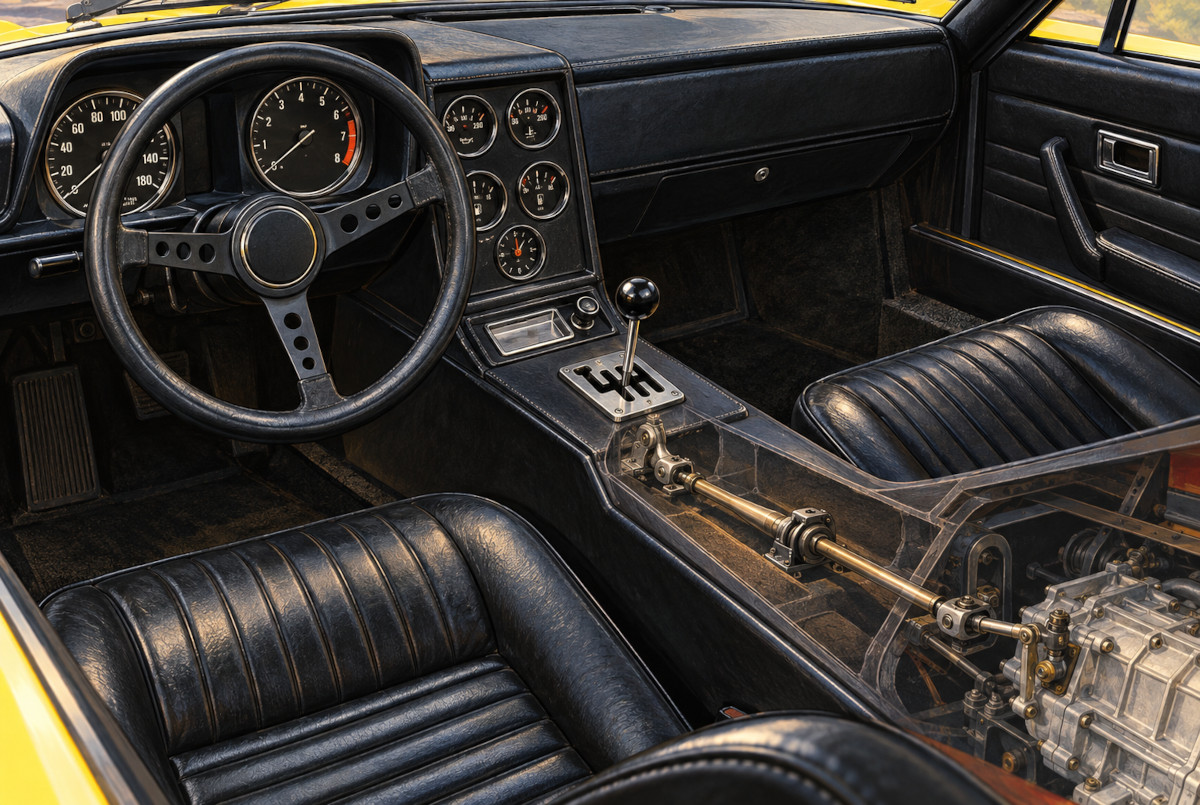
AI-generated visualization of the Pantera’s shift mechanism. The real car uses a dogleg pattern with first gear down to the left and a remote linkage to operate the rear ZF transaxle. The exact shapes and dimensions of the gate, instruments, console and linkage are simplified rather than reproduced from factory engineering drawings.
The Shifter Was Awkward — Yet You Did Not Need It That Often
This is where the Pantera becomes especially interesting. In a 1979 drive of the Pantera GTS, veteran Japanese motoring journalist Yasutake Tokudaiji noted just how flexible the 5.8-liter V8 could be at low speed. Once the car was moving, he found that it could pull comfortably in third and even fourth gear.
The gearshift could be fussy, yet the big American V8 reduced how often you actually needed to use it. That is almost the opposite of the stereotypical high-revving Italian exotic, where keeping the engine on song can make frequent shifting part of the experience.
The Ford engine did not merely make the Pantera cheaper to build. Its broad torque also made the car less nervous in ordinary driving than its exotic appearance might suggest.
The Pantera Works Because It Was Never Pure
Ford ended its official U.S. import program at the end of 1974, but the Pantera itself did not disappear. De Tomaso continued developing the model, and production carried on until 1993. De Tomaso’s own historical material puts total production at more than 7,000 cars — a remarkably long life for a low-volume exotic.
The Pantera was never a pure Italian exotic in the Ferrari sense, and it was certainly not an American muscle car either. An American designer drew it in Italy. Dallara helped engineer it. Ford supplied the V8. ZF supplied the transaxle. American buyers could purchase it through Lincoln-Mercury dealerships.
The Pantera is interesting not because it was fast despite being a mixture, but because the mixture created a personality no purist design could have produced. A big Cleveland V8 thumping behind your back, a metal gate in your right hand and first gear hiding down to the left: neither a Ferrari nor a Mustang offered quite that combination.
Editor’s Note
The thing that originally bothered me was simple: why would an Italian supercar use a Ford engine? When I was younger, a bespoke DOHC engine or a V12 somehow felt more “proper” for an exotic. The deeper I looked into the Pantera, the more I started to think that the Ford V8 is exactly what makes the car interesting.
You have a 5.8-liter American V8 behind the seats, an oddly expensive ZF transaxle behind that, and a dogleg first gear down to the left. It is not a car whose engineering story fits neatly into one national tradition. You can see the seams where the ideas meet. And that may be precisely why it still feels so alive. If perfection were the only thing that made an old supercar memorable, the 1970s would have been a much duller decade.
References
- De Tomaso Automobili — Pantera: Official Model History
- De Tomaso Automobili — “The Echo—A Vision from 1965, Revived For The Future”
- Ford Motor Company — “This Rare Sports Car Sold by Jim Farley Has a Surprising Ford Backstory”
- Car and Driver — “DeTomaso Pantera,” August 1971 Road Test
- Best Car Web — Yasutake Tokudaiji’s period drive of the De Tomaso Pantera GTS (Japanese-language source)
- Pantera International — De Tomaso History
- Pantera Place — 1971 De Tomaso Pantera Specifications and Details