
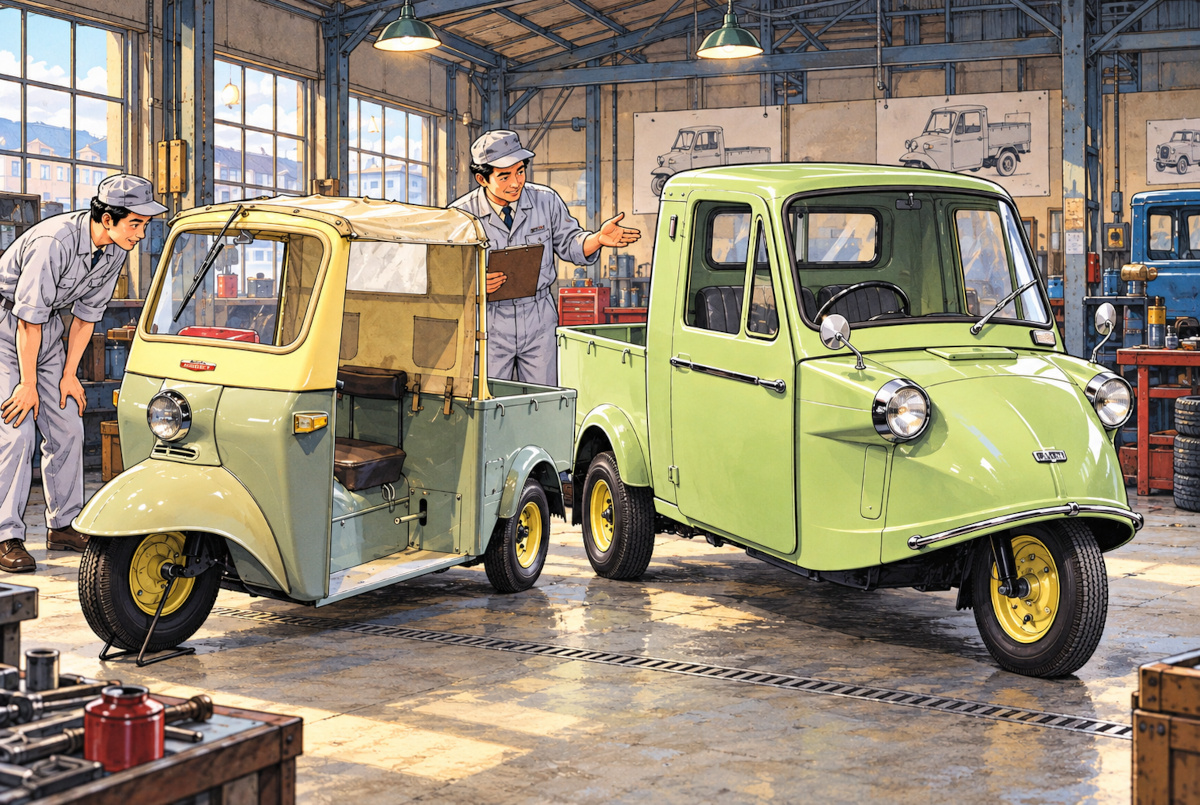
When the Daihatsu Midget DKA arrived in 1957, it was a remarkably simple little machine: a 249cc engine producing just 8 PS, motorcycle-style handlebars, one seat and no side doors.
By the time the final MP5 series arrived, the Midget had grown into something much closer to a conventional Japanese light truck. It had a 305cc engine producing 12 PS, a round steering wheel, a two-person cab and a considerably larger body. Give it a second front wheel and it might almost pass for a four-wheeled kei truck.
But the interesting part is not simply that the Midget became more powerful.
Engine output rose by 50%, from 8 to 12 PS. Maximum payload, however, increased by only 16.7%, from 300 to 350kg. And by 1964, the MP5’s body width was just 5mm below Japan’s legal limit for kei vehicles.
That raises an oddly specific question: what exactly did the Midget gain as it evolved, and what happened to the original idea of an exceptionally small, lightweight delivery vehicle?
To find out, we need to follow the DK, DS and MP models rather than treating the entire 15-year production run as one unchanging three-wheeler.
The Original DKA Was Closer to a Motorcycle with a Roof
The first Midget DKA was designed around a simple idea: provide small businesses with more carrying capacity than a motorcycle without the size and expense of a conventional truck.
Its 249cc air-cooled, single-cylinder two-stroke engine drove the rear wheels. It could carry up to 300kg (approximately 661 pounds), while the driver sat alone behind motorcycle-style handlebars. There were no proper side doors, and the vehicle ran on one front wheel and two rear wheels.
Early DKA versions produced 8 PS (metric horsepower). Later improvements brought more power: Toyota’s GAZOO specifications and historical automotive records also list 10-PS versions of the DKA.
That is an important distinction for anyone comparing old specification sheets. Not every DKA was an 8-PS vehicle. The model evolved even before the familiar MP series appeared.
Then came the DS derivatives around 1959. The DSA introduced side doors, the DSV offered a van-style cargo compartment, and the DSAP used a shortened cargo bed to accommodate two occupants while retaining the handlebar-based layout.
In other words, the Midget’s move toward greater comfort and practicality did not begin with the round steering wheel. The DSAP had already explored the idea of carrying two people.
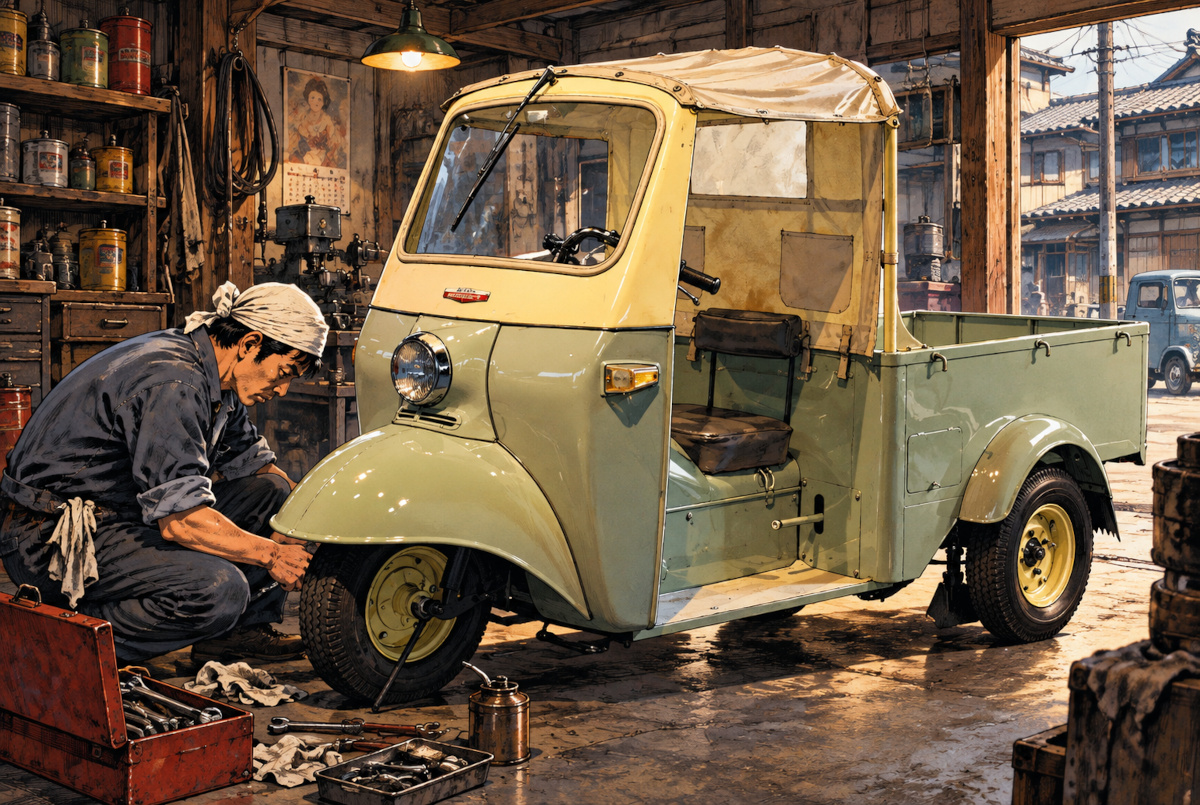
AI-generated illustration inspired by the 1957 Daihatsu Midget DKA. Body details and the handlebar control arrangement are not exact mechanical reproductions of the original vehicle.
The MP2 Arrived in October 1959. The MP3 Followed Just Two Months Later.
The biggest visual transformation came in 1959.
After the export-oriented MPA, Daihatsu introduced the MP2 for the Japanese market in October of that year. It featured a conventional round steering wheel, an enclosed cab with doors and two seats positioned side by side.
The result looked and felt far more like a small automobile than a motorcycle adapted to carry cargo.
But the pace of development was remarkable. By December 1959, Daihatsu had already introduced the MP3, increasing engine displacement from 249cc to 305cc and output to 12 PS.
Specialist histories describe inadequate power for the enlarged body as a factor behind the change. That explanation makes engineering sense, but I could not verify it directly against the original development team’s test records. It should therefore be treated as an informed historical explanation rather than a proven statement of the engineers’ intentions.
Development continued. The MP4 appeared in May 1960 with an extended cargo bed and a maximum payload of 350kg.
The final MP5 series followed in 1962, bringing further changes to the cab and cargo body, including a steel roof. Later versions also progressed from premixed fuel and lubricating oil to a separate oil-injection system for the two-stroke engine.
Sources disagree on whether the MP5 first appeared in September or December 1962. Since the exact month cannot be firmly resolved from the material reviewed here, 1962 is the date used throughout this article.
And there is another small but significant point: the MP3 arrived only two months after the MP2’s introduction. That does not, by itself, prove that MP2 production stopped on a particular date.
50% More Power, but Only 16.7% More Payload
To understand how much the Midget changed, I compared representative specifications for the DKA family with a documented 1964 MP5.
| Specification | DKA Family | MP5 |
|---|---|---|
| Reference period | 1957–1960 | 1964 |
| Engine displacement | 249cc | 305cc |
| Maximum output | 8 PS initially / 10 PS later | 12 PS |
| Seating capacity | 1 | 2 |
| Overall length | 2,540mm | 2,970mm |
| Overall width | 1,200mm | 1,295mm |
| Vehicle weight | 305kg | 415kg |
| Maximum payload | 300kg | 350kg |
Source note: The DKA dimensions and 305kg vehicle weight come from Toyota GAZOO’s 1958–1960 specification listing, while 8 PS describes the earlier launch specification. The MP5 figures come from a specialist publication covering a 1964 vehicle. These are representative specifications from different years, not a perfectly matched comparison of two vehicles from the same date. A separate historical record also lists a DKA overall length of 2,450mm rather than 2,540mm.
First, consider weight. The listed vehicle weight increased from 305kg to 415kg, a difference of 110kg.
110 ÷ 305 × 100 = approximately 36.1% heavier.
Maximum payload, meanwhile, increased by only 50kg, or 16.7%.
Now compare payload with the vehicle’s own weight:
DKA: 300 ÷ 305 × 100 = approximately 98.4%
MP5: 350 ÷ 415 × 100 = approximately 84.3%
The payload-to-vehicle-weight ratio fell by about 14.1 percentage points, even as engine output rose substantially.
This ratio is not a complete measure of transport efficiency. It says nothing directly about acceleration, braking, durability, driver fatigue or real-world running costs.
Nevertheless, it reveals something that a simple horsepower comparison misses. The Midget was no longer evolving solely to carry more goods. A second seat, a larger cabin and a more substantial body were becoming part of the product.
It is reasonable to infer that the more powerful engine was needed not just for the extra 50kg of rated payload, but also to move the heavier, more developed vehicle itself.
The MP5 Was Using 99.6% of the Kei Width Allowance
Here is the figure that really caught my attention.
At the time, Japan’s kei vehicle regulations limited three- and four-wheeled light vehicles to 3.00 metres in length, 1.30 metres in width and 360cc of engine displacement, among other requirements.
The documented 1964 MP5 measured 2,970mm long and 1,295mm wide.
Subtract those dimensions from the legal maximum and the result is almost absurdly tight:
Length: 3,000 − 2,970 = 30mm remaining (99.0% of the limit)
Width: 1,300 − 1,295 = 5mm remaining (approximately 99.6% of the limit)
The vehicle that had begun as an unusually compact alternative to a motorcycle had grown to occupy almost the entire legal size allowance for its class.
By the MP5 stage, Daihatsu’s little three-wheeler was operating under practically the same dimensional constraints as a four-wheeled kei truck—and using nearly all the permitted width.
That does not mean there was literally no room left for further engineering improvements. Cabin design, cargo-body layout, materials and mechanical packaging could still change.
But it does raise a fascinating question about the Midget’s original advantage. If a compact delivery vehicle becomes progressively larger, heavier and more car-like, how long does retaining just three wheels remain the best solution?
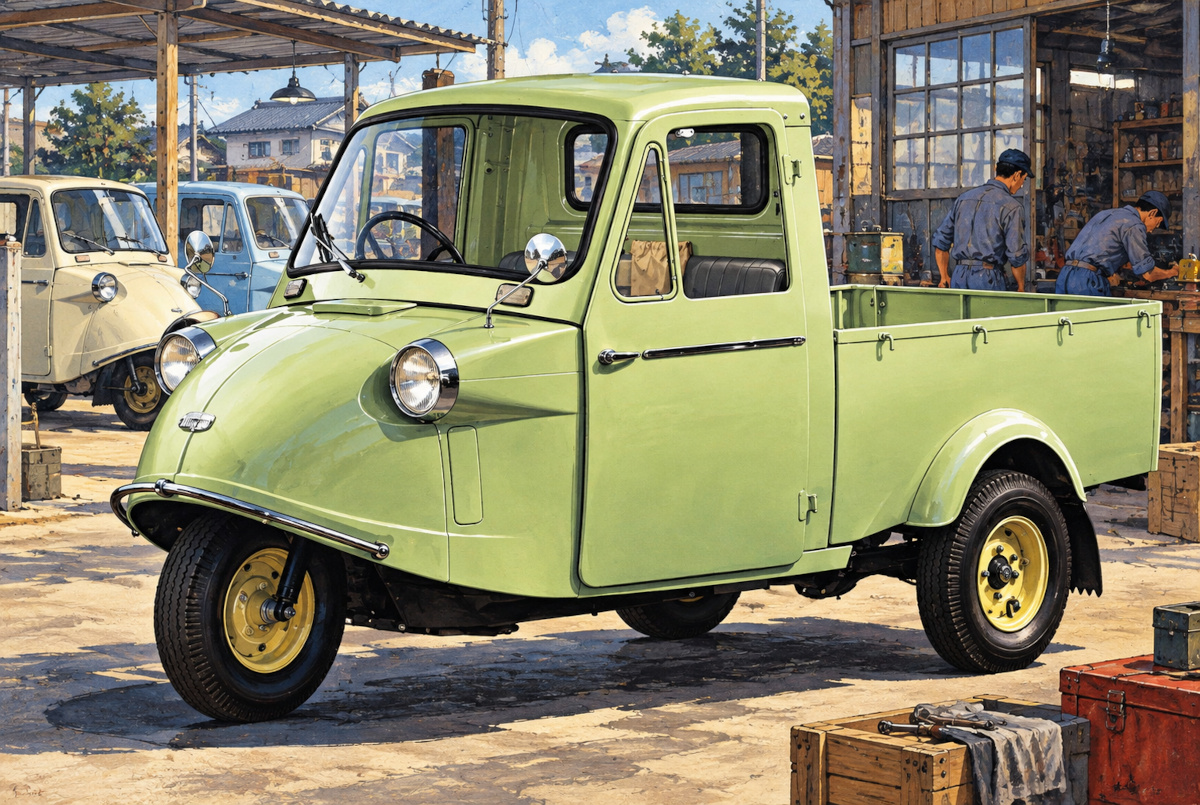
AI-generated illustration inspired by the Daihatsu Midget MP5 around 1964. Lighting, trim and equipment details, as well as the workshop setting, are artistic reconstructions rather than exact records of a specific vehicle or location.
Was the Three-Wheeler’s Biggest Weakness Really Its Tendency to Tip Over?
Throughout its development, the Midget retained the same fundamental layout: one wheel at the front and two at the rear.
In simplified terms, the three tire contact patches form a triangular support area. Under cornering loads, the relationship between that triangle, the vehicle’s centre of gravity and the forces acting on it becomes crucial.
Vehicle speed, turning radius, track width, wheelbase, cargo placement and centre-of-gravity height can all influence rollover stability.
This was not a problem discovered decades later.
In 1951, Eiji Masuda of Toyo Kogyo published a paper titled Stability of Three-Wheeled Vehicles in the Transactions of the Japan Society of Mechanical Engineers. The study examined the effects of wheelbase, track and centre of gravity on overturning, including the relationship between cornering speed and turning radius.
Of course, it would be an oversimplification to declare every three-wheeler inherently more dangerous than every four-wheeled vehicle under all conditions. Actual stability depends on the particular design and operating conditions.
Braking arrangements are another detail worth investigating.
Toyota GAZOO’s DKA specification lists no front-wheel brake and a rear drum brake. The MP5 specifications published by Meisha Bunka Kenkyujo (Classic Car Culture Research Institute) also describe a version without a front service brake.
Yet another 1959 MP-series specification in that specialist source records a front drum brake. So it would be unsafe to claim that every Midget, in every configuration, lacked front-wheel braking.
Nor can brake specifications alone tell us a vehicle’s stopping distance or historical accident rate. Those conclusions would require comparable test data, including vehicle load and road conditions.
The Midget gained power, capacity and comfort, but retained its three-wheel foundation. That was one of the most important things that did not change as the body grew around it.
Editor’s Note
Of all the numbers I found while researching the Midget, the one that stuck with me was not the 12 horsepower. It was the 5mm.
Here was a machine that started life looking barely more substantial than a motorcycle with a cargo bed. Yet by the MP5, it had grown almost to the maximum width Japan allowed for a kei vehicle.
More power, a proper second seat, a bigger cargo bed, a real cab—and still just one wheel at the front. I can almost see the engineers working through each new demand while trying to preserve the concept that made the original Midget useful.
I also think it is too easy to laugh at the original 8 PS and call the DKA hopelessly underpowered. This was a tiny machine rated to carry 300kg. For a shopkeeper who had previously relied on a motorcycle, that could be a very substantial improvement.
But the numbers tell an awkward story. The more practical the Midget became, the larger and heavier it got. Eventually the obvious question is hard to avoid: if you’re already building something close to a conventional kei truck, why not give it four wheels?
That’s where the next chapter of the Midget’s history starts to become interesting.
Terms That May Need a Quick Explanation
- Two-stroke engine
- An internal-combustion engine that completes a power cycle in two piston strokes. Early Midgets used fuel mixed with lubricating oil, while later versions adopted a separate lubrication-oil supply system.
- Kei vehicle
- Japan’s regulated category of very small motor vehicles. In the Midget’s era, three- and four-wheeled kei vehicles were limited to 3.00m in length, 1.30m in width and 360cc of engine displacement. These historical limits differ from today’s kei regulations.
Daihatsu Midget — Four-Part Series
From the sales efforts that preceded its famous TV commercials to the evolution of the DK, DS, and MP models, competition with rival three-wheelers, and the shift to four-wheel kei trucks, we trace the history of the original Daihatsu Midget in four parts.
- Part 1: Before the Famous TV Ad: How a Butcher’s 20 Shops Helped Sell the Daihatsu Midget
- Part 2: From 8 to 12 HP—and Just 5 mm to Spare: The Daihatsu Midget’s Evolution
- Part 3: The Daihatsu Midget Was Booming. So Why Was Mazda K360 Catching Up? Coming soon
- Final Part: 86,000 Registrations in a Year—Why Did the Daihatsu Midget Disappear? Coming soon
References
- Daihatsu Motor Co., “DAIHATSU 111th HISTORY,” Vol. 3 (Japanese) — The original DKA, its 249cc engine, 300kg payload and subsequent development of the Midget.
- Toyota GAZOO, “Daihatsu Midget (DKA)” — Vehicle Specifications (Japanese) — DKA dimensions, vehicle weight, 10-PS engine specification and braking equipment.
- Nostalgic Hero, “1964 Daihatsu Midget MP5,” Vol. 2 (Japanese) — MP model chronology and the 1964 MP5’s dimensions, 415kg vehicle weight, engine output and 350kg payload.
- Meisha Bunka Kenkyujo, “Daihatsu Midget MP” (Japanese) — Early engine specifications, MP-series development and a historical 1959 MP braking specification.
- Meisha Bunka Kenkyujo, “Daihatsu Midget MP5” (Japanese) — MP5 development, changes to the lubrication system and braking arrangements.
- NAKARAI, “The Nostalgic Daihatsu Midget Three-Wheeler” (Japanese) — Supplementary historical overview of the DSA, DSV and DSAP derivatives and the transition from DK to MP models.
- Light Motor Vehicle Inspection Organization, “What Is a Kei Vehicle?” (Japanese) — Official historical kei vehicle regulations, including the dimensional and displacement limits in force from 1955 through 1975.
- Society of Automotive Engineers of Japan, “240 Landmarks of Japanese Automotive Technology: Daihatsu Midget DKA” (Japanese, reproduced by Kotobank) — Alternative historical DKA specification records, with reference to a 1962 Daihatsu service manual.
- Masuda, Eiji, “Stability of Three-Wheeled Vehicles,” Transactions of the Japan Society of Mechanical Engineers, Vol. 17, No. 63, pp. 140–142 (1951) — Engineering analysis of three-wheeler stability, wheelbase, track, centre of gravity and cornering conditions.