

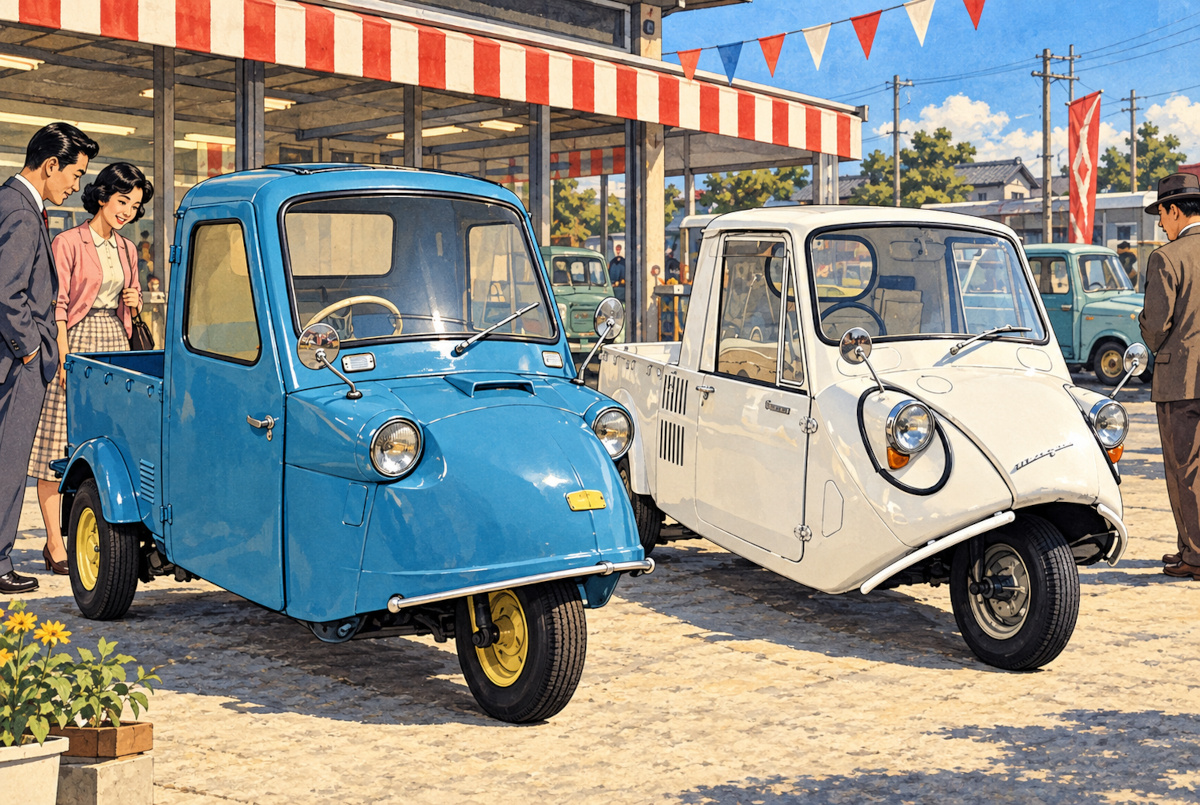
In 1960, Japan’s Daihatsu Midget recorded 86,000 vehicle registrations in a single year. Just three years after its debut, the tiny three-wheeled truck had become a familiar sight on Japanese streets, helped by television commercials featuring comedian Kon Omura.
It sounds like a straightforward success story. But there is an awkward number buried in the production statistics.
Daihatsu’s share of Japanese light three-wheeler production fell from approximately 69% in 1958 to just 45% in 1960. The Midget was booming, yet its manufacturer’s market share was shrinking.
And one of the most important challengers was Mazda’s K360, affectionately nicknamed Kesaburo, which arrived in May 1959.
So what really made the Midget a success? Television advertising? Determined salespeople? The vehicle itself? Or was the three-wheeler market growing so quickly that even a runaway hit could lose ground?
Looking at the numbers alongside the rival manufacturers’ histories reveals a rather different side of Japan’s miniature-truck boom.
The Midget Was Selling Before Its Famous TV Commercials
Introduced in August 1957, the original Daihatsu Midget DKA was an extraordinarily simple working vehicle: a 249cc engine, a 300kg (661lb) payload capacity, motorcycle-style handlebars and seating for just one person.
It occupied a gap between motorcycles used for deliveries and the larger three-wheeled trucks already common in Japan. For a small shopkeeper, it offered a way to carry more goods without buying a conventional truck.
In an interview published by Daihatsu on June 26, 2026, former salesman Ueda recalled visiting a butcher’s business during the summer of 1957. The initial sales pitch was rejected. But when he explained how the Midget could make motorcycle-based deliveries easier, the owner became interested.
According to Ueda’s recollection, the business eventually agreed to purchase Midgets for all 20 of its stores.
The important detail is not merely the number of stores. The salesman was offering a solution to an everyday delivery problem, not trying to sell an amusing novelty with three wheels.
Ueda also recalled that orders were already surging by October 1957, leaving production struggling to keep up.
The celebrated television commercials starring Kon Omura and Juro Sasa did not begin until 1958.
In other words, the Midget had already found genuine commercial demand before television turned it into a household name.
There is an important limitation, however. This account comes from an interview conducted nearly seven decades later. Contemporary monthly order records and delivery documents have not been independently verified here.
The Famous Commercial Began with an Unexpected Substitution
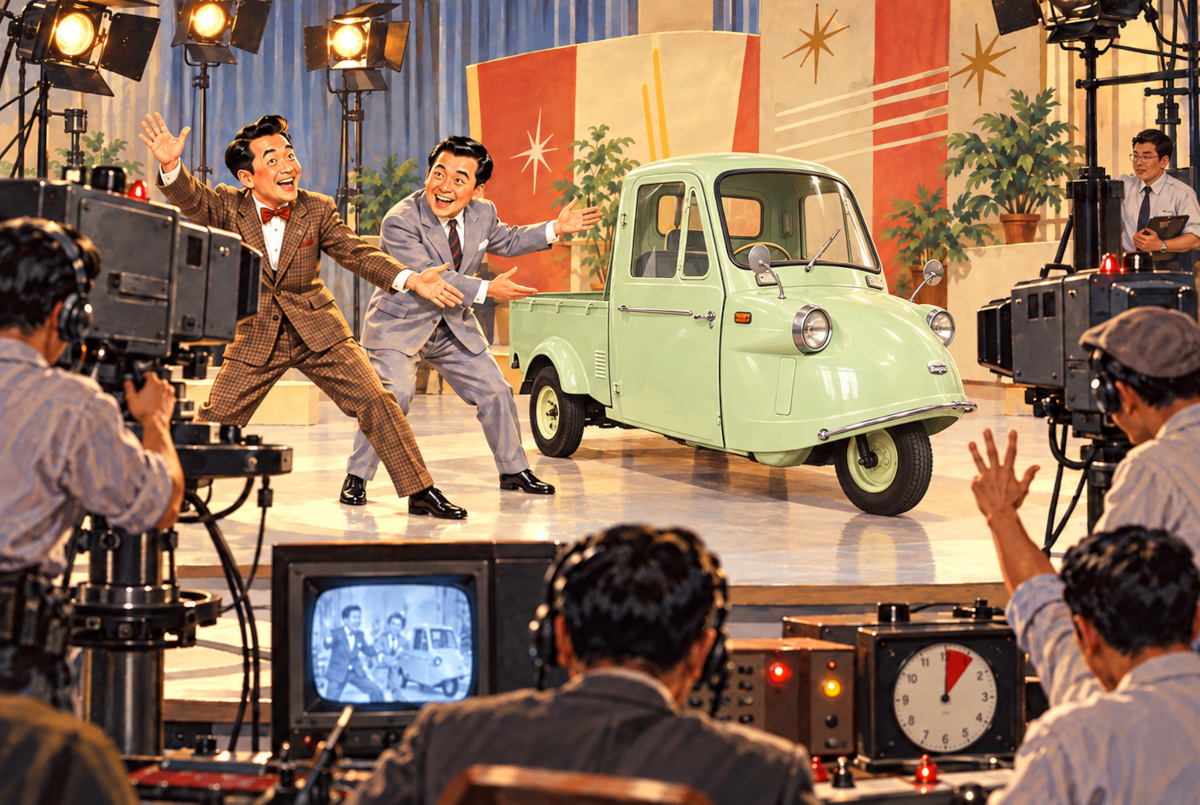
In 1958, the Midget appeared in live commercials associated with Yarikuri Apartment, a Japanese television comedy broadcast by Asahi Broadcasting.
The broadcasts helped turn the little truck into something recognizable far beyond the businesses that might actually need one.
But the origin of the commercial was not quite the carefully planned advertising triumph one might imagine.
In Daihatsu’s 2026 interview, Kon Omura recalled that a female performer originally scheduled for the commercial collapsed shortly before the broadcast. Omura and fellow comedian Juro Sasa were unexpectedly asked to take her place.
They had to perform live, trading lines while watching cue cards indicating how much time remained. Unlike a prerecorded advertisement, there was no opportunity to simply edit out a mistake or run another take.
That gives the famous advertising campaign an appealingly improvised beginning.
Daihatsu’s official company history credits television advertising with dramatically increasing public awareness of the Midget.
But there is a distinction worth making.
Making a vehicle famous is not the same as proving exactly how many additional vehicles the advertisements sold. Without comparable monthly sales data before and after the broadcasts, the sales attributable specifically to television cannot be calculated reliably.
AI-generated historical concept illustration. It represents the atmosphere of a late-1950s live television commercial, not actual broadcast footage or the real performers. The vehicle’s styling and details are not an accurate reconstruction of the 1958 Midget DKA.
Daihatsu Had Also Rebuilt Its Sales Organization
The television campaign is only part of the story.
According to Daihatsu’s official corporate history, the company established a dedicated Light Three-Wheeled Vehicle Sales Department in 1957, the same year the Midget was launched.
It also introduced dealership agreements, sales manuals and more systematic after-sales service arrangements. Product-training sessions and promotional materials, including the Midget Photo News, followed.
These details may sound less glamorous than a television comedian chanting the name of a tiny truck, but they mattered.
Daihatsu was not simply selling a smaller version of an existing commercial vehicle. Its potential customers included neighborhood butchers, liquor retailers, rice merchants and other small businesses that had previously relied on motorcycles for deliveries.
Such customers needed to understand not only what the vehicle could carry, but also how it would fit into their daily work and how it could be maintained.
The evidence suggests three different functions working together.
The product gave businesses a reason to buy. The sales organization made purchasing and ownership practical. Television made the name familiar.
That is an interpretation of their respective roles, not a measured breakdown of sales contributions. The surviving evidence does not allow us to assign each factor a percentage of the Midget’s success.
Mazda’s K360 Arrived with a Steering Wheel from the Start
Then came Toyo Kogyo, the company now known as Mazda.
Its K360 light three-wheeled truck went on sale in May 1959. Nicknamed Kesaburo, it entered a market Daihatsu had already helped transform.
Yet the K360 had an unusually rebellious development history.
According to Mazda’s official centennial history, company president Tsuneji Matsuda initially regarded the small three-wheeler boom as a passing fashion. He wanted engineers concentrating on four-wheeled vehicles instead.
Some engineers disagreed. Convinced that demand for a well-designed light three-wheeler was real, they pursued development without formal approval.
The project reportedly went so far underground that the team enclosed part of the factory with wooden barriers to conceal the prototype work.
For a vehicle as modest as the K360, that is a wonderfully unlikely origin story.
The finished truck was also technically different from the earliest Midget. It featured a 356cc four-stroke V-twin engine, a conventional steering wheel, an enclosed steel cab and a 300kg (661lb) payload capacity.
Daihatsu, meanwhile, introduced its steering-wheel-equipped MP series in 1959, followed by further improvements to passenger accommodation, engine capacity and payload.
The market was clearly moving beyond the simplest possible three-wheeled delivery machine.
However, the available records do not establish that Mazda’s K360 directly caused a particular MP-series engineering decision. Competition between the companies is documented; the precise motivation behind each design change is a separate question.
Daihatsu’s Production Grew Almost Ninefold. Its Share Still Fell.
Now for the statistic that makes this story particularly interesting.
A 2006 study by Shohei Hakoda, Interfirm Competition in Japan’s Postwar Three-Wheeled Vehicle Market, brings together historical production data from Japan’s three-wheeler industry.
Using the figures cited in that study, I recalculated Daihatsu’s share of total domestic light three-wheeler production in 1958 and 1960.
| Production measure | 1958 | 1960 |
|---|---|---|
| Total Japanese light three-wheeler production | 14,002 | 190,975 |
| Daihatsu production | 9,659 | 86,411 |
| Daihatsu’s share of production | Approx. 69.0% | Approx. 45.2% |
Source: Production statistics reproduced in Shohei Hakoda’s study, with market shares recalculated for this article. These figures measure vehicle production, not domestic retail sales or registrations.
Between 1958 and 1960, Daihatsu’s production increased from 9,659 to 86,411 vehicles.
86,411 ÷ 9,659 = approximately 8.9 times
That would be an impressive result by almost any standard.
But production across the entire Japanese light three-wheeler industry grew even faster.
190,975 ÷ 14,002 = approximately 13.6 times
So Daihatsu was dramatically expanding production while the overall market expanded even more dramatically.
The falling share did not mean that the Midget had stopped selling. It meant that other manufacturers were increasing production even faster.
This is the distinction that gets lost when a historical success story is reduced to a famous vehicle and its famous commercial.
A market leader can be booming in absolute numbers and still surrender a substantial portion of its market.
By 1960, Mazda K360 Was Only 12,214 Vehicles Behind
The same academic study cites another historical source giving individual manufacturers’ production figures for 1960.
These figures make the rivalry much easier to visualize.
| Vehicle | 1960 production |
|---|---|
| Daihatsu Midget | 86,690 |
| Mazda K360 | 74,476 |
| Difference | 12,214 |
The Midget remained ahead. But K360 production had already reached approximately 86% of the Midget’s figure.
That is not the picture of one company enjoying an uncontested market while everyone else watches from a distance.
Mazda’s own centennial history reports that its share of Japan’s domestic light three-wheeler market was approximately 30% in 1959, rising into roughly the 40–50% range in subsequent years.
In other words, the little Kesaburo was not merely an obscure alternative remembered by a handful of collectors. It had become a serious rival in one of Japan’s most rapidly expanding commercial-vehicle categories.
Statistical note: Hakoda’s paper reproduces figures from different historical sources. One series gives Daihatsu’s 1960 production as 86,411 vehicles; a separate manufacturer-by-manufacturer comparison gives 86,690 Midgets. The first figure is used for the market-share calculation and the second for the K360 comparison. Daihatsu’s officially reported 86,000 annual registrations are a different measure again. These three figures should not be treated as interchangeable.
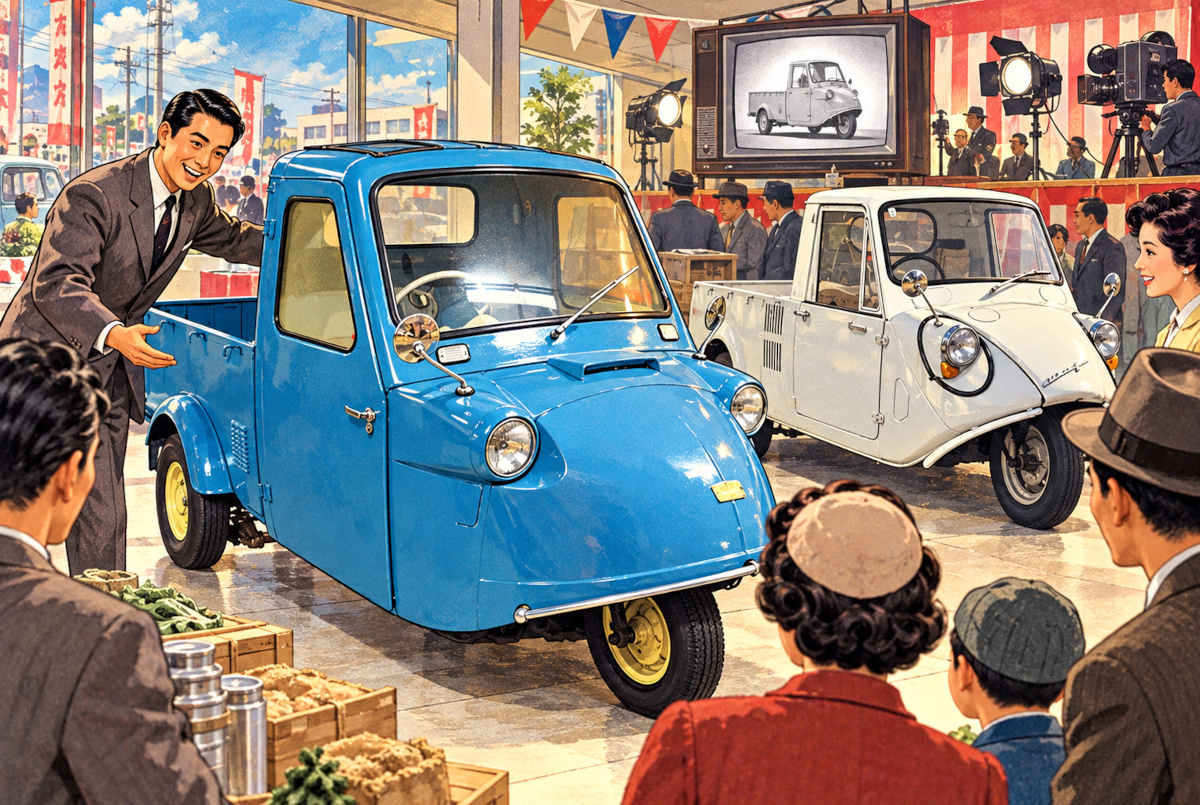
AI-generated comparison illustration inspired by the Daihatsu Midget MP series and Mazda K360 around 1960. The setting is fictional and does not reproduce a documented joint exhibition. Vehicle details are illustrative rather than an exact restoration of a specific model year.
So Who Really Sold the Midget: Television, Salespeople or the Truck Itself?
After comparing the manufacturers’ accounts with the production statistics, attributing the Midget’s success entirely to Kon Omura’s commercials becomes difficult to defend.
The underlying delivery needs existed before those broadcasts. Daihatsu established a dedicated sales organization and improved the way vehicles were marketed and supported. Television then greatly expanded awareness of the Midget.
Meanwhile, Mazda and other manufacturers were rapidly increasing their own light three-wheeler production.
The K360’s success suggests that the broader product category met a genuine demand. But Mazda’s performance cannot, by itself, tell us how many Daihatsu customers were persuaded by television advertising.
There is no reliable basis here for saying the commercials accounted for 30%, 50% or 80% of the Midget’s success.
What the evidence supports is a more complicated picture: a useful product, an organized sales network, effective mass advertising and product development taking place in an increasingly competitive market.
And there was another twist coming.
Japanese light three-wheeler production reached its peak in 1960. Soon afterward, four-wheeled light trucks began taking over the role that vehicles like the Midget and K360 had made their own.
The Midget had helped create an enormous market. But its ultimate challenge would not come from Mazda’s three-wheeler alone.
Editor’s Note
When I started looking into this, I wanted to know how many Midgets Kon Omura’s commercials had actually sold. It seemed like the obvious question. Surely somebody had worked out the numbers.
Apparently not, at least not in the sources I could verify.
Instead, I found the production figures for Mazda’s K360. And that turned out to be more interesting than the neat advertising statistic I had been hoping for.
Think about it. The Midget was a genuine smash hit, yet by 1960 Mazda was already breathing down its neck. Daihatsu kept producing more trucks, but its share of the market kept falling.
Classic-car history has a habit of polishing the winners until everything else disappears from view. We remember the famous name, the catchy commercial and the vehicle that became an icon. The competitors somehow end up as footnotes.
But those competitors were building trucks, selling them and fighting for exactly the same customers.
And I have to admit I love the story of the K360 being developed behind wooden barriers because the boss thought the whole category was a distraction. One little truck became a television celebrity. The other emerged from a factory project that was not supposed to exist.
That is the kind of gloriously untidy industrial history I enjoy.
Maybe the real Midget boom was never about the Midget alone. It was about an entire generation of Japanese manufacturers realizing that a remarkably small truck could become a remarkably big business.
Terms That May Need a Quick Explanation
- Kei vehicle
- A Japanese classification for very small motor vehicles, defined by legal limits on dimensions and engine displacement. The Daihatsu Midget and Mazda K360 belonged to the light three-wheeled commercial-vehicle segment of this category. The applicable size and engine limits have changed over time.
Daihatsu Midget — Four-Part Series
From the sales efforts that preceded its famous TV commercials to the evolution of the DK, DS, and MP models, competition with rival three-wheelers, and the shift to four-wheel kei trucks, we trace the history of the original Daihatsu Midget in four parts.
- Part 1: Before the Famous TV Ad: How a Butcher’s 20 Shops Helped Sell the Daihatsu Midget
- Part 2: From 8 to 12 HP—and Just 5 mm to Spare: The Daihatsu Midget’s Evolution
- Part 3: The Daihatsu Midget Was Booming. So Why Was Mazda K360 Catching Up?
- Final Part: 86,000 Registrations in a Year—Why Did the Daihatsu Midget Disappear? Coming soon
References
- Daihatsu Motor Co., Ltd. — “DAIHATSU 111th HISTORY,” Vol. 3 (Japanese): Official corporate history covering the Midget’s development, sales organization, television advertising, production history and 1960 registration figures.
- Daihatsu Motor Co., Ltd. — “Carrying Big Dreams in a Small Vehicle: The Midget’s Past, Present and Future” (June 26, 2026; Japanese): Interviews with former salesman Ueda about early dealership sales and with comedian Kon Omura about the live television commercials.
- Mazda Motor Corporation — Mazda 100th Anniversary Virtual Museum, Episode 11, “The Light Three-Wheeled Truck Born in a Secret Factory” (Japanese): Official account of the K360’s development, engineering features and domestic market share.
- Mazda Motor Corporation — Corporate History, 1920–1979 (Japanese): Confirms the May 1959 launch of the K360, its 356cc engine and 300kg payload capacity.
- Shohei Hakoda — “Interfirm Competition in Japan’s Postwar Three-Wheeled Vehicle Market,” Otemon Economic Review, Vol. 41, No. 2, 2006, pp. 105–132 (Japanese; translated title): Academic study presenting historical light three-wheeler production statistics and manufacturer-level figures. The market-share calculations and Midget–K360 comparison in this article are based on these data.
- Japan Light Motor Vehicle Inspection Organization — “History of Kei Vehicles” (Japanese): Historical overview of Japan’s light three-wheeler boom, the industry’s 1960 production peak and the subsequent growth of light four-wheeled trucks.