

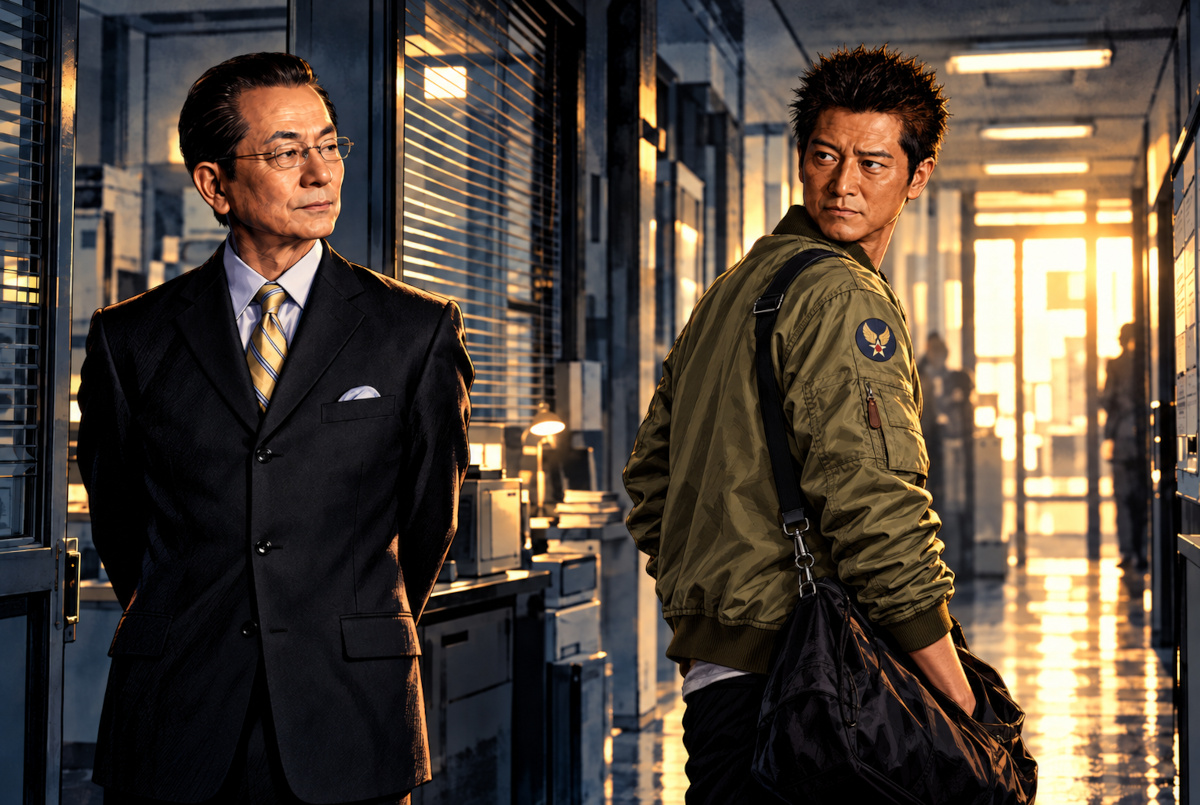
Why did Yasufumi Terawaki leave AIBOU in 2008, just as the Japanese detective series was reaching new heights of popularity?
Terawaki played Kaoru Kameyama, the original partner of Ukyo Sugishita (Yutaka Mizutani) in AIBOU: Tokyo Detective Duo. His departure generated speculation about tensions behind the scenes. Years later, reports revisited rumors that the two actors had fallen out, raising an uncomfortable question: had Terawaki effectively been pushed out?
But in 2023, Mizutani and Terawaki described the departure rather differently. Terawaki recalled leaving to broaden his experience as an actor, while Mizutani explained that he had wanted his colleague to take on leading roles beyond AIBOU.
Here is the odd part. In 2008, the producer had talked about dramatic realism. Fifteen years later, the actors were talking about professional growth. Why did the explanation seem to change?
To find out, I compared the original 2008 announcement, the actors’ later accounts, and the reason Kameyama left within the fictional story. They reveal three different perspectives on the same departure.
Why Remove Kameyama When AIBOU Was at Its Peak?
On August 28, 2008, TV Asahi announced that Terawaki would leave AIBOU during Season 7, which had not even begun airing.
For a popular detective drama built around a familiar partnership, revealing a major cast departure before the season premiere was an unusual decision.
Looking back at a contemporary Nikkan Sports report, the numbers make the announcement even stranger.
Season 6 had achieved an average household television rating of 16.1% in Japan’s Kanto region, a series record at the time. The first AIBOU theatrical film, released in May 2008, had attracted approximately 3.7 million moviegoers and earned ¥4.43 billion at the box office by the time of the August report.
Those were hardly the figures of a failing franchise.
The available numbers do not support a simple explanation that Kameyama was replaced because the series had lost its audience. Quite the opposite: the original partnership was being broken up during an especially successful period.
Motohiro Matsumoto, the show’s chief producer, explained at the time that Kameyama’s departure was necessary in pursuit of realism. He also argued that the success of the film made this an appropriate moment to bring the first phase of Kameyama’s life to a close.
Terawaki’s own public statement was positive in tone. He said he had agreed to leave on good terms, while encouraging viewers to watch how Kameyama’s story would unfold.
Then there is the timing.
The announcement came on August 28. Season 7 premiered on October 22, and Kameyama’s final episode aired on December 17.
Calculating the intervals between those dates gives us:
| Event | Date | Days After Announcement |
|---|---|---|
| Departure announced | August 28, 2008 | 0 |
| Season 7 premiere | October 22, 2008 | 55 days |
| Kameyama’s final episode | December 17, 2008 | 111 days |
These are calendar-day differences, not filming intervals or the time elapsed within the story.
Viewers were told about Kameyama’s departure 111 days before they would see it happen. They even knew it was coming 55 days before the season began.
Matsumoto explained that the production team had wanted to keep the development secret but chose to make a formal announcement because information might otherwise leak. He also described the announcement as a matter of respect for viewers.
Whatever discussions took place privately, the public explanation in August 2008 centered on storytelling and the handling of a major character—not on declining popularity or a feud between the actors.
AI-generated conceptual illustration of a television production office around the time of the 2008 announcement. It does not depict an actual meeting, negotiation or filming session involving the actors.
In 2023, Mizutani Gave a Different Kind of Explanation
On February 22, 2023, TV Asahi released a special interview with Mizutani and Terawaki through the Japanese streaming service TELASA, celebrating the series passing 400 broadcasts.
One of the questions concerned the original partner’s departure.
Mizutani recalled encouraging Terawaki to take on the responsibility of being a leading actor, rather than spend his entire career playing Kameyama alongside him. Taking the lead in another production could bring both success and failure, but Mizutani believed it was an experience Terawaki needed.
Terawaki described his departure using the Japanese expression musha shugyo—literally, a warrior’s training journey. In this context, he meant leaving a comfortable professional partnership to test and develop his abilities elsewhere.
It was an unexpectedly generous explanation for a departure sometimes portrayed as an expulsion.
But does it contradict what the producer said in 2008?
| Source and Year | How the Departure Was Explained |
|---|---|
| 2008 — Production team | Dramatic realism and a turning point in Kameyama’s life |
| 2008 — Yasufumi Terawaki | A public statement accepting the departure in positive terms |
| 2023 — Yutaka Mizutani | A desire for Terawaki to gain experience carrying productions as a leading actor |
| 2023 — Yasufumi Terawaki | A chance to venture out, train and grow as an actor |
At first glance, the story seems to have changed over 15 years. Yet the explanations are not actually answering the same question.
The 2008 producer’s statement addressed why Kameyama, the fictional character, needed to leave the story.
The 2023 interview addressed how Terawaki, the real actor, understood and accepted the move in his career.
A production decision and an actor’s professional motivation are not necessarily competing explanations. Both can be true without revealing every detail of the decision-making process.
This was not merely a one-off recollection. In an official TV Asahi interview dated August 31, 2023, Terawaki again said that Mizutani had sent him off to experience the responsibility of carrying a production as its lead.
That gives us a consistent account from Terawaki in two separate interviews in 2023. It does not, by itself, prove that every private discussion back in 2008 was harmonious.
What About the Feud and Forced-Exit Rumors?
Of course, this is where the old entertainment-tabloid instincts kick in.
A successful television partnership suddenly breaks up. A major character leaves. The official explanation sounds almost too tidy. It is exactly the sort of situation that makes people wonder what happened behind closed doors.
On June 24, 2022, the Japanese magazine Josei Jishin revisited reports of friction between Mizutani and Terawaki, along with claims of disagreements involving production staff. The reporting included accounts attributed to unnamed people with knowledge of the production.
Those reports are relevant to the history of the rumors. But they do not establish how serious any disagreement actually was, or whether it directly caused Terawaki’s departure.
The distinction works in both directions. Mizutani and Terawaki’s friendly statements in 2023 cannot prove that no disagreement ever occurred during production in 2008, either.
There is, however, documented evidence of their later relationship.
When his return to AIBOU was announced in 2022, Terawaki described Mizutani as a mentor in his acting career. In 2023, both men publicly discussed the circumstances of the earlier departure. TV Asahi’s interviews also described their reunion and continued professional rapport.
Based on the material examined here, there is insufficient evidence to state as fact that Mizutani forced Terawaki out because of a personal feud.
That is not quite the same as declaring the rumor definitively false. It means that a serious accusation should not be treated as an established fact without evidence strong enough to support it.
Why Did Kameyama Leave for Salween in the Story?
So far, we have been discussing the actors and the television production. But Kameyama’s fictional departure has its own explanation—and it was not improvised at the last moment.
In Season 7’s opening two-part story, “Kanryu,” broadcast on October 22 and 29, 2008, Kameyama encountered an old high school friend named Kanetaka, who was subsequently murdered.
The investigation exposed misconduct involving international aid supplies intended for Salween, a fictional South Asian country in the AIBOU universe.
The case also involved Beizo Setouchi, a former Japanese Minister of Justice. Kameyama’s friend had been working to support people in Salween, and his death became a turning point in Kameyama’s thinking about his own future.
Several weeks later came the two-part story “Level 4,” broadcast on December 10 and 17, involving a murder plot with a deadly virus.
After that investigation, Kameyama resigned from the police and left Japan with his wife, Miwako, to continue his late friend’s work in Salween.
He was not simply reassigned from Sugishita’s unit. He chose to leave the police organization altogether.
Within the fictional story, Kameyama traded a police career for another way of pursuing justice: working with children and supporting a community overseas.

AI-generated illustration imagining educational and community work in Salween, a fictional country in AIBOU. It is not an actual scene from the series or a depiction of a real school.
There is an especially strange twist to this story.
When Kameyama returned to Japan in Season 21 in 2022, his homecoming followed events that resulted in his expulsion from Salween. One of his former students, who had become a leader in the country’s new political order, ordered him to leave.
So the character who was widely discussed as having been “pushed out” of AIBOU in 2008 actually received an expulsion order within the fictional story 14 years later.
The irony is almost too neat for a detective series: in 2008, Kameyama voluntarily left the police; in 2022, he was forced to leave Salween.
Was the 2008 Departure Really an Expulsion?
After separating the evidence, three distinct accounts emerge.
First, the production team said it wanted to move the series into a new phase while giving Kameyama’s life a credible turning point.
Second, Mizutani and Terawaki later described the actor’s departure as an opportunity for professional development beyond the series.
Third, within the fictional world, Kameyama chose to honor his friend’s memory and pursue justice through humanitarian and educational work instead of policing.
These are different explanations from three different perspectives: production, performer and character.
They do not establish who had the final say in every private production discussion. Nor do they explain every personal relationship behind the cameras.
What they do show is that the popular “forced out” narrative goes further than the verified evidence supports.
It is not justified to conclude that Terawaki was expelled because of a feud. But the available record also cannot prove that every part of the separation was entirely amicable.
That less sensational distinction may be closer to the truth than either an entertainment-industry conspiracy or a perfectly polished farewell story.
Editor’s Note
The thing that bothered me from the start was simple: why would a network break up a winning detective duo?
A 16.1% average household rating. A theatrical film that had already taken ¥4.43 billion at the box office. Those are the numbers of a hit, not a show desperately searching for a replacement cast.
If I had been writing for an old-school entertainment gossip magazine back in 2008, I’d probably have been circling that decision in red ink. Something must have happened, right?
Then you read what the two actors said 15 years later, and suddenly the story is about leaving to gain experience rather than being thrown out.
And in the drama itself, Kameyama was not pushed away. He made a choice to do something else with his life.
Still, I don’t want to turn the whole business into a heartwarming tale just because the later interviews sound reassuring. We don’t know everything that was said in the production offices back then. A polished public statement is not a transcript of a private meeting.
What strikes me as even stranger is what happened afterward. The show let its original partner go at the height of its popularity, brought him back in 2022, and then announced in 2026 that he would hand the role over to Takeru Kanbe—the very man who succeeded him the first time.
Most television series have a habit of disposing of characters once they’re gone. AIBOU seems to do the opposite. It keeps their pasts available for future stories.
Maybe that is one of the reasons the show has lasted so long.
AIBOU: The Partner Switch $2014 Four-Part Series
Why is Takeru Kanbe returning after Kaoru Kameyama? Across four articles, we examine the 2008 departure, the rumors surrounding Kanbe's exit, and what the 2026 handover could mean for the long-running detective series.
- Part 1: AIBOU Is Going Back to 2009—Why Bring Back Takeru Kanbe?
- Part 2: Was AIBOU’s Original Partner Forced Out? The 2008 Exit Revisited
- Part 3: Was Mizutani Really Furious With Oikawa? Revisiting AIBOU’s 2012 Exit Rumors Coming soon
- Final Part: Was AIBOU Supposed to End with Kameyama? What Mizutani Actually Said Coming soon
References
- TV Asahi — AIBOU: Tokyo Detective Duo (Official English Program Guide) — English title, character names and Kameyama’s relocation to Salween.
- ORICON NEWS, August 29, 2008 — Announcement of Yasufumi Terawaki’s Departure from AIBOU — Contemporary Japanese report including producer Motohiro Matsumoto’s explanation.
- Nikkan Sports, August 29, 2008 — Yasufumi Terawaki to Leave AIBOU — Original Japanese report documenting the advance announcement, the 16.1% rating, ¥4.43 billion in box office revenue, attendance figures and statements from the cast and producer.
- TV Asahi, February 22, 2023 — Special Interview with Yutaka Mizutani and Yasufumi Terawaki — Official Japanese announcement of the interview marking AIBOU’s 400th broadcast.
- ORICON NEWS, February 22, 2023 — Mizutani and Terawaki Explain the Original Partner’s Departure — Japanese report detailing the actors’ comments about leading roles and professional growth.
- TV Asahi, August 31, 2023 — Official Season 22 Interviews with Mizutani and Terawaki — Terawaki’s reflections on Mizutani’s advice and their working relationship.
- Josei Jishin, June 24, 2022 — Rumors Surrounding Terawaki’s Earlier AIBOU Departure — Japanese entertainment reporting about alleged disagreements. Anonymous claims are cited as reports, not established facts.
- TV Asahi — AIBOU 300th-Episode Special Archive — Official retrospective of the Season 7 “Kanryu” storyline, Kanetaka’s death and the aid-supplies scandal involving former justice minister Beizo Setouchi.
- TV Asahi — Ukyo Sugishita and His Partners: Official Character History — Kameyama’s departure for Salween, later expulsion and eventual return to Japan.
- TV Asahi Post, June 23, 2022 — Yasufumi Terawaki Returns to AIBOU After 14 Years — Official comeback reporting and Terawaki’s description of Mizutani as a mentor.
- TV Asahi, October 13, 2026 — Season 25 Partner Handover Announcement — Confirmation of Kameyama’s upcoming handover to Takeru Kanbe.