

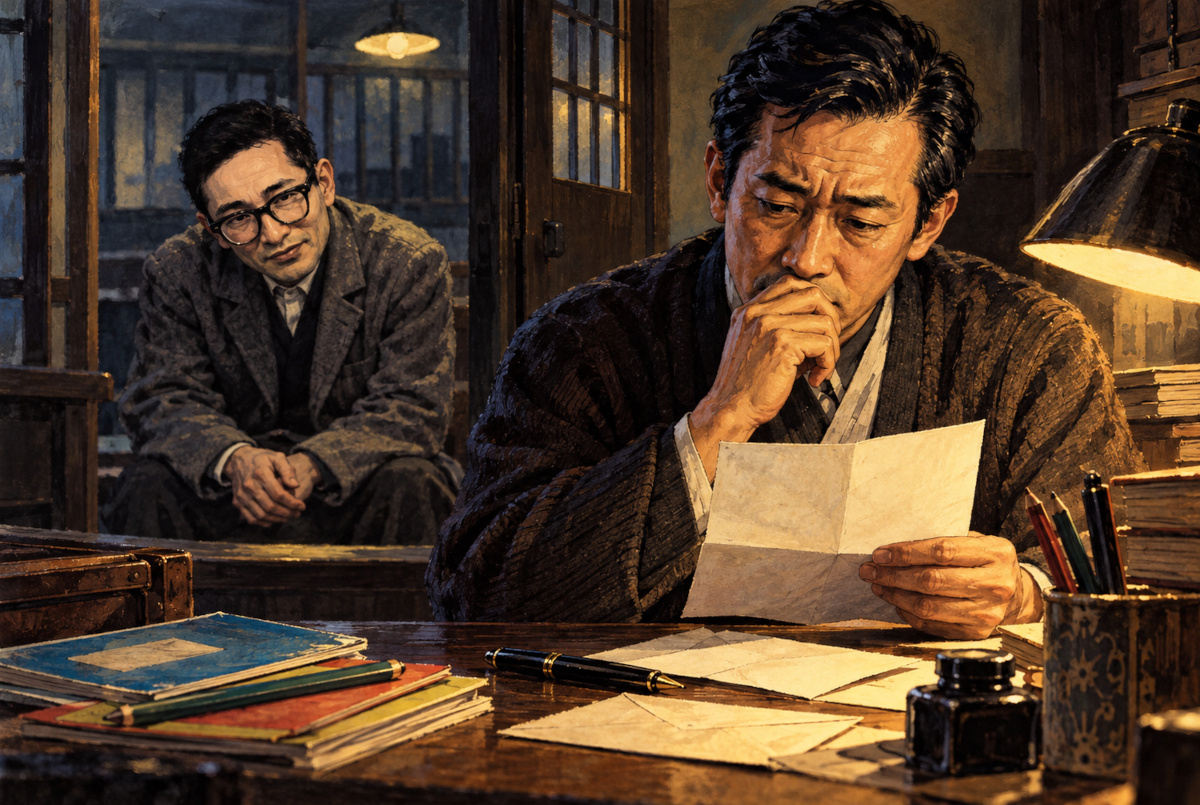
On January 3, 1964, Japanese serial killer Akira Nishiguchi was arrested at the home of religious activist Tairyu Furukawa in Tamana, Kumamoto Prefecture.
According to later reports, Nishiguchi had intended to murder the Furukawa family, steal money intended for Furukawa’s activities, and escape to Okinawa. However, the original interrogation records have not been independently verified for this article, so the precise details of that alleged plan remain unconfirmed.
What is beyond dispute is that a man who had already murdered five people had been staying dangerously close to the Furukawa family.
That should have been the end of their relationship.
Except it wasn’t.
Furukawa reportedly continued corresponding with Nishiguchi after his arrest. He also maintained contact with the killer’s family and even helped pay for his children’s education.
Why would anyone go to such lengths for a man who had endangered his own family? And is helping a convicted murderer necessarily the same as forgiving his crimes?
To understand Furukawa’s decision, I went looking for evidence from after the arrest. Unexpectedly, one of the most revealing records came from 224 days before Nishiguchi even appeared at his door.
Furukawa Was Already Challenging Prison Authorities Before Nishiguchi’s Arrest
Tairyu Furukawa was a religious figure who had served as a prison chaplain at Fukuoka Prison since 1952.
One of his major causes was the campaign to reopen the criminal proceedings arising from the 1947 Fukuoka Case, a separate murder case involving two condemned prisoners.
A distinction is essential here: Takeo Nishi, one of the prisoners in the Fukuoka Case, was not Akira Nishiguchi. They were different men involved in entirely separate crimes.
Takeo Nishi denied involvement in the Fukuoka Case. Another condemned prisoner, Kenjiro Ishii, acknowledged firing a gun but maintained that the circumstances involved self-defense or an unintended killing.
Furukawa investigated the case himself, became convinced that the convictions deserved to be challenged, and began campaigning for retrials and clemency.
His activities eventually attracted the attention of Japan’s Parliament.
On May 23, 1963, the matter was discussed by the Committee on Judicial Affairs of the House of Councillors, the upper chamber of Japan’s National Diet.
During the hearing, officials from the Ministry of Justice acknowledged that the prison authorities had asked Furukawa to relinquish responsibility for providing religious guidance to Nishi and Ishii.
The conflict was not difficult to understand. Prison officials regarded religious guidance for condemned inmates as a means of protecting religious freedom and helping them maintain emotional stability. Furukawa, meanwhile, was actively challenging the validity of their convictions.
But there was an important qualification.
The authorities were not seeking to remove Furukawa from every chaplaincy assignment. They still wanted him to provide religious guidance to other prisoners.
In July 1963, Furukawa also published his own investigation into the Fukuoka Case. The National Diet Library’s catalogue identifies the work as a privately circulated report titled Kyusenman-nin no Naka no Kodoku, part of a longer Japanese title concerning his investigation into the murders.
Now consider the dates.
The parliamentary hearing took place on May 23, 1963. Nishiguchi arrived at the Furukawa residence on January 2, 1964.
Count the calendar days between those dates and the result is 224 days.
Furukawa had been publicly defending condemned prisoners long before Nishiguchi entered his life. His later involvement with the killer was not a sudden transformation into a saint after a dramatic arrest.
It was connected to work he had already been doing, even when that work brought him into conflict with prison authorities.
Why Did Furukawa Also Help Nishiguchi’s Children?
So what happened after the arrest?
A 2026 article published by Bunshun Online describes Furukawa’s continued correspondence with Nishiguchi, connecting it to his belief that criminal behavior reflected a sickness of the human spirit.
A 2019 episode of Fuji Television’s Unbelievable (Kiseki Taiken! Unbelievable) also reported that Furukawa maintained contact with Nishiguchi’s family and helped cover educational expenses for the killer’s children.
The program further described Nishiguchi as repeatedly expressing gratitude toward Furukawa while in prison.
There are limits to what these sources establish. The complete correspondence, the exact number of letters, and the total amount or duration of educational assistance could not be confirmed from original records examined for this article.
Those details therefore remain accounts presented in later reporting, not independently established facts.
But another question is worth asking: were all the people Furukawa supported in the same position?
They were not.
| Person or Group | Furukawa’s Involvement |
|---|---|
| Takeo Nishi and Kenjiro Ishii, prisoners in the Fukuoka Case | Questioned their convictions and campaigned for retrials and clemency |
| Akira Nishiguchi, convicted serial killer | Reportedly maintained correspondence after his arrest |
| Nishiguchi’s children | Reportedly maintained contact with the family and helped pay educational expenses |
This comparison was assembled by our editorial team from the parliamentary record and subsequent reporting. It matters because the three forms of assistance addressed different issues.
In the Fukuoka Case, Furukawa questioned whether the courts had reached the correct conclusions.
With Nishiguchi, he apparently chose to maintain human contact with someone whose crimes he was not attempting to erase or excuse.
And Nishiguchi’s children were not responsible for their father’s murders in the first place.
How society treats a convicted murderer and how it treats that murderer’s children are two fundamentally different questions.
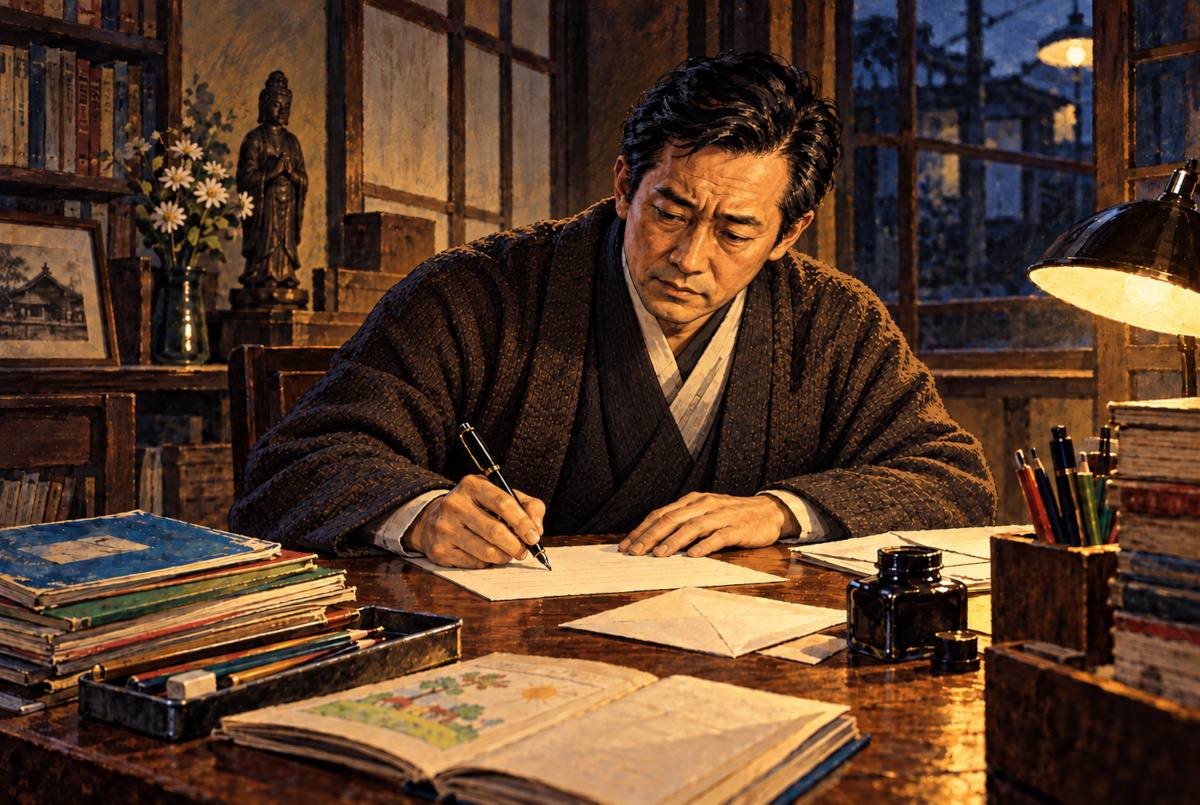
Furukawa reportedly continued corresponding with Nishiguchi and helped pay educational expenses for his children. AI-generated conceptual illustration. The man is not a faithful portrait of Tairyu Furukawa, and the study, letters and school supplies are not reproductions of actual items involved.
But Five Murder Victims Were Still Dead
At this point, the story could easily become a heartwarming account of extraordinary compassion.
That would be a mistake.
In 1963, Nishiguchi murdered two people in Fukuoka Prefecture, two in Shizuoka Prefecture, and one in Tokyo: five victims in all. Those deaths are recorded in the National Police Agency’s official history of the case.
Whatever gratitude Nishiguchi may have expressed, none of those five people could be brought back.
Nor is there sufficient evidence in the materials examined here to establish how the victims’ surviving relatives regarded Furukawa’s relationship with Nishiguchi.
It would be entirely unjustified to write that the victims’ families had forgiven him simply because Furukawa continued corresponding with him.
These are separate moral questions, and they deserve to remain separate.
Recognizing a convicted person’s humanity does not cancel responsibility for murder. Helping an offender’s children does not reduce the suffering of the victims or their families.
Whether Furukawa made the right choice is something readers may reasonably disagree about.
But reducing the story to a simple tale of forgiveness would conceal precisely what makes it so difficult.
A Death Sentence, an Execution, and a Question the Letters Cannot Answer
Nishiguchi was sentenced to death by the Kokura Branch of the Fukuoka District Court in December 1964.
The sentence was upheld on appeal in 1965.
According to subsequent case chronologies, Nishiguchi withdrew his own appeal to Japan’s Supreme Court on August 15, 1966, allowing the death sentence to become final.
That distinction is important. His sentence did not become final because the Supreme Court delivered a new judgment upholding his conviction. The finality followed his withdrawal of the appeal.
Nishiguchi was executed on December 11, 1970. That date also appears in Kodansha’s biographical reference dictionary, Nihon Jinmei Daijiten.
Later accounts describe Nishiguchi expressing thanks to Furukawa during his imprisonment. But they cannot tell us exactly what effect any particular letter had on his thinking.
To declare that Furukawa completely reformed him would go beyond the available evidence.
So would the opposite claim: that every expression of gratitude was merely another act of manipulation.
Neither conclusion is established.
What interests me more is not whether Furukawa could prove that Nishiguchi had changed.
It is that he reportedly continued reaching out to a man without knowing whether that man would ever genuinely change.
There is a difference between hoping someone can become better and pretending that person has done no wrong.
1975: A Novel. 1979: A Film. A Real Crime Becomes a Story.
Nishiguchi’s death did not mark the end of public interest in his crimes.
In 1975, author Ryuzo Saki published Vengeance Is Mine (Fukushu Suru wa Ware ni Ari) through Kodansha.
The novel won the 74th Naoki Prize, one of Japan’s major literary awards.
On April 21, 1979, director Shohei Imamura’s film adaptation was released, starring Ken Ogata.
In the film, the character based on Nishiguchi is named Iwao Enokizu.
Both the original novel and the film offer interpretations of the killer’s behavior, his family relationships, and the society around him.
That is part of what makes such works compelling.
But a dramatized scene or line of dialogue cannot automatically be treated as something the real Nishiguchi said or did.
There is another uncomfortable point here.
The more celebrated a film about a notorious killer becomes, the more memorable the killer himself may become. His appearance, personality and behavior can dominate the audience’s memory.
Yet the five people who died were not characters created to serve a film’s plot. They were real people whose lives ended because of his crimes.
It should be possible to appreciate a major work of cinema while still refusing to let the artistic portrayal overshadow the actual victims.
Perhaps that is the final challenge this case leaves us with: how to examine the humanity of the offender without allowing his story to swallow everyone else’s.

Ryuzo Saki’s novel Vengeance Is Mine, inspired by the Nishiguchi case, was adapted into a 1979 film directed by Shohei Imamura. AI-generated illustration of a fictional late-1970s projection room. The projectionist is neither Akira Nishiguchi nor Tairyu Furukawa. The image does not reproduce the film’s actual footage, equipment or projection procedures.
Editor’s Note
My first reaction to this story was pretty simple: the man reportedly wanted to kill your family, and you’re still writing letters to him?
If it had been my family, I would have wanted nothing more to do with him.
Then I started digging into Furukawa’s history.
It turned out he had been working with condemned prisoners and challenging prison authorities long before Nishiguchi came along. He didn’t suddenly turn into a saint because a notorious killer appeared at his front door.
That changes how I look at his decision.
But something still bothers me more than the question of whether Nishiguchi was genuinely grateful.
What about the five people he killed?
We can discuss letters, repentance, children receiving educational support, and an extraordinary act of compassion. Fine. Those things deserve examination.
But if we end the story there, with everyone feeling moved, what happens to the victims?
At the same time, punishing Nishiguchi’s children for what their father did makes no sense to me. Why should a child lose the chance to study because a parent committed murder?
Whether you forgive a killer and whether you help that killer’s children are not the same question.
And then there is one last irony.
Nishiguchi repeatedly borrowed respectable identities, including those of a university professor and a lawyer, to make people trust him.
Furukawa, meanwhile, reportedly kept reaching out even after the man’s true identity was beyond doubt.
One man exploited other people’s trust. The other tried to work out what could be done for someone who had demonstrated just how little he deserved it.
That is quite a contrast.
Still, I refuse to turn this into a neat little story about the beauty of forgiveness. Five people were murdered. That fact must remain in the picture.
Only then does Furukawa’s decision become something worth wrestling with rather than just another comforting anecdote about human goodness.
Terms That May Need a Quick Explanation
- Prison Chaplain (Kyokaishi)
- In Japan, a kyokaishi is a religious figure who provides spiritual and religious guidance to inmates in prisons or detention facilities, generally in response to their religious needs. The role is distinct from that of a defense lawyer or legal representative pursuing a retrial.
The Girl Who Ended a 78-Day Manhunt: The Akira Nishiguchi Case $2014 Four-Part Series
A fifth-grader recognized a wanted killer posing as a lawyer. Across four articles, we trace her discovery, Nishiguchi's deceptions and crimes, the police response to his arrest, and the human story that followed.
- Part 1: The Adults Trusted a Fake Lawyer. Why Did a Fifth-Grader Suspect Him? — The Akira Nishiguchi Case
- Part 2: Professor, Lawyer, Five Murders: Akira Nishiguchi’s Bizarre 78-Day Crime Spree
- Part 3: 21 Police Officers Outside, None Inside: What Went Wrong in Akira Nishiguchi’s Arrest?
- Final Part: Why Did Tairyu Furukawa Keep Writing to Akira Nishiguchi, the Killer His Family Exposed?
References
- National Diet Library, House of Councillors Committee on Judicial Affairs, Meeting No. 14, May 23, 1963 (Japanese) — Primary parliamentary record documenting Furukawa’s prison chaplaincy, his activities concerning the Fukuoka Case, and the Ministry of Justice’s explanation of why he was asked to withdraw from working with Takeo Nishi and Kenjiro Ishii. See especially statements 60, 64 and 81–83.
- National Diet Library Search, Tairyu Furukawa’s 1963 Investigative Report on the Fukuoka Case (Japanese) — Bibliographic record of Furukawa’s privately circulated report, published in July 1963 by Cosmos-sha. Confirms that he had documented his investigation before the Nishiguchi arrest.
- Fukuoka Case Student Support Group, History of the Retrial Campaign (Japanese) — Account from a group involved in the campaign, describing the Furukawa family’s work, the support offered to Nishi and Ishii, and subsequent developments in the separate Fukuoka Case.
- Television Nishinippon, Document Kyushu: The Fukuoka Case and the Campaign for Retrial (Japanese) — Documentary material explaining the differing claims of Takeo Nishi and Kenjiro Ishii.
- National Police Agency of Japan, Police White Paper 2000, Chapter 1 (Japanese) — Official account of Nishiguchi’s series of robberies and murders, including the five victims and the wider criminal investigation.
- Fuji Television, Kiseki Taiken! Unbelievable, May 30, 2019: The Terrifying Visitor and the Family’s Decision (Japanese) — Later television reconstruction discussing Nishiguchi’s alleged plan involving the Furukawa family and reports that Furukawa supported Nishiguchi’s children after the arrest.
- Bunshun Online, May 3, 2026: The Young Girl Who Recognized a Wanted Serial Killer (Japanese) — Secondary historical reporting on the encounter at Furukawa’s home, the arrest, and the subsequent relationship between Furukawa and Nishiguchi.
- Kodansha, Digital Edition of Nihon Jinmei Daijiten+Plus, Entry on Akira Nishiguchi (Japanese) — Biographical reference recording the date of Nishiguchi’s execution as December 11, 1970.
- National Diet Library Search, Ryuzo Saki, Vengeance Is Mine, Kodansha, 1975 (Japanese) — Bibliographic record confirming the original novel’s author, publisher and year of publication.
- Society for the Promotion of Japanese Literature, Complete List of Naoki Prize Winners (Japanese) — Official listing confirming Vengeance Is Mine as the winner of the 74th Naoki Prize.
- Shochiku, Vengeance Is Mine: Official Film Information (Japanese) — Confirms the April 21, 1979 release, director Shohei Imamura, lead actor Ken Ogata, and the fictional protagonist Iwao Enokizu.