


On January 2, 1964, a man claiming to be a lawyer from Tokyo visited the home of Tairyu Furukawa, a religious activist in Tamana, Kumamoto Prefecture, Japan.
The visitor said he wanted to help Furukawa’s efforts to overturn wrongful convictions. He even knew the names of people connected to Furukawa’s work. To his host, the man seemed like a welcome ally.
But Furukawa’s daughter, a fifth-grade schoolgirl, was not convinced.
She told her family that the visitor looked remarkably like a wanted murderer whose photograph she had seen before.
The visitor was Akira Nishiguchi, a fugitive who had already killed five people while evading police across Japan.
Why did the adults trust a man whom a schoolgirl immediately suspected? And what, exactly, made this supposed lawyer so convincing?
The answer is more unsettling than a simple story about a clever child catching a criminal. It reveals how easily familiar names, professional credentials and even good intentions can be used to manufacture trust.
Five Murders, Twelve Other Crimes, and a New Identity as a Lawyer
According to the Japanese National Police Agency’s Police White Paper 2000, Nishiguchi committed three separate robbery-murder incidents between October and December 1963, killing five people in Fukuoka, Shizuoka and Tokyo.
During a period of 78 days before his capture, he was also responsible for two thefts and ten fraud offenses, according to the same official account.
He stole money, killed people and moved on under borrowed identities. Even while committing serious crimes, he continued the performance of being someone respectable. It was a particularly vicious combination.
In early January 1964, his attention turned to Tairyu Furukawa.
Furukawa was involved in religious counseling for prisoners under sentence of death and campaigns to help people he believed had been wrongfully convicted. Those efforts required financial support, and he had devoted considerable personal resources to them.
Then a lawyer supposedly arrived from Tokyo offering assistance.
It would be tempting to dismiss Furukawa as someone fooled by the prospect of easy money. But that would miss the point.
Furukawa was looking for help with a cause he considered important, not a personal windfall. Nishiguchi appears to have exploited not merely a desire for money, but a man’s deeply held convictions.
The Most Disturbing Detail: The Lawyers’ Names Were Real
Here is where the impersonation becomes especially interesting.
On February 4, 1964, the National Police Agency commissioner testified before the House of Councillors Committee on Judicial Affairs, part of Japan’s national parliament, the Diet.
He explained that Nishiguchi had used a business card bearing the name of a lawyer called Kawamura and a letter of introduction associated with another lawyer named Kondo.
When police contacted Tokyo, they discovered that both lawyers actually existed.
But one was at home, not in Kumamoto, while the other denied having written the introduction.
That distinction matters.
Confirming that a lawyer exists is not the same as confirming that the person standing in front of you is that lawyer.
There was another possible ingredient in this elaborate performance.
In a 2019 reconstruction of the case, Fuji Television reported that Nishiguchi had stolen New Year’s greeting cards addressed to the Furukawa family and used the names on them to sound familiar with their acquaintances.
This detail comes from a later television account rather than the parliamentary testimony examined here, so it should not be treated as an independently verified part of the official record.
Still, if the account is accurate, it shows how deliberately he prepared his approach.
A genuine lawyer’s name. An apparent introduction from another professional. Knowledge of the family’s acquaintances. A promise to support a cause they cared about.
The visitor was not relying on one convincing lie. He was surrounding himself with details that made his story appear credible.

The lawyer’s business card, introduction letter and familiar names helped create an impression of legitimacy. AI-generated conceptual illustration, not actual evidence from the case. The documents, stationery and postal designs are not precise reproductions of items from 1964.
The Adults Saw Credentials. The Girl Recognized a Face.
Meanwhile, Furukawa’s daughter, known as Ruriko, had been paying attention to something quite different.
According to later accounts, she had repeatedly seen Nishiguchi’s wanted photograph on a public noticeboard along her route to school.
When the supposed lawyer arrived, his face looked familiar.
Some published accounts say she recognized two distinctive moles on his face. Fuji Television’s version describes marks or blemishes instead.
The descriptions differ, and there is no reason to pretend that every detail has been conclusively established. What the accounts share is that the girl recognized similarities between the visitor and the wanted photograph.
Now compare the information the adults and the girl were using.
| What Made the Adults Trust Him | What Made the Girl Suspicious |
|---|---|
| He claimed to be a lawyer from Tokyo. | His face resembled a wanted man’s photograph. |
| He knew the names of Furukawa’s acquaintances. | His facial features seemed to match the photograph. |
| He offered help with the wrongful-conviction campaign. | She remembered the image of the fugitive she had seen before. |
This comparison was assembled by our editorial team from the available accounts. It does not mean every adult remained convinced until the end.
After hearing his daughter’s warning, Furukawa began paying closer attention. The visitor’s legal knowledge and behavior no longer seemed quite right. Furukawa also examined the wanted photograph and came to share the family’s suspicions.
The girl did not need some extraordinary ability to detect lies.
The adults initially evaluated the visitor through his credentials, conversation and apparent connections. She compared his face against an image already stored in her memory.
They were judging the same stranger using different kinds of evidence.
And in this case, the visual clue proved more useful than the impressive professional story.
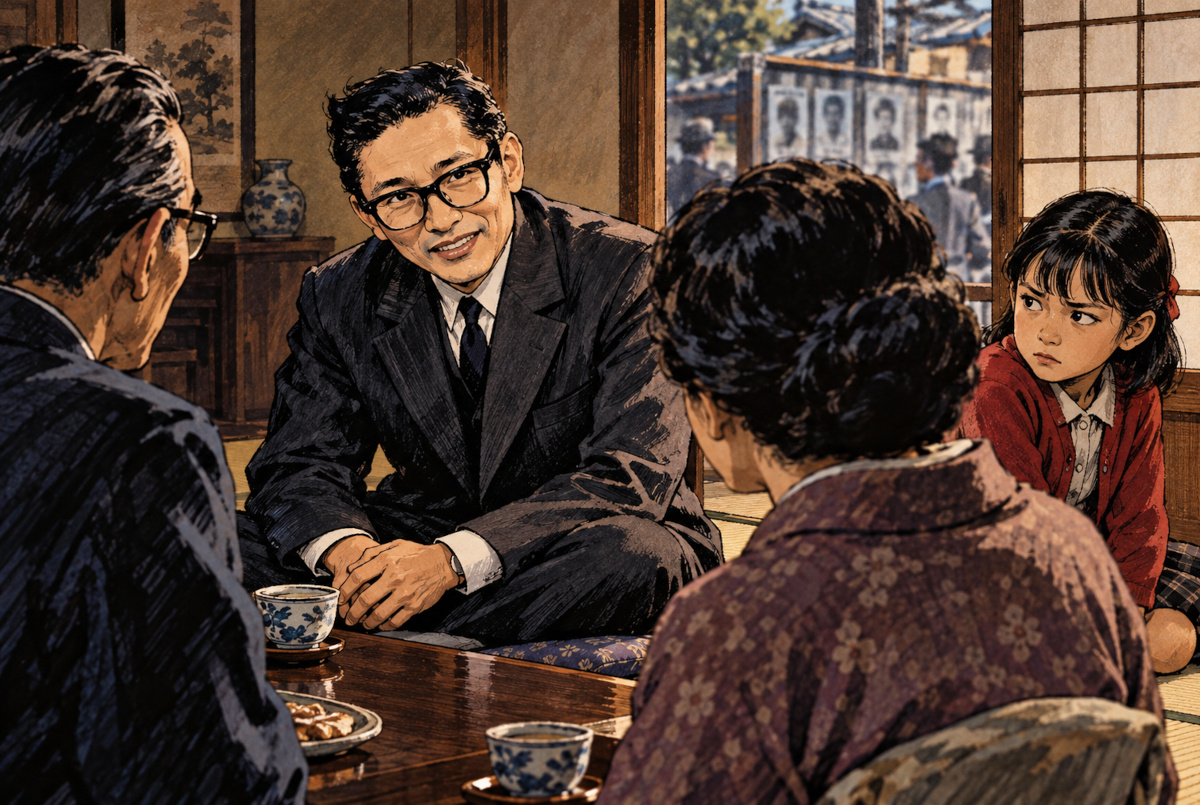
Conceptual illustration of the contrast between the adults’ initial trust and the girl’s suspicions. The wanted photographs outside the window symbolize her memory; their placement does not represent the actual scene. AI-generated artwork that does not reproduce the real people, house or seating arrangements.
Four and a Half Hours After the Report, the Killer Was Still in the House
Once the Furukawa family became suspicious, they faced a dangerous problem.
They needed to contact police without alerting a fugitive suspected of multiple murders.
They allowed Nishiguchi to stay overnight. Family members gathered in a separate room and fitted a lock to its door as a precaution before contacting the police.
The events that followed can be reconstructed from testimony given to Japan’s House of Councillors on February 4, 1964.
The family contacted police at approximately 11:30 p.m. on January 2.
At about 1:30 a.m. on January 3, the first five police officers took up positions outside the property. Four more arrived around 1:50 a.m., with additional officers following.
At approximately 4:00 a.m., officers signaled to the family inside.
Subtracting the reported times gives a striking figure:
About four hours and thirty minutes passed between the family’s report and the police signal to those inside the house.
But there is an important distinction here.
Fuji Television’s 2019 reconstruction describes police arriving after 4:00 a.m. Yet the parliamentary testimony says the first five officers had already begun watching the property around 1:30 a.m.
That gives us two different intervals:
- From the family’s report to the first outside police deployment: approximately two hours.
- From that deployment to the signal to the family: approximately two and a half hours.
In other words, the family was not necessarily waiting four and a half hours for the first officers to arrive.
Police being outside the house and the family knowing they were there were two very different things.
The officers were not simply doing nothing. They were checking the visitor’s claimed identity and gradually positioning personnel around the property.
Nevertheless, from the family’s perspective, a suspected serial killer remained under the same roof while they waited for clear contact from the authorities.
Questions about how the police handled this situation were later raised in Japan’s parliament. The details deserve their own investigation and will be examined in Part 3 of this series.
Nishiguchi was taken into custody and arrested on January 3, 1964.
The girl’s initial suspicion had become a crucial step in bringing the 78-day crime and flight to an end.
Editor’s Note
My first reaction to this story was rather uncharitable: why on earth would anyone trust such a suspicious-looking lawyer?
Then I looked into the details, and that easy explanation started falling apart.
The man used the names of real lawyers. He appeared to know people his host knew. He offered to help with a cause that meant a great deal to the family.
That’s a nasty piece of work.
It’s easy enough to understand a scammer targeting someone who dreams of getting rich overnight. But this case raises a more uncomfortable possibility: what happens when the thing being exploited is not greed, but a sincere desire to help somebody?
And I have to admire the girl’s observation.
While the adults were listening to an impressive professional introduction, she was looking at the face behind it. Something did not add up, and she refused to ignore it.
Perhaps the person a con artist should fear most is not someone armed with complicated arguments, but someone willing to question the basic story.
A respectable title. A convincing business card. The wrong face.
More than sixty years later, variations on that old confidence trick have hardly disappeared. Human trust remains a wonderfully useful thing, and an alarmingly easy thing to misuse.
The Girl Who Ended a 78-Day Manhunt: The Akira Nishiguchi Case $2014 Four-Part Series
A fifth-grader recognized a wanted killer posing as a lawyer. Across four articles, we trace her discovery, Nishiguchi's deceptions and crimes, the police response to his arrest, and the human story that followed.
- Part 1: The Adults Trusted a Fake Lawyer. Why Did a Fifth-Grader Suspect Him? — The Akira Nishiguchi Case
- Part 2: Professor, Lawyer, Five Murders: Akira Nishiguchi’s Bizarre 78-Day Crime Spree
- Part 3: 21 Police Officers Outside, None Inside: What Went Wrong in Akira Nishiguchi’s Arrest? Coming soon
- Final Part: Why Did Tairyu Furukawa Keep Writing to Akira Nishiguchi, the Killer His Family Exposed? Coming soon
References
- National Police Agency of Japan, Police White Paper 2000, Chapter 1 (in Japanese) — Official account of the three robbery-murder incidents, five victims, 78-day period, two thefts and ten fraud offenses.
- National Diet Library, House of Councillors Committee on Judicial Affairs, Meeting No. 2, February 4, 1964 (in Japanese) — Parliamentary testimony on the business card, introduction letter, identity checks, police deployment and communication with the family.
- Fuji Television, Unbelievable!, May 30, 2019: The Frightening Visitor and the Family’s Decision (in Japanese) — Later television reconstruction of the family’s actions, the wanted photograph and the reported use of stolen New Year’s greeting cards.
- Bunshun Online, May 3, 2026: The Schoolgirl Who Recognized a Fugitive Killer (in Japanese) — Secondary account of the girl’s discovery and the Furukawa family’s response, adapted from a published collection of historical crime stories.